Category Archives: Plant collector

flowering this week, tried and true plants

Plant Collector: Tecomanthe venusta

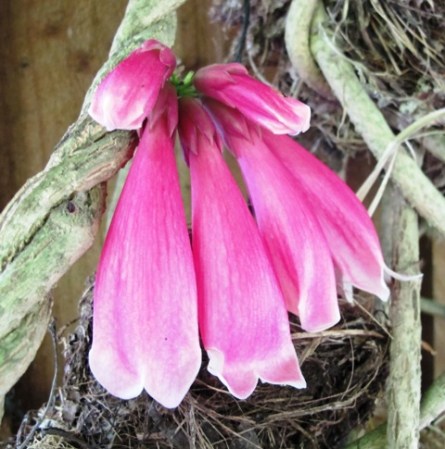
The pink bells of Tecomanthe venusta

The pink bells of Tecomanthe venusta

We are so excited by our Tecomanthe venusta in bloom. That is because it is tropical but we are not so it doesn’t often flower for us. And I have to admit that there are only a few clusters of these pink flowers in evidence. A garden visitor once told us there was a specimen at the entry to Whangarei Gardens’ glasshouse which flowers magnificently. We have not seen it but it would figure that it is happier further north because it originates in New Guinea and is the most cold-sensitive member of the tecomanthe family, all evergreen climbers in the bignoniaceae group.

The tecomanthe family is not large and some readers will know our own T. speciosa – a tender but rampant climber which was found in the wild as a single, surviving specimen on Three Kings Islands. It needs a frost free position which rules it out for most inland locations and it needs a bit of training and management if you want to see the lovely creamy trumpet flowers. It will shoot up the highest tree available and flower only at the very top if left to its own devices, but if you train it along a horizontal support, it can be encouraged to flower along its length.

Back to T.venusta. We grow it under the cover of a deep verandah with opaque roofing. When it does decide to flower, it puts out clusters from its bare vines, which is very obliging because they are so obvious. Most plants set flowers on either new growth or last season’s growth but venusta appears to be quite happy to do it on gnarly old growth. We get a far more spectacular display in spring from the species we have as T. montana, also from New Guinea, which is grown in the same conditions but there is a delicious unpredictability to venusta.

First published in the Waikato Times and reprinted here with their permission.
Plant Collector: Ulmus elegantissima “Jacqueline Hillier”

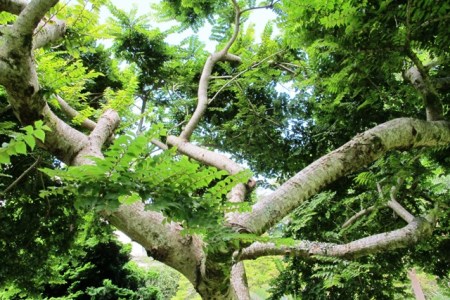
Ulmus (should that be elegantissima, minor or x hollandica?) "Jacqueline Hillier"

Ulmus (should that be elegantissima, minor or x hollandica?) "Jacqueline Hillier"

It’s an elm but from there on there seems to be some debate. We received it under the species classification of elegantissima. The Hillier Manual of Trees and Shrubs lists it under the species name of minor with elegantissima added as a synonym. A quick net search and I see others now list it as Ulmus x hollandica which is a natural hybrid of minor and glabra. In other words, nobody knows for certain so we will stick with Hillier’s own classification.

The reason nobody knows for certain is that it was found in a garden in Birmingham in the early 1960s and it was visibly different. Most elms are renowned as handsome, large trees, though they have suffered hugely in the UK and Europe since the 1970s from a major outbreak of Dutch Elm disease which kills them. “Jacqueline Hillier” is smaller growing. In fact it came to us under the descriptor of dwarf. It has tiny, sawtooth leaves and very fine tracery of branch structure whereby the leaves are held in fan shapes. This means it is extremely attractive when it is a bare skeleton in winter. It is delightful when flushed with bright spring growth and it is lovely and lush in summer until the predations of the red spider sometimes defoliate it.

Dwarf it is not. I planted a specimen in our rockery where it set out to prove it belongs to the large shrub category. We have to keep working on it extensively every year to keep it down to about 3 metres x 3 metres. It also seeds and suckers but not in a dangerous way. Had I realised it would grow to that size, I would have planted it somewhere with more space – but I would definitely still have planted it.

First published in the Waikato Times and reprinted here with their permission.
Plant Collector – Pinus montezumae

Pinus montezumae - just one of the more special pines

Pinus montezumae - just one of the more special pines

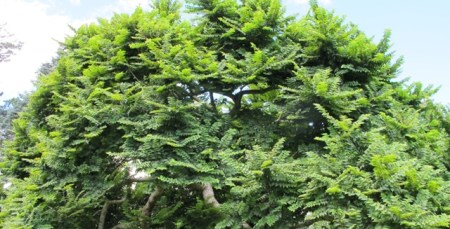
The pine tree family is a great deal more extensive than the common radiata pine we know so well in this country. Perhaps it is because the timber tree is such a widespread and drearily predictable planting that we tend to take little note of the other 100 or so species in the group. The beautiful Pinus montezumae is a case in point. It comes from Mexico and into Central America (think Guatemala) though usually growing in areas with some altitude which cools temperatures. Despite this origin, the Montezuma is hardy for our New Zealand conditions.

What sets the Montezuma Pine apart as a specimen tree is its very long needles which give the appearance of a pendulous or spreading habit of growth. The needles can be 25cm or even more, whereas most pine needles are in the 10 to 15cm range. Because they are so long, they appear to curve and drape themselves in a most elegant manner. They are also of what is called glaucous hue. This simply means they are toned to a bluish-grey in colour, not the forest green we associate with common pines.

You do need space. It will make a large tree, over 30 metres or more so it is not one for the back yard. As with all the pine family, it likes open, sunny conditions. It is not a forest or woodland tree. What about the pine plantations, you may ask. They are planted at the same time and at prescribed spacings which allows equal sun to all the plants. A plantation is different to a forest. With hindsight, I would plant the Montezuma in splendid glory all on its own. We have a few lower, evergreen shrubs beneath ours and they tend to look a bit scruffy when the falling needles catch in their foliage. At least keep underplanting deciduous for easier grooming.

First published in the Waikato Times and reprinted here with their permission.

Plant Collector: Rhododendron diaprepes

Flowering in the height of summer - R. diaprepes

Flowering in the height of summer - R. diaprepes

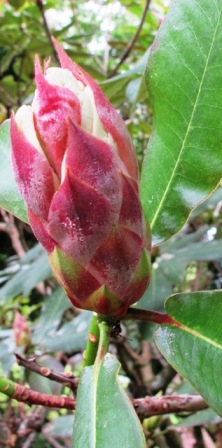
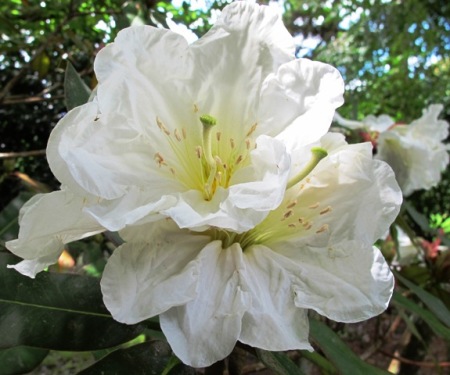
A rhododendron flowering in late January? Yes, and a big, fragrant white one at that. It is something of a visual surprise each time I look at the curved border of rhododendrons, all resolutely green with their spring foliage still fresh and bright. There, in their midst, is a large plant flowering freely.

Big buds open to big fragrant flowers - R. diaprepes

Big buds open to big fragrant flowers - R. diaprepes

R. diaprepes is one of the Rhododendron fortunei group. Any plant which bears a variation of the word fortune in its name has been named, and in most cases was first collected by, one of Britain’s foremost plant collectors – Robert Fortune. He was also responsible for getting tea out of China and into British control in India but that is another story. However, it was not he who collected R. diaprepes from the Yunnan area of China. It was found later. He did collect the species, R. fortunei which has a sub species in the form of R. decorum (which flowers earlier and is a little smaller than diaprepes but otherwise similar). Then R. decorum has a subspecies in the form of diaprepes. Got that? Our rhododendron is a sub sub species (or ssp). It probably does not matter unless you are into the botany and taxonomy of rhododendrons.

R. diaprepes has big flowers, big buds, big leaves and is several metres high. Although it has a little thrip (which is what causes silver foliage), it is not too bad in that department and overall, the foliage is pretty clean and healthy. This is a collector’s rhododendron. The chances of finding it offered for sale these days are probably zero in this country. It is a good reason to learn how to do your own propagation if you want the unexpected delight and fragrance of such a late flowering cultivar in your own garden.

First published in the Waikato Times and reprinted here with their permission.
Plant Collector: The golden-rayed lily of Japan (Lilium auratum)

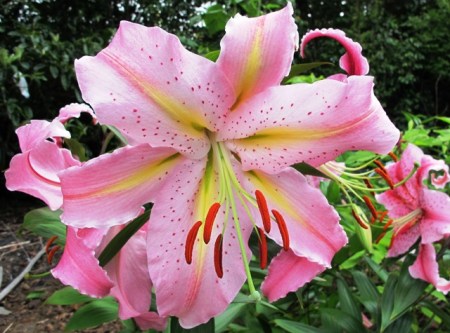
The wonderfully fragrant auratum lily hybrids - hybridising and raising from seed keeps the plants healthy and reduces problems with virus

The wonderfully fragrant auratum lily hybrids - hybridising and raising from seed keeps the plants healthy and reduces problems with virus

The golden-rayed lily of Japan – what a beautifully evocative common name. We grow quite a few lilies here but it is the auratum hybrids that are the mainstay of our summer garden. These are the results of decades of breeding, first by Felix Jury and now by Mark. This particular pink one is a pleasing new selection from that breeding programme. There is no commercial gain in breeding these auratums. The aim is to extend the colour range and vigour so they perform better as plants in our own garden as well as keeping them free of virus, which is common. We also prefer outward facing flowers (rather than the upward facing blooms used in floristry) because that gives more protection from the weather.

The hybrids are bigger and showier than the species. This flower is over 30cm across so not for the shy or retiring gardener. The species are predominantly white with yellow or red streaks and crimson spotting. Hybridising extends that colour range into pure whites, white with dominant yellow markings, reds and pinks. We also want strong growing plants that can hold themselves up without needing to be staked every year and which will keep performing under a regime of benign neglect (which means digging and dividing every decade, not every second year). We grow them both in sun and on the woodland margins – wherever there are reasonable light levels, good drainage and soil rich in humus.

Auratums are offered for sale as dormant bulbs from time to time but they don’t like being dried out and dessicated so try and find ones which are plump and firm.

Saving the best for last: oh, the fragrance. The auratum lilies are one of the flowers I cut to bring indoors. A single stem has multiple blooms and can scent a large room all by itself. I remove the pollen which will stain everything it falls upon.

First published in the Waikato Times and reprinted here with their permission.