Category Archives: Plant collector

flowering this week, tried and true plants

Plant Collector: Magnolia Athene

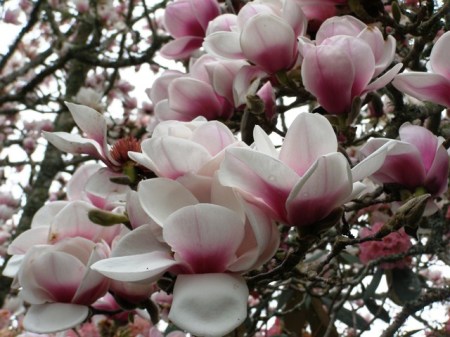
Magnolia Athene in her glory

Magnolia Athene in her glory


Thank goodness for the mid season magnolias this year. There we were, as usual, admiring the early season ones in flower when a once in a hundred year event hit here – snow followed by a killer frost in late August. The early bloomers did not like it one bit. But the next flush rose to the challenge and their flowering was unaffected. This one is Magnolia Athene, a particularly lovely variety with big ivory white flowers sporting a violet pink base. It is what is called a cup and saucer form. When open, the outer layer of petals drops a little to form the saucer, while the inner petals keep a tight cup form. Botanically, magnolias don’t actually have much in the way of petals, they have tepals which look like petals but that tends to confuse all but the most enthusiastic gardener.

Bred in the early 1960s, Athene is one of a small series from the late Felix Jury in his quest for new plants which would carry the good aspects of the classic campbellii magnolias but flower on young plants and not grow as large. It should flower within a year of planting out. The parents are magnolias lennei alba (which is a very tidy, smaller tree with pure cream flowers) and Mark Jury (which is a large growing tree with very large, heavy textured flowers in lilac tones). Athene was a significant advance on the parents and puts on a magnificent display with its bi-coloured blooms. It will eventually reach about 5 metres with an upright habit and the flowers are pleasantly scented.
Plant Collector: Tropaeolum tricolorum

The dainty climbing delight of Tropaeolum tricolorum

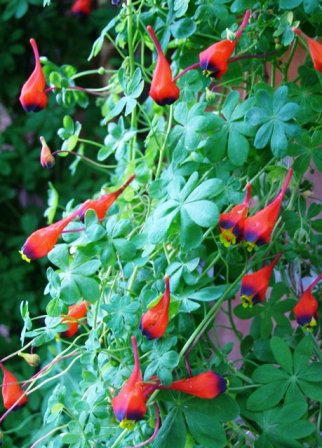
The dainty climbing delight of Tropaeolum tricolorum

It does not, alas, have a common name but give yourself a huge pat on the back if you immediately identified it as a member of… the nasturtium family. I guess if you took the common nasturtium (Tropaeolum majus) and scaled it down, you might see a faint similarity. Or maybe not. The flowers are tiny but oh so exquisitely detailed and abundant. Shaped perhaps like a 2cm long Chinese lantern with a tail or spur, they are orange red, tipped navy blue with a yellow frill. Tricolorum (or tricolor) means three coloured, of course. The lobed leaves are similarly dainty.

This is a plant from Chile and Bolivia which grows from tubers resembling baby potatoes. It is dormant in summer and autumn, coming into growth in winter and putting on its peak flowering in early to mid spring, after which it dies down very quickly. It is a climber so it needs something to cling to but because it is so light and with a short season, it doesn’t smother any plants it climbs up. We grow it in abundance in two of the narrow beds beside the house which are always problematic because they are so dry beneath the eaves. It has not been as happy in woodland areas so we think it needs good light levels. It certainly does not want to be in wet conditions or it will rot out when dormant. T. tricolorum should not be confused with its thuggish cousin, the red Tropaeolum speciosum which seeds down and is reputed to be a noxious weed in Scotland as well as being a problem in some NZ gardens. Any plant that can be a weed in Scotland and New Zealand is dangerous. We have never seen our tricolorum set seed although there are internet references to growing it from seed. We find it increases gently from the tubers. There are, by the way, over 80 different species in the nasturtium family, all from South America.

First published in the Waikato Times and reproduced here with their permission.

Plant Collector – Camellia chrysantha

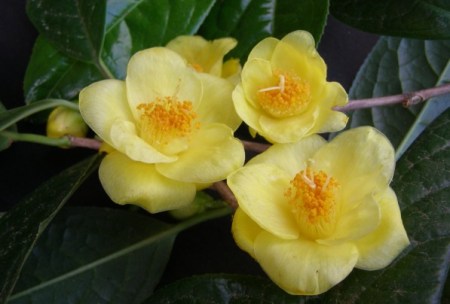
Indisputably yellow - Camellia chrysantha

Indisputably yellow - Camellia chrysantha

It is a camellia and it is indubitably yellow – bright yellow. Camellias don’t only come in pink, white and red. There was huge excitement in the west when the yellow camellias started to become available out of China in the early 1980s and they are certainly a curiosity though hardly great garden plants. Our specimen of C. chrysantha is now about 4 metres high and 4 metres wide. It took many years before it started to flower and even then, the flowers are few, far between and rather small. What is more, the flowers face downwards, well hidden amongst the foliage. I had to pick these to get a photo – don’t be thinking this is how they look on the bush. But even the fat yellow balls of buds are interesting. We have other yellow species which are not flowering yet, after about a decade! So these are plants for the curious collector and the plant breeder rather than the home gardener.

Nuccio’s Nursery in USA has apparently done a lot of work breeding new cultivars using the yellows but we have not seen any of the progeny in this country yet. That said, with its big, glossy, heavily textured leaves (called bullate foliage) C. chrysantha is a handsome plant in its own right for large gardens, even if it is shy on flowering. In this day and age, you are not likely to find it offered for sale in this country though it is around in camellia collections if you are determined to track it down. Grafting is the best option for getting your own plant. It does set seed, apparently, but we have never seen seed on our plant.

First published in the Waikato Times and reproduced here with their permission.

Plant Collector – Prunus campanulata

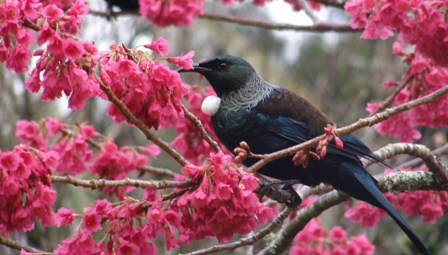
It took many attempts to capture the tui in the campanulata cherry

It took many attempts to capture the tui in the campanulata cherry

The cherry trees which have been in flower in recent weeks are the campanulata or Taiwanese cherries. Sometimes you will still see them referred to as Formosan cherries which may require a lesson in history for anybody under the age of about 60. True, the colours can be a little harsh in carmine pink, cerise and sugar-candy pink tones but on a bleak early spring day, who is going to quibble about the mass of flowers which appear on bare branches? The biggest bonus of the campanulatas is their attraction to tui who feed on the nectar. Our native birds are wonderfully unconcerned about whether or not their food sources are indigenous plants. We can have upwards of 30 tui bickering and squabbling for territory in a single tree, but they don’t stay still long enough to count accurately.

Campanulata cherries are not as hardy as the later flowering Japanese types but this is rarely a problem except in the coldest parts of the country. They are also more disease resistant and healthier in our climate and don’t succumb to the dreaded witches broom which can be a problem in other types. If you plant several (and being a tree of light stature, they are easy to fit in alongside other trees), you can have them flowering in succession over many weeks which keeps the tui at home. The big disadvantage is that many forms set seed freely and germinate readily. They are such a problem that they are on the banned list in Northland unless it is a known sterile form which doesn’t set seed. If you border native bush or a national park, make sure you search out forms advertised as sterile but otherwise you just have to be vigilant with your weeding.

(first published in the Waikato Times and reproduced here with their permission)

Plant Collector: Podocarpus henkelii

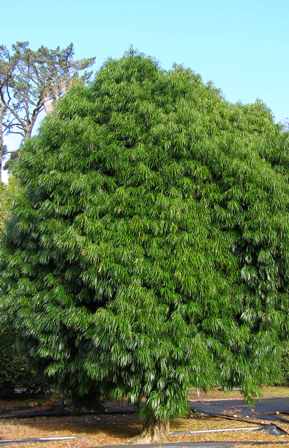
Podocarpus henkelii looks handsome all 12 months of the year

Podocarpus henkelii looks handsome all 12 months of the year

One of my favourite trees here is this African podocarpus. It must be fifty years old by now and stands some 8 metres high. About 25 years ago, we built part of our nursery around it but we made sure it remained unaffected. Now, as we turn that nursery area into garden, we are really pleased that we kept it as a feature tree for our planned Palm Walk. You can’t hurry up maturity on slow growing trees. Not that it has any connection to palms but it fits right in to that slightly exotic theme.

Henkelii comes from the Eastern Cape and Kwazulu-Natal area of South Africa. In the wild, it now has protected status but it is common as a garden plant in its homeland because it is an elegant, slow growing evergreen tree. It is commonly referred to as the Yellowwood because its timber is apparently yellow and excellent for making furniture. This may account for it needing to be protected. The narrow leaves measure over 20cm long and hang in a sickle shape. We know ours is a female because it produces plenty of seed which looks like green olives but as henkelii is dioecious, it needs both male and female plants to get fertile seed. In other words, the seed from our tree is sterile because it is a solitary specimen.

The podocarps are a big family and widespread, though mostly from milder areas south of the equator. Our native totara is a member.