Category Archives: Plant collector

flowering this week, tried and true plants

Plant Collector: disa orchids

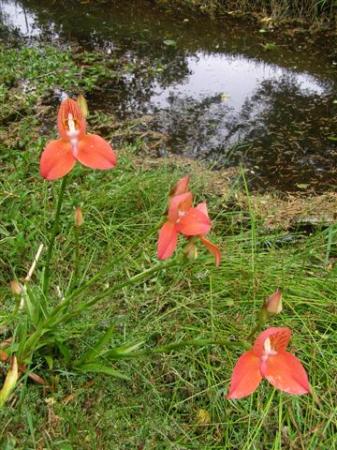
Working to naturalise disa orchids by our stream

Working to naturalise disa orchids by our stream

It was a bit of a mission earlier this week to find anything looking good after Sunday night’s fierce storm but the disa orchids held up well. Trying to get these delights naturalised on the margins of the stream which runs through our park is a recent venture. It is far too soon to decide that it is a success because this is their first season so all we can say is so far, so good. If we still have some and they are gently increasing in five years time, we will hail it as a success.

Of all the plant families in the world, orchids are by far the most complex. The sub group of disas alone has about 170 separate species and that does not take into account multitudinous hybrids. Mark is not trying to get to grips with the detail. He just accepts gratefully what local orchid expert and friend, George Fuller, gives him to try out. As far as we know, it was the dainty little Disa tripetaloides which gave us white flowers earlier in the season and these larger red ones in flower now are from the more common D. uniflora. It is the natural habitat of the disa orchids which caught our attention. They occur in damp conditions on the margins of streams and waterfalls, predominantly in South Africa. That is why we hoped they could be naturalised on the margins of the stream where they are a great deal more exotic than the thuggish yellow Primula helodoxa. You need a situation where you can control floodwaters however, as we do with a weir and a flood channel, or our frequent torrential downpours will scour out marginal plantings.

If Wikipedia is correct, the tuberous root of the disa orchid is used to manufacture maltodextrins, used in artificial sweeteners. How curious is that? Mark is a bit concerned at the absence of the Mountain Pride Butterfly here, that being the natural pollinator for D. uniflora in South Africa. We are not at all sure that our monarch butterflies, which we have in abundance, are up to taking on additional duties in this respect.
Plant Collector – auratum lilies

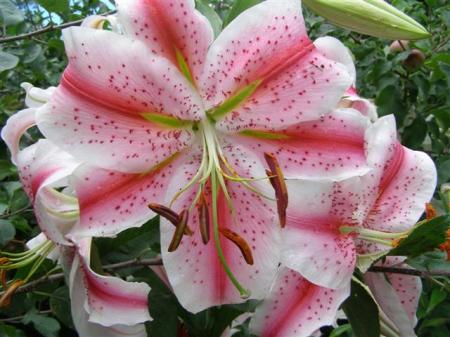
Auratum lily Flossie - one of Felix Jury's hybrids

Auratum lily Flossie - one of Felix Jury's hybrids

I don’t cut flowers to bring indoors very often. When every window of the house looks out to a garden, it doesn’t seem necessary. But as soon as the auratum lilies start to open, I reach for the kitchen scissors and head out. They are just the perfect cut flower – one stem can have up to ten flowers (sometimes even more) and put in a tall, slender vase they not only look superb, they can spread their delicious scent through an entire room.

Auratums are known as the golden-rayed lily of Japan – how lovely does that sound? The flowers are the largest of the lily family, often more than 20cm across, and they are a mainstay of our January garden. Felix Jury adored them (probably for all the same reasons that we do) and dabbled with breeding them, naming several selections. This one is the very large flowered Flossie. The upshot is that we have a lot of auratums in the garden and generally they are quite happy with benign neglect, growing in both full sun and semi shade. They prefer soils with good drainage and plenty of humus but not too rich.

The bulbs are large – fist-sized even – and we tried to get around all the plants last winter to dig and divide them. They haven’t had any attention for many, many years but when the clumps get too congested, the tops tend to fall over if they are not staked. The freshly divided patches are mostly standing up like little soldiers without any assistance. Some of the taller ones can get over 2m high and they need some support though often I will intertwine them through neighbouring plants.

You can sometimes find lily bulbs for sale in garden centres in winter. Make sure you avoid any dry, shrivelled specimens – they do not like to be dried out completely even when dormant. You may be lucky and find some auratums but they are not widely offered on the NZ market despite their spectacular summer display.

Plant Collector: Schima wallichii subsp. noronhae (probably)

Schima, probably noronhae

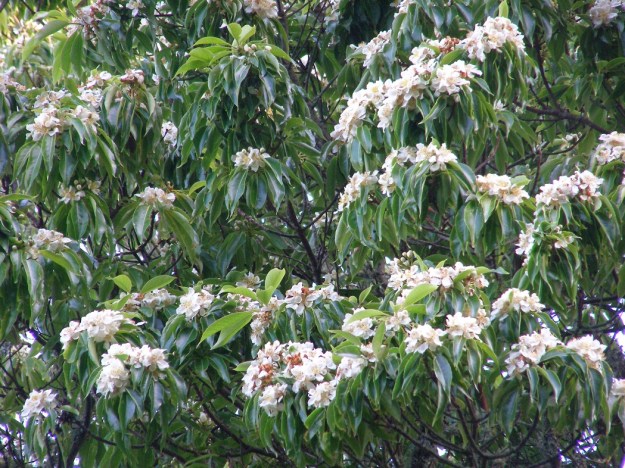
I went on a bit of a search for the accurate species name of this tree in flower here, trying to sort out whether it was Schima wallichii or Schima noronhae. The naming of plants can be a fluid affair with reclassification happening often but schimas are more like quicksand than fluid – described by the most recent, authoritative tome on trees (New Trees) as simply a mess. What we do know is that it is that schima are a somewhat tender tree family from subtropical and tropical Asia and this particular specimen is rather large now. We live in a two storied house with reasonably tall gables but this tree is now closer to a third story level.

The little white 5-petalled flowers are pretty enough en masse this week, but it is the new growth at the end of October which I like more. The fresh young leaves are bright lime green and it is like a large beacon in the distance. Soon after the new leaves arrive, it drops all its old leaves in a whoosh. It is an evergreen – it is never totally bare, but most evergreen trees gently shed old leaves all the time, not in one hit. We have a number of schimas here (S.khasiana is even larger) but as far as we can make out, this one is S.noronhae. They belong to the theaceae family and are distant relatives of both camellias and gordonias. Schimas are commonly raised from seed – there don’t appear to be named clones yet though in time, no doubt there will be selections made to be grown by people with plenty of space and very mild conditions.

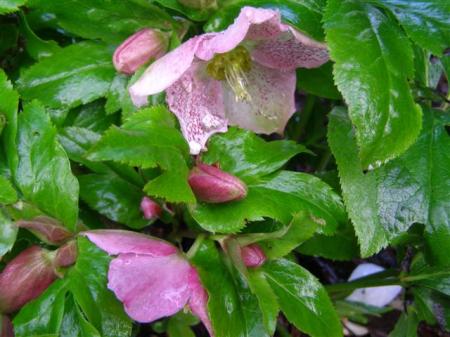
Tried and True – Helleborus orientalis

Helleborus orientalis - gentle and understated garden performers

Helleborus orientalis - gentle and understated garden performers

  • Winter flowering.
  • Require very little care and maintenance.
  • An undemanding plant for filling spaces.
  • Very hardy evergreen.


Helleborus orientalis are not from the exotic Orient. In fact they are native to areas of Turkey and Greece which may explain their tough constitution. They are often called winter roses, presumably because they flower in winter and are easy to grow. Their link to roses is as remote as their link to the Orient. They are an enormously obliging and gently understated plant, with pretty cup flowers which face downwards. These are not plants for deep shade – keep them to the margins of bush or woodland or even the open because they need reasonable light levels and can cope with full sun. Easy-care plant and leave specimens, they don’t appreciate being lifted and divided but are happy to be left to their own devices with the occasional feed.

There has been an explosion of different hellebore cultivars on the market in recent years, many of them orientalis hybrids. Some of the frilly doubles are very pretty, some are just average doubles. The really good dark maroon and slate colours will be better if you live inland and can give colder conditions. The simplest seedling forms are just single flowers in shades of pink, white and green, with or without freckles on the inside. Floating blooms in a glass bowl is the usual method of displaying them once cut.

Helleborus orientalis sets seed freely but the seed will not come true to its parent and you will get considerable variation. Push hoe or weed out surplus germinating seed to prevent too much competition. Aphids can make the spent flower head their home so it is often advisable to deadhead once at the end of the flowering season in spring. We cut off all the old foliage in mid autumn which gets rid of any lingering aphids and also exposes the pretty flowers to view before the fresh foliage appears.

Plant Collector: Cordyline petiolaris

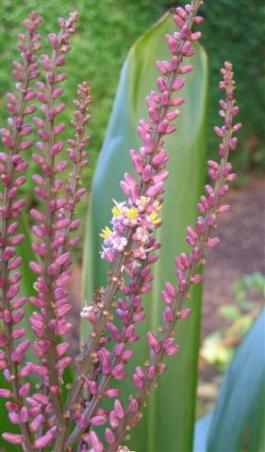
The Paris pink and yellow flowers of Cordyline petiolaris

The Paris pink and yellow flowers of Cordyline petiolaris

I have been waiting for weeks for these cordyline flowers to open and finally it is starting to happen. It is not that they are overly spectacular, more that they are an unusual Paris pink in colour with golden centres. In due course, they will turn to eye-catching red berries which hang on for a long time and are widely regarded as the more spectacular feature. Though it should be added that the wide, spatula-shaped leaves measuring up to 8cm across are also eyecatching.

Cordylines are of course what we commonly refer to as cabbage trees but the family is a little larger and geographically more widespread than our iconic native species, C. australis. This is an Australian species which occurs in the rain forests of northern New South Wales and Queensland. Our loyal cabbage tree moth whose offspring caterpillars chew the leaves of our native cabbage trees to shreds does not appear to like our Australian neighbours and consequently the foliage stays clean which is a distinct bonus in a garden plant. However, its flowers lack the heady summer fragrance of our native forms. The plant is somewhat hardier than its subtropical origins suggest, though it won’t tolerate heavy frosts. Given moist, sheltered conditions, it is not difficult to grow and will eventually reach about 5 metres high, keeping leaves down most of its length. It can be propagated relatively easily from stem cuttings or raised from seed.