Category Archives: Plant collector

flowering this week, tried and true plants

Plant Collector: Jovellana punctata

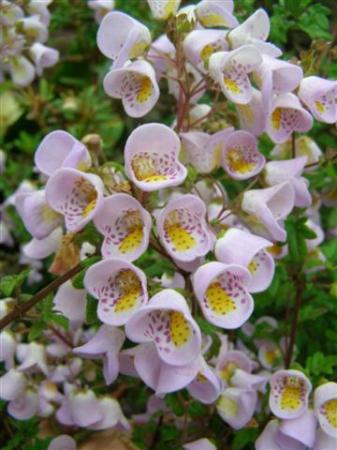
The little flower pouches of Jovellana punctata

The little flower pouches of Jovellana punctata

The jovellana has been flowering away cheerfully over recent weeks. This soft lilac one is a small shrub from Chile and fits very well into a whole range of garden situations. It only has small leaves which are in scale with its abundance of lilac pouched flowers with burgundy freckles and a yellow flare inside. The flowers are small – think finger nail proportions. When it has finished blooming, I will give it a pass over with the hedgeclippers to keep it reasonably dense and about 75cm in height. It can get a bit sprawling over time if not trimmed.

We had thought this was Jovellana violacea until very recently when a friend turned up with a plant of the true violacea and told me, in the nicest possible way, that in fact what we have is Jovellana punctata. Apparently it is a common error in New Zealand to refer to J. punctata as J. violacea but he had seen them both growing in the wild. The true violacea has a larger leaf, though of similar form, a smaller flower – though also similar – and the sample he brought was a deeper colour.

The jovellanas belong to the foxglove family and some of you may recognise their close relatives, the calceolarias. We have a native jovellana with white flowers – J. sinclairii – which gently blooms throughout summer. It has much bigger leaves and I would have described it as an herbaceous perennial (leafy, not woody) but I see it is technically described as a sub-shrub. Punctata is a shrub and is rated internationally as only half hardy at best but we have never seen it tickled up in winter at all. It is not difficult to root from cutting if you know somebody with a plant. The native sinclairii can generally be found layering along the ground so is easy to take a piece from.

Plant Collector: Rhododendron Loderi Venus

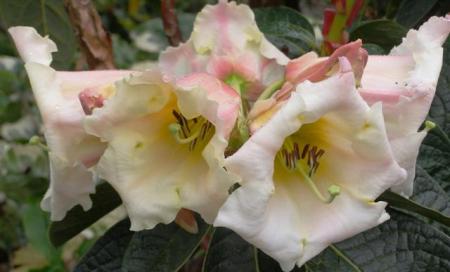
Loderi Venus - still at the top of its class

Loderi Venus - still at the top of its class

If ever there was a good reason to learn to graft plants at home, it is the Loderi rhododendrons. These used to be widely available in the days when specialist rhododendron nurseries produced a huge range and when customers understood that sometimes special varieties need to be grafted, so were willing to pay a premium. These days there will only be one or two places in the whole country still producing these lovelies, which can’t, in the main, be grown from cutting.

The Loderi group date back to the turn of last century when Sir Edmund Loder of Leonardslee near London crossed fortunei with griffithianum. The results were rather large trees with exceptionally large flowers, fantastic fragrance and reasonable hardiness. Despite the passage of over a century, little has been produced that is the equal, let alone an improvement, in the big, fragrant class of rhododendrons. This one is Loderi Venus. Unfortunately our mature Loderi King George bit the dust when one a huge Lombardy poplar landed on top of it but Mark is hoping that his emergency grafts will take so that we can keep it represented in the garden. Venus has the best pink colour of the group and is a picture in full flower.

Tried and True: Lachenalia aloides

Lachenalia aloides

Lachenalia aloides

• The easiest lachenalia to grow.
• Widely available, from many other gardeners if not from every garden centre.
• Bright winter colour.
• Often sold as Lachenalia Pearsonii.

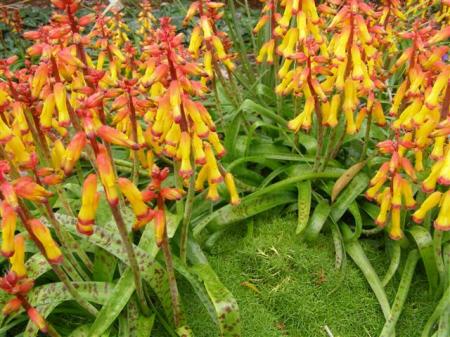
In the gloom of winter when the main colour comes from pink camellias, the early flowering lachenalias ring a colour change to orange and red. Whether you consider this form of aloides to be garish or cheerful depends on your personal taste. It is the most common lachenalia in New Zealand and is often referred to as Pearsonii. It has two strappy leaves per bulb, usually with burgundy spots. These are South African bulbs which thrive in areas which have winter rainfall although even the toughest aloides will not want to be out in hard frosts. Lachenalias have a long dormancy period so are easy to lift and divide.

Try underplanting citrus trees to repeat the colour, or we find it also combines well with the green, mounding hillocks of our native scleranthus biflorus. It will combine equally well with any predominantly green scene to add a bright spot.

Plant Collector: Rhododendron Floral Legacy

Floral Legacy - aptly named, perhaps

Floral Legacy - aptly named, perhaps

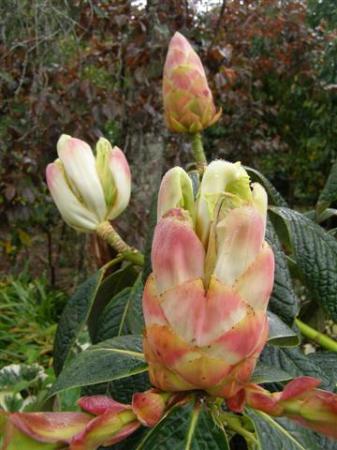
Even the buds are spectacular

Even the buds are spectacular

In honour of our Taranaki Rhododendron and Garden Festival which starts today, I had to choose a rhododendron this week and could there be a more splendid choice than the elite nuttallii family? This is like the Rolls Royce of the rhododendron world – a spectacular statement of style. The flowers are the largest of any rhododendron – each flower being about 15cm long, tubular with frilly edges and very fragrant. The leaves are large and what is called bullate – heavily textured and veined, like stiff corduroy fabric. Even the massive flower buds are spectacular. The nuttalliis come from that northern band from Upper Burma across Tibet and India, the sinonuttalliis from China (sino means Chinese in the plant world). This form is a cross between the two, which means technically it still a species and it was done here by the late Felix Jury to get better garden forms. It is quite a legacy.

The nuttallii family have been used in breeding to give cultivars like White Waves, Lady Dorothy Ella, Mi Amor and Yvonne Scott although none of the hybrids I have seen keep the size of the parent flowers and leaves. Both the species and the hybrids have a tendency to rangy, open growth but the beautiful peeling bark and cinnamon colour compensate because this is yet another feature for this handsome family. We are completely besotted with them and luckily we have very good conditions for growing them. There are large parts of the world where it is just too cold to grow these handsome plants.

Plant Collector – Syringia palibiniana

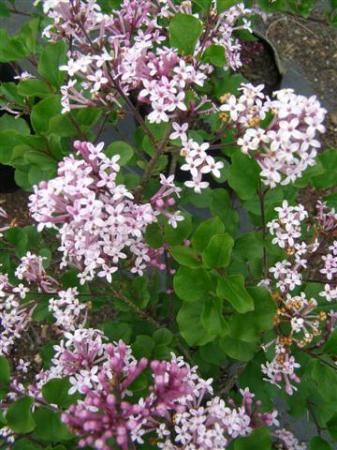
Syringia palibiniana - Korean lilac

Syringia palibiniana - Korean lilac

We are not the world’s greatest territory for growing lilacs, those wonderfully fragrant cones of lilac blooms in spring, which is why you don’t see them around this area a great deal. They favour a more continental climate with cold winters and, preferably, hot summers, heavy soil and more alkaline conditions. Taranaki with its friable, volcanic soils and very mild climate is at the opposite end of the scale. But this dwarf Korean lilac is wonderfully adaptable to our conditions. It doesn’t have as strong a scent as the common lilac (Syringia vulgaris), but it is sweetly perfumed and makes a compact little shrub to about 100cm x 100cm. Like all lilacs, it is deciduous and when its little leaves appear, they are completely in scale to the dainty flowers and the small habit of growth. It is one of those handy little shrubs that you can fit in anywhere in the garden which gets reasonable sun and it will delight you at this time each year as it opens its many panicles of little lavender flowers.