Category Archives: Plant collector

flowering this week, tried and true plants

Plant Collector: Edgeworthia gardneri

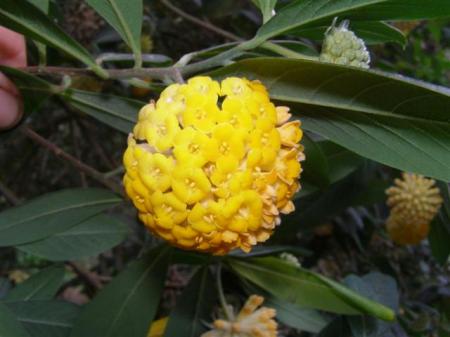
The scented golden orb of Edgeworthia gardneri

The scented golden orb of Edgeworthia gardneri

This plant has a very curious flower head – fully rounded golden pompoms of tightly packed, almost waxy flowers. Sweetly scented too, which is not surprising because it is a close relative of the daphnes, but because it does not mass flower, it lacks the fragrant oomph of its cousins. Each flower head is only about 3cm across, not much larger than an old fashioned gobstopper. Gardneri is still newly introduced to the west – it comes from Nepal – not easy to propagate from cutting and rare. I tell you this because several years ago we did manage to get some plants successfully growing and offered them on the mailorder list we used to put out. At the same time a gardening magazine showed a photograph of the flower but gave no idea of the size. Somebody in Palmerston North tracked us down and ordered the plant. We shipped her down a splendid specimen but she was not happy. She was expecting a flower more akin, I suspect, to the size of a cricket ball rather than a pingpong ball. She sent back this rare and choice shrub. It cost her more in freight than the plant was worth, but clearly it was a matter of principle because she felt short-changed by the size of the flower.

There are only two, maybe three, species of edgeworthia. The more common Chinese form, papyrifera or chyrsantha, is deciduous but gardneri is fully evergreen and makes an open, airy bush with a graceful appeal. It is not particularly hardy and won’t thrive in areas with cold winters. It has good nectar for the tuis and we are planning to add another plant in full sun to feed our butterflies.

Plant Collector: Tulipa saxatilis

Plant Collector: Tulipa saxatilis

Plant Collector: Tulipa saxatilis

I am not a great fan of the common tulip and even less so of the novelty forms so prized in colder, northern European gardens. But get back to the original species, (how they occur naturally in the wild) and it is a different matter altogether. This very pretty tulip is a combination of soft lilac with a yellow throat which is not the world’s most obvious colour scheme but generally the colours of nature do not clash. It hails from the island of Crete (the home of Zorba the Greek) though apparently it is also found in Turkey. In their natural environment, these are wild flowers and if you have ever visited the Greek islands or the coast of Turkey, you will know that conditions are hard with poor stony or clay soils, very low fertility, drying winds and next to no rain for most of the year. These are not conditions that we can replicate in the garden here but Tulipa saxatilis is not too picky and has thrived in our rockery for many years. With open conditions and excellent drainage, it is genetically programmed to be a survivor.

This is an early spring bulb, so it starts to grow in winter (triggered by autumn rains) and flowers in early spring for a period of several weeks. Each bulb puts up a stem which flowers its way down in succession so you get several blooms per bulb. It is a good example of a bulb which will find the depth it is happiest at in the soil so it will often drag itself down quite deep and it is a rarity amongst the tulips because it runs below ground. Because the foliage doesn’t hang on very long, it lends itself to being co-planted with a summer perennial which is dormant when the tulip flowers. We have had a dwarf species oenothera, better known as Evening Primrose, interplanted with our main bed of Tulipa saxatilis for many years and it comes into its own as the tulip goes dormant.

Plant Collector – reticulata camellias

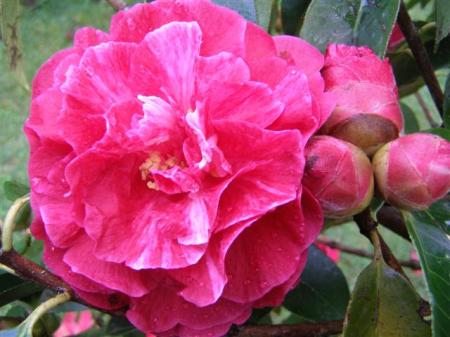
Camellia reticulata Purple Gown - a little optimistic on the colour

Camellia reticulata Purple Gown - a little optimistic on the colour

It is a sign of the times that I would even consider classifying reticulata camellias as collector’s plants. They used to be widely available and very reasonably priced – in fact greatly underpriced. The problem is that few of the desirable garden forms grow on their own roots so they have to be grafted and there are many plants which are much easier to graft than camellias. Added to that, many of them have virus (which gives variegated leaves and sometimes variegated flowers) weakening the plant and making it even harder to propagate. In fact, the president of the NZ Camellia Society tells me that he doesn’t know of anybody who is grafting camellias commercially these days. It may be a good reason to learn how to do them yourself at home. If you grow them from seed, the vast majority will be single blooms which are good value for feeding the birds but the desirable garden forms are the doubles like this one, somewhat optimistically named Purple Gown.

The reticulatas (commonly referred to as retics) come from western China. What sets them apart are their enormous blooms, often the size of a bread and butter plate or even larger. The foliage is not as shiny as the more common japonica types and is usually larger and more sparse so they make quite open, airy large shrubs and can even be trained to small tree status. It is the advent of camellia petal blight which has had us looking at our big old retics with new respect. Because the bushes are open and the flowers are so large, they tend to drop cleanly rather than hanging on in an unsightly fashion. And with most being in rich shades of deep pink or red, the stronger, darker coloured blooms don’t show up the browning from petal blight anywhere near as much as pale flowers. For late winter flower power, the reticulatas have left the japonicas for dead this year.

Plant Collector: Rhododendron veitchianum

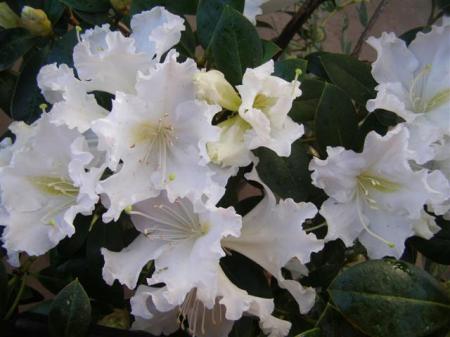
Rhododendron veitchianum - frilly, fragrant and white

Rhododendron veitchianum - frilly, fragrant and white

There is something about the pristine purity of a white flower, a snow white flower with just a hint of green in the bud stage and the merest reference of yellow in the throat. Add to that the fact the flowers are relatively large, frilly, sweetly scented and there are masses of them. The plant itself is compact and stays bushy around the 150cm mark, with most attractive, oval leaves. Being a species, there will be considerable variation in the wild but the form we have, which is probably the most common form in this country, is a particularly good selection from Strybing Arboretum in San Francisco.

Veitchianum occurs naturally around Thailand, Burma and Laos which is an indicator of another characteristic – it is not particularly hardy. In fact in the nursery, it is one of the only rhododendrons that we used to worry about getting burned by frost. It never gets frosted in the garden here (young nursery plants are more tender) but it is not going to love you if you live in an area prone to heavy frosts. On the bright side, it is part of the maddenii group and this means that it is much more resistant to thrips – the nasty leaf sucking insects that turn rhododendrons silver. So it is what we refer to as a higher health rhododendron suitable for growing in warmer areas of the country. The name honours the Veitch family of nurserymen who employed no fewer than 22 different plant collectors over a period of 65 years (late Victorian times onwards) and who were responsible for introducing a vast array of new plant material to avid English gardeners. I am not sure how they would have got on with R. veitchianum but maybe they grew it in glasshouses.

Tried and True: vireya rhododendrons Jiminy Cricket, Saxon Glow and Saxon Blush

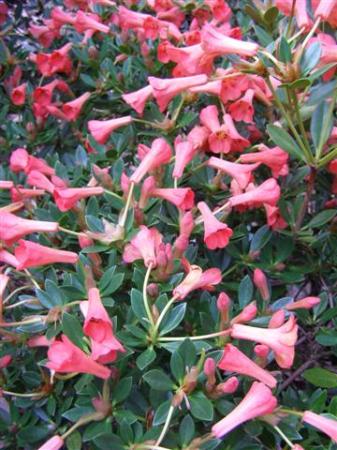
Jiminy Cricket - the hardiest of any vireya we know

Jiminy Cricket - the hardiest of any vireya we know

  • The hardiest of the vireya family.
  • Tidy, compact growth around 75cm high.
  • Widely available.
  • Flower freely over a long period of time.

Siblings, these three cultivars. The breeder, Os Blumhardt, gave us seed of the cross and one plant grew so well we put it into production with his agreement. We called it Jiminy Cricket because the flowers are held upright and as singles, reminding one of the original Jiminy Cricket’s eyes swivelling on stalks. The remaining plants with Os also grew well and in due course another nursery took two and named them Saxon Glow and Saxon Blush. Glow is a little redder, Blush is a little paler pink while Jiminy is more coral orange coloured but they all have similar habits of growth. They are funny dense little plants with stiff, upwardly pointed leaves. And hardiness in colder, wetter conditions where most vireyas would promptly curl up and die – that is their biggest attraction of all. This is not to say that they will take bog, repeated heavy frosts or snow. They are just hardier than any other vireya we know so are a good choice for very marginal conditions. They make a corker little hedge – we have a semi circle planted beneath a mandarin tree and after close to a decade, they are still bushy and only about 60cm high. Vireyas are easy to strike from cutting so patient gardeners may just buy one plant and build up the numbers for a hedge.