Category Archives: Plant collector

flowering this week, tried and true plants

Tried and True: Crassula ovata or the Jade Plant

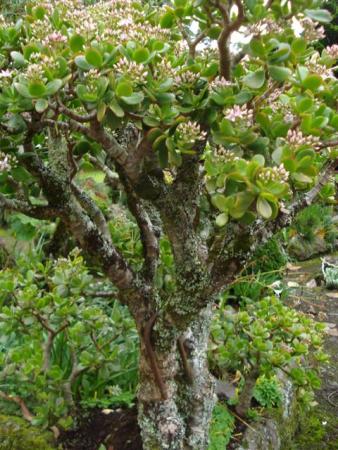
The Jade Plant or Crassula ovata

The Jade Plant or Crassula ovata

  • Grows like a natural bonsai.
  • Flowers in late autumn and winter.
  • Widely available and dead easy to increase at home.
  • Optimistically called the Money Plant sometimes.
  • Apparently good for feng shui.

This crassula comes from a very large family and has undergone a number of name changes – the current choice seems to Crassula ovata. But it is commonly known as the Jade Plant. In near frost free areas, it is fine as a garden plant but inland, it will need some protection. The dry border under the eaves of the house may be an option, or a container brought under some cover in winter. Frosts will destroy the flowers and can burn the fleshy leaves, even kill the whole plant in bad cases. Being succulent, it doesn’t want wet feet, either. In return, the crassula will reward you by being genuinely easy care and undemanding and putting on a very pretty floral display in the gloom of early winter. I have never seen it more than 90cm high but it develops into a naturally characterful, gnarly looking plant with relative speed. To get more plants, just cut a branch off. Let it dry for a few days and then stick it in some potting mix or good garden soil. Bingo, it will grow roots, just as long as you don’t let it get too wet in the meantime or it may rot. This is a good plant for children to try growing – get them to put in cuttings now and the plants should be well established as Christmas presents for grandparents. Be generous and put in larger cuttings, whole branches even, for more impressive results.
Plant Collector – double hellebores

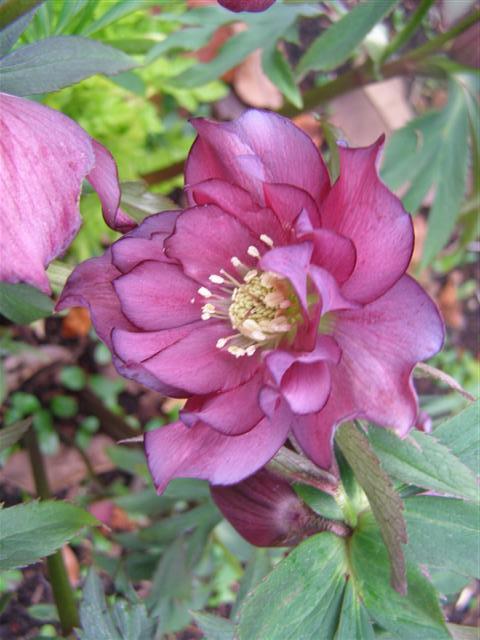
The pretty double hellebores

The pretty double hellebores

When we were in England in the mid nineties, Mark was taken to meet plant breeder Robin White who played a large role in introducing double hellebores to the market – known for his Party Dress series. We had not seen the doubles in this country at that stage and Mark was absolutely fascinated by how quickly and how far it was possible to get in breeding a whole new strain of helleborus. These days double hellebores are widely available in New Zealand, thanks mainly to Clifton Homestead Nursery, with a range of colours and under half the price they were when first introduced.

The doubles are not the same as the common Helleborus orientalis types and you can see that the foliage is quite different with deeply divided leaves. They also tend to flower later. Most are bred from a very limited number of double forms of Helleborus torquatus which is native to the former Yugoslavia. Torquatus has also had a role to play in introducing the highly desirable deep slate colours. In 1971 Elizabeth Strangman found just two plants showing double flowers somewhere in the nether regions of Montenegro and the quest to stabilise double forms started immediately. It appears that the majority of the doubles on the market still descend from those two plants. Most helleborus are single and have five petals. A semi double has an extra layer of petals (so about 10 all up), a full double has more. They all still face downwards so these gentle plants are better suited to people who take time to look at the detail of their garden and to turn the flowers upwards to admire them, unless you plant them on a slope to be viewed from below.

Plant Collector: Magnolia Lanarth

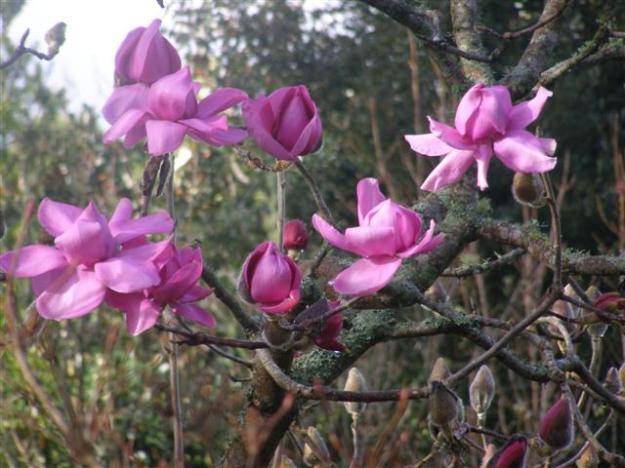
Magnificent in its purple splendour - Magnolia Lanarth

Magnificent in its purple splendour - Magnolia Lanarth

It is magnolia time and Lanarth is always one of the early bloomers and still sets the standard for pure stained glass purple colouring. We have yet to see a modern hybrid match the colour, flower form and size of Lanarth. So it is a bit of a shame that it is hard to propagate, so rarely offered and not that easy to establish so there can be a fall-out rate amongst those that are produced. On top of that, it takes a few years to flower (sometimes a decade or so), it makes a fairly large tree and the flowering can be short-lived. Get a storm at the wrong time and the season is pretty much over not long after it began. But in full bloom, it is a magnificent sight and that is why it is a collector’s plant.

Its full name resembles a stud animal – Magnolia campbellii var. mollicamata Lanarth – but it is usually just referred to as Lanarth, sometimes with the mollicamata in front to impress. Lanarth refers to where the seed was raised which was a garden in Cornwall. Intrepid plant collector George Forrest collected the seed in North West Yunnan in China back in 1924 where it was growing at a fair altitude of over 3000 metres. Only three seeds were grown and Lanarth was selected as the best of them. The usual pink and white campbellii magnolias come from the more westerly areas of China, Tibet and Burma whereas the mollicamata variants come from the more easterly side of that magnolia habitat.

Tried and True: Tree Dahlias

•Flower from mid to late autumn when few other perennials flower.
• Fill a large space in the garden.
• Many of the best new varieties available here have been bred in New Zealand by our own expert, Dr Keith Hammett.
•Deciduous, so the foliage dies away completely over winter and returns afresh.
• Easy to grow in good conditions which don’t get too dry over summer.

You do need space for these late autumn beauties and they will be badly affected by heavy frosts.


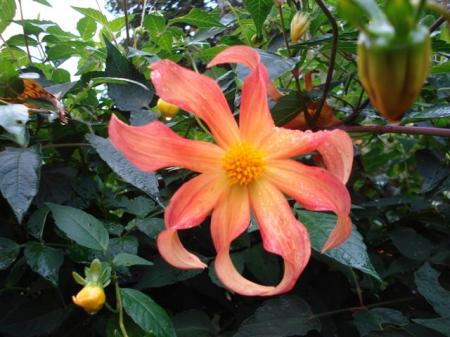
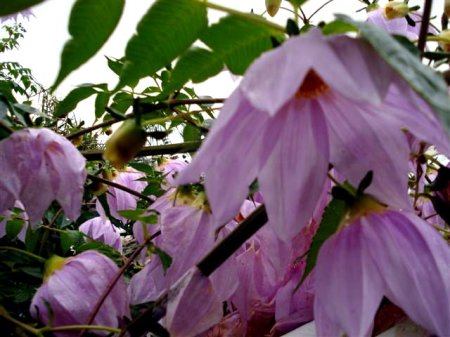
But if you have a suitable position, they are an easy-care delight. These two varieties are both from the breeder, Keith Hammett and alas we no longer have the names. The big, floppy pastel lilac is so pretty against our shed and I thought at first I was looking at a clematis from afar (it is about 2 metres tall). The golden orange sunburst bloom (love the slightly twisted petals) is a little more compact (a little shy of two metres) and has delighted us for a number of years, planted as it is by the mandarin tree whose fruit are colouring to match.

They are not called tree dahlias because they grow up like a tree but rather because they grow much larger than the usual type of perennial dahlias. In windy conditions they need a bit of support – some of ours we fence in with heavy duty bamboo cross bars. Otherwise, they are like any other dahlia with typical hollow stems and dahlia leaves, growing in a large clump from tubers below ground. Most tree dahlias come from D. imperialis which is native to Columbia and Guatemala which explains why they are not keen on cold and frosty conditions.

Plant Collector: Illicum simonsii

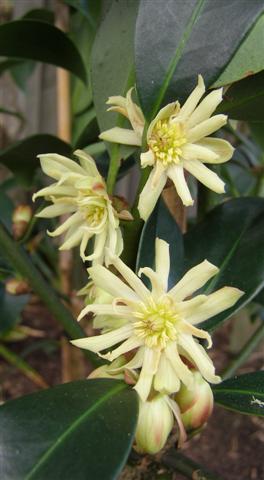
The small, waxy flowers of Illicum simonsii

I would be telling porkies if I said that these lovely soft lemon flowers are spectacular. Understated might be a better descriptor, maybe subtle. They only measure about 2cm across but they are really interesting, looking like miniature waterlilies cast out of wax. If you think they remind you of something else, you may be thinking of star anise which is the seed head of Illicum verum. Don’t be tempted to try the seeds of other illiciums – most are poisonous. Until I looked it up, I had assumed that Illicium anisatum should be the source of star anise –far from it and anisatum too is very toxic. Simonsii is still a relatively rare shrub in cultivation, originating from the Yunnan and Sichuan areas of China. It is evergreen with a lovely glaucous blue tone to its sturdy leaves and grows much more upright than most other illiciums as well as being more tolerant of full sun and relatively dry condtions. If you break a leaf, you will discover immediately how aromatic the foliage is. Whether you like the aroma or not depends a bit on your attitude to wintergreen or Vick’s Vapourub. It smells a little too close to the bizarre raspberry Sarsi drink we once bought in Kuala Lumpur – in itself an unforgettable experience.

Illiciums are a genus all of their own though they have a distant botanical alliance to magnolias but you could never tell that from looking at them.