Category Archives: Plant collector

flowering this week, tried and true plants

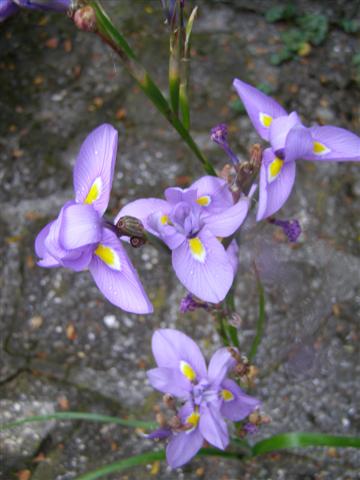
Flowering this week: Moraea polystachya

Moraea polystachya - blue lilac flowers all autumn into winter

Some bulbs are a fleeting seasonal delight but you can’t say that about Moraea polystachya which has been a sight to behold for many weeks in our rockery and which will continue to flower for some time to come. The wiry stems are about 50cm high and while individual flowers don’t last long, fresh buds keep opening because it flowers down the stem, a bit like a bearded iris. The colour is an intense blue lilac with yellow markings. When the foliage follows, it is narrow and unobtrusive so these are not plants which take up much room.

Moraeas grow from corms, like gladiolus, and most of the family hail, yet again, from South Africa. It is the spring flowering M.villosa which has given the common name of peacock iris to the whole family (its flattish blooms have markings like the eye of a peacock feather). Polystachya looks more akin to a dainty iris. It is not tricky to grow and seeds down easily in well drained conditions without becoming weedy. If you can find somebody with one, it sets seed freely and is easy to raise. I have never timed its flowering season from go to whoa but it is more likely into the months rather than days or weeks.
Tried and True – vireya rhododendrons

• Extended flowering, sometimes more than once a year.
• Once established, generally only need dead heading and an occasional prune.
• Available from garden centres in a range of colours.
• Easy to propagate at home from cutting.

The smaller leafed, smaller flowered vireya hybrids are often tougher and better performing as garden plants.

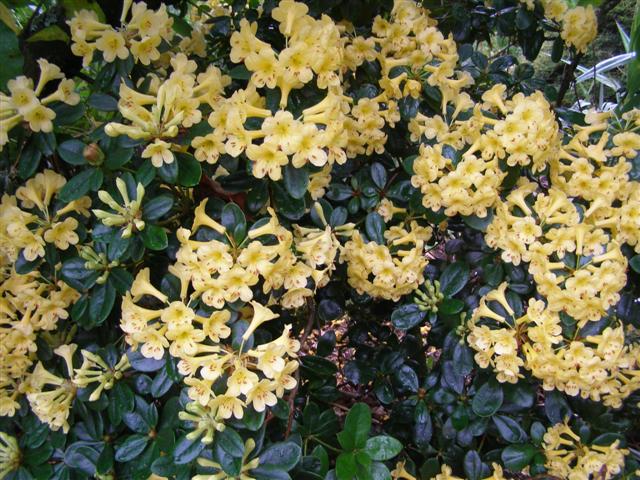
This small flowered yellow vireya has been a picture in full flower in recent weeks. Vireyas can be touchy as garden plants but get them well established in a frost free area with good drainage and they are most rewarding. Unfortunately people are often drawn to the exceptionally showy, fragrant varieties and bypass these less spectacular types. The big scented trumpet types with heavy felted foliage can be very touchy indeed and you often don’t get the flower power display of the smaller leafed, smaller flowered ones. This particular one is a sister seedling to one we have sold in the past under the name of Mellow Yellow but there is a whole range of different vireyas available with the same characteristics – in different colours too. They are hardier and tougher by nature and certainly justify a place in the garden. Flowering times are unpredictable with vireyas but many will repeat flower later in the year or gently open flower buds over an extended period of many months.

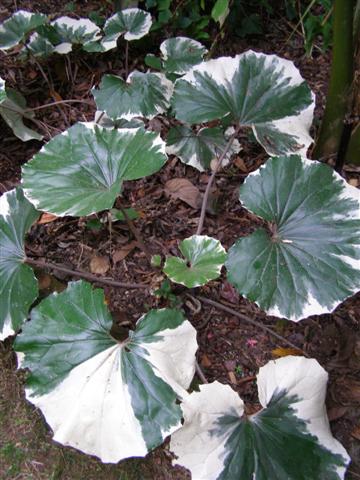
Plant of the week – Farfugium japonicum argenteum

A farfugium, these days, no longer a ligularia

I had to do some decoding of the name of this evergreen, clump-forming plant for woodland and shade areas. It used to be known as a ligularia (Ligularia tussilaginea argentea to be precise) but the family were reclassified as farfugiums. Argenteum’s siblings are far easier to build up so are a great deal more common – aureomaculatum which many of you will know as the Leopard ligularia (about which we are bit sniffy – looks as if it has been sprayed with Paraquat, is Mark’s opinion) and cristata (also known as crispatum) which looks a little like a tough oak-leafed lettuce. Argenteum is slow to increase so usually passed by in the nursery trade in favour of those which get a quicker turnaround. But none of the alternatives can light up a dark space quite like the startling white splashes on the often enormous leaves of this plant. The kidney-shaped leaves can reach up to half a metre across.

These plants are classified within the daisies, asteracea, and the flowers are typically nasty yellow things but you can cut them off. Argenteum prefers some shade (the white parts will burn in the sun) and grows in similar conditions to hostas – humus rich with adequate moisture. The beauty is that they keep their leaves all year and are largely impervious to slug and snail attack. The one defect they can suffer from is anthracnose which can result in little shot holes in the leaves. We don’t worry about it but if you want perfect leaves every time, you may need to use a fungicide occasionally.

Flowering this week: Gordonia yunnanensis

A gordonia not a camellia

A gordonia not a camellia

This is not a camellia though the flower looks very similar to a large, pure white single camellia with showy golden stamens. They are botanically related from a distance, as stewartias are too. Gordonias are sometimes known as the fried egg plant because the flowers drop off whole and land sunny side up where they resemble, loosely speaking, that breakfast food. This form is yunnanensis which simply means it is from the Yunnan province in southern China. As far as I know, it is the largest flowered form. There are other forms around – axillaris is the most common but yunnanensis has much better flowers and plenty of them which open from now through winter. It also has a lovely glaucous, or blue-grey, tone to the shiny leaves. We also have an unidentified Vietnamese species which has slightly smaller flowers, bright green foliage and a more compact habit than yunnanensis though we are still talking around four metres high.

Gordonias are evergreen with shiny foliage and reasonable wind resistance. Most of them come from eastern parts of Asia (there are a few which come from mild areas of North America) and will make large shrubs or small trees. While we have seen the odd pink tinged one, basically they are all white with petals that look a little like crushed tissue paper. They could, perhaps, be described as the very large pure white camellia you have when you are not having a camellia.

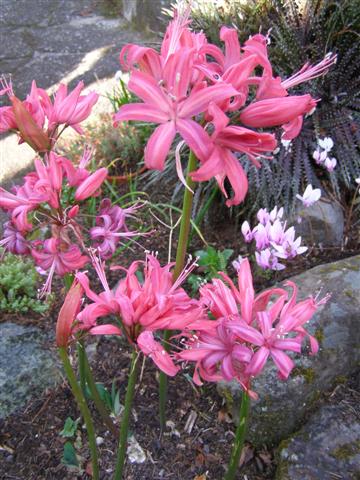
Flowering this week: Nerine sarniensis hybrids

Years of work have made the sarniensis nerines a real autumn feature in our rockery

The nerines are looking wonderful in the rockery. These autumn flowering South African bulbs are members of the amaryllis family and are a mainstay of our April garden. There are a number of different species (about 30, apparently) but it is the large flowered, showy sarniensis hybrids which we feature. Felix Jury imported some bulbs and did quite a bit of work to extend the colour range here. He particularly favoured the smoky burgundy colours but we also have a shocking pink which is near iridescent, along with a whole range of different reds, oranges, pinks and corals from pastel to verging on purple and even apricot. They are grown as a cut flower commercially but we prefer them in the garden setting. These are large bulbs which are planted to half depth only with their necks exposed and they are happy with summer baking. Their strappy leaves come after the flowers and hang on until spring.

Nerines are sometimes called the Guernsey lily or the Spider Lily. Some of the other species have much finer, more spidery flowers than the sarniensis types, but lilies they are not. Neither do they originate in Guernsey though that island became renowned for its cut flower production and the bulbs have since naturalised there. Nerines were named after Nereis, a mythological Green sea nymph.