Category Archives: Plant collector

flowering this week, tried and true plants

Flowering this week: Angelica gigas

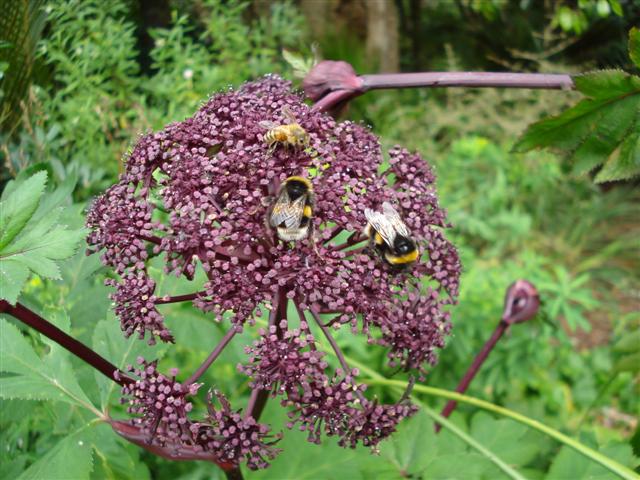
Angelica gigas alive with bumble bees and honey bees, along with a few unwelcome wasps leaving little room for the butterflies who would also enjoy it

Angelica gigas alive with bumble bees and honey bees, along with a few unwelcome wasps leaving little room for the butterflies who would also enjoy it

Being on a train of thought about feeding the butterflies and the bees, I could not pass by the purple flower heads of Angelica gigas which are rarely seen without the nectar feeders this week. In fact the whole bush is fair humming. This is an ornamental angelica (the edible one is Angelica archangelica) which originates in the areas of Korea, Japan and northern China. It is biennial which means it flowers in its second year, sets seed and dies and observant readers will not be surprised to find that it belongs to the carrot family, or apiaceae. Apparently it can grow up to two metres but our plants sit with flower heads closer to 150 centimetres. At this size, it does not quite fit in with carpet bedding plants but it is splendid in the herbaceous or mixed border. If you don’t garden with glyphosate, angelica should seed down easily but to be sure, gather at least one seed head and germinate in controlled conditions. There is nothing particularly rare or choice about this plant, though we understand this form is a recent collection, but it is a charming addition to the late summer garden.
Flowering this week: Justicia carnea

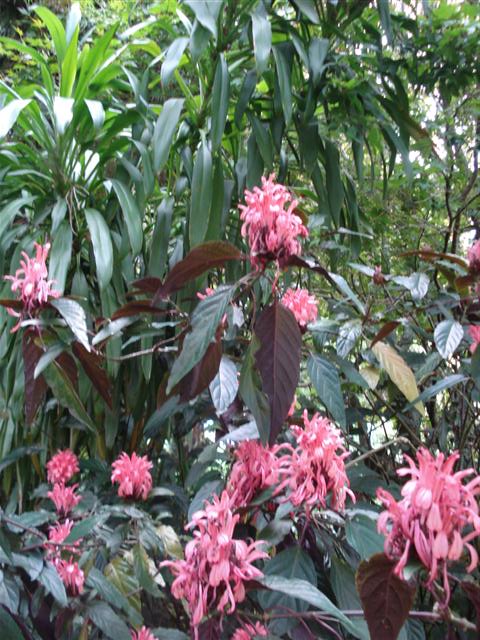
Summer flowering Justicia carnea in our woodland

Plants which thrive and flower prolifically in reasonably dense shade are rare indeed but Justicia carnea is a stand out this week with a particularly lovely combination of foliage and flower colour visible from quite some distance. The tufted flowers of justicias always remind me of the old candlewick bedspreads despised by my mother but now having a second coming as a collectable on Trade Me (our NZ equivalent of Ebay). This form of carnea has a salmon pink flower complimented by very dark green leaves which are velvety maroon on the back but it does come in other colours, including a pure white form. And the yellow candlewick form which we used to know as Jacobinia chrysostephana is also referred to as Justicia aurea (which means yellow).

These central American shrubs are members of the acanthus family. It had never occurred to us that they are frost tender but in large parts of the world they are regarded as glasshouse plants or they are lifted each winter so they must be more tender than we thought. We have never seen them suffer from frost or cold in our garden but we do tend to favour them as a woodland plant. We just ignore them most of the time. When they start to get a bit rangy and leggy after several years, I cut the tallest stems back to the base of the plant. The old wood is surprisingly hard which is why I use loppers in preference to secateurs. It takes many years for them to get to the size of this one and you could keep them more compact by pruning and pinching out from the start but we don’t mind the tufted pink flowers and slender growth occupying an area about 2.5m x 2.5m. It combines well here with a tropical cordyline behind and ferns, Solomon Seal and mid green hosta at its feet.

Flowering this week: Michelia alba

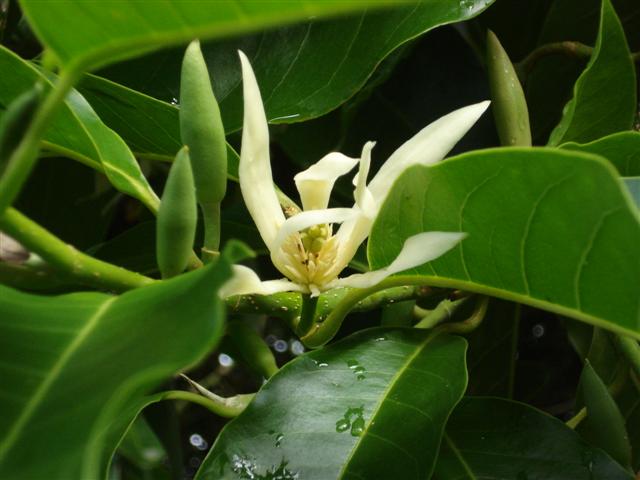
Michelia alba - grown for fragrance and foliage rather than any spectacular floral display

Probably the most fragrant tree we know, Michelia alba is in flower now and will be for most of summer. The flowers are definitely not spectacular to look at, being small and rather sparse for the size of the tree, spidery in form and cream. But for a knock you down fragrance which permeates the air all round, alba is amazing. In fact it is apparently the fragrance of Joy perfume. The tree gives us a few worries because it is growing considerably larger and faster than we anticipated and we wonder if we have it planted in the right place. Glyn Church tells us he had to cut one of his out because it outgrew its position. At least it is upright, rather than spreading and its foliage is lush tropical green all year – possibly because it comes from tropical and sub tropical areas of Asia.

Michelias have now been reclassified as magnolias – a somewhat arbitrary decision with which we do not agree so we will continue to use the former names. Alba was given to us by an elderly Chinese gentleman who told us that it was sacred and we could sell one to every Chinese family in NZ. We tried, believe me we tried but it does not set seed and it very rarely strikes from cutting so it has to be grafted and it is not easy to reproduce that way either. We have seen it used as a street tree throughout Asia and we think they aerial layer it.

For the botanically interested, current information is that alba is probably a natural hybrid from the orange flowered Michelia champaca and all alba plants throughout the world are therefore the one clone. Champaca sets seed freely but we have yet to hear of anybody who has proven experience with alba showing fertility. The plant appears to be a genetic dead end.

For a photograph of the tree in our garden, check out Magnolia Diary 14.

Flowering this week: Scadoxus multiflorus ssp. katherinae

Scadoxus ssp. katherinae is very happy in dry shade

Scadoxus ssp. katherinae is very happy in dry shade

This particular patch of scadoxus is looking very fine this week and stands around 140cm tall which is fairly remarkable given that it is growing in quite hard condtions. But then, scadoxus like dry shade and that is one thing we have in abundance in our garden.

These are very large bulbs, hailing yet again from the bulb wonderland of Zimbabwe and South Africa. Mark has always described the flowers as being like the chimney brush of the bulb world because they resemble the round brushes used by old fashioned chimney sweeps. Katherinae flowers red in mid summer. Her cousin from Natal, Scadoxus puniceus, flowers orange in spring with a similar flower form. The foliage of both is large and lush. If you know of anybody with either variety, the seed will germinate readily. It is very slow to increase from the bulb (no doubt you could twin scale it) so it is normally done from seed. You are more likely to find bulbs of katherinae for sale rather than the rarer puniceus.

Flowering this week: Eucomis or pineapple lily

Neither pineapple nor lily, this burgundy coloured eucomis is a feature in our summer garden

Our best guess is that this is a good form of Eucomis comosa, possibly a hybrid. It actually has nothing to do with pineapples or lilies because it is a bulb from South Africa and belongs to the hyacinth family. But the flower with top knot is seen as resembling a pineapple and that may be more PC than referencing caricatures of certain indigenous tribes who favoured top knots. The bulbs are big fist-sized affairs and build up quite readily in well drained, sunny positions. Each bulb makes a large clump so it is a plant for the summer herbaceous border where it has room to spread out and where it doesn’t matter that it leaves a bare area when it dies off in autumn. The long-lived flowers are apparently widely used in floral work and because the eucomis is happy to grow in covered houses, flowering seasons can be extended.

Our eucomis has leaves which are a subtle blend of burgundy and brown with a green undertone, bright burgundy flower stems and buds opening to a scented lilac flower with lovely yellow anthers. Green forms of eucomis are more common and there has been a range of dwarf eucomis hybrids introduced in recent years. This is a genus that lends itself to hybridising and it is generally an easy garden plant in our favoured conditions here in Taranaki.