Category Archives: Plant collector

flowering this week, tried and true plants

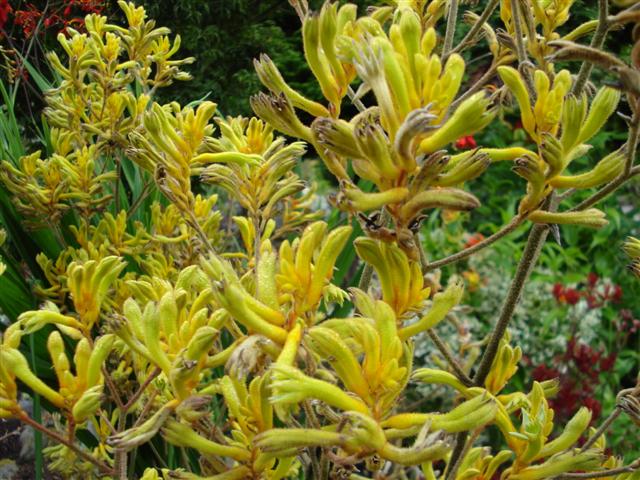
Flowering this week: anigozanthos, probably a flavidus hybrid.

The Australian anigozanthus requires perfect drainage in our conditions

I have never been up close and personal with Kanga and certainly not so near that I can examine her feet, so the reason why the anigozanthos family are widely referred to as kanagaroo paws eludes me. While the flowers are slightly furry, that doesn’t seem sufficient reason to liken the two. But these interesting clumping, evergreen perennials from South Western Australia are worthwhile additions to the sunny garden, if for no other reason than that they flower most of the year.

The critical issue with anigozanthos is perfect drainage. Apparently flavidus is more tolerant of damper conditions than the other species (which may be why this yellow one thrives where we have lost others over time) but we are only talking tolerance of Australian damp which is not at all the same thing as Taranaki damp. Perfect drainage, a raised bed and very open conditions are still recommended.

Modern breeding has led to the commercial release of a range of jewel-like colour combinations going well beyond the common red and yellow toughies, more into the rosella parrot colourings. We have tried a number of these over the years and gradually lost the lot – you should have more success if you garden in sandy, coastal conditions. But the reliable yellows and reds give consistent and curious flowers in our rockery and are also good as a cut flower. This yellow plant puts up flower spikes to around 150cm and, bless, they hold themselves up without staking. Many others are a great deal more compact and with flower spikes closer to 20 or 30cm

Anigozanthos are frequently available in garden centres.
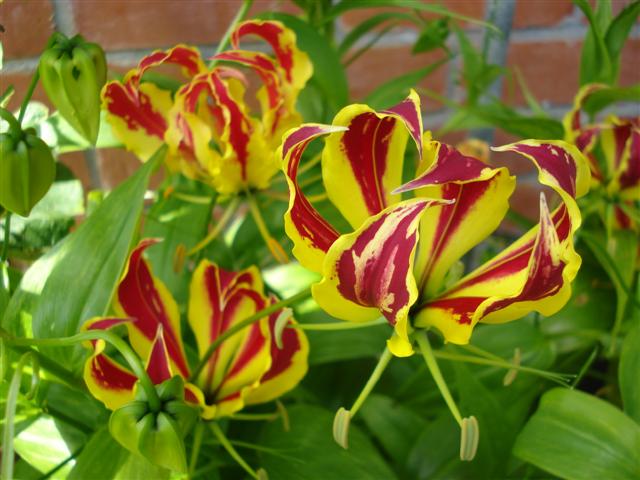
Flowering this week: Gloriosa superba

Summer glory in Gloriosa superba

Commonly called the glory lily, flame lily or climbing lily, this plant should be recognised by all ex-pat Zimbabweans and some Indians. Oddly enough, it originates in both areas and is the national flower of Zimbabwe and also accorded special status in the state of Tamil Nadu in India. It is only a very distant relative of the lily, being a member of the colchicum family and because it is full of the chemical colchicine, all parts of the plant are poisonous. Colchicine is used to double the chromosomes in plant cells and is highly toxic in concentrated form. Not that I have ever seen anybody want to eat gloriosas.

The plants grow from V shaped tubers which will survive in very dry, sandy conditions so we use them in the narrow dry house border facing north where very little else but succulents will grow. They are winter dormant and never get watered, even in summer. The tubers find their own required depths and can end up quite some distance below ground.

Gloriosa is a good cut flower, lasting well in a vase though the pollen can stain. But look at the flower shape. It opens conventionally enough but then the petals reflex entirely (in other words they all bend backwards) leaving the anthers and stamens completely exposed. Sometimes the petals can be so recurved that it looks like a full crown with fringe. The colours are always in the yellow/orange/red spectrum and the most desirable forms tend to be those with the sharpest yellow and dark red contrast. It is not particularly rare in this country, so you should be able to find gloriosas if you want them and they are an ideal plant for sandy, coastal gardens.

Flowering this week: Hydrangea Immaculata

Perfection in pristine white - Hydrangea Immaculata

The most perfect floral display in our garden this week has been Hydrangea Immaculata – such an appropriate, if somewhat Roman Catholic name. A smaller growing, compact variety, being about a metre high and a metre wide, its moptop flower heads are pristine white. It is best grown in the shade where it will light up a dark area because it tends to burn in our intense summer sun. Beyond that, there is nothing fussy or difficult about this summer perfection. It is just one of the common macrophylla types and as the flowers age, they often develop a pretty rose pink tinge. Cuttings are easy to strike, even for the novice gardener.

Hydrangeas are a wonderful source of colour in summer and ideal in verdant Taranaki with our combination of high sunshine hours and summer rain. Because our soils are acid, most are blue though as you drive northwards through the Pio Pio and Te Kuiti area, you may notice that their hydrangeas tend to pink which indicates alkaline soils in their limestone country.

We just happen to have an international expert living in our midst here. Glyn Church at Woodleigh Nursery and Garden near Oakura is probably better known overseas than here (ain’t that just the way?) but locals at least have the chance to go and see his garden in person. Mark was there a few days ago and can vouch that it is full of summer colour and looking great with some gorgeous hydrangeas. Bloody Marvellous was a showstopper in purple. Glyn is working towards being accredited as holding the national collection of hydrangeas in New Zealand which means he has a wide range. He has targetted the summer garden and the floral display goes well beyond hydrangeas. His garden is open by appointment.

Flowering this week: The San Pedro cactus or echinopsis pachanoi (syn. Trichocereus pachanoi)

The San Pedro cactus or echinopsis pachanoi (syn. Trichocereus pachanoi)

The San Pedro cactus or echinopsis pachanoi (syn. Trichocereus pachanoi)

During summer this amazing plant flushes over several months, sprouting a profusion of sweetly scented, large and exotic flowers. Each bloom lasts a couple of days, after which it shrivels up and falls to the ground where it then resembles something unsavoury left by a visiting dog.

This South American cactus is best not planted where visible to passers-by lest horticulturally enabled young people with extremely strong stomachs, no taste buds and a thrill seeking disposition raid your plant. In a sunny position with excellent drainage, it stands bold and tall and distinctly phallic in a spiky sort of way. Like most cacti, San Pedro is easy to propagate. Cut a short length from the end, leave it to dry for a few days and then stick in a pot or the ground. The trick is keeping it upright because it is top heavy and may rot if you plant it too deeply. If you use a length cut at both ends, it will sprout two new shoots and resemble rabbits’ ears but it tends to be weak at the point of the fresh growth.

Left to its own devices, it will tower and sway to around 4 metres, putting out side growths and clumping from the base over time. Should you happen to have a problem with tinea in the hooves of your cattle or goats, the San Pedro cactus is a traditional medicine for dealing to this affliction – just add alum and lye.

For the botanically precise, there is a bit of a question mark over the finer differences between echinopsis pachanoi (syn. trichocereus pachanoi) also referred to as the San Pedro cactus and echinopsis peruviana or the Peruvian torch cactus. The differentiation is not helped by the possibilities of plants being hybrids between the two closely related forms. We tend to call ours the Carlos Castaneda trichocereus for reasons which will be understood by readers who have encountered the works of Castaneda or indeed Aldous Huxley.

Flowering this week – Rodgersia aesculifolia

The scented cream plumes of Rodgersia aesculifolia

The rodgersias hail from temperate areas of Asia and are deciduous perennials. In other words, like hostas they drop all their leaves in autumn and disappear below ground, emerging afresh in the spring. Also like hostas, they are accepting of heavy soils and even boggy ground although they are less of a shade plant.

This form is Rodgersia aesculifolia – meaning the leaves look somewhat like an aesculus which is better known as a chestnut. They can get a bit of size to them. This plant has typical seven leaf clusters in a flattish circle which can measure up to 70cm across. The fine, feathery spires of cream flowers resemble an astilbe in appearance and are even sweetly scented. Rodgersia pinnata superba emerges with bronze growth and commonly has pink flower plumes.

Rodgersias are members of the saxifrage family and increase below ground with chunky, tuberous roots which can be lifted and divided in winter. Most of the saxifrages are dainty, delicate little things but the only delicate thing about the rodgersia is the dainty flower plume.