Category Archives: Plant collector

flowering this week, tried and true plants

Flowering this week – meconopsis or Himalayan blue poppy

A little weather beaten after the rains, but a small gardening triumph in our conditions - the blue poppy

The blue poppy must be one of the simplest and bluest of any flower anywhere. It is such a shame that it is so difficult to keep alive in our conditions because you can never have too many simple blue flowers in a garden. The meconopsis has as few as four petals (and they look like slightly crumpled tissue paper) surrounding a boss of golden stamens and the central ovary, but the blue can be a startling electric blue. A clump of meconopsis is a sight to behold.

The blue poppies hail from the Himalayas and surrounding areas which gives a hint to their preferred growing conditions – alpine meadows. Without a winter chill here and with high winter rainfall, it is more likely that they will rot out below ground and they simply never get the signal that tells them winter has gone (they are probably still waiting for it to arrive here) and to break dormancy. So most gardeners struggle to keep them going and they tend to be one season wonders (annuals) and never seed down. The fact that we now have clumps of them well established in a cold border in our park area and that those clumps are getting bigger and return each year (so are perennial) is testimony to some years of persistence on Mark’s part. He has been selecting stronger growing clumps and good blue tones over time, hand pollinating to increase seed set, raising seed in the nursery and generally taking great care of these blue babies to get them to naturalise. Of course if you come from a colder, somewhat drier area, you may wonder what all the fuss is about because they can be relatively easy to grow there but they are very rare indeed in warmer climates.

For the record, these plants have been hand pollinated so frequently that Mark has lost track of the genetic proportions but they are basically downstream sheldonii back crosses which means that they have varying proportions of betonicifolia (both blue and white forms) and grandis.

Flowering this week – we still call it Urceolina peruviana

From the alpine meadows of the Andes, Stenomesson miniatum

From the alpine meadows of the Andes, Stenomesson miniatum

I was all set to write about this little gem of a bulb from our rockery, which we have always known as Urceolina peruviana but a quick net search tells me that it is now called (wait for it) Stenomesson miniatum. At least the Peruvian reference gives a hint to its origin from the alpine meadows of the Andes but do not be thinking that this means it is extremely hardy. In fact the snow blankets it in winter, protecting it from the damaging effects of freezing. In our mild climate, it is largely evergreen although the occasional frost can turn the leaves to slush. It is completely deciduous in colder conditions.

Whether stenomesson or urceolina, it is a member of the amaryllis family and we appreciate it particularly for its timing. It flowers now when pretty well all the spring bulbs have finished so the hanging (or pendulous) trumpets in orange with even longer yellow stamens are a standout feature. It has a reasonably long flowering season over several weeks and if you have sufficient to enable picking, it lasts well in a vase. Also to its credit, there is a not a lot of choking leafy foliage for the months following flowering. In fact there is not a lot of foliage at all which makes it tidy in the garden. The bulbs don’t increase at a speedy rate so it is a plant to treasure if you can acquire it.

Flowering this week – Kalmia latifolia “Ostbo Red”

Kalmia Ostbo Red with its look of piped icing rose buds

If ever there was a cake decoration flower, it is the kalmia. The buds look pretty much like piped icing rose buds right through to the point where they finally open to a pastel shaped cup with deeper colouring on the underside. These flowers are also successful cut for a vase indoors, lasting a fair time in water.

Kalmias are evergreen members of the heath family, growing here in similar conditions to rhododendrons (they like an acid soil) and coming into flower just as the rhododendrons are largely over. They are native to the eastern seaboard of North America from Canada to Mexico so are tolerant of a wide range of temperatures but generally we would describe them as very hardy. Americans often refer to them as the Calico Plant or Mountain Laurel. Over time, they will grow to about 1.5 metres high but they are pretty slow growing.

Kalmias are not rare but they are not often available in garden centres simply because they are notoriously difficult from cutting. Sometimes plants will come in a rush through tissue culture (micro propagation) in which case you should buy on sight because you don’t know when they will be offered again. If you know of somebody with a plant you can grow them by layering (we did an Outdoor Classroom on the topic about six weeks ago) or if you find any seed on a plant, they are straightforward and reasonably consistent from seed although you will get some variation from the parent. Alas some of the common named varieties don’t set much, if any, seed at all.

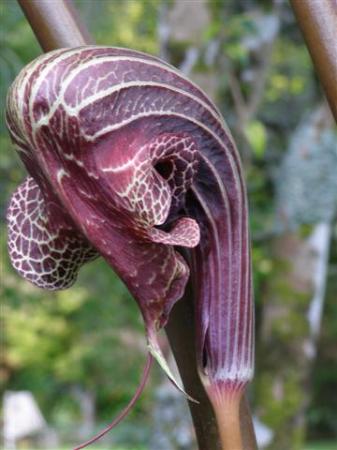
Flowering this week – Arisaema dahaiense

October 27 2009 001 (Small)

Not quite a mouse eating plant, but truly remarkable - A. dahaiense

In a quiet moment in the middle of our garden festival last week, Mark must have been suffering from boredom to be so mischievous as to tell a garden visitor that this flower had just eaten a mouse. She actually believed him too, until he twiddled the long tendril which comes out from the flower and resembles a mouse tail. She wasn’t sufficiently gullible to believe that the mouse was still alive. But this extraordinary flower is decidedly reptilian in appearance.

You certainly won’t find this plant on the shelves at your local garden centre. Mark spent many years hoping to be given one of the rare bulbs and it finally came to pass last year so this is its first flowering for us. At this stage, it is strictly who you know when it comes to acquiring this plant. Dahaiense comes from the Yunnan area of China although this strain was collected somewhere round the Burmese border area. In the wild, it has been photographed at close to two metres in height but our plant has yet to reach anywhere near that stature.

There are a whole range of different arisaemas and some are much more spectacular than others. They are a most curious genus being true hermaphrodites. When the plant is strong and robust, it becomes female and able to set seed but when it is immature or feeling a little weak and poorly it becomes male and is only capable of pollen donation. We will say no more on that topic.

Mark has spent some years gathering all the different species available here and hybridising to get some unique forms to use in the garden. He has a large number of spring flowering plants which hold their cobra-like heads above the foliage (most species hide their flowers below the leaves) and his summer flowering forms extend the colour from the more usual brown or greenish flowers into pinks and burgundies. They are not pretty but they are certainly interesting and nobody else has bedding plants quite like our arisaemas. Dahaiense has opened a whole new range of possibilities as a pollen donor this year.

Flowering this week: Eupatorium sordidum

Like a giant fluffy blue ageratum on steroids

Like a giant fluffy blue ageratum on steroids

It is a member of the wider daisy family but it looks like the annual fluffy blue ageratum on a massive overdose of steroids. In fact it is a perennial woody shrub from Mexico which reaches about 3 metres high and nearly as wide with big leaves (slightly felted) and big fluffy, fragrant flowers in lilac blue. Normally it is in full flower for our spring garden festival but it is a little late this year. It is not very hardy and presumably it didn’t like the cold winter.

We grow it outdoors here but we saw it in the covered house at Kew Gardens in London under a different name and then we saw it in a garden in Italy under yet another variation but it appears that all are more or less correct: Eupatorium sordidum, Eupatorium megalophyllum, Bartlettina sordida or Bartlettina megalophylla. It does not appear to have a common name so it is referred to here upon occasion as that giant overgrown blue ageratum-like plant. You are not likely to find it for sale but it does grow easily from cuttings if you find somebody with a plant.