Category Archives: Plant collector

flowering this week, tried and true plants

Plant collector: the curious native Muehlenbeckia astonii

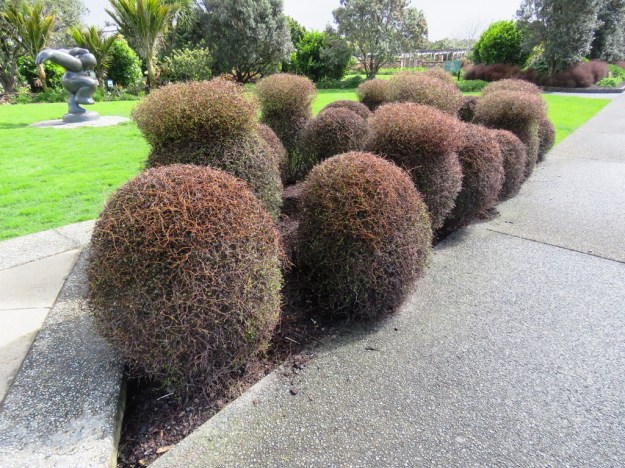
An unusual clipped specimen, M. astonii

An unusual clipped specimen, M. astonii

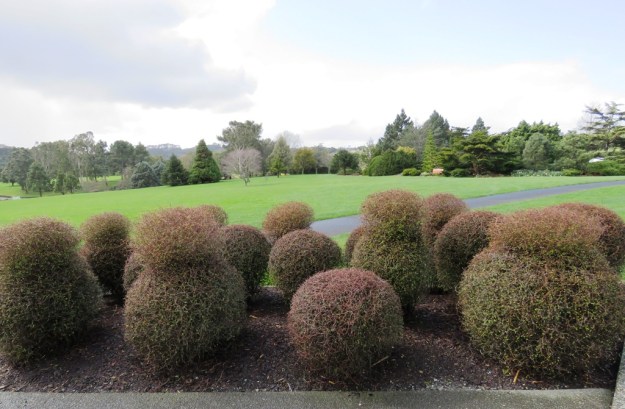
The proper name of this plant is not easy to spell – Muehlenbeckia astonii – but I have never even heard it referred to by its alleged common names of ‘shrubby tororaro’ or ‘wiggy-wig bush’. Not that common, apparently. The plantings in a prominent position at Auckland Botanic Gardens have caught my eye before. I am guessing they are planning to extend the clipping up another layer. In this interim phase. Mark chuckled and suggested they resemble Kim Jong-Un. The hair, dear Reader, the hair.

This is another of our native plants now threatened by loss of habitat. These days it is limited to the eastern coastal lowlands, stretching from Wairarapa to Banks Peninsula but it may have been more widespread in the days before extensive land development. Fortunately, it makes a good garden specimen and it is the ability to integrate into gardens that has saved critically endangered plants like Tecomanthe speciosa, Pennantia baylisiana and the kakabeak (clianthus).

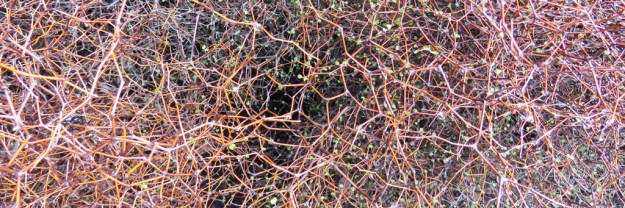
Divaricating plants are not unusual in this country – divaricating being that tight criss crossing of the branches, often combined with tiny leaves. The ever-handy internet advances two botanical theories for the prevalence of divaricating plants here. I like the first theory which is that plants evolved this way to protect themselves from moa grazing on them. The second theory is that the plants have adapted to withstand harsh climatic conditions, particularly wind and dryness found in exposed coastal conditions and maybe hard frosts.
Muehlenbeckia astonii (7)
M. astonii will be deciduous in hard conditions but retains some of its tiny leaves in Auckland. The orange and red tones in the wiry zigzag branches add interest. It clips well and is apparently not difficult to strike from cutting or raise from fresh seed. We don’t have M. astonii in our garden but we do grow a comparable tiny-leafed divaricating coprosma which has a natural form of mounding layers that is often described as cloud form.

Muehlenbeckia astonii, featuring prominently at Auckland Botanic Gardens

Muehlenbeckia astonii, featuring prominently at Auckland Botanic Gardens

Plant Collector: Chamaedorea woodsoniana

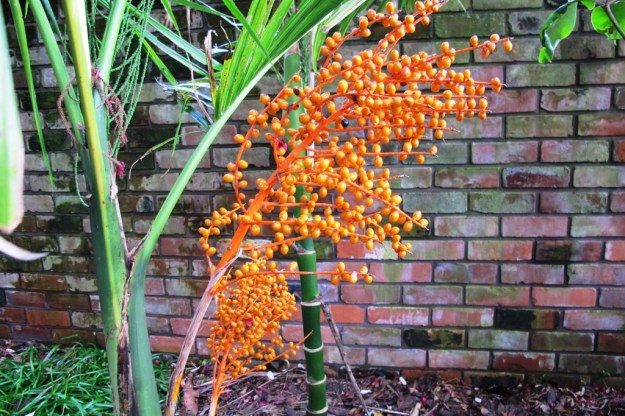
Attractive fruit but a worryingly large amount of it on the Chamaedorea woodsoniana

Attractive fruit but a worryingly large amount of it on the Chamaedorea woodsoniana

“Look at this,” said Mark putting the seed upon the table. “Off a small palm. It’s either the next invasive weed here or it has a future as a substitute in the palm oil industry.”

It took us a little while to track down the name. We knew it was a chamaedorea but there are quite a few different species so we had to go back to the original purchase to get the C. woodsoniana bit. Like most of the family, it hails from Mexico and Central America, growing in montane rainforest which is why we can grow it here. We can do the rain and the montane reference means it comes from areas with some altitude, making it a little bit hardier. However, given that its climate zone range is 10 to 11 (meaning that if the temperature plummets to around zero fahrenheit, it is not going to thrive – or even survive) and we have been moaning all week about the bitter chill of mid winter, we must be close to the limits of its tolerance. We have it planted on the margins of evergreen woodland so it will be protected from the worst of the cold. In its natural habitat, the palm encyclopaedia tells me it can reach 40 feet (about 12 metres) but we think that is extremely unlikely here. Ours is currently sitting around 2 metres and it is not growing like a rocket.

Mark tries to take the fruiting seeds off the bangalow palms here, to restrict their spread. He is now wondering if he is going to have to do it to this pretty chamaedorea too.

Chamaedorea woodsoniana growing in a protected position in our temperate climate

Chamaedorea woodsoniana growing in a protected position in our temperate climate

Sole survivor – Tecomanthe speciosa

Tecomanthe speciosa - a sole surviving specimen was found in the wild

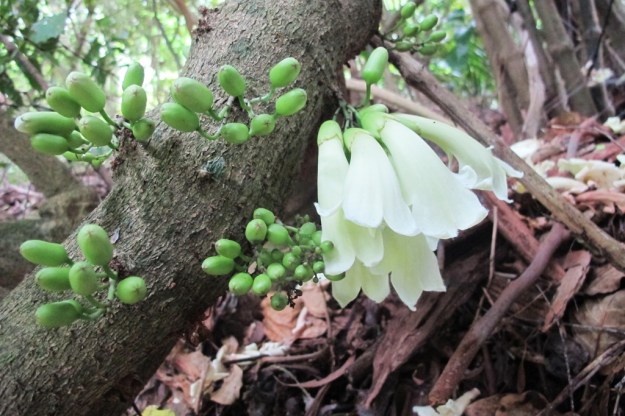
Tecomanthe speciosa – a sole surviving specimen was found in the wild

Plants cannot come more endangered than our native Tecomanthe speciosa. Only one has ever been found in the wild and that was back in 1945-6 on Manawa Tawhi, the biggest island of the Three Kings group off the northern coast of New Zealand. Blame the goats which were introduced to our offshore islands, as I understand it, to provide food for shipwrecked sailors back in the days when this was a more common event.

I have a fondness for carpets of fallen blooms

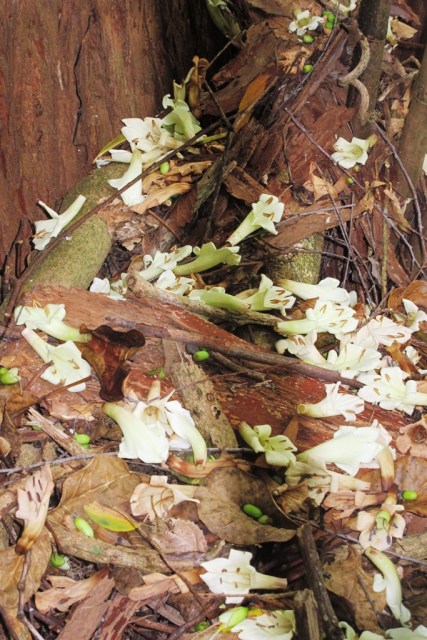
I have a fondness for carpets of fallen blooms

Fortunately T. speciosa is not difficult to propagate and it is its use as a garden plant in frost-free areas of the country that has ensured its survival. I usually miss the autumn flowering on our vines because most of it occurs about 10 metres up in the sky where it has clambered its way up to the light on one of our road boundaries. I only noticed it this season because I happened across the flower carpet below and looked more closely. I must admit that I did not realise it put out clusters of blooms on bare wood in its lower reaches too.

Tecomanthe  venusta

Tecomanthe venusta

There aren’t many tecomanthe species, all of which are members of the bignoniaceae family and evergreen. There seems some agreement on the number five, maybe six. There is our T. speciosa, one maybe two from Queensland in Australia (T. hillii is the most recognised) and three from New Guinea. We have two New Guinea forms here. The first is what we call T. venusta (syn dendrophylla).

It is distinctly tropical but shows the same characteristics as T. speciosa when it comes to putting up strong tendrils and flowering in clusters from bare wood.

Tecomanthe montana

Tecomanthe montana

We had T. hillii which was sold commercially in NZ some years ago but it didn’t look like too much of a gem here so we didn’t take care of it and no longer have it. The real gem for us is not even on the usual lists of species but we have it under the name T. montana from New Guinea. It flowers in mid spring and is much finer leafed, finer growing and more floriferous than its larger two cousins we also grow.

Our native speciosa appears to be the giant in the family. The vines on our well established plant are as thick as human limbs. It also has much larger, glossy leaves. The best plants I have seen have been trained and kept pruned along the verandah fronts of houses. You need a very strong structure to hold them and to be consistent on pruning but it does at least get them flowering well at a level where it is visible.

Vines are large as human limbs on our native T. speciosa

Vines are large as human limbs on our native T. speciosa

On the same botanical survey of the Three Kings that the sole tecomanthe plant was found, another sole remaining specimen of a tree species was found – Pennantia balyisiana.

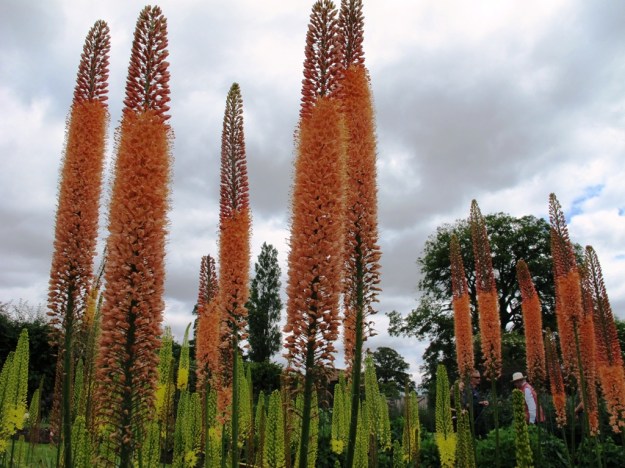
From foxgloves* to foxtail lilies – eremurus

Eremurus - but in Yorkshire not Tikorangi

Eremurus – but in Yorkshire not Tikorangi

We don’t have foxes in New Zealand. In that huge modification of our environment that took place with the early settlers in the 1800s, we were at least spared those. True, we could have done without the bunny rabbits, the possums, deer, goats, many common
garden slugs and snails and assorted other introductions, but foxes we did not get.

This is by way of introducing the so-called foxtail lily, which we don’t have here in the warmer north although plants are sold and no doubt perform well the further south one gardens. I imagine they are perfect in Central Otago. I photographed these in the cutting garden at Mount St John in Yorkshire last June, so in early summer. I had not seen them before and I wondered why we were not growing them. Having Mark at my side is akin to a resident technical advisor and he immediately commented that he had tried growing them (of course he had, how could I have doubted that?) but they don’t like our conditions.

The reason eremurus don’t like our conditions is that in their native habitat, stretching from north eastern Europe across western and central Asia to China, they have good drainage, especially in winter and winter chill. They also need full sun. These are areas we might describe as cold climate deserts and the other common name for eremurus is desert candles. No desert here in Tikorangi.

Eremurus are deciduous perennials in the asphodeloideae family, growing from fleshy root systems. Their growth is rapid and their season is short – again indications of a harsh climate. There are a fair number of different species which I have not unravelled (somewhere over 60 of them, according to Wiki) as well as hybrids. Some will put up flower spikes to 3 metres of more, so as a cut flower they might be better suited to the baronial hall than the domestic living room. I would hazard a guess that modern hybridists have set about breeding more compact forms, allegedly better suited to edging suburban gardens in the same manner that handsome alstromeria, eryngiums, zinnias and many other plants have been scaled down to compact little clumps. I have yet to see any that are improved by this treatment but if you have the right conditions, full-sized eremurus are a handsome delight. They also come in white and pink and any number of colour combinations between those and the oranges and yellows.

The cutting or picking garden at Mount St John in Yorkshire

The cutting or picking garden at Mount St John in Yorkshire

* The foxglove reference is to the post immediately preceding this one.

Plant Collector: Z is for habranthus

Habranthus. Not zephyranthes any longer. Apparently.

Habranthus. Not zephyranthes any longer. Apparently.

We have always called this a zephyranthes. It probably came to us as a zephyranthes and in the past it has been referred to as one of that family but it appears it is now an habranthus – H. andersonii from the description. Or rain lilies, to use the common name, for the flowering is triggered by summer rainfall. Lilies are a bit of a stretch because these habranthus belong to the Amaryllidaceae family not the Liliaceae one. Besides, they look more like summer crocus, really.

They gently seed down and are established here amongst the prostrate thyme that edges our driveway, popping up also in the cracks in the concrete. The many flowers spring up very quickly throughout summer and set seed which matures equally quickly. This is usually an indication of weed potential but we have not found them to be invasive over many years. From time to time, I thin out the seedlings and I pull off some of the seed heads as I pass. Foliage follows after flowering and is the thin, grassy persuasion.

Habranthus andersonii is native to Uruguay and Argentina and indeed all the habranthus and zephyranthes seem to originate from that area of Central America, north into Texas and the warm areas of South America. The difference between the classification of the two plants may, it appears, come down to the angle at which they hold their stamens. That is a little esoteric, even for us.

No longer first published in the Waikato Times and I do not need their permission to publish here. Replaced, I have been, by a page that tells you how to grow savory, how to go about hanging wallpaper and to go and buy your swan plants from the garden centre now. It is too late for the last suggestion. You need your swan plants well established and sizeable already if you want to get through the late summer rush of monarch caterpillars.