Category Archives: Plant collector

flowering this week, tried and true plants

Plant Collector: Davidia involucrata

???????????????????????????????
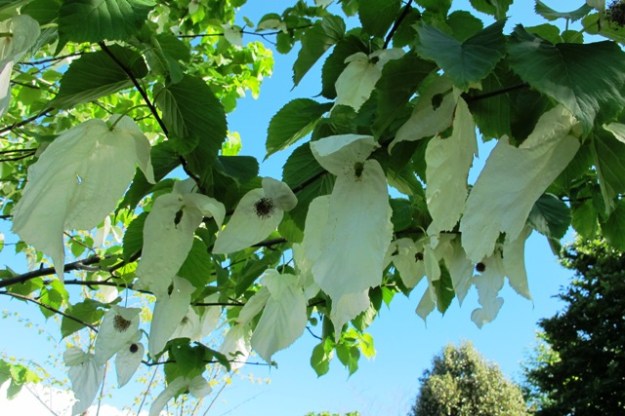
Many readers will know this tree by its common names – variously “Dove Tree”, “Handkerchief Tree” or “Ghost Tree”. I’m going for the handkerchief. In full flower it does look as little as if somebody has pegged white hankies all over it. In fact the showy white bits are not flower petals, they are what are called bracts – specialised leaves which are an adjunct to the flower structure. The actual flower is pretty insignificant. It is the same with bougainvillea where the showy, colourful bits are bracts, not petals.

The davidia is a deciduous tree from central and western China which means it is cold hardy. It is a medium sized tree, upright and conical in habit, reaching maybe 10 metres in height. It needs a bit of age before it reaches flowering size so is not a tree for the impatient gardener. Keep an eye out for damage from cicadas which can weaken branches.

The davidia makes a handsome tree with lovely, light green, pleated leaves – not unlike a tilia or lime tree but more compact in the longer term – with a floral display which is quite remarkable.

First published in the Waikato Times and reprinted here with their permission.
Plant Collector: Doronicum orientale

Doronicum orientale, not as was fixed in my mind, a geronicum

Doronicum orientale, not as was fixed in my mind, a geronicum

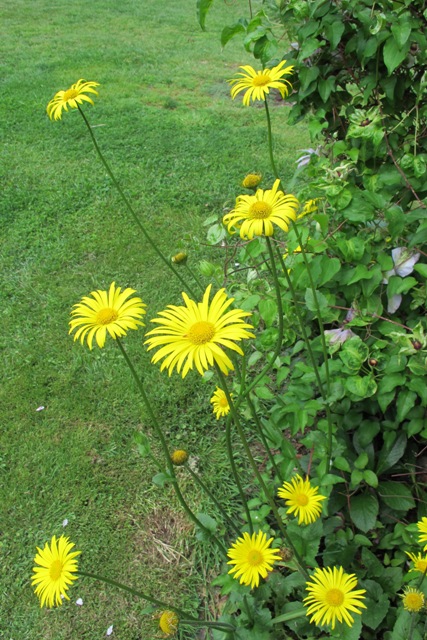
Who knew that the daisy family – or asteraceae – is one of the largest extended plant families in nature? Rivalling even the massive orchid group, in fact, with somewhere over 23 000 different daisy species. But really, it is the apparently simple charm of the daisy form, as with the poppy, that makes many of us smile. The sunny yellow doronicum has been lighting up the garden these past few weeks. To my embarrassment, I thought it was a geronicum but no, somewhere it had bedded into my memory under the wrong name. It is in fact Doronicum orientale, widely referred to in the UK by its common name of leopard’s bane. It is one of the earliest daisies of the season. The almost flat rosette of leaves grow from a small tuber below the ground and the root system is generally small and shallow. The flower stem can push upwards to about 50cm high and sets multiple blooms in succession. When it has finished, it gently fades back down and goes into a state of semi or total dormancy by late summer. This doronicum is native to southern Europe and the Middle East which may explain the timing of its dormancy period.

Botanically speaking, daisy flowers are not so simple after all. What we call petals are often individual ray flowers, with the fertile disk flowers being clustered in the centre (the bit that looks like a pincushion).

???????????????????????????????

First published in the Waikato Times and reprinted here with their permission.
Plant Collector: Kerria japonica “Pleniflora”

Kerria japonica 'Pleniflora'

Kerria japonica ‘Pleniflora’

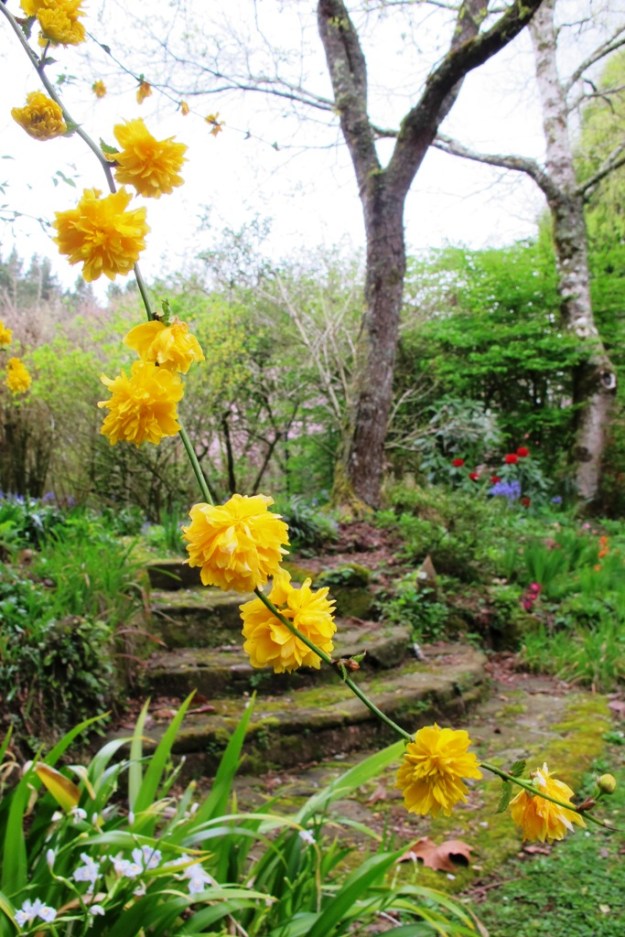
I hadn’t registered the kerria until we went to see the bluebells at Te Popo Gardens and there, lo and behold, it was impossible to ignore. The double form looked somewhat like a bright gold, thornless banksia rose. I wasn’t quite so keen on the single form which is a bit like a giant buttercup flower but others may like the simplicity. On a gloomy early spring morning, the kerria were like rays of gold.

This is a deciduous, clumping Chinese shrub which will spread by putting out suckers. It flowers just at the point when the leaves start to emerge. It is not a plant with strong form or shape, being more a thicket of arching canes. When not flowering, it is one of those anonymous plants that does nothing to attract attention to itself. It benefits from being pruned (thinned, really) once a year because the flowers come on the newest canes. Treat it like a raspberry, in other words.

The real boon is that kerrias are not fussy and they will grow and flower in shade – full shade, even. It is no surprise that the Japanese have always liked them. An arching spray of golden flowers is a wonderful statement of both simplicity and cheer.

First published in the Waikato Times and reprinted here with their permission.

Pink bluebells

Pink Hyacinthoides almost certainly hispanica - I picked them because the light conditions were not good enough for the row  multiplying in the old vegtable garden to be photographed

Pink Hyacinthoides almost certainly hispanica – I picked them because the light conditions were not good enough for the row multiplying in the old vegtable garden to be photographed

“Besides all this and spotted by awful white rocks and holed limestone rocks like a great fungus, there was the pink bluebell glade. Miss Anna Rose often remarked to him upon the prolific beauty of the pink bluebells which some aunt of hers had planted here. And he always refrained from expressing his absolute preference for the blue bluebells. Only the very young prefer pink bluebells to blue. Equally, they prefer pink primroses to yellow.”

Molly Keane Treasure Hunt (1952)

Plant Collector: Magnolia Iolanthe

The inimitable Magnolia Iolanthe

The inimitable Magnolia Iolanthe

I cannot let the season pass without celebrating magnolias. At this time of the year we live and breathe these flowering trees and the settled weather has meant a particularly good season this year. Not all of them get as large as this glorious specimen of ‘Iolanthe’. In this country, it is a lucky tree that is permitted to survive into its sixth decade without being unceremoniously severed from its roots.

Iolanthe was the product of Felix Jury’s first attempts to hybridise magnolias. He was looking for larger blooms with good colour. Certainly the bloom is still exceptional with its large cup and saucer form. The colour has been criticised for its lavender hue, but I can tell you that it remains spectacular. Because it sets flower buds down the stem, it has one of the longest season of any of our many magnolias here. Some only set buds on the tips where they all come out at once. As soon as they pass over – or if they are hit by strong wind, heavy rain or frost – that is it for the year as far as floral display goes. Not so with Iolanthe. Twice we have seen the display turned to mush by extraordinary frost events but a few days later, a fresh flush of blooms has opened and the display is back. From first to last spring bloom, we get about two months of flowering, of which maybe three weeks is full glory. It repeat flowers in summer, though as the tree is then in full leaf, it is nowhere near as showy or prolific – more a bonus than a mainstay.

Iolanthe and Serene are the only plants for which Felix ever received external payment. We recall this because it was in our early married days when we were impoverished students. He gave the fee of a couple of hundred dollars to Mark. It was not the sort of event one ever forgets.
???????????????????????????????
First published in the Waikato Times and reprinted here with their permission.