
- We are starting to dry out already. Keep a close eye on container plants. If they are showing signs of stress, it is likely they are either badly root bound (should have been potted on when we told you in winter), hungry or dried out. To get water back into dehydrated plants, a squirt of dishwashing detergent or surfactant will help absorption. However, ignore any advice given elsewhere to add water holding crystals (also called Crystal Rain) to potting mix for anything other than annuals. In our climate with high rainfall, woody plants and perennials will rot out in winter if you add these crystals, however tempting it may be in summer to use them. Partially burying pots and containers into the garden (called plunging) can reduce excessive drying out. It also stops pots with taller plants from blowing over in the wind.
- It is late in the season for planting out woody trees and shrubs, especially if they are large or root bound. Our advice is to heel them into the vegetable garden until autumn. If you are determined to plant into other garden positions, make sure that the root ball is soaked right through. A watering can just will not do. It can take hours (or leave overnight) to get the water into the middle if it is very dry. Once planted, mulch to conserve moisture and keep an eye on the plant until Christmas at least to ensure that it has not dried out again.
- If you spray for thrips on rhododendrons (the leaf sucking critters which cause silver leaves), get the first application on when you see the insects on the under side of the new growth. We are not keen on this practice and will only spray one or two special plants ourselves. We would be much happier to hear of gardeners opening up around the plant to encourage air movement, feeding and mulching to encourage more health and vigour and taking out plants which are particularly susceptible to replace with healthier selections. We have drawn a line under many of the cold loving German and American hybrids here and said that we just can not grow them well in our mild, coastal conditions.
- It is the optimum time for planting kumara runners. This is one plant which really loves warm, light soils.
- As soon as we get more rain, fungi are likely to attack potatoes and tomatoes. A copper spray applied as soon as the foliage has dried out after rain is usually necessary if you wish to guarantee a harvest later.
- Brassicas will be under siege shortly, if not already, from much of the insect population and in particular the dreaded cabbage white. This is the single biggest reason for not growing brassicas for summer harvest in our climate. If you don’t wish to spray with an insecticide, you have to start getting creative with old net curtains and the likes. However, this only stops the cabbage white laying more eggs and does nothing to deal to existing caterpillars in residence. We will be eating our remaining brassicas soon and not replanting until autumn, with the exception of brussel sprouts which are best sown in the summer for harvest next winter.
- Leeks can be sown now.
Category Archives: Seasonal garden guides
In the Garden 6 November 2009
- There is precisely no gardening going on here this week as we meet and greet visitors – just the daily garden equivalent of housekeeping with the mower, the blower vac, hose, leaf rake and push hoe. It is a good exercise in keeping a garden looking sharp by maintaining freshly mown lawns and defined edges.
- Start deadheading rhododendrons as they finish flowering. Oiling your fingers (olive oil is fine), means you don’t get the sticky residue hanging on. If you only have a few plants, deadheading all of them certainly tidies them up but if you have many, then take the time to work our which ones set seed and give these priority. Try and avoid breaking off the new shoots which are coming through just underneath the spent flower.
- Be vigilant now on weeds. Early season control saves a great deal of work later on. It is warm enough now to push hoe and on a fine day, the sun will dry them to a frazzle. You can only do this if you catch them before they reach seeding stage. If you let them get too large, you really need to cut off and remove the seed heads or you are just spreading the next generation.
- Do not delay on laying garden mulch before summer. It needs to be down before the ground dries out. Laying mulch suppresses many germinating weeds, conserves moisture, improves the look of a garden and if you are using a nutritious mulch (compost) it adds nutrition and structure to the soil. It is a myth that laying pea straw adds nitrogen to the soil because the peas store all the nitrogen in their roots not their tops. If you are worried about your carbon footprint look for local alternatives – we don’t grow peas commercially in Taranaki and your cheap garden mulch is shipped from points quite some distance away.
- Top priority in the vegetable garden is getting the crops in which have the longest growing season – melons, aubergines, tomatoes, cucumbers, gherkins, kumara, Florence fennel and corn. You can continue sowing peas but it might be a little late for getting the Christmas Day harvest through in time unless they are already growing. Keep sowing the salad veg for continued harvest (lettuce, mesclun, radishes, micro greens). You can get sowings of basil and coriander in now from seed. Making pesto at home is so easy that that you will wonder why ever bought it.
- Plant main crop potatoes if you have not yet done so.
- Last year’s notes tell me that we had a triumph eating our first bowl of home grown strawberries at this time. We certainly won’t be achieving that milestone this year. I don’t think there is even a hint of red visible yet. This can be attributed to the use of a cloche last year.
30 October, 2009 In the Garden – including the recipe for preserved lemons as promised in the Taranaki Daily News
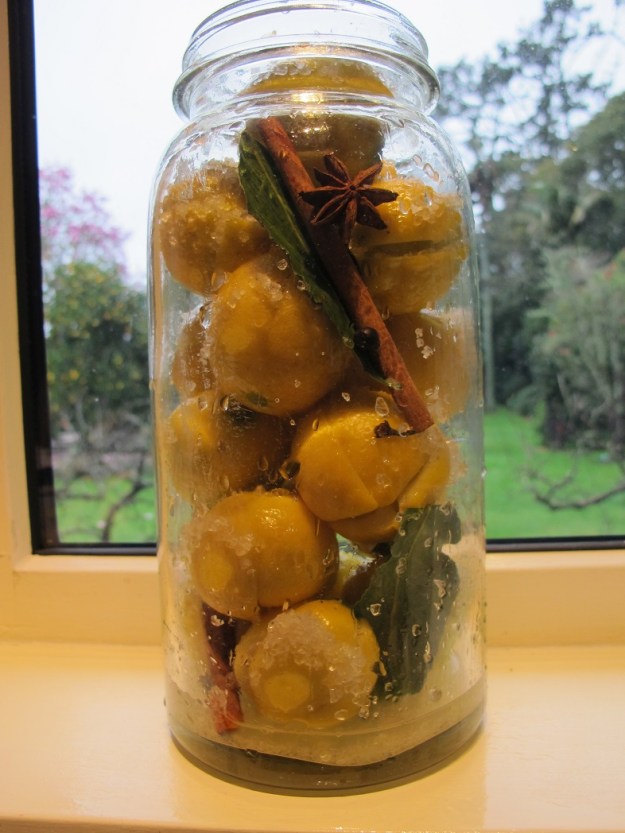
1) If you are into making home grown Christmas presents, I can vouch for the preserved lemons I made last year (except I used limes because they were a better size for the jar). I didn’t think I would use them because we have citrus available here all year, but the preserving intensified the flavour so well that I am finding all manner of uses for them. They would make a decorative festive gift in an attractive jar for very little expense and not a lot of effort.
I used a recipe from Robyn Martin’s delightful book on preserves called Relish :
Preserved Lemons
10 lemons
1 cup coarse sea salt
2 cinnamon sticks
4 bay leaves
10 coriander seeds
10 black peppercorns
1 cup lemon juice
Boiling water
Method: Cut the lemons in quarters to within 2cm of the base. Sprinkle 1 tablespoon of salt over the base of a large jar. Fill each lemon with salt and pack into the jar. When 4 lemons are packed in, place half the herbs and spices in the jar. Top with the remaining salt filled lemons and add the other herbs and spices. Pour the lemon juice over and cover with boiling water.
Seal and store in a cool dark place, shaking the jar daily to distribute the salt and spice flavours. Leave at least three weeks before using and store in the refrigerator after opening. To use, rinse the lemon well in fresh water, discard the pulp and use the skins.
Being paranoid about food safety (my toxicologist father raised us with a healthy fear of botulism), even with all that salt and lemon juice, I kept my jar in the fridge and after close to a year, the flavour is intense and delicious.
I can recommend Robyn Martin’s book for a modern take on all sorts of interesting preserves. It is a New Zealand publication by Chanel and Stylus and the ISBN is 978 0 9582729 5 7
2) This is the busiest week of the year for open gardens in Taranaki. We would encourage everyone to get out and do a spot of visiting. It is really affirming for the garden opener to receive good numbers of visitors and there is also much information sharing that goes on. All garden openers should, by definition, be a welcoming and friendly lot but the camaraderie with other garden visitors may surprise. So, no excuses. If you do not have your own garden open, then make the effort to go and get some ideas and to enjoy looking at other people’s gardens.
3) If you are tempted into buying trees and shrubs now, do not delay on getting them planted. It is not so critical with bulbs and leafy plants (perennials) but woody plants sometimes don’t recover if they get too dry and stressed. Before planting, if you can, plunge the whole plant, pot and all, into a bucket of water and hold it down until the bubbles stop rising. You can leave it overnight in the bucket. This ensures that the rootball does not have dry patches in it. If you are on coastal, sandy soil you are better to heel the plant into well cultivated soil such as the vegetable garden and relocate it to its permanent position next autumn.
4) Mulch. Mulch. Mulch. It has to go on to the garden beds before they dry out over summer if there is to be any benefit. As a general rule, if you are going to add fertiliser to your garden, apply it now and then lay the mulch on top. You don’t have to fertilise everything every year. It is best to do it when a plant starts to look a little hungry or when an area of the garden starts to look little hard done by. If you are managing your garden well, adding fertiliser should be an occasional rather than a regular occurrence.
5) In the vegetable garden, it is a continuation of the great Labour Weekend plant out. Get the kumaras and potatoes in. Start pumpkins –these are so easy to grow from seed that it is almost a crime to buy plants. Make a mound about a metre across and 60cm high comprised of layers of soil and grass. The grass will generate heat as it rots and hurry the pumpkin along. Plant tomatoes, melons, courgettes, cucumbers, gherkins – all the summer veg go in now. Unless you have a massive whanau, you will only need two or three plants of each of them, except maybe the tomatoes where a varied range of different ones is more fun all round. When you have done all that, you can be planting corn, green beans and ensuring a continuation of salad greens.
23 October, 2009 In the Garden This Week
- Every vegetable gardener knows that Labour Weekend is a signal for the great plant out. Sensible gardeners in colder areas will be cautious but in most of coastal Taranaki it is now fine to put in the first sowings of corn and to plant out all the summer veg such as tomatoes, cucumbers, courgettes, aubergines, pumpkin and melons. Main crop potatatoes and kumara can go in, along with peas and carrots. This just may be the biggest weekend of the vegetable year. It is not critical that these vegetables all get planted this weekend but give priority to melons, kumaras and aubergines, if you like them, because they need long growing seasons.
- Thin out earlier sowings of vegetable seed. One lesson we have learned from the micro-veg/mesclun fashion is that all these fresh, young thinnings are delicious in salads and stirfrys.
- We are currently eating our fennel bulbs and yet again we are reminded of just how versatile and easy this vegetable is. Its aniseed taste is very mild when eaten raw (grated in salads or salsas) and all but disappears when roasted or sliced for stir fries. The fennel we are eating at the moment was planted at the end of February this year, but you can sow a crop now.
- A reminder that it pays to keep an eye on self seeded annual flowers and to pull out inferior specimens before they get too far down the track. I particularly dislike the crosses we get between old fashioned blue pansies and yellow pansies – they show as a yukky blue and brown combination with no merit. If you don’t keep an eye on your self seeders, in time they will become dominated by the lowest common denominator. We saw it happen over a period of years in a planting of beautiful electric blue meconopsis poppies in Dunedin Botanic Gardens. With the red form in the same bed, over time they ended up with an awful lot of murky maroon colours and far too few pure blues.
- Daffodil bulbs can be protected from the dreaded narcissi fly by removing foliage and piling on a layer of mulch. The flies lay their eggs in the top collar of the bulb and gain access down the foliage stems. Daffodils need 65 days of growth, which is a very precise figure. If you can recall back that far, as long as your daffodils were in growth by mid July, you can safely remove the foliage now and put them to bed for summer.
- While the Great Vegetable Plant Out takes priority for most people (this is your summer and early autumn harvest you are planting), in the ornamental garden, it is getting perilously close to the last call for planting out woody trees and shrubs and any pruning and shaping. It is also the optimum time for feeding and for getting mulches onto garden beds. No wonder spring is such a busy time in the garden.
- Writing of the Labour Weekend plantout, I relocated Mark, a good North Taranaki boy, to Dunedin for three years in our early life together. Corn is a very marginal crop there because the growing season is too short and he carefully started his corn plants in baby pots and planted them out at Labour Weekend, as one does. It snowed on the Tuesday and his poor little corn plants all died. We moved back north.
October 16, 2009 In the Garden
- In the vegetable garden, the end of October signals the time for the major plant out for summer crops. The soils are warming up by then and for all but the most extreme areas, the threat of a late frost is over. Even minor late frosts can be devastating to plants with tender, young growth. It is not critical that you time it for Labour Weekend – a week or two either side is fine. But if you have your garden all dug and ready and waiting, keep raking it regularly to expose any germinating weeds to the sun and air and to keep it well tilled and fluffed.
- The only reason to raise a vegetable bed any more than about 20cm above the ground is to save your back. As vegetables rarely go much deeper than that, any additional depth is wasted soil which will compact over time. But raising the bed a little does stop you walking on it and compacting it. If you do not have permanent paths to keep you off the soil, you can use wooden boards that you move around. Pavers are also a good option that can look attractive and you can lay yourself at moderate cost.
- Mounding rows of the vegetable beds on an east-west axis has been proven to accelerate growth, particularly when soils are heavy, damp or cold. Mark routinely mounds his vegetable rows here. The east-west axis is to ensure maximum and even exposure to the sun.
- Keep sowing a few lettuce seeds each week to ensure continued supply. One of the skills of good veg gardening is managing successional sowing to keep a range of vegetables available in the garden, rather than feast or famine. A diary is very helpful to record what you have done, as long as you remember to refer to it next year. While it is getting late for main crop onions, those sown now can be harvested as spring onions later.
- In the ornamental garden, give top priority to planting out woody trees and shrubs before we get too warm and dry, pruning evergreens, dividing perennials and feeding anything that looks needy. Time is fast running out for all these tasks. It is already too late for moving trees and shrubs. Wait until autumn to carry out further relocations.
- If you are currently enjoying clivias, especially the highly desirable lemon or even peach toned varieties, you can increase the chances of your plant producing good seed by hand pollinating. This involves transferring the pollen from one plant to the anthers of another plant. Usually a paint brush is used to carry out this process. If you carried out this operation as we advised last year, the seed is probably still on the plant and it is fine to collect and sow it now.
- Lawns are currently showing their weaknesses including major weed infestations. You can green up sad, yellow or starved looking lawns with fertiliser (the locally produced Bioboost can be spread any time without risk of burning dry lawns). Keep shunning hormone sprays for a few weeks longer to avoid any risk to surrounding plants coming into growth. While we normally advocate cutting lawns reasonably long (leave at least 2.5cm in length), scalping a lawn at this time can deal death to some of the seasonal weeds. The one weed we think you can justify spraying is the highly undesirable and prickly Onehunga weed. Seek advice from your local garden centre as to what is currently recommended to deal to this menace to bare feet. If you have children in your life, you will need to take action on this one.
 Tikorangi The Jury Garden