Category Archives: Tikorangi notes

Tikorangi notes: May 6, 2010

Latest posts:

1) Dear oh dear, Penguin Books (NZ). Did nobody even bother to double check the content of the new Tui New Zealand Fruit Garden book released this week? Not only are there rather too many errors, but there seems to be a certain amount of what might be called plagiarism going on – a bit too much cutting and pasting from easily traced overseas websites (even Wikipedia – who cuts and pastes from Wikipedia for a book?) and none of it seems to be attributed.

2) A woodland plant supreme – now Farfugium japonicum argenteum but still often referred to as a ligularia.

3) Autumn is well and truly here and we advise taking full advantage of the continuing fine, calm and dry weather – garden tasks for this week.

Some fruits of a Tikorangi autumn

It is feijoa season here. This is a fruit from South America which we have almost made our own in mild areas of New Zealand. The plant grows to a large evergreen shrub which is amazingly forgiving, tolerating even salt winds so it is sometimes used as hedging. Good forms will fruit prolifically. When our children were little, we had a row of four old plants along a roadside boundary and they would routinely head outside with a teaspoon to sit under the trees and eat their fill. Now that they have all left home and live in places where the humble feijoa is virtually unknown, they get very nostalgic when I tell them the fruit is falling. For those who have never encountered a feijoa (and they don’t transport well so while they are sold dirt cheap in fruiterers and on roadside stalls locally, they are not generally shipped elsewhere), the common method of eating them is either to scoop out the centre with a teaspoon or to peel it and eat the whole centre. There are no bothersome pips or stones.
And just to show how mild we are, the physalis (referred to here as Cape Gooseberries even though they too are South American) seed down and pop up around the place and we even grow macadamia nuts successfully. We are right on the margins of suitability for growing macadamia trees and we get occasional years when fruit set is aborted, but in the main they crop consistently for us. It is just a shame they are so difficult to get out of their shells because they are a Rolls Royce nut of choice.
Tikorangi notes: April 30, 2010

Latest posts.
1) The flower may look like a white camellia on steroids, but it is in fact Gordonia yunnanensis opening its first flowers now.
2) Lifting and dividing smaller growing perennials is straightforward, but sometimes it can be a bit daunting to know how to tackle huge and tough clumps of large growing plants such as our native flax (phormium) or astelia. We show how in the latest Outdoor Classroom.
3) Despite dry conditions throughout much of the country (and a downpour on Tuesday hardly penetrated the ground at all though it swirled all the mulch and leaf litter around) autumn can be a highly productive time in the garden – our recommended garden tasks for the week.

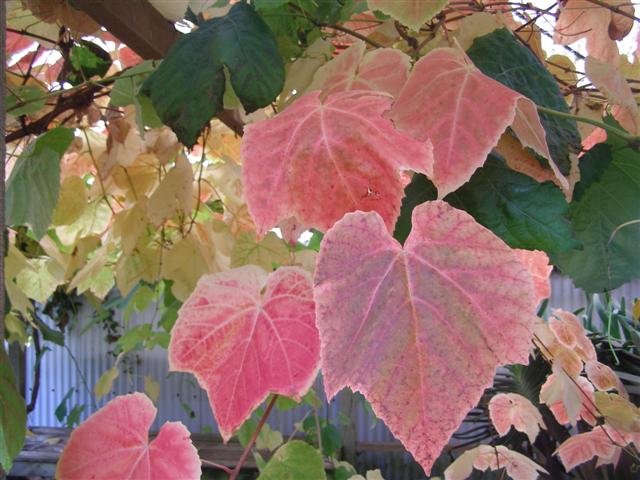
Grateful for the autumn colour of the humble grapevine

Autumn continues to be unusually dry and calm but as a rule, we don’t do good autumn colour on the coast. We drift so slowly from waning summer into autumn and winter that there is not sufficient temperature change to signal plants to change colour. Added to that, New Zealand gardens use so much evergreen material (and all this country’s native plants are evergreen) that the blaze of autumn colour common to countries with deciduous forests is largely missing. But the grapevines do colour and this one, a fruiting grape, has particularly ornamental foliage.

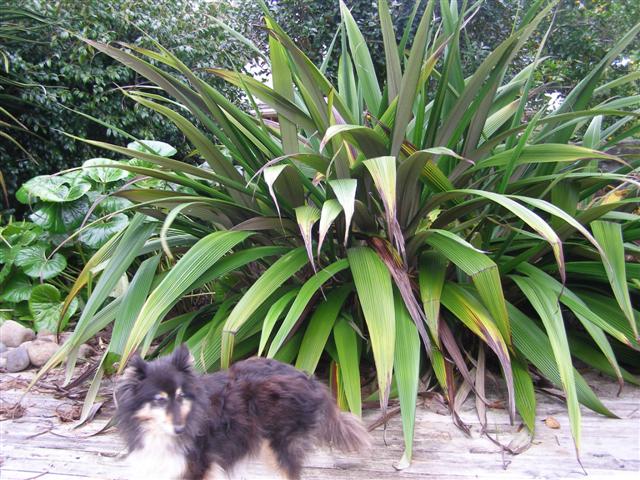
Curculigo recurvata is not common here and needs s p a c e


In an area where the giant gunneras – both manicata and tinctoria – are on the banned list and recommended for total eradication (they have naturalised too readily even on cliff tops and are swamping out native flora), the Curculigo recurvata in our swimming pool garden has been doing its best to emulate the proportions of the gunnera, reaching several metres across and staging a takeover bid. It is a most handsome plant with its pleated leaves, completely evergreen, but we had to reduce the clump back or we would have no decking left.

Tikorangi notes: April 23, 2010

Latest posts.
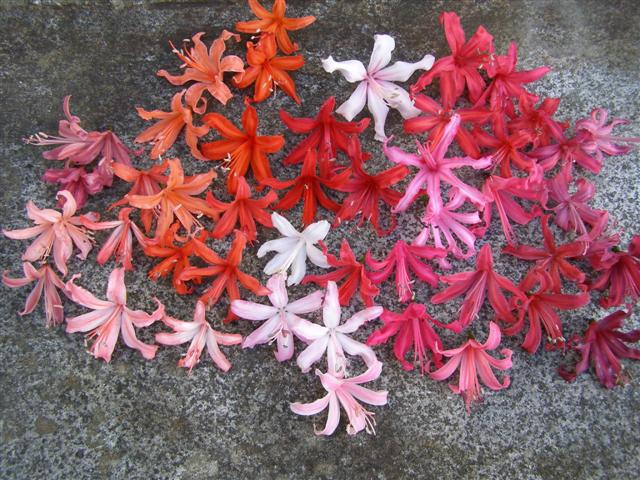
1) Nerines, mostly sarniensis hybrids, are a mainstay of our autumn rockery.
2) Instead of thinking buxus hedges, think instead about lines and definition in the garden. There are other ways to achieve a similar outcome without the blighted buxus hedge – Abbie’s column.
3) Our mild and dry autumn continues – weekly garden tasks and hints.
4) It may be six months until our annual Garden and Rhododendron Festival here in Taranaki, but dedicated garden openers are hard at work and counting down already.

Autumn in the rockery at Tikorangi

Our rockery has two main periods when it is at its fullest and most colourful – in the early spring when dwarf daffodils, snowdrops and many other tiny treasures bloom and right now in autumn when the nerines and cyclamen hederafolium are at their best. My summer mission taking apart every pocket in the rockery has borne fruit with renewed vigour apparent throughout. Some may think the nerines on the garish side but we love their autumn display. We have a whole range of colours now from nearly apricot through coral, orange, reds, pastel pinks to highlighter pink and deeper, smoky colours bordering on purple. Felix Jury worked with the nerines, mainly sarniensis hybrids and he acquired some of the Exbury hybids over 40 years ago. Most of the cultivars in our garden are unnamed hybrids from that time although Mark has also had a play in his turn and did name one, Coral Star, which we have sold in the past. Felix’s preference leaned towards the smoky plum colours and he named two: Smoky Queen and Nelson’s Blood.

From near apricot to near purple with plenty of oranges, reds and pinks between

Tikorangi notes: April 16, 2010

Latest posts:
1) April 16, 2010 There are times we have regretted letting our purple bougainvillea reach its natural massive proportions but it is a splendid sight in flower.
2) April 16, 2010 There are no like for like replacements for the ever handy (if a little dull and clichéd) buxus hedge.3) April 16, 2010 Making the most of mild autumn conditions in the garden – what to do in the Taranaki garden this week.

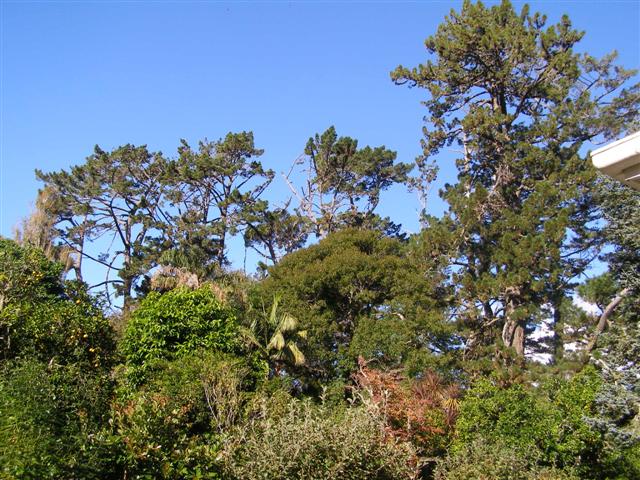
Our venerable old man pines against the blue sky of autumn

The common reaction from New Zealanders to our massive, but elderly pine trees is that we should be taking them out immediately because they are dangerous but we are fond of their scruffy majesty on our south eastern skyline. Planted in a double row around 1880 by Mark’s great grandfather, they were originally a shelter belt and will rank amongst the oldest specimens in the country. Californians are often impressed because these Monterey pines tower around 50 metres or over 150 feet high which we are told is unusual for their homeland on the Monterey Peninsula.

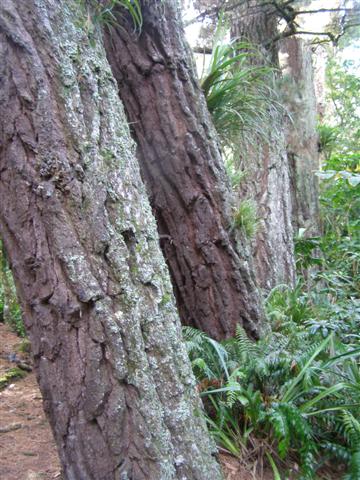
Our Monterey pines - not all are exactly at right angles to the ground

But to New Zealanders, they are just crusty old Pinus radiata, a cultivar the timber industry has made our own as a very quick turn around, low grade timber crop covering vast acreages.

Occasionally we lose a pine tree – running about once every fifteen years at the moment – and the last one dropped itself in the one clear space that we would have chosen had we deliberately felled it, doing minimal damage as it crashed down but gouging out a 30cm deep indentation on the ground. Because they started life as a shelter belt and are planted in more or less straight rows, they now give us a woodland avenue below to grow frost tender material such as vireya rhododendrons, cymbidium orchids, monstera delicosa and a range of woodland bulbs. Such is their location, they would have to removed by logging helicopter but we are happy to live with them as a characterful backdrop.

Tikorangi notes: Thursday 15 April, 2010

R.I.P. Buffy –
Farewell to a feisty character.

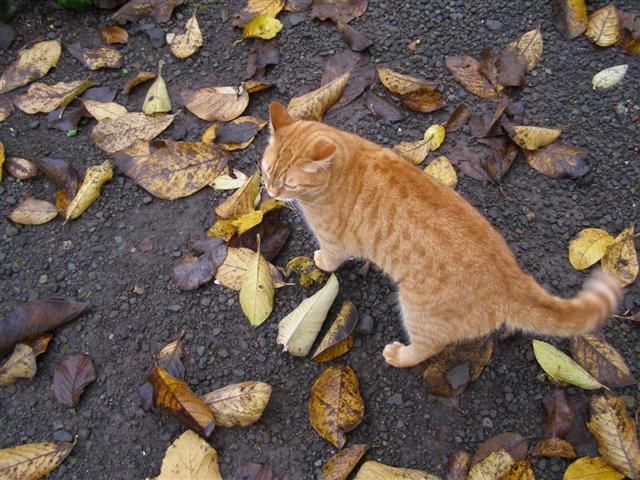
The end of a chapter. Buffy the cat, a part of our lives for over 10 years, is no more.

The end of a chapter. Buffy the cat, a part of our lives for over 10 years, is no more.