
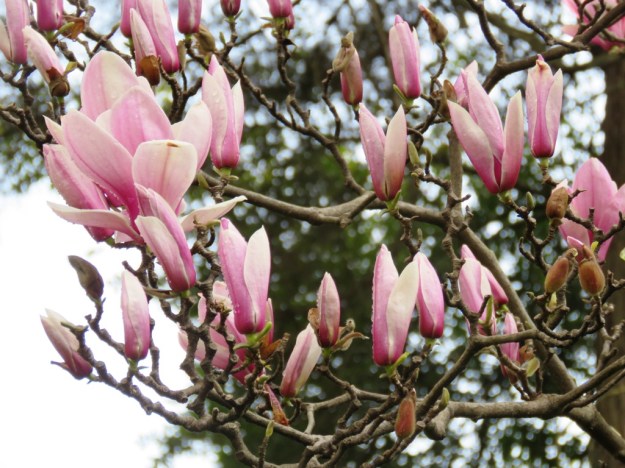
No yellow denudata image – just soulangeanas at Kunming Botanic Gardens
I missed photographing the most interesting magnolia we saw on our recent trip to China. It looked to be a roadside amenity planting of the yellow form of Magnolia denudata. Or it may have been one of the many big tree nurseries we saw. Because we were in a moving entourage of coaches, we couldn’t stop. I can’t think why it never occurred to us to hop into a taxi and return to the site. It is not as if taxis are expensive in China.
As far as we know, the yellow form of denudata is not in New Zealand, though it would be legal to bring it in because the species is already here. We first heard about it – but did not see it – in Italy about 10 years ago but we didn’t get too excited because we figured it was probably more cream than yellow. I think I did a search on it at the time and found Magnolia denudata ‘Fei Huang’ or ‘Yellow River’ widely available in Europe with assorted photos showing colour from cream through to bright yellow, but the authoritative sources leaned to describing it as cream with pale yellow tint at best. So we were taken aback by the trees we saw in bloom in China which were indubitably yellow and with a different flower form to the American yellows bred from M. acuminata. We kept enquiring about it as we passed through other areas, but failed to find out more information. It may have been a particularly good form that we were looking at. I just mention this in case anybody happens to be driving along the access road to Longxiadeng Village, which I am pretty sure is where we saw it.
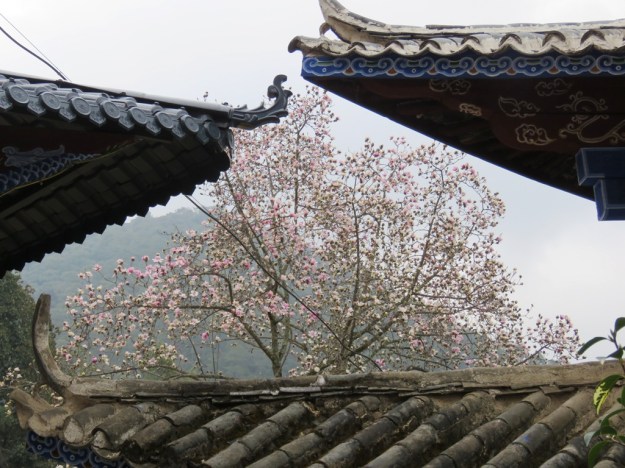
Magnolia campellii at Mount Baotai
We were of course focussed on camellias for this trip. It was the International Camellia Congress after all, but we had hoped to catch some glimpses of magnolias along the way. The M. campbelli at the Forest Administration Station on Baotai Mount was in full bloom but not the best form we have seen of this species.
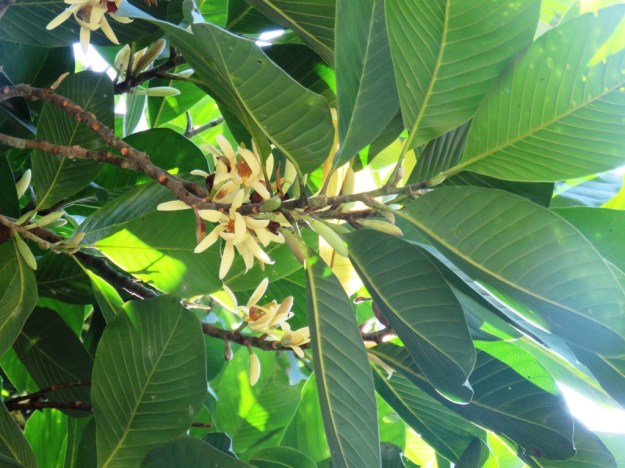
Tropical Magnolia balansae
Because we were not there to look at magnolias, Mark took solace in the sight of a solitary tropical specimen at the botanical garden in Xishuangbanna. Magnolia balansae (formerly a michelia) is not one we know at all but there are many tropical species that we don’t have in this country and which are therefore of curiosity value only. It was very handsome, was M. balansae, but large. With small flowers.

Professor Sun Weibang, Tony Barnes and moi at Kunming
 I was honoured to be taken to meet Professor Sun Weibang at the Kunming Institute of Botany. Alas Mark was back in the hotel room, dying of the plague (a bad bout of the flu, to be accurate) so I was painfully aware that I was deputising for him at that meeting with a world expert on magnolia. We bonded over the magnificent book, Magnolias in Art and Cultivation, discovering a mutual friendship with one of the authors. There are several pages devoted to the Jury hybrids.
The most interesting aspect of my conversation with Professor Sun was his explanation that their focus had moved away from hybridising to conservation. This was demonstrated clearly when I subsequently came across the huge specimen of Magnolia sinica (formerly known as a manglietia). It was surrounded by scaffolding which is there to enable the systematic collection of seed. For this is one of the most endangered magnolia species in the world. There are only somewhere between 10 and 22 plants known in the wild and there is a concerted effort to build stocks for replanting.
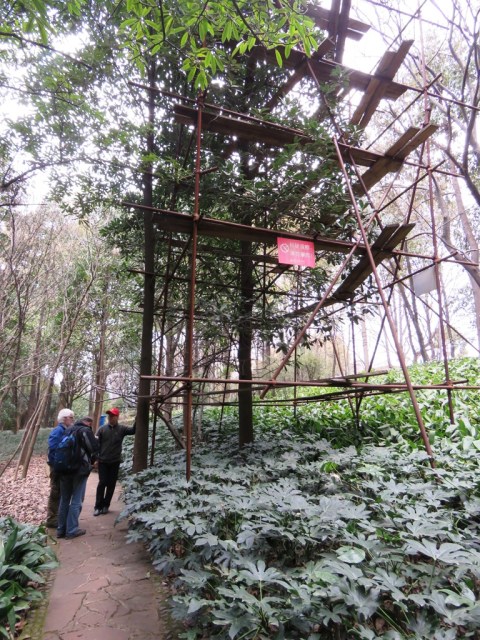
Magnolia sinica
The conservation of indigenous plants was a theme that came through repeatedly on this trip to China. We were not in a position to work out whether the efforts in the field match the official talk, but there is certainly a high level of awareness and public funding being made available for this officially sanctioned priority. It made us think about the quaintly imperialist attitude that sees some in the West thinking that we can preserve the world’s flora. Unless it is a massive project such as the international seed bank at Kew, I think we may over-rate our efforts. There are times we wonder whether the ratepayers of Taranaki realise they are paying to conserve rhododendrons while some of our native flora is under extreme threat. And, frankly, one of this plant here and one of that plant there is not a significant effort in preserving another country’s native flora. This is not to deride the importance of maintaining genetic diversity but the maintenance of indigenous species is surely best supported in their country of origin, where possible.
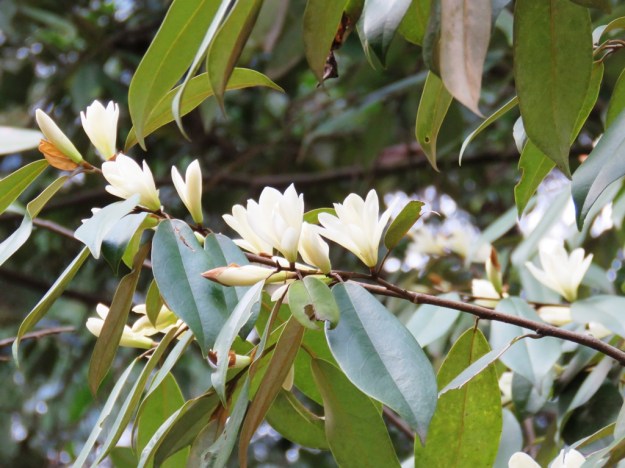
Random michelia at Kunming. Not, as suggested, M. laevifolia, I think.




 Finally a few snippets: If there is one thing I absolutely loathe on purchased fruit, it is the sticky little labels which do not even break down in the compost. I often peel them off in the shop and leave them behind. These apples solved the problems of labels but we have no idea how imprinting the branding on the skins is achieved.
 I do not know if children’s Saturday sports matches continue to serve up segments of orange as half time refreshments (this may be a tradition that has died out at Saturday netball, rugby and hockey), but if they do, I feel that we could practice more class in the presentation….
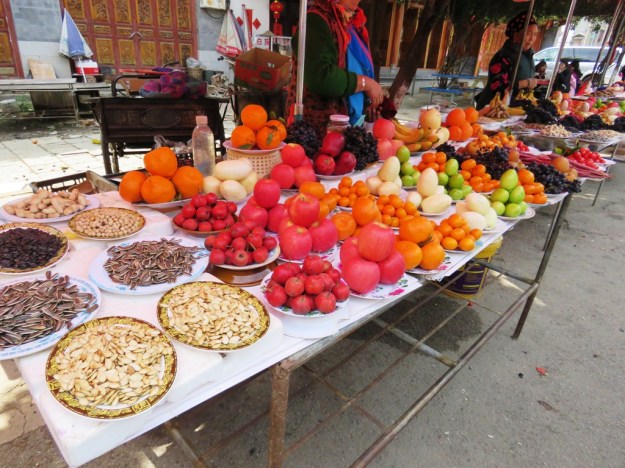 Similarly, the displays of fresh produce in New Zealand can leave a lot to be desired when compared to the care taken with the street stalls that lined a road near Dali.
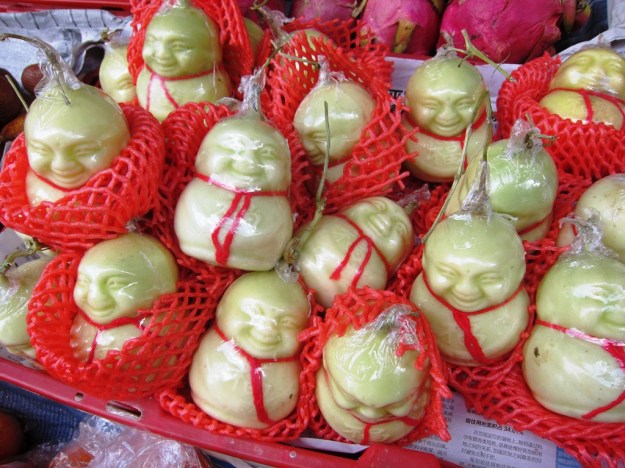 Buddha fruit! Not carved. Grown in plastic moulds, the ever-useful internet tells me. There is a labour intensive way of growing a novelty crop. These may be pears. If your curiosity is whetted, there are many
 Some things are not what they appear. This is not a dead leaf. It is in fact a butterfly – quite possibly Kallima inachus, also referred to as the orange oakleaf or dead leaf butterfly. We saw butterfly houses at both the Butterfly Spring in Dali and again in Xishuangbanna, though it was a cool spring so we didn’t see any in the wild.
 I had thought that the advertisement on NZ television that features what appear to be blue as blue monarch butterflies might have undergone some computer intervention to change the colour, but no – they do exist. Though my perfunctory net search does not suggest they belong to the monarch family.
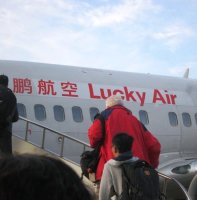 As we flew into Xishuangbanna (on Lucky Air – not entirely sure of that branding), I wondered about the huge plantations visible from the air. Something twiggy. Rubber trees! I had not realised they were deciduous. I have always associated commercial rubber production with Malaya but maybe modern Malaysia has found palm oil more lucrative, leaving a substantial gap in the market for entrepreneurial Chinese. In fact the most common tree used for rubber, Hevea brasiliensis, originates from South America around the Amazon.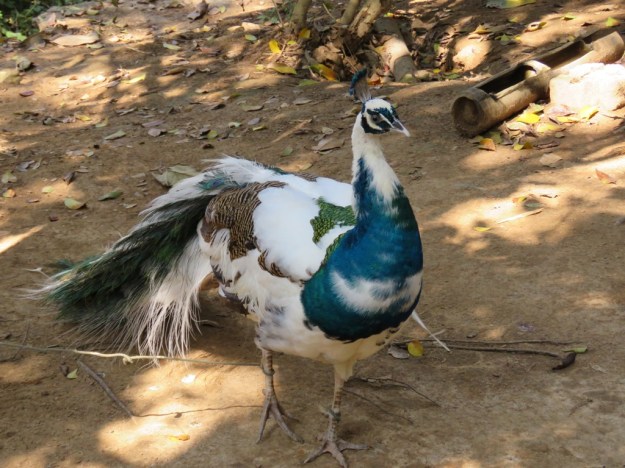
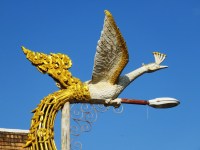 Jinghong is branded as the peacock city – even to light fittings in one area. In the tour of “primitive forest” (I was not entirely sure how primitive it was now that it has been adapted to accommodate tens, nay hundreds of thousands of visitors) there were tethered peacocks. What happens when you cross a pure white with a traditional blue? Why, this interesting combination.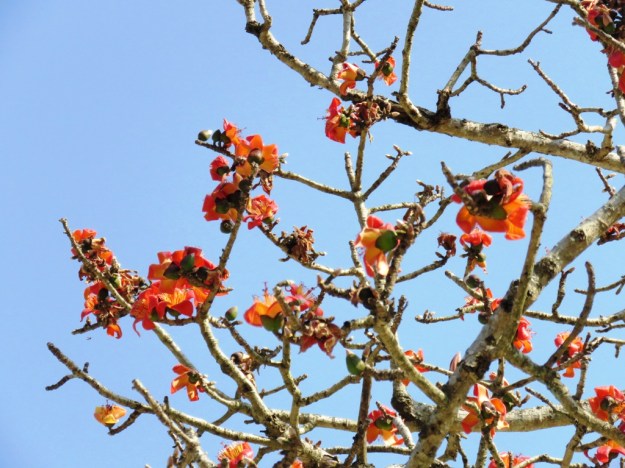
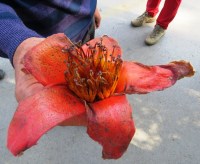 Kapok flowers. Some of us are old enough to remember the days of kapok mattresses and pillows but I doubt that many of us knew that they were stuffed with the fluff from the seed pods of the kapok tree, Ceiba pentandra. However that species has flowers that are considerably less spectacular than the ornamental kapoks. We had seen kapoks used as street plantings in Hue in Vietnam some years ago but they were not in flower.
 Tikorangi The Jury Garden