The Avocado Thief

Avocado tree

Avocado tree

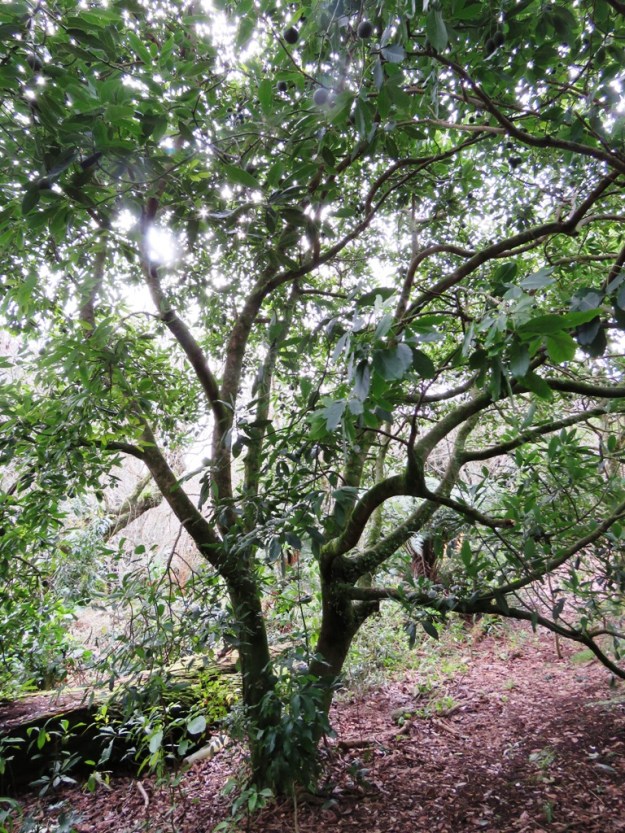
023 - CopyBehold an avocado tree. A tree, I admit, that demonstrates a case of allowing a twin trunk to develop though I am told that is permitted with avocados. It is a tree which has had the best ever crop of Hass avocados this year. It has truly been a mast year. We are a bit marginal when it comes to avocados and they tend to crop biennially. There is no crop next year so we are making hay (or guacamole, to be precise) while the winter sun shines.
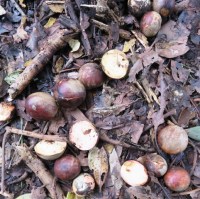
 

Exhibit A

Exhibit A

Exhibit A is the pile of avocado pits around the place. These tell us that we are not alone in harvesting the crop. In fact given the predations of waxeyes, starlings, blackbirds, rats and possums, it is a miracle that we still collect fruit by the bucket load. Possums are a major pest in this country and Mark and the dogs do a round each evening checking for them. Mark conducts an autopsy on the stomach contents of each possum he shoots – mostly to check who is eating the buds of the magnolia trees at this time of the year – and noted last week that one appeared to be full of guacamole.
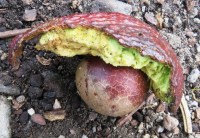
Exhibit B

Exhibit B

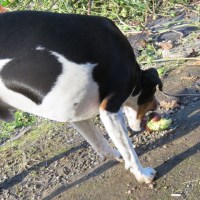
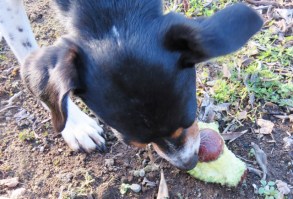
But exhibit B fingered another avocado thief. None of the aforementioned raiders stashes partially eaten fruit all round the place. We had noticed that new dog Dudley was looking particularly glossy and plump. The natural avocado oils are clearly kind to his fur. Mark has taken to doing a circuit twice a day to pick up whole fruit that has fallen in an attempt to beat Dudley to the draw but any time the dog disappears from view, it is a fair bet that he can be found near the avocado tree.
005 - Copy009 - Copy


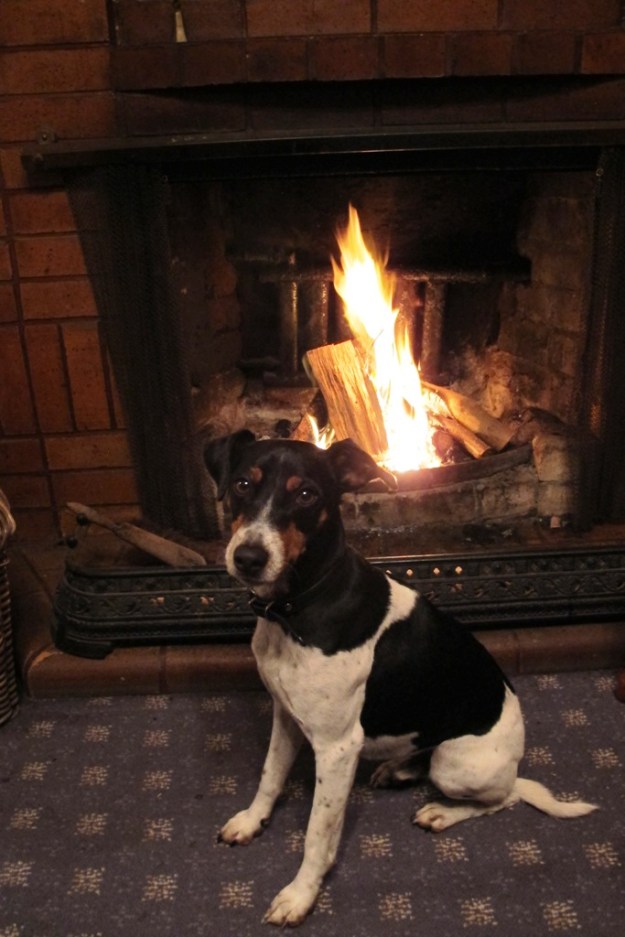
Dudley is a four year old fox terrier, surrendered by his previous owner to the SPCA for re-homing. He came to us in January – clearly a well-loved townie dog used to being fed tidbits any time his previous owner was eating, allowed on any furniture and accustomed to sleeping in his owner’s bed. He was a little timid at the space here and confused by the changes in rules. But now he has taken on the role of estate dog as though he were to the manner born. He is a whizz on rats, a keen possum dog, happy to assist with moving the four beefies that comprise Mark’s little cattle herd, patrols the boundary to ensure that Sam the neighbour’s dog does not make incursions and  he is more than happy to deal to the perceived surplus of avocados.
 

To the manner born

To the manner born

“The Holy Grail of horticulture”

Daphne Perfume Princess

Daphne Perfume Princess

As a people, we New Zealanders tend to be a little more reserved than our Australian neighbours across the Tasman. So I post this link to their prime time Channel 9 last night with a slight sense of unseemly boasting. But to have somebody of the stature of Don Burke declaring Mark’s Daphne Perfume Princess to be the Holy Grail of horticulture and the best new plant to be released in Australia in the last 50 years is high praise indeed.

We knew the story was going to air. We had been sent photos – Don donning a knight’s costume in a theatrical take on the search for the Holy Grail. Indeed, we had raised our eyebrows at Channel 9 wardrobe department’s selection of a knight’s costume owing to the fact that we think it was King Arthur and the Knights of the Round Table who were in search of the Holy Grail, not so much the Templar Knights of the Christian crusades…. But no matter, Don carried it off with panache.

Mark’s comment is that the ultimate challenge for a plant breeder is to take a really well known, common plant and to make it better. We hope he has achieved this with Daphne Perfume Princess. Others certainly think so.

Farewell to a friend

Ever curious, Charles headed cross country at A Place for Plants

Ever curious, Charles headed cross country at A Place for Plants

A year and a week ago we were touring summer gardens in England. We started in Suffolk again because that is where Charles and Gill Notcutt live. Today we heard that Charles has died.

On that last trip, Charles met us at Beth Chatto’s garden for lunch. While he was much more a tree man than a flower and garden man, I still recall his great pleasure at the delight and inspiration Mark and I felt in the dry garden there. He then said “follow me” and drove off in his Audi while we climbed into our very modest little rental car. What followed was an alarming pursuit through the back roads of Suffolk as we tried to keep Charles’ car in view because we had no idea where we were going. It was to Rupert and Sara Eley’s “A Place for Plants”. From there we went to Charles and Gill’s home where they hosted a dinner party in our honour.

This Suffolk pub, and I could find its name if I needed to, served the best ever hit chips with lunch

This Suffolk pub, and I could find its name if I needed to, served the best ever hot chips with lunch

The next day he took us to Blooms of Bressingham, we had lunch at a Suffolk pub which served the best hot chips Mark and I had ever eaten (nobody, we discovered, can do chips as well as some English pubs) and then went on to The Old Vicarage Garden in Norfolk. The next morning we said goodbye and headed north to Yorkshire.

These are such lovely memories to have and even at the time, we knew it may be the last time we would see Charles. Others will record his contribution to British horticulture through Notcutts’ nurseries and garden centres and various trade and professional bodies. It was how we first met him in the early nineties. He was also extremely active in contributing to his local community of Woodbridge, even serving as mayor in recent times.

It is Charles the man that we remember. He had an exceptional zest for life, such wide ranging interests – a modern Renaissance Man – underpinned by great kindness. We held him in the highest regard and felt privileged to have him as a friend in our lives.

RIP Charles. Our lives were made richer for having known you.
184

Plant Collector: Chamaedorea woodsoniana

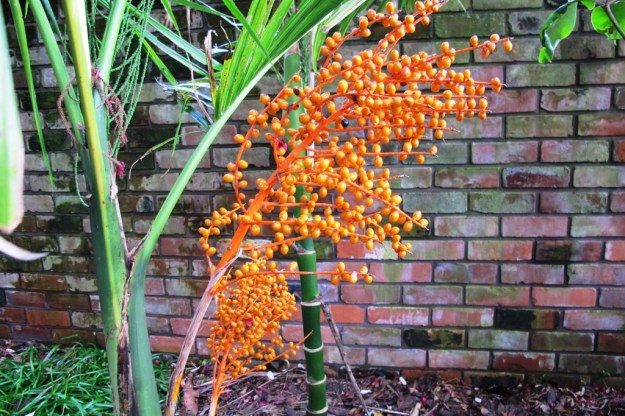
Attractive fruit but a worryingly large amount of it on the Chamaedorea woodsoniana

Attractive fruit but a worryingly large amount of it on the Chamaedorea woodsoniana

“Look at this,” said Mark putting the seed upon the table. “Off a small palm. It’s either the next invasive weed here or it has a future as a substitute in the palm oil industry.”

It took us a little while to track down the name. We knew it was a chamaedorea but there are quite a few different species so we had to go back to the original purchase to get the C. woodsoniana bit. Like most of the family, it hails from Mexico and Central America, growing in montane rainforest which is why we can grow it here. We can do the rain and the montane reference means it comes from areas with some altitude, making it a little bit hardier. However, given that its climate zone range is 10 to 11 (meaning that if the temperature plummets to around zero fahrenheit, it is not going to thrive – or even survive) and we have been moaning all week about the bitter chill of mid winter, we must be close to the limits of its tolerance. We have it planted on the margins of evergreen woodland so it will be protected from the worst of the cold. In its natural habitat, the palm encyclopaedia tells me it can reach 40 feet (about 12 metres) but we think that is extremely unlikely here. Ours is currently sitting around 2 metres and it is not growing like a rocket.

Mark tries to take the fruiting seeds off the bangalow palms here, to restrict their spread. He is now wondering if he is going to have to do it to this pretty chamaedorea too.

Chamaedorea woodsoniana growing in a protected position in our temperate climate

Chamaedorea woodsoniana growing in a protected position in our temperate climate

Garden Lore: “Touch the earth lightly”

“Touch the earth lightly, Use the earth gently
Nourish the life of the world in our care
Gift of great wonder, ours to surrender
Trust for the children tomorrow will bear.”

Verse 1 from the hymn “Touch the Earth Lightly” by Colin Gibson and Shirley Erena Murray (1991).
Photo0084 - Copy
Photo0072 - CopyReally it is the first line I like – “touch the earth lightly, use the earth gently” but I added the rest of the verse to give it context.

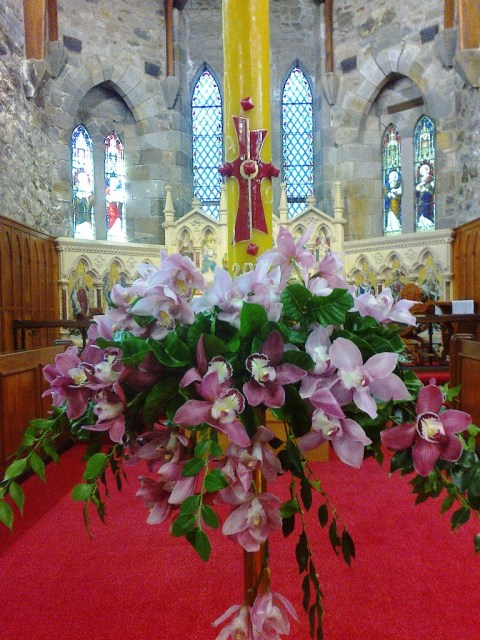
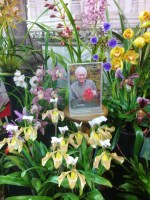
We went to a funeral this week which we do not often do, I admit. But in this case we both wanted to honour the late George Fuller. George was probably best known in this area as long standing curator of our main central city gardens, Pukekura Park, and as a defender of trees. In this role, he was more successful than we have been recently. His personal passion and his international reputation was in the field of orchids – hence the orchid display at his funeral.

To die at the age of 86, surrounded by a large, loving family and to leave behind a worthwhile legacy is to be celebrated. The selection of the hymn seemed particularly apt for such a gentle, humble man.

What a wonderful epitaph, or indeed a principle to live by – touch the earth lightly, use the earth gently.