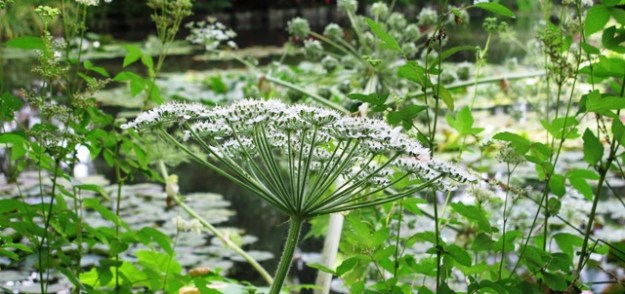
 My first encounter with a garden strongly promoted for its romanticism was in northern Italy – Villa San Remigio. If you have ever been to the Italian lakes district, you will nod in agreement when I say that the whole place seems impossibly romantic. Stresa, Mennagio, Bellagio (the Lake Como one, not the Las Vegas one) – in the right circumstances these are places of charm bordering on enchantment.
Villa San Remigio had a wildly romantic back story – the love affair between a Neapolitan poet and musician and an Irish artist. If my memory serves me right, there was some sadness, earlyish deaths and childlessness. It had the mandatory handsome villa and a particularly lovely old church along with beautiful views across Lake Maggiore. But were the gardens romantic? It was all gentle decay when we were there, especially of the old concrete (and there was a lot of old concrete in larger than lifesize shrine-like constructions and terraces) and whoever managed the place was hoping to get grants for a major restoration. It may have been done by now but competition for restoration money is stiff in a country with such a long history and so many things in need of major investment.
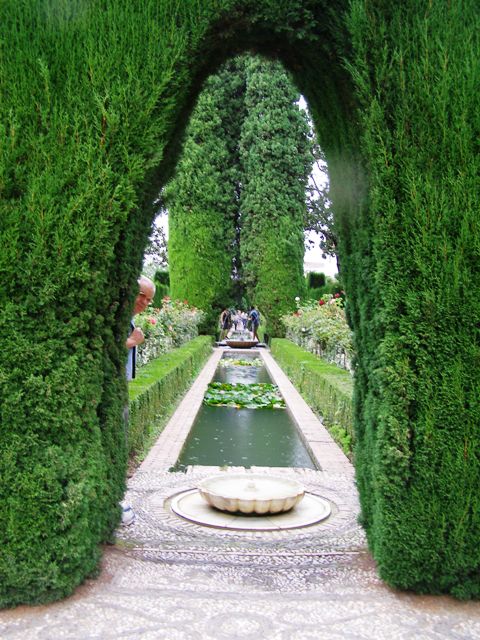
The gardens at the Alhambra are re-creations. Note the gentlemen on the left, politely trying not to intrude on my photo.
I searched on line and found an article in the UK Telegraph, listing their pick of the ten most romantic gardens. Villa San Remigio wasn’t on it, but the Alhambra in Grenada, Spain and Monet’s water lily garden in France were and I have been to both of those. The Alhambra is an amazing place but the gardens are a modern re-creation. It is the whole package there that makes the romance – the history, the beautiful palaces which are on quite an intimate scale, the light, the view across to the Albaicin (or medina)…. The garden enhances but does not generate the romance. The most recent. modernistic gardens at the Alhambra were anything but romantic.
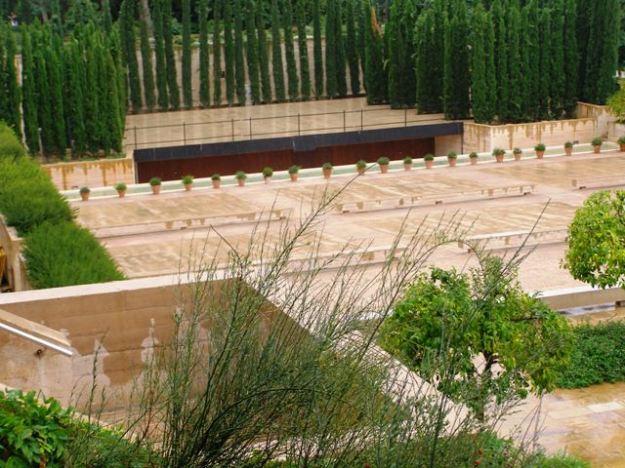
There is nothing romantic at all about the latest, hard-edged modern garden addition at the Alhambra.
Monet immortalised his garden in so many paintings which imbues the place with added mystique. An analysis of the garden itself rather belies that. However the water lily garden is loosely maintained and in a naturalistic style which contrasts with his more rigid stripes in the upper garden.

Monet’s waterlily garden is charming enough, as long as you don’t mind sharing it with many strangers.
What these gardens have in common is a rich history, age and gentle decay, some solid architecture of note and romantic back stories. The gardens do not necessarily stand on their own merits. And let’s face it, in this country we lack most of the above although some of us can manage some gentle decay. But age is measured here in decades, not centuries.
These gardens – and most of the ones on the Telegraph list – are all well out of private ownership now but the love of romantic gardening dates back to the original visions of private owners, albeit generally ones with considerable personal wealth to achieve their dreams. These days the romance is a product of sophisticated marketing. I am yet to be convinced that an institution or business ownership model is capable of generating a romantic garden.
But private individuals can and do. I would disagree with the Telegraph’s list but that is because I am interested in the modern return to romantic gardening – what is being done here and now, not what was done last century or the centuries before.
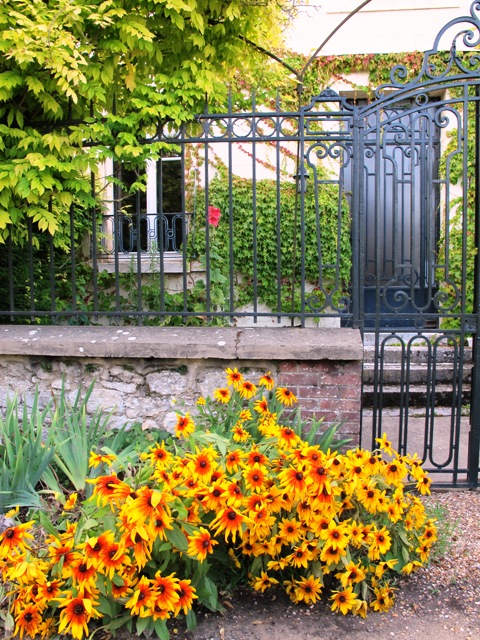
The soft-edged naturalism, helped by French village style, showed romantic gardening at a very domestic level.
We spent a couple of nights in the village of Giverny where Monet’s garden is located. I am quite willing to admit that our delight in the charm of the village may have been influenced by the departure of the daytime crowds, the soft evening light and the consumption of the fermented fruit of the French vine, but we found ourselves more engaged with the village scenes than we were with the star attraction. This was romanticism on a very personal, domestic level. The soft-edged naturalism, often with charming detail, has nothing to do with great wealth, grand vision and power. It is equally within the reach of the individual.
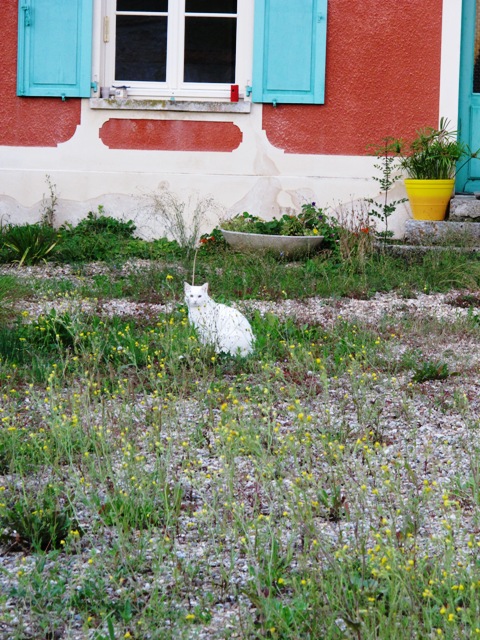
In the village of Giverny, even le chat français and le yellow plastic pot had a certain romantic charm in the evening light.
The Romantic Garden Part 1
First published in the Waikato Times and reprinted here with their permission.

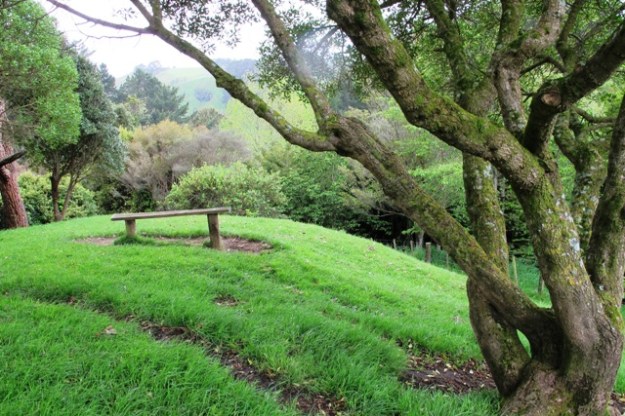 1. Sometimes it is the setting, not the seating which is the important feature. A simple bench is all that is needed to draw attention to the beautiful long vista, inviting you to take the time to sit and look. You need tanalised timber of course and farm posts are the most practical option. Make the bench long enough to hold two people and their coffee mugs without having to be too close, but not so long that it sags if somebody sits in the middle. This lovely scene is at Puketarata Garden near Hawera.
 2. How could I not include this example from Wairere Garden in Gordonton? Obviously there are a few practical issues when it comes to sitting on this hand crafted bench which looks as if it has been made from old fence battens. With that length it would only be suitable for a single person or two young lovers. I really liked the sense of enclosure with it being placed inside a curved hedge and the contrast between the lichen-encrusted, rough simplicity and the clipped formality behind.
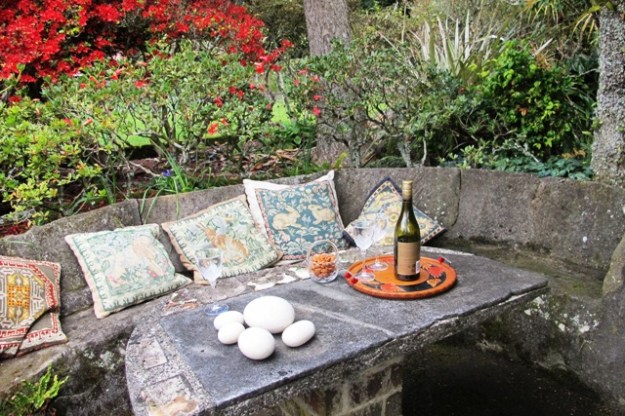 3. This is one of our own favoured seating areas, especially in summer when there is dappled light through the trees above. It is comfortable enough even without the tapestry cushions made by my late mother. The curved bench seat is stone, the table concrete on a brick plinth. I am guessing it was Mark’s mother who inset the vintage tiles around the edge of the table to add detail although few remain now. It does not always come equipped with the bottle of wine.
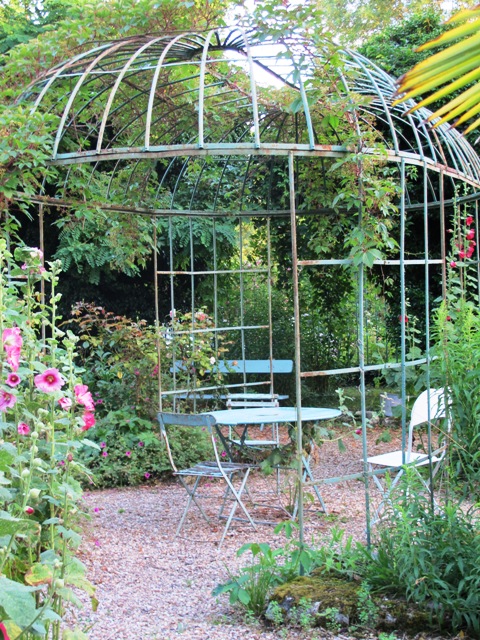 4. From home to away – the garden out the back of Restaurant Baudy in Giverny (where Monet himself used to dine with friends and you can repeat the experience to this day) applied casual French deshabille style to the outdoors. You would not want to be of large stature and trust to this outdoor setting, but the hollyhocks and gently rusting iron are the epitome of what is sometimes styled shabby chic in modern parlance.
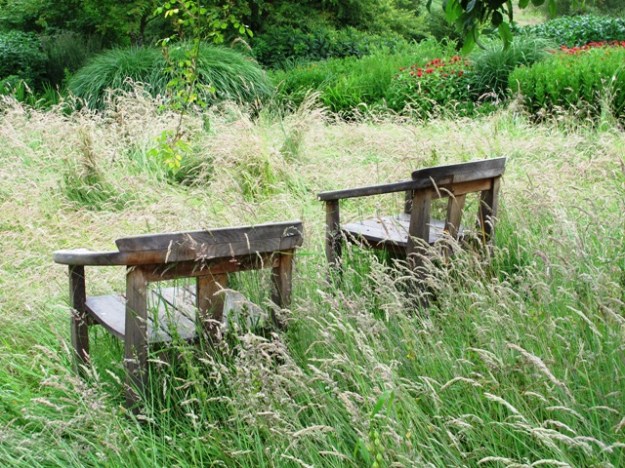 5. Let’s be honest, you would not be wanting to sit on these chairs when the grass is wet, but then if it has been raining, outdoor seating will be wet too. The absence of worn track marks to the chairs suggested that they were not in great use when we visited this garden near Stratford on Avon. But that long grass, meadow look is very charming. And at least if the seats are sited in the long grass, the legs will not be making holes in the lawn and you don’t have to move the furniture to mow.
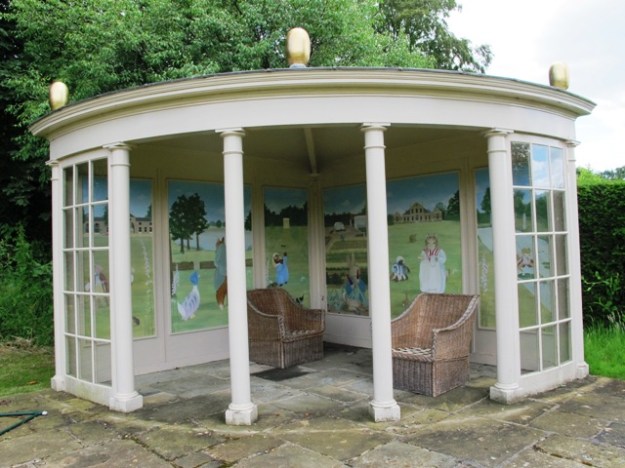 6. This is in a private Yorkshire garden and is, believe it or not, the children’s pavilion though I doubt that the comfortable cane chairs are there for the children to sit upon – far more likely for adults. Traditional cane needs to be under cover. It is only the all weather modern synthetics that can be left out in all weathers but modern or old, I have yet to meet outdoor seating that is more comfortable than cane. Personally I covet a little semi-enclosed pavilion like this one – with or without the Beatrix Potter wall paintings. In a climate which is never quite as warm as I would like, this type of outdoor room seems eminently practical.

 Tikorangi The Jury Garden