Garden lore

“Now us the time to thin out the carrots…” (is) an observation which always makes me come out in a cold sweat, when I read it in a London paper. As though the earth were hardening, minute by minute, so that one must rush up to the country and do things before it is too late.”

Down the Garden Path by Beverley Nichols, (1932).

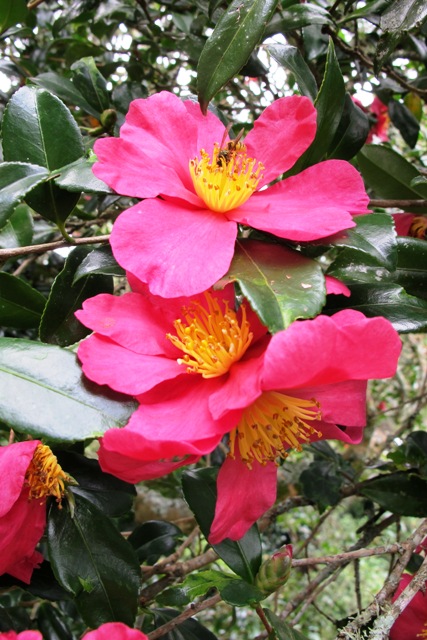
Camellia sasanqua Crimson King

Camellia sasanqua Crimson King

Autumn flowering sasanqua camellias
Most of the early camellias just coming into bloom now are sasanquas. Not snackwas, sankwas or other variants. Nor are they all white and called Setsugekka, as rather a lot of novice gardeners used to think.

Sasanquas come from Japan (most of the other types of camellias are Chinese) and are small woodland trees in their native habitat. They generally have smaller, darker leaves which is why they clip so well to hedges as well as being tolerant of full sun and wind. Being somewhat slower to get away as nursery plants, you may find plants for sale are a little smaller and more spindly than their stronger growing japonica cousins but they make up for it when planted out. While often described as scented, it is a mossy sort of scent rather than sweet perfume.

The big plus for sasanquas now is that they are generally free from petal blight which is decimating the flowering displays of many other camellias. Petal blight is what turns lovely camellia blooms splotchy and brown almost overnight. I hedge my bets.

We have never seen it on a sasanqua camellia here and we have been looking since seeing reports on the internet that it can attack them. As far as we are concerned they don’t get it in our conditions so we enjoy the full floral display through autumn into winter. If you don’t want a clipped hedge or a topiary shape, sasanquas can make graceful, light airy trees to about 3 metres over time.

First published in the Waikato Times and reprinted here with their permission.

At the end of a golden summer come the autumn bulbs

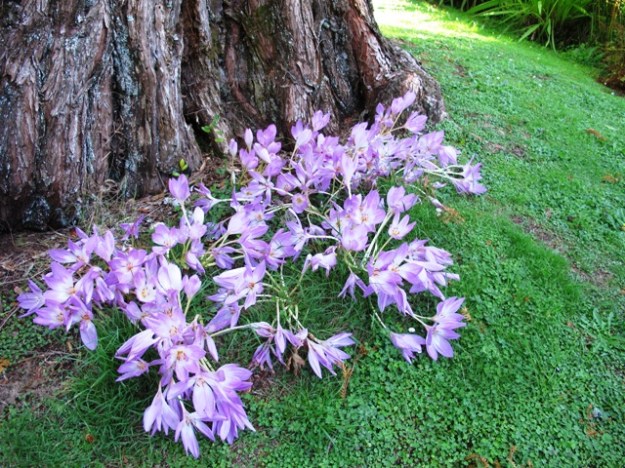
Colchicums, not autumn crocus

Colchicums, not autumn crocus

Autumn. It is indubitably autumn. I can no longer pretend it is just the summer slowly waning and that winter is still a long way off. For most people, autumn is synonymous with leaves colouring to fiery hues.

However those of us in coastal areas may carry that mental image but the reality can fall well short. Inland areas get much better autumn colour because the nights cool down more rapidly and it is the sharp drop in temperatures which triggers the colouring response in most deciduous plants as much as the declining day length. The moderating effect of the sea means we drift far more slowly between seasons and the leaves are inclined to turn brown and fall, skipping much of the colouring process.

Our extensive use of evergreen plants in this country also mitigates against fantastic mass displays of autumn colour. Our native plants are all evergreen and in a generally benign gardening climate, we tend to favour evergreen exotics as well. I have met many gardeners who shun deciduous plants because they are allegedly messy and lack winter interest, which has always seemed a bit myopic to me. We are never going to rival countries like Canada with its native maples when it comes to a mass blaze of autumn tones.

It is the autumn bulbs that signal the change in season for me. There are so many pretty seasonal flowers coming through now. These are triggered into bloom by a drop in temperature, declining day length and some by late summer rain – don’t laugh at that last one.

The charm of carpets of Cyclamen hederfolium

The charm of carpets of Cyclamen hederfolium

Gardeners in this country tend to focus on the spring bulbs – from the early snowdrops through the snowflakes, bluebells, tulips, daffodils, anemones and ranunculus. These are readily available and marketed widely. They also flower at a time when the majority of trees and shrubs are blossoming forth.

The autumn bulbs have never captured the market in the same manner yet they bring freshness to the garden at a time when many plants are looking tired or passing over. I find them a wonderful antidote to the autumnal despondency of declining day length. There they are, all pretty and perky, just coming into their prime.

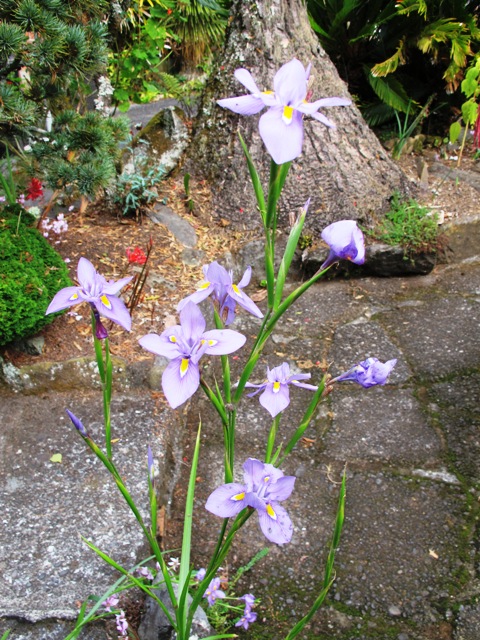
I often feature selected autumn bulbs in Plant Collector because this is their time to shine. As I wander around the garden, I see carpets of Cyclamen hederafolium (flowers only so far – the leaves have yet to appear) and taller spires of the autumn peacock iris, Moraea polystachya, which is inclined to seed itself around a little. This lovely lilac moraea has one of the longest flowering seasons of any bulb I know. The common old belladonnas are already passing over but I enjoy their blowsy display while it lasts. We use them in less tamed areas on the road verge.

Moraea polystachya - the autumn flowering peacock iris

Moraea polystachya – the autumn flowering peacock iris

Over the years, I have waged a campaign to convince people of the merits of the ornamental oxalis, many of which are autumn stars. Call them by their common overseas name of wood sorrel, if the mere mention of oxalis makes you shudder. The range of different species is huge. By no means are all of them nasty weeds and many are not the slightest bit invasive. We have them flowering in white, yellow, apricot bicolour, a whole range of pinks, lilac, lavender and even crimson. Some are perfectly garden-safe. I can vouch for their good behaviour after decades in the garden here. Others I keep in pots – preferably wide, shallow pots for best display.

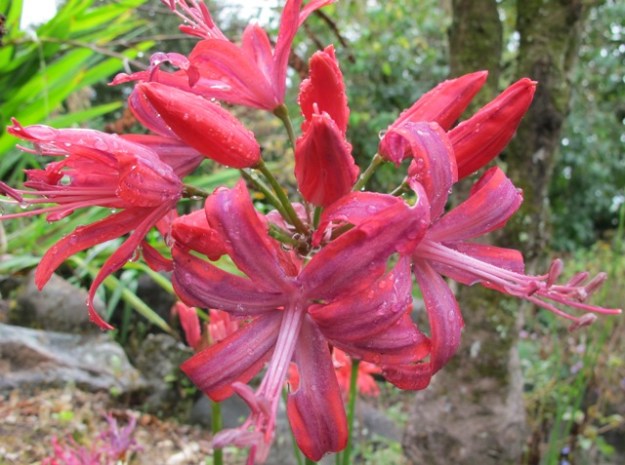
We are big fans of the Nerine sarniensis hybrids

We are big fans of the Nerine sarniensis hybrids

And nerines are the major feature of our autumn rockery. The majority of these are sarniensis hybrids with big heads of flowers. By no means are all of them the common red of Nerine fothergillii or the strong growing pink Nerine bowdenii which comes later in the season. We have some lovely smoky tones, reds deepening to violet hues, a remarkable lolly pink – the colour of a highlighter felt pen, two tone sugar candy and even heading to apricot. Nerines are renowned as a good cut flower but I never cut them. There is only one stem per bulb and I would rather admire them in the garden than indoors.

Then there are the bold colchicums which, contrary to popular belief, are not autumn crocus but certainly put on a splendid show with a succession of flowers from each corm. You have to go a long way back in the botanical family tree to get any relationship between colchicums and the proper autumn crocus. The latter is a much more delicate and transient performer whose flowers appear at the same time as its foliage. Currently, we are enjoying both in bloom.

Some bulbs are quite transient in flower but no less delightful for all that. If I am ever forced by declining health and aged frailty to trade down from a large garden, I can see that it would bulbs that I would chose to grow. I love the way they mark the seasons and how there can always be a different one coming into its time to star.

First published in the Waikato Times and reprinted here with their permission.

Plant Collector: Syagrus romanzoffiana

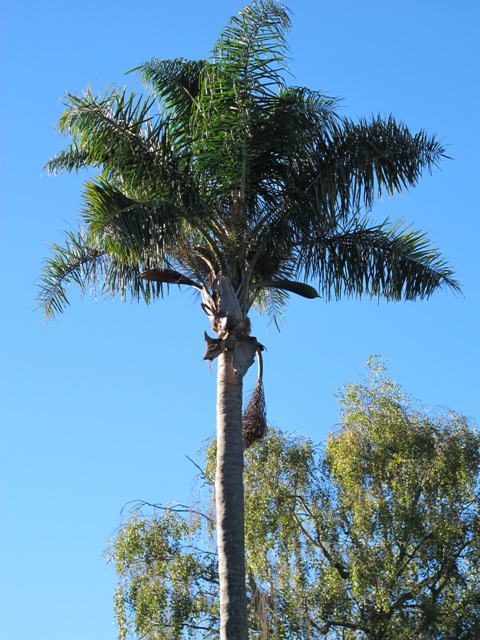
The towering Queen Palm, or Syagrus romanzoffiana growing in coastal Taranaki

The towering Queen Palm, or Syragus romanzoffiana growing in coastal Taranaki

I asked Mark how tall he thought our queen palms are. Mentally I was stacking 2 metre men on top of each other which is how I estimate tree heights. “About eighty feet,” Mark replied, “to the top of the crown.” I leave it in imperial feet because it sounds more impressive than 25 metres. They are tall, these handsome palms, and we have three of them. All were planted in the late 1950s by Felix Jury, from seed given to him by one of the Australian botanic gardens. Not that they are an Australian native. These are South American palms, coming from that mid band where Argentina, Brazil and Bolivia meet.

The single trunks are tall and slender and the impressive top knot houses an entire condominium of nesting birds. In spring time, there are often small, lightly feathered corpses at the base because fledglings are not going to survive a fall of that magnitude. It is mostly sparrows with the occasional starling. We often sit in a spot which looks out to one palm and the amount of comings and goings are prodigious.

I read advice on line that said: “the fronds die early and must be pruned to keep the tree visually pleasing”. No, we do not get the extension ladder out to groom our queen palms. Fronds do indeed die but they detach themselves in time and crash to the ground. As the sheaf of the frond is quite substantial, you don’t want special plants beneath and you certainly wouldn’t want one of these beside a building or near the car.

S. romanzoffiana is a suitable substitute for the common bangalow palm. While there are reported incidents of it escaping into the more tropical wilds of Australia, it has nowhere near the weed potential of the bangalow and we have never heard of it being a problem in NZ.

First published in the Waikato Times and reprinted here with their permission.

Garden lore

“What is a weed? I have heard it said that there are sixty definitions. For me, a weed is a plant out of place.”

Donald Culross Peattie, (1896 -1964).

Weed plants
After my recent faux pas with Lilium formasanum, I was contacted by Carolyn Lewis, the national coordinator of Weedbusters, an organisation with support from many interested parties, dedicated to raising awareness of the problem weeds in this country. Too many of these are garden escapes and gardeners need to take some responsibility for unleashing vegetable time bombs. The website http://www.weedbusters.org.nz gives extensive information on individual weeds including how to eradicate each species in your area and useful suggestions of alternative plants to use instead.

Weedbusters are not covering the plants included in the National Pest Plant Accord (which are the banned ones) although there is a link through to the Ministry for Primary Industries section on these agreed pests. Some of the inclusions surprise me (Bartelttina sordida for one), others don’t. The arum lily, aristeas and agapanthus are widely recognised as problematic. I would have liked to have seen more information on where these plants are problems (national, regional or specific to just one area) because one region’s weed can be another region’s valued garden plant.

Without becoming too paranoid, take notice of those that seed down too freely or spread rampantly in your domain. If they are popping up all round the place, threatening to invade well beyond their allotted space and choking out other plants, or are extremely difficult to eradicate then you are probably looking at plants with significant weed potential for your conditions. While purists may advocate total eradication, in some cases we choose to manage such plants. We don’t want to be without our campanulata cherries that feed the tuis but we take responsibility for the seedlings and are vigilant weeders. The vegetable garden is not exempt either. We rated strawberry spinach as downright dangerous and went for eradication.

We don’t need more weeds in this country.

First published in the Waikato Times and reprinted here with their permission.

A gem of a garden

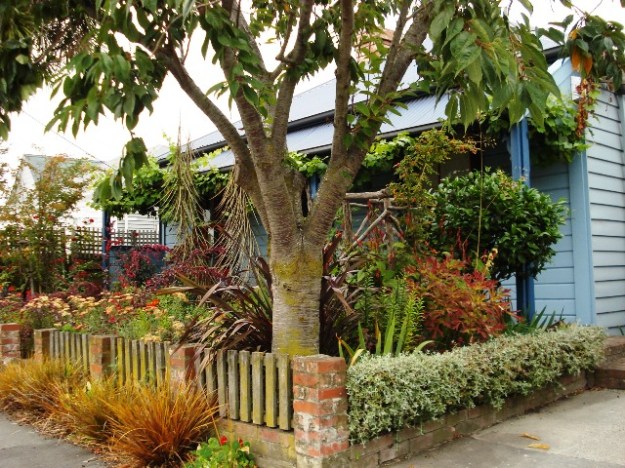
The front garden of Number 11 in tawny and red tones

The front garden of Number 11 in tawny and red tones

Tiny gardens have not featured large on my radar. They are just not part of my life experience so far but they are a reality for many people, whether by choice or circumstance.

When your allotted physical space in life is to have only one of those smaller garden spaces, it is undeniably different. I stayed with garden writer and gardener, Robyn Kilty, in Christchurch. Her own garden which has been acclaimed as one of the best examples of its type, is huge in charm but very small in size.

If you are working in a small space, you can go the Ellerslie show garden way and produce a static scene which is primped and starched to perfection as if frozen in time. Show gardens leave me cold, personally, and the idea of creating and maintaining that in my own environment around my home is even less appealing. So you will need to look elsewhere for ideas on that approach. Try magazines because that is what you will be creating – the glossy feature look. It will probably be unchanging through the seasons and it will not usually have a specific sense of place but be more universal in style. To me, that is like making more housework outdoors because it will need tidying, dusting and vacuuming twice a week to keep it pristine.

I was far more interested in what Robyn was achieving – seasonal change, interesting plants with plenty of colour, texture and detail and a garden which invited you take a little time to enjoy it. But in small spaces, everything has to be thought out, carefully controlled and restrained. “If you get something wrong in a small garden,” Robyn said to me, “it is in your face all the time. You can’t ignore it or get away from it.”

It is a mistake to think that all plants have to be tiny to be in proportion. Sure, if your garden bed is only 3 metres long and 1 metre wide, you don’t want a plant that is going to spread to a couple of metres across. But if you keep everything itsy bitsy, you will end up looking as if you have planted a traffic island. You still need height and some plants with stature in their foliage to give grace and proportion. But you need height without width. You can still be bold in a tiny space.

You will probably end up having to prune and clip regularly to keep plants to their allotted space. Bold foliage may be fine but triffids you can do without.

It is not compulsory to have lawn. If you have grass, you need a lawnmower which will also mean a shed to contain it. Sometimes it is better to manage a little open space by paving and do away with lawn altogether.

Achieving some level of continuity is pleasing in any garden, no matter the scale. In a tiny garden, it might be by a little formality in design, by small groupings of the same plant, mirroring a planting on one side of the path to the other, or by very careful colour management. In late summer, Robyn’s front garden was in tawny autumn shades and red whereas her even smaller back area was featuring deep burgundy with just touches of pure blue and yellow to give it zing.
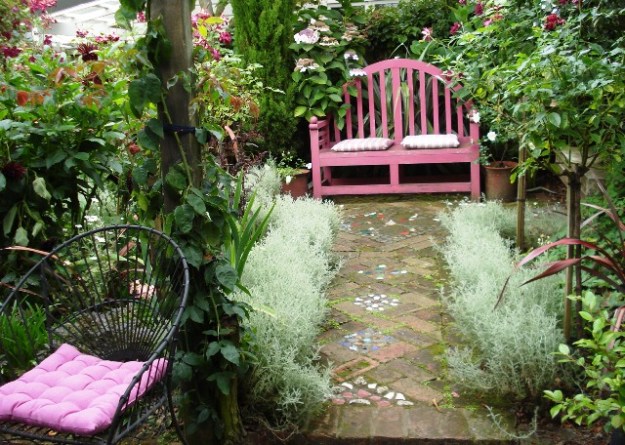
A touch of formality, careful colour choices and paving instead of lawn in a tiny back garden area

A touch of formality, careful colour choices and paving instead of lawn in a tiny back garden area

You have to be more restrained in a small space, even if you are creating a colourful or maybe flamboyant display. Every plant has to justify its place. The real gardening skills come in managing changes through the seasons, which make it all a great deal more interesting. Bulbs need to be used so they can star when in flower, but not look awful and scruffy when they are passing over. As one dominant plant passes over for the season (maybe a hydrangea that has finished flowering or a hosta that is going dormant), another nearby plant needs to be coming into its own. The challenge in a small garden is to make the whole area work for you all year, giving you lovely views out your windows, from the road frontage and from all your viewing points within the space.

Ever the practical type, I would find it hugely challenging to manage without the hidden areas “out the back” as we call them. If you have plants in containers, you need somewhere to repot them. You still need a shed or cupboard for tools and packets, even if your space is too small to warrant a wheelbarrow. Dealing with green waste would be a challenge without a compost heap. Yet if you have a small one of those, there will be trimmings and prunings that are too large for it. You probably can’t run a closed system in a tiny garden, recycling your own waste.

I am not ready to trade down on space, but when I thought about tiny gardens, I developed a new respect for the few I have seen where the owners have made them into something special. It is harder than it looks to do it well.

First published in the Waikato Times and reprinted here with their permission.