Garden lore

” You have only to think of the front gardens you drive past in summer that are planted up almost entirely with dwarfs to realise how lacking in character and individuality they are. Such plants never get off the ground; they are mere colour explosions.”

The Well Tempered Garden by Christopher Lloyd (1973)

Summer lawn care

Set your lawnmower a notch higher for summer, or several notches higher if you are one who scalps your lawn. It is a myth that if you cut your lawn very short, it will need less mowing. In fact if you cut it very short, you weaken the grass growth to the point where it is likely to die off over summer and what you get instead is an invasion of weeds. Paspalum, kikuyu, summer grasses and flat weeds – all will thrive in the vacuum you are creating. Without exception, good lawns and turf are cut a little longer. If you have neglected, long, rank grass (which can happen at holiday homes), don’t try and get it down in one hit. Cut first on the highest setting. Wait a few days and then cut a second time to the desired length. Your grass is less likely to go into shock and die over summer.

First published in the Waikato Times and reprinted here with their permission.

Letter to the Parliamentary Commissioner for the Environment

The latest rig near us, photographed from Ngatimaru Road

The latest rig near us, photographed from Ngatimaru Road


589 Otaraoa Road,
RD43, Waitara
jury@xtra.co.nz Phone 06 754 6671
December 30, 2012

Parliamentary Commissioner for the Environment
PO Box 10-241
Wellington 6143
New Zealand

pce@pce.parliament.nz

Dear Dr Wright,
Hearing you speak on National Radio recently about your interim report on fracking was like a breath of fresh air. I refer particularly to your comment referencing the proliferation of industrial sites in the countryside and the impact on local residents.

It seems to me that two critical areas that have fallen through the cracks are:

1) The total absence of any public sector planning. Planning is all done by private companies and all the public sector does is to respond to applications by applying the relevant legislation. So there is no overview of development. The location, pace, nature and management are all determined by individual private companies.

2) With that has come the total absence of any public sector duty of care for local residents. Any care is entirely at the whim and discretion of private companies and woefully inadequate. Worse is that an ethos has developed which is deeply unsympathetic to complaints from local residents. At its most extreme, this takes the form of public vilification of individuals.

We are immediate neighbours to the Mangahewa C site in Tikorangi and every piece of heavy machinery passes along two of our road boundaries. The latest rig is both visible and, at times, audible to us. We have a large garden which we open to the public and the negative impact of recent development has been so extreme, that the company concerned ceases road operations when we have a coach tour booked in for a garden visit. At those times, it is as if the off switch has been flicked but it is a stark reminder of how bad things are the rest of the time. I now garden wearing an iPod in an attempt to mute the noise.

I have no confidence in the ability of local councils to effectively monitor and manage development and am frankly alarmed at suggestions that Taranaki be paraded as a model for successful practice. I have been lobbying for over 15 years for councils to take a more proactive role in managing development and mitigating the negative effects on local residents but the councils remain an impenetrable brick wall and appear oblivious to issues and, at worst, antagonistic to opposition and to complaints.

Of considerable concern is the publicly supportive position of the petrochemical industry taken by the CEO of the Taranaki Regional Council, Basil Chamberlain. I strongly believe that the CEO of the monitoring body MUST be seen to be neutral and independent.

Fracking has been taking place on the adjacent property for about three years now but it was only this year, and only at our request, that testing of our bore water started. Yet apparently we have the only deep water bore close to that site. Three years to set monitoring in place is not best practice.

Definitions of affected party zones appear to be at the discretion of councils. Fifteen years ago, it was a one kilometre radius. At some point, Regional Council apparently contracted that zone to 300 metres, New Plymouth District Council even less. In the countryside, 300 metres is not far at all. This has had the effect of hugely reducing the number of people defined as “affected parties” which is decidedly beneficial for the companies but has only negative effects on local residents.

Consents are for such a long time that much can change in the interim, including environmental expectations, yet it appears that the conditions of the original consent stand for the duration. I understand old sites have been reopened under original consents. Too much reliance is placed on the “goodwill” and “good practice” of the companies to respond to issues during the consented periods. And once consent is given, it sets the precedent for renewal.

When the Mangahewa C site was first applied for, I had to fight hard to be ruled an affected party. The NPDC planning officers were unhelpful and uncooperative in the extreme. Once we had that status, we were presented with a document to sign. We wanted to sign consent for the first well only and then review it. We were told that was not an option and unless we signed unconditionally, it would go to the Environment Court and that we would have to fight it there. Nobody suggested we seek independent advice.

I could not face the time and energy it would take to go to the Environment Court so we signed. I have only recently found a copy of the information which prompted us to sign. Our concern was traffic. We were informed that there was a remote possibility of up to 8 wells being drilled over a 20 year time span and that once drilling commenced, a maximum of 3 heavy vehicles and 8 light vehicles a day would pass our road boundaries. Once in production, the light vehicle movements would drop to 3 per day, the same as heavy vehicles. I recall it seemed churlish to be difficult over a mere 6 additional vehicles a day passing us.

In the time since that affected party consent was signed, one initial exploratory well has ballooned out to at least 9 additional planned wells (we are on to number 3) on the neighbour’s property and a further 8 multi well head site down the road, all over the next 5 years. That makes 19 or 20 wells over a period of 7 years (far from the “unlikely possibility” of up to 8 over 20 years). Every piece of transport passes our two road boundaries with a sharp 90 degree turn and a hill so the huge volume of trucking movements could not be noisier and more intrusive.

We are now assuming that in the references to between 6 and 11 additional vehicles each day during drilling and production phases, they omitted to add the important words: “before 7.30am each day with an unspecified number thereafter”. That is closer to what our reality is now.

Compensation for landowners and affected parties should not be left to the discretionary largesse of individual companies who often ring-fence it with confidentiality agreements.
It is not appropriate to think that continuing to allow the companies to play Santa Claus is all that is required. Too often, for affected parties it merely consists of a hamper here, free tickets to a show there, maybe tickets to Australia for an event if they really like you.

The development levies back in the days of Think Big projects may not have been a perfect system of recompensing on a larger scale, but they did at least keep grants at arm’s length. The current system where individual companies get to make grants is all too redolent of Santa Claus again and raises doubt about the independence of recipient councils. Todd chose to make a generous grant to New Plymouth District Council for their favoured project of the new Len Lye Centre. As a result, I doubt very much that any NPDC councillor is going to be critical of anything that company does.

Over fifteen years ago when it first became clear that our district may face enormous petrochem development, I sat in the then mayor’s office with her and the town planners and pleaded with them to adopt a proactive position in planning for the potential development. I pointed out to them that there was nobody else to look after the interests of local residents and that the current model of the petrochem companies picking off areas and then working with individual landowners locked in to confidentiality agreements had the effect of pitting neighbour against neighbour.

Nothing happened and the only thing that has changed is that the development is happening.

I attempted several times to raise the same matters with the next mayor and also presented a submission to the full council showing them what the effect was and begging them to look into what could be done to minimise the negative effects for local residents. They commissioned a report but nothing changed.

I have given up trying to talk to councils. There is no will for councillors and their officials to see anything negative.

If you are back in this area, we would be very pleased to meet you and to take you to visit some of the other affected residents in our immediate area. That is considerably more than anybody connected to the local councils has ever done.

I have posted four blogs to my website, if you are interested in reading any of these.

1) No problems with petrochem development in Taranaki???
2) Living in petrochemical heartland
3) Tikorangi Notes; Friday 20 January 2012
4) Tikorangi – the new Texas?
5) And three short You Tube clips attempting in a minor way to catch the flavour of what living here is now like.
Relentless noise
The Park, Tikorangi the Jury Garden
Rimu Walk, Tikorangi the Jury Garden.
Yours sincerely,
Abbie Jury

NB This letter replaces the earlier letter dated December 4. In the time since, we have discovered there are to be an additional 17 wells drilled close to us by Todd Energy over the next 5 years. I also found a copy of the “affected party” consent we signed in 2006 and the information provided which led to us signing that consent.

A pedestrian matter

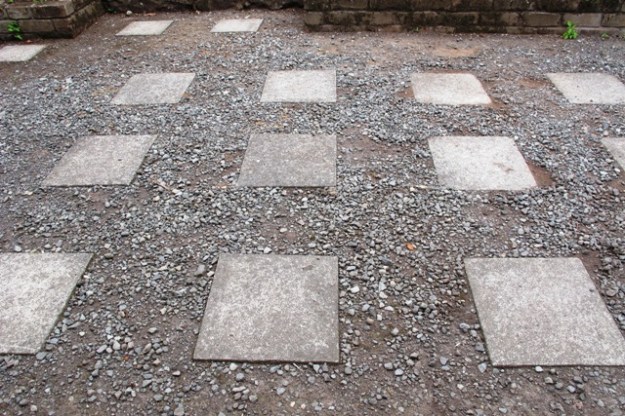
The chequer board approach (in need of a gravel top up)

The chequer board approach (in need of a gravel top up)

This morning’s column is for readers on low budgets or in mature gardens. Path surfaces. If you are on a new property which has been landscaped, or what passes for landscaping, odds on your paths are in place and are concrete. We just love the utility and endurance of concrete in this country.

New concrete dries to a somewhat startling white which is usually appropriate to a new build, but can look garish and out of place on an older property. It also leaches lime for the first few years so you are likely to have trouble growing plants such as rhododendrons and camellias alongside it. The foliage will go yellow on acid loving plants.

Aged concrete softened at the edge with prostrate thyme

Aged concrete softened at the edge with prostrate thyme

Because we have a fair amount of old concrete here, where we have chosen to go with extending concreted areas or new paths, we take the trouble to mask the new look. Adding colouring (black oxide) counteracts the whiteness. Once it is all smooth and starting to start dry, we spray a sugar and water solution over the top. That strips the smooth top layer and exposes the aggregate. Voila. The concrete looks aged from the start.

Were we English, we would have a tradition of flag stones and stone pavers. We are not, so they are a very expensive option. You can get a similar effect in concrete pavers which come already roughed up and coloured to give the overall impression of stone. It’s a good product. We have used it to pave a small courtyard and the same style of pavers were used in a modern outdoor dining area I featured on this page a fortnight ago. The larger sized pavers look better if you want the flagstone look. Ours are 600mm square.

I don’t recommend brick unless you live in a dry climate. Old bricks are porous which means they soak up moisture and retain it, enabling moss to grow very nicely thank you. Brick paths tend to be extremely slippery for much of the year and therefore hazardous. It is also difficult to get a relatively even surface and if you don’t construct a solid edging, the side bricks roll out.

Gravel paths are usually best retained with a solid edging to reduce spilling. We have used concrete sidings on ours. We like gravel paths. There is something satisfying about the scrunch as you walk along them and they are softer on the eye than unforgiving concrete. They are not as simple to install as they first look, however. You can’t just pile gravel onto the ground because the mud will rise from below. You need to excavate down to lay a compacted base course first before you top with your choice of gravel. For foot traffic, a 5cm base should be fine. Don’t lay the top gravel so thickly that it makes walking difficult. You also need to choose your gravel with care. Rounded stones can be like walking on marbles but you want a grade which is reasonably consistent (in other words it has passed through a screen) to look attractive.

Gravel can be quite difficult to keep looking smart without a leaf blower. We did it for years with a leaf rake to remove the build up of litter but it is labour intensive and doesn’t do a particularly thorough job. The leaf blower removes humus in a trice and we wondered why it took us so long to discover its merits. However it is a noisy and intrusive machine and your neighbours will come to dread it as much as your lawnmower. A certain amount of gravel will get blown into the surrounds too.

If you have a larger area to cover, placing pavers at regular intervals throughout a gravel area can add interest and style cheaply. To look good, measure the placement of the pavers to keep them regular and put them down before you lay the top layer of gravel.

We have not gone with wooden walkways at all. In our garden, they would make us look too much like an institutional or public garden (“the DOC look” as we call it). Having seen them elsewhere, I would comment that even corrugated decking timber can get slippery if it is wet for protracted periods or in shade areas and it can be particularly hazardous on slopes. There are non slip products you can buy to secure to your wooden paths or steps but they will add to the cost. If you are not a public garden, then I think wooden walkways tend to be a better aesthetic fit to a modern house with acres of timber decking.

Mulching the leaf litter for the most pleasant walking surface of all

Mulching the leaf litter for the most pleasant walking surface of all

In woodland areas, we keep a thick layer of natural mulch on paths and we shun hard edgings because we want a natural look. In the last few years, when we groom up for our annual spring garden festival, we have gone a step further and raked up the all the litter and fed it through the mulcher. What comes out is a consistent grade of anonymous brown mulch which we then rake back over the paths. It gives the softest and springiest surface to walk on. While it doesn’t compact down, it is remarkably durable as long as it doesn’t get washed away and it can be maintained with a leaf rake. It looks really good until autumn when we get both wind and fresh leaf drop so it is not a long term solution but it gives an attractive option for wooded areas without expenditure.

Some level of consistency is desirable. No matter what size your garden is, you probably don’t want to be using a whole range of different path surfaces. They don’t all have to be the same and paths can differentiate between high use, formal and informal areas. But the overall effect will usually be more cohesive if you can keep some level of uniformity.

First published in the Waikato Times and reprinted here with their permission.

Garden lore

If your relatives are coming for Christmas and you are worried about the state of your garden, prioritise. You don’t have time to clean up the lot so take a leaf out of the garden openers’ book. Hedges, edges and lawns are what present a garden well. Clip any wayward hedges, cut your edges to give sharp lines and mow your lawns (but not too short). Sweep hard surfaces and, if time allows, clean up the bit that people see first (usually around the letter box or entranceway). Only keen gardeners or those determined to find fault will see beyond that veneer of presentation. The rest will see tidy, sharp lines and not even think to look at the weed infested garden.

The Terminator of the World of Weeds?

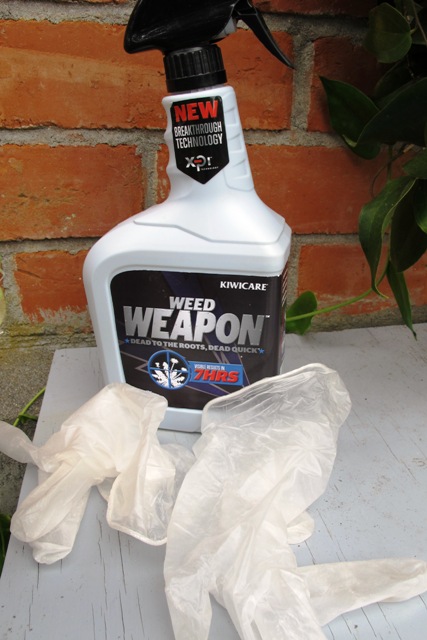
A free sample for review! The terminator of the weed world.

A free sample for review! The terminator of the weed world.

It is not in the job description for garden writers that freebies are included. In all my years of garden writing, excluding books for review, I could count such things on the fingers of one hand. I only mention this because I once found out that the wine writer for a provincial newspaper received boxes of samples to his door. I was so jealous.

Imagine my excitement when something arrived. Even more excitable was the accompanying publicity sheet which proclaimed “hasta la vista” to weeds when using (wait for the drum roll) Weed Weapon. Yes folks, I had a convenient spray bottle of weed killer in my hands.

First up, let us be clear. Despite the name of the company that produces this product being Kiwicare, which sounds so wholesome, there is nothing organic about it. It is a new twist on an old standby which is glyphosate (formerly sold only as RoundUp). Forty years of experience tell us that of all the herbicides around, glyphosate is as close to safe as you can get. It could be argued that it has revolutionised the way we think about gardening and lowered our tolerance for weeds. Glyphosate has often been described as the equivalent of a labour unit because you can whip around with a knapsack on your back and cover a large area very quickly.

We use glyphosate here and Mark has always dreaded the day that it may be found dangerous because we could not maintain the standard we want in our garden without it. He has kept an eye on the research and there is no hard evidence that it is damaging or dangerous. This is because it does not accumulate and it breaks down very rapidly on contact with soil or water. It does not cause cancers, it does not appear to harm insect life and basically you would have to swallow a fair amount of it undiluted to cause yourself any harm.

It was a very different story with earlier weed killers. Paraquat was and still is used in some quarters as an alternative to glyphosate. It knocks down plants within hours of application and its environmental bill of health is not too bad. It is also the main tool with which to commit suicide in third world countries because it is cheap, readily available, has no antidote and you need very little in order to cause a deeply unpleasant death. Its dermal toxicity (in other words the ability to be absorbed through the skin) is very high which makes it dangerous for gung-ho home gardeners.

Back to Weed Weapon, which gives the quick hit of Paraquat, apparently without the dangers. One of the problems with glyphosate is that it takes a long time to be sucked into the plant’s system and to kill it. This is temperature related so it can be about seven days in summer and anything up to three weeks in the depths of winter. In that time, some weeds have the capacity to set viable seed. Weed Weapon’s active ingredient remains glyphosate, at 7.2 grams per litre. As far as I can see from Monsanto’s website, this is at the weaker end of dilution rates best suited to quick growing annual weeds and grasses. What makes the difference is the combination with saflufenacil which is a recent addition to the weedkiller range. It is this that gives the knockdown, browning effect on weed leaves within hours. I did a bit of a search on this saflufenacil but the papers Google pulled up were all highly technical and well beyond my very limited high school science. The publicity from Kiwicare blinded me further with science (Protoporphyrinogen Oxidase inhibitor) but it will have been approved for sale by the appropriate New Zealand authorities. It is claimed that it is biodegradable in soil. I mention this because we know glyphosate is but sometimes, when different chemicals are combined, the result can be less predictable than just the sum of the parts.

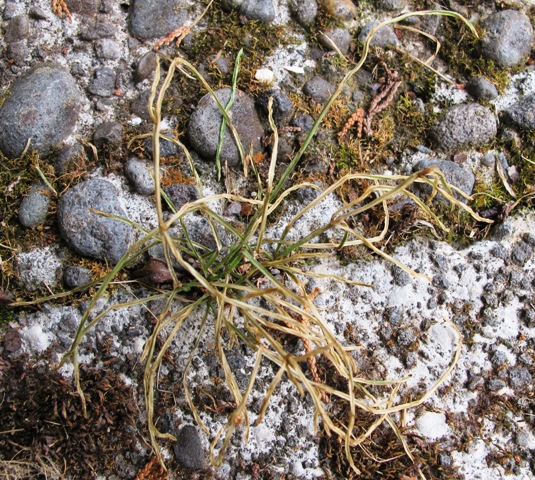
At least the pesky equisetum is dying

At least the pesky equisetum is dying

What I can tell you is that Weed Weapon in its ready to use form is perhaps worryingly easy to use. It comes in a squirty bottle like window cleaner. It requires an accurate aim because if you catch other plants, you may kill them too. It certainly knocks down most plants quickly – the dying process is visible within hours. You will be paying for convenience. It retails for around $20 for a one litre squirt bottle. For me, its most useful application is killing out a nasty, invasive equisetum which wriggles out between rock walls but resists being pulled out with its roots. Paraquat users would be well advised to swap to this safer option.

If you are going to use it, you should always wear gloves and not just gardening gloves as shown on the little pic on the back of the pack. Most gardening gloves are absorbent to some degree. You should be using rubber, plastic or latex gloves which you can buy at the supermarket. While it may well be relatively safe to use with low dermal toxicity, good practice says to take precautions. Wearing impermeable gloves is one and never spraying on a windy day is another.

First published in the Waikato Times and reprinted here with their permission.