I felt as if I was looking at a parallel universe as I browsed “Contemporary Gardens of New Zealand”.
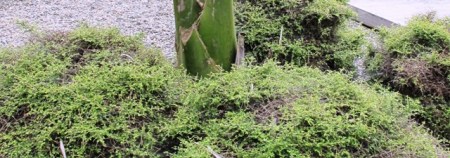
In fact, I think that the book is incorrectly named. It might be more accurately titled: “The Modernist Revival in New Zealand Garden Design”. The dominant impression is that the contemporary garden in this country is hard-edged design stripped of colour and plantsmanship. Who needs more than griselinia, nikau palms, corokia, strelitizia (the bird of paradise plant), xeronema (Poor Knights lily) and trachelospermum (star jasmine)? Yes, I know that is over simplifying, but most of the gardens included in the book use a very limited range of plants.
Modernist gardening has its roots in 1930s garden design. In fact, if you look back at some of those early examples, they would still look cutting-edge today. But it is only one style and the mistake is to think that modernism as a movement is synonymous with modern and therefore contemporary.
I would argue that modern gardening in this country goes well beyond the modernist revival style. How can anyone write about modern gardening without discussing the huge resurgence in interest in the edible garden? There is a distinct trend returning to utilitarianism usually seen in times of war and food shortage, where the growing of plants for ornamental purposes was seen as frivolous and every plant should be edible. These edible gardens, even when dressed up as potagers, don’t look contemporary and don’t photograph as well, but they are a definite modern trend.
Similarly, we are witnessing a movement against the chemical intervention of the last few decades. Call it organics, call it ecology, or naturalistic gardening, even sustainability – all reflect a rejection of the gardening values of the previous generation and a concern for harmony in nature. The modernistic gardens in the aforementioned book all play lip service to the idea of a “strong sense of place”, being “deeply respectful of the unique location”, the context – to the extent that I somewhat uncharitably started to think of all the Miss Universe contestants who give 60 second speeches about wanting world peace and homes for fluffy kitties. I would argue that at least some of those gardens demonstrated man’s imposition of rigid symmetry and entirely unnatural monocultures which is in fact the opposite of a harmony with place.

Most people actually like flowers
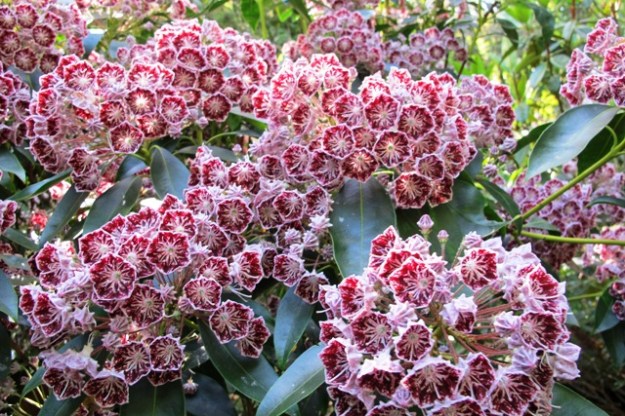
What is difficult to believe is that a garden genre which strips colour, seasonality and flowers from the garden is ever going to be more than a passing trend which appeals to a minority, most of whom are not gardeners themselves. There is next to no pink in this book on contemporary gardens, nothing voluptuous or even pretty. At its best, it is all terribly sculptural. If the owners want to have flowers indoors, most of them will be buying them from the flower shop. In my experience, most people like flowers and colour in their garden. And while seasonal change is messy, it is also what gladdens the heart for many.
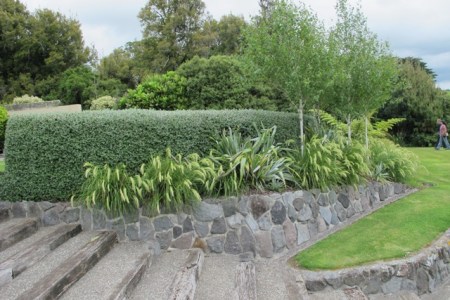
The Foreman Garden in Lepperton
I visited two local gardens last week which I would describe as modern or contemporary examples. Both are the creations of younger woman who are very keen gardeners and both are beautifully maintained and represent a great deal of time, thought and skill. The first was an example of green and brown austerity with a very limited range of plants, which has its origins in the modernist style though I found the use of curves to be more sympathetic to the surrounding countryside than hard edged symmetry. The total package of “the look” was what mattered and it was clearly designed to be as static as is possible when working with living plants. It was well executed and I can enjoy looking at such a garden, even if it is not to my personal taste.
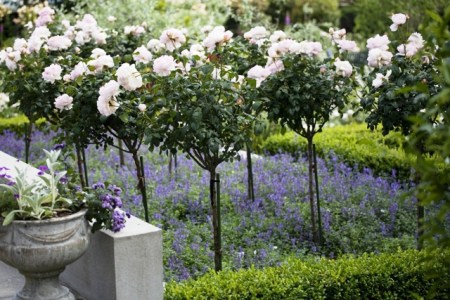
La Rosaleda – photo credit Jane Dove Juneau
The second garden was equally beautifully executed but could not be more different. It was an over the top riot of flowers, particularly roses, where the owner wields total control over the colour scheme and every plant combination represents thought. But pastel. Indubitably pastelle, with the most refined colour transitions throughout the garden. That love affair with the romance of pastel colour and the rejection of primary hues harks back to the Edwardian rejection of the garish Victorian gardens. It is incredibly pretty, feminine and romantic and in its most recent incarnation, is just as contemporary as the modernist garden design.
Landscapers are a breed apart from gardeners. That is not a value judgement. They are just on a different path, as indeed are plantspeople who have no interest in design but find the botanical detail of different plants fascinating. Both landscapers and plantspeople have their own unique language which sets them apart, accords them a higher plane is some eyes. In the middle are the gardeners who try to bring together both the design and the plants.
That said, there was one garden in the book that rendered me awestruck. It was the work of Queenstown landscape architect, Paddy Baxter and the location was in a remote area on the flanks of the Remarkables. It was not pretty, it was not conventional. It used pretty much all local native plants and it was the most exquisite example of anchoring a residence into its environment by sensitive landscaping. That was a very fine example of one type of contemporary garden.
First published in the Waikato Times and reprinted here with their permission.
-39.042098
174.300314

 Twenty three gardens by twenty one New Zealand designers – this book has certainly prompted a great deal of discussion here over the past couple of weeks. There is a heavy bias towards high budget properties with stunning views in or around Auckland, often with hard-edged modern, architecturally designed houses. The response is dominated by hard edged, angular gardens, pared back planting schemes largely stripped of colour and heavily dominated by native plants. Water features and swimming pools abound, usually with wet edges of the infinity style (so that the body of water melds into the sky or sea in front) and sometimes with the water lapping at the walls of the house. Generally, there is little evidence that the property owners want to garden themselves. Most want an exterior which will complement their homes, their lifestyle and, apparently, the environmental context of the property.
 Tikorangi The Jury Garden