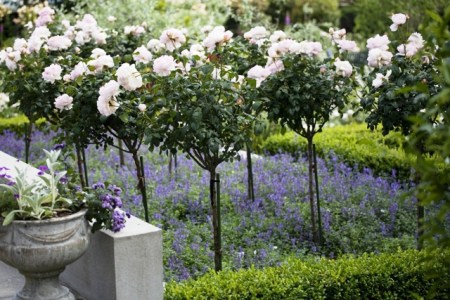
The vexing issue of underplanting

A row of alternating annuals makes a statement, though it may not be the statement the gardener is aiming for

I had a day out and about looking at gardens recently and I was struck by the nature of under planting, though this preoccupation may have had more to do with my thoughts at the time. What I noticed about the under planting was how badly it was done in a couple of gardens. Bear with me, dear readers. You are going to have to imagine it because I know the garden owners so I was not going to whip out m’camera and take photos of the worst examples to embarrass them in the newspaper and on line.

Words like mishmash and hodgepodge came to mind as I looked at the bottom layer of plants in otherwise perfectly competent gardens. In other words, they had good upper layers of larger plants but when it came to the bottom layer of ground covers and under plantings, the selection criterion seemed solely that the plant should not reach more than 30cm in height. And there was one of this, one of that and one of the other, bunged in higgledy piggledy in most spaces.

Even worse, and I had to visit my local garden centre to set up a photo to demonstrate, is the horror of alternating annuals in a row along the edge. These certainly make a statement in the garden, though it may not be the statement that the gardener thinks when he or she plants them. I saw something similar (maybe with pansies and alyssum?) looking incongruous in a garden with otherwise high quality woody trees and shrubs and there were not any resident children to justify such a lapse in taste.

Nor am I a fan of edging plants, or indeed anything planted in rows other than proper hedges or vegetables, but that is a matter of style and personal taste. Fringes of mondo grass, liriope or anything else leave me cold but edging rows of matched annuals make me raise my eyebrows. Not even moderately tasteful white petunias cut the mustard when planted as an edging.

The contemporary look is to plant in blocks. The landscaper look is to plant in sharply defined geometric blocks each comprised of only one evergreen plant. Clivias are good, renga renga lilies are a bit untidy. Hellebores are probably acceptable, as is liriope or trachelospermum. Natives like prostrate muehlenbeckia are better.

Bergenia ciliata and Siberian irises – this gardener’s version of block planting

The middle ground is to gently block-plant but in more interesting combinations and in less rigidly defined grids. I am far more comfortable with that approach and it makes gardening interesting to play with different combinations. It also has advantages in making maintenance easier to group plants which require more frequent care – such as dead heading, staking, dividing, or grooming. Rectifying mistakes or bad decisions including eliminating invasive thugs is more localised if you are planting in blocks. I tend to blur the edges of my block plantings so that the overall look is softer and less delineated because that suits our style of gardening better. There is no doubt that if the upper layers of the garden are varied and mixed, some sort of unity in the bottom layer creates a more harmonious picture. I would argue that the flip side of the coin is also true: if your upper layers are rigidly conformist and consist of restrained plantings of only one or two different plants, ringing the changes with more complex and varied under plantings will make it a great deal more interesting.

Acceptable clivias

If you don’t want to go the block planting route, the old fashioned cottage garden genre may be an alternative. Essentially this is a jostle of perennials, annuals and bulbs in combination with small shrubs, often roses, where self seeding is encouraged. If you want a more modern look, you colour tone it rather than the traditional riot of random colour that nature achieves. If you like a tidy garden which is weed free, it is not an easy style to manage well. More often it is best viewed in passing, rather than looking at the detail.

Then, of course, you could ask yourself whether under planting is even necessary in some areas. The requirement that all garden beds and borders be layered with nary a glimpse of garden soil is relatively recent. In times past, it was fine to plant shrubs and trees without any bottom layer at all. It was called a shrubbery. Just don’t plant the shrubs too close together or you end up with a hedge. Each shrub needs to stand in its own space. As nature abhors a vacuum, mulch all the bare earth with something anonymous or you will grow a carpet of weeds. It is certainly easier to maintain than more complex plantings. It will probably look more attractive than the hodge podge assemblage of random plants I saw. It should look classier than the row of alternating annuals. Maybe it is time to start a movement called The Shrubbery Revival. Neo-shrubberies, maybe?

First published in the Waikato Times and reprinted here with their permission.
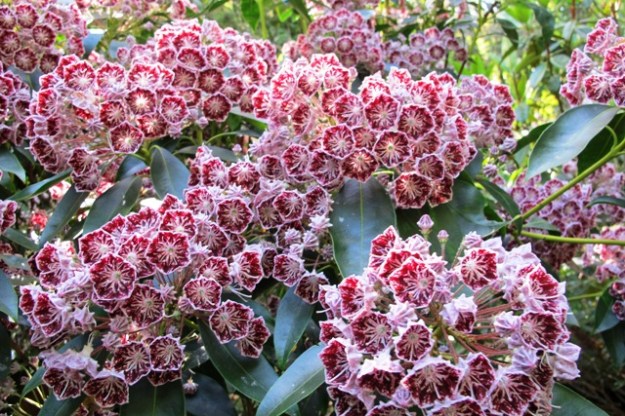
Plant Collector: Kalmia latifolia “Nipmuck”

Kalmia latifolia “Nipmuck”

Just when all the spring flowering trees and shrubs have passed over and we move into early summer, the kalmias open. They look as if they belong in the spring group and they like to grow in similar conditions to rhododendrons and camellias but their blooms take us into December. This one has the rather odd name of “Nipmuck” and is the darkest variety we grow. I failed to find out how it came by its name but would guess it may derive from the indigenous people of America.

In leaf, these slow growing, evergreen shrubs are pretty anonymous. But when the buds appear, they look like piped icing such as often adorns wedding cakes, opening to little cups, chalices maybe. The backs of the petals are white with just the red shading through from the inside.

Kalmias are native to North America, though only to the east coast where they stretch from Canada to as far south as Mexico. Locals call them the Calico Plant or Mountain Laurel. Most of the prized garden selections are forms of latifolia which is hardy. In other words it won’t be harmed by cold winters of the type we get in New Zealand, even inland, southern areas. They belong to the ericaceae family.

There is nothing rare about kalmias but they are very difficult to propagate from cutting so you may find them hard to source. When you do find them for sale, be prepared to pay a decent price for one. Cheap plants are cheap to produce so difficult ones should command a higher value.

From 2009, Kalmia Ostbo Red.

First published in the Waikato Times and reprinted here with their permission.
Garden lore

I am strongly of the opinion that a quantity of plants, however good the plants may be themselves and however ample their number, does not make a garden; it only makes a collection.

Colour in the Flower Garden by Gertrude Jekyll (1908).

Dead heading

Plants don’t flower to delight humans. That is merely a bonus for us. Plants are genetically programmed to reproduce themselves and flowering is part of that process. Dead heading plants is therefore akin to contraception – preventing them from setting seed. In many cases, the plant will try again and set more flowers. That is what happens with annuals, perennials and repeat flowering roses. Removing spent blooms will extend their flowering season considerably. It doesn’t work for plants where flowering is set the preceding year (bulbs, rhododendrons and many other woody plants) but interrupting the process of setting seed can make the plant concentrate its energies on fresh growth and setting more flower buds instead. Annuals and biennials die after setting seed. Some plants can set so much seed that they weaken themselves and may eventually die (some rhododendrons and pieris, for example). Plants which are sterile often flower extremely well because they never get past that optimistic first stage of procreation.

First published in the Waikato Times and reprinted here with their permission.

Modernist gardening, modern gardens and contemporary design


I felt as if I was looking at a parallel universe as I browsed “Contemporary Gardens of New Zealand”.

In fact, I think that the book is incorrectly named. It might be more accurately titled: “The Modernist Revival in New Zealand Garden Design”. The dominant impression is that the contemporary garden in this country is hard-edged design stripped of colour and plantsmanship. Who needs more than griselinia, nikau palms, corokia, strelitizia (the bird of paradise plant), xeronema (Poor Knights lily) and trachelospermum (star jasmine)? Yes, I know that is over simplifying, but most of the gardens included in the book use a very limited range of plants.

Modernist gardening has its roots in 1930s garden design. In fact, if you look back at some of those early examples, they would still look cutting-edge today. But it is only one style and the mistake is to think that modernism as a movement is synonymous with modern and therefore contemporary.

I would argue that modern gardening in this country goes well beyond the modernist revival style. How can anyone write about modern gardening without discussing the huge resurgence in interest in the edible garden? There is a distinct trend returning to utilitarianism usually seen in times of war and food shortage, where the growing of plants for ornamental purposes was seen as frivolous and every plant should be edible. These edible gardens, even when dressed up as potagers, don’t look contemporary and don’t photograph as well, but they are a definite modern trend.

Similarly, we are witnessing a movement against the chemical intervention of the last few decades. Call it organics, call it ecology, or naturalistic gardening, even sustainability – all reflect a rejection of the gardening values of the previous generation and a concern for harmony in nature. The modernistic gardens in the aforementioned book all play lip service to the idea of a “strong sense of place”, being “deeply respectful of the unique location”, the context – to the extent that I somewhat uncharitably started to think of all the Miss Universe contestants who give 60 second speeches about wanting world peace and homes for fluffy kitties. I would argue that at least some of those gardens demonstrated man’s imposition of rigid symmetry and entirely unnatural monocultures which is in fact the opposite of a harmony with place.

Most people actually like flowers

Most people actually like flowers

What is difficult to believe is that a garden genre which strips colour, seasonality and flowers from the garden is ever going to be more than a passing trend which appeals to a minority, most of whom are not gardeners themselves. There is next to no pink in this book on contemporary gardens, nothing voluptuous or even pretty. At its best, it is all terribly sculptural. If the owners want to have flowers indoors, most of them will be buying them from the flower shop. In my experience, most people like flowers and colour in their garden. And while seasonal change is messy, it is also what gladdens the heart for many.

The Foreman Garden in Lepperton

The Foreman Garden in Lepperton

I visited two local gardens last week which I would describe as modern or contemporary examples. Both are the creations of younger woman who are very keen gardeners and both are beautifully maintained and represent a great deal of time, thought and skill. The first was an example of green and brown austerity with a very limited range of plants, which has its origins in the modernist style though I found the use of curves to be more sympathetic to the surrounding countryside than hard edged symmetry. The total package of “the look” was what mattered and it was clearly designed to be as static as is possible when working with living plants. It was well executed and I can enjoy looking at such a garden, even if it is not to my personal taste.

La Rosaleda - photo credit Jane Dove Juneau

La Rosaleda – photo credit Jane Dove Juneau

The second garden was equally beautifully executed but could not be more different. It was an over the top riot of flowers, particularly roses, where the owner wields total control over the colour scheme and every plant combination represents thought. But pastel. Indubitably pastelle, with the most refined colour transitions throughout the garden. That love affair with the romance of pastel colour and the rejection of primary hues harks back to the Edwardian rejection of the garish Victorian gardens. It is incredibly pretty, feminine and romantic and in its most recent incarnation, is just as contemporary as the modernist garden design.

Landscapers are a breed apart from gardeners. That is not a value judgement. They are just on a different path, as indeed are plantspeople who have no interest in design but find the botanical detail of different plants fascinating. Both landscapers and plantspeople have their own unique language which sets them apart, accords them a higher plane is some eyes. In the middle are the gardeners who try to bring together both the design and the plants.

That said, there was one garden in the book that rendered me awestruck. It was the work of Queenstown landscape architect, Paddy Baxter and the location was in a remote area on the flanks of the Remarkables. It was not pretty, it was not conventional. It used pretty much all local native plants and it was the most exquisite example of anchoring a residence into its environment by sensitive landscaping. That was a very fine example of one type of contemporary garden.

First published in the Waikato Times and reprinted here with their permission.
Contemporary Gardens of New Zealand by Carol Bucknell, photography by Sally Tagg

Twenty three gardens by twenty one New Zealand designers – this book has certainly prompted a great deal of discussion here over the past couple of weeks. There is a heavy bias towards high budget properties with stunning views in or around Auckland, often with hard-edged modern, architecturally designed houses. The response is dominated by hard edged, angular gardens, pared back planting schemes largely stripped of colour and heavily dominated by native plants. Water features and swimming pools abound, usually with wet edges of the infinity style (so that the body of water melds into the sky or sea in front) and sometimes with the water lapping at the walls of the house. Generally, there is little evidence that the property owners want to garden themselves. Most want an exterior which will complement their homes, their lifestyle and, apparently, the environmental context of the property.

Two things stop this book from being any more than one for the coffee table book. One is the absence of critique or interpretative commentary. It is a showcase presentation of a narrow selection of modern NZ garden design. The second is the actual design of the book. Unfortunately, the decision was made not to caption the photographs. This of course gives a very clean, some might say contemporary, look to the book but it is not a lot of help to the reader. This is even more so where four photographs are placed on a page with no borders separating the images. We know they are artsy because sometimes one or two are in black and white and sometimes they are cropped so heavily that you are not even sure what the detail that is shown is. Sometimes features referenced in the text are not illustrated in the photographs and it takes frequent flicking backwards and forwards to try and match text to photograph. Given the calibre of the photographer, this almost certainly comes back to the book designer, as does the photo selection.

From the point of view of the reader and given the reportage style of most of the writing, showcasing the photographs with extended captions instead of wodges of descriptive journey around the properties might have integrated text and illustration better.

Sally Tagg is vastly experienced in garden and plant photography. She doesn’t cut corners and the photography throughout is of a very high standard. The author, Carol Bucknell, has faithfully recorded each garden and gives the landscaper’s framework for the decisions behind the design and construction of each. It makes an attractive coffee table book but is unlikely to contribute much to the garden history of NZ.

Contemporary Gardens of New Zealand by Carol Bucknell, photography by Sally Tagg. (Penguin; ISBN: 978 0143 56694 6).

For more thoughts on the topic, related more to the ideas than the book, check out: Modernist gardening, modern gardens and contemporary design

First published in the Waikato Times and reprinted here with their permission.