Modernist gardening, modern gardens and contemporary design


I felt as if I was looking at a parallel universe as I browsed “Contemporary Gardens of New Zealand”.

In fact, I think that the book is incorrectly named. It might be more accurately titled: “The Modernist Revival in New Zealand Garden Design”. The dominant impression is that the contemporary garden in this country is hard-edged design stripped of colour and plantsmanship. Who needs more than griselinia, nikau palms, corokia, strelitizia (the bird of paradise plant), xeronema (Poor Knights lily) and trachelospermum (star jasmine)? Yes, I know that is over simplifying, but most of the gardens included in the book use a very limited range of plants.

Modernist gardening has its roots in 1930s garden design. In fact, if you look back at some of those early examples, they would still look cutting-edge today. But it is only one style and the mistake is to think that modernism as a movement is synonymous with modern and therefore contemporary.

I would argue that modern gardening in this country goes well beyond the modernist revival style. How can anyone write about modern gardening without discussing the huge resurgence in interest in the edible garden? There is a distinct trend returning to utilitarianism usually seen in times of war and food shortage, where the growing of plants for ornamental purposes was seen as frivolous and every plant should be edible. These edible gardens, even when dressed up as potagers, don’t look contemporary and don’t photograph as well, but they are a definite modern trend.

Similarly, we are witnessing a movement against the chemical intervention of the last few decades. Call it organics, call it ecology, or naturalistic gardening, even sustainability – all reflect a rejection of the gardening values of the previous generation and a concern for harmony in nature. The modernistic gardens in the aforementioned book all play lip service to the idea of a “strong sense of place”, being “deeply respectful of the unique location”, the context – to the extent that I somewhat uncharitably started to think of all the Miss Universe contestants who give 60 second speeches about wanting world peace and homes for fluffy kitties. I would argue that at least some of those gardens demonstrated man’s imposition of rigid symmetry and entirely unnatural monocultures which is in fact the opposite of a harmony with place.

Most people actually like flowers

Most people actually like flowers

What is difficult to believe is that a garden genre which strips colour, seasonality and flowers from the garden is ever going to be more than a passing trend which appeals to a minority, most of whom are not gardeners themselves. There is next to no pink in this book on contemporary gardens, nothing voluptuous or even pretty. At its best, it is all terribly sculptural. If the owners want to have flowers indoors, most of them will be buying them from the flower shop. In my experience, most people like flowers and colour in their garden. And while seasonal change is messy, it is also what gladdens the heart for many.
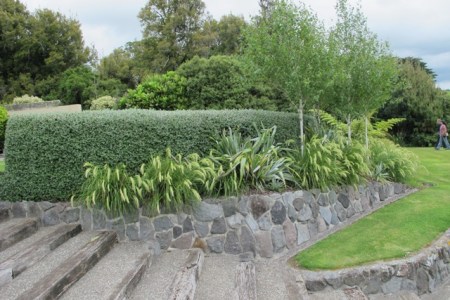
The Foreman Garden in Lepperton

The Foreman Garden in Lepperton

I visited two local gardens last week which I would describe as modern or contemporary examples. Both are the creations of younger woman who are very keen gardeners and both are beautifully maintained and represent a great deal of time, thought and skill. The first was an example of green and brown austerity with a very limited range of plants, which has its origins in the modernist style though I found the use of curves to be more sympathetic to the surrounding countryside than hard edged symmetry. The total package of “the look” was what mattered and it was clearly designed to be as static as is possible when working with living plants. It was well executed and I can enjoy looking at such a garden, even if it is not to my personal taste.
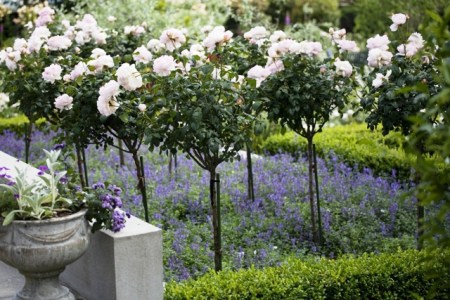
La Rosaleda - photo credit Jane Dove Juneau

La Rosaleda – photo credit Jane Dove Juneau

The second garden was equally beautifully executed but could not be more different. It was an over the top riot of flowers, particularly roses, where the owner wields total control over the colour scheme and every plant combination represents thought. But pastel. Indubitably pastelle, with the most refined colour transitions throughout the garden. That love affair with the romance of pastel colour and the rejection of primary hues harks back to the Edwardian rejection of the garish Victorian gardens. It is incredibly pretty, feminine and romantic and in its most recent incarnation, is just as contemporary as the modernist garden design.

Landscapers are a breed apart from gardeners. That is not a value judgement. They are just on a different path, as indeed are plantspeople who have no interest in design but find the botanical detail of different plants fascinating. Both landscapers and plantspeople have their own unique language which sets them apart, accords them a higher plane is some eyes. In the middle are the gardeners who try to bring together both the design and the plants.

That said, there was one garden in the book that rendered me awestruck. It was the work of Queenstown landscape architect, Paddy Baxter and the location was in a remote area on the flanks of the Remarkables. It was not pretty, it was not conventional. It used pretty much all local native plants and it was the most exquisite example of anchoring a residence into its environment by sensitive landscaping. That was a very fine example of one type of contemporary garden.

First published in the Waikato Times and reprinted here with their permission.

Contemporary Gardens of New Zealand by Carol Bucknell, photography by Sally Tagg

Twenty three gardens by twenty one New Zealand designers – this book has certainly prompted a great deal of discussion here over the past couple of weeks. There is a heavy bias towards high budget properties with stunning views in or around Auckland, often with hard-edged modern, architecturally designed houses. The response is dominated by hard edged, angular gardens, pared back planting schemes largely stripped of colour and heavily dominated by native plants. Water features and swimming pools abound, usually with wet edges of the infinity style (so that the body of water melds into the sky or sea in front) and sometimes with the water lapping at the walls of the house. Generally, there is little evidence that the property owners want to garden themselves. Most want an exterior which will complement their homes, their lifestyle and, apparently, the environmental context of the property.
Two things stop this book from being any more than one for the coffee table book. One is the absence of critique or interpretative commentary. It is a showcase presentation of a narrow selection of modern NZ garden design. The second is the actual design of the book. Unfortunately, the decision was made not to caption the photographs. This of course gives a very clean, some might say contemporary, look to the book but it is not a lot of help to the reader. This is even more so where four photographs are placed on a page with no borders separating the images. We know they are artsy because sometimes one or two are in black and white and sometimes they are cropped so heavily that you are not even sure what the detail that is shown is. Sometimes features referenced in the text are not illustrated in the photographs and it takes frequent flicking backwards and forwards to try and match text to photograph. Given the calibre of the photographer, this almost certainly comes back to the book designer, as does the photo selection.

From the point of view of the reader and given the reportage style of most of the writing, showcasing the photographs with extended captions instead of wodges of descriptive journey around the properties might have integrated text and illustration better.

Sally Tagg is vastly experienced in garden and plant photography. She doesn’t cut corners and the photography throughout is of a very high standard. The author, Carol Bucknell, has faithfully recorded each garden and gives the landscaper’s framework for the decisions behind the design and construction of each. It makes an attractive coffee table book but is unlikely to contribute much to the garden history of NZ.

Contemporary Gardens of New Zealand by Carol Bucknell, photography by Sally Tagg. (Penguin; ISBN: 978 0143 56694 6).

For more thoughts on the topic, related more to the ideas than the book, check out: Modernist gardening, modern gardens and contemporary design

First published in the Waikato Times and reprinted here with their permission.

Plant Collector: Ananas sagenaria

Ananas sagenaria - hardier than a tropical pineapple

Ananas sagenaria – hardier than a tropical pineapple

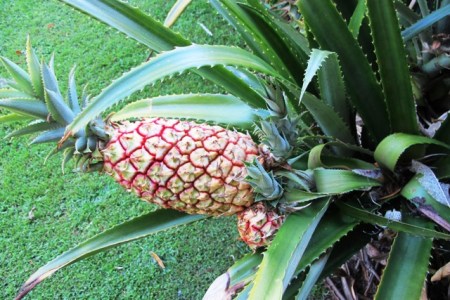
My photograph of a ripe pineapple attracted considerable comment last week and I am pleased to report that it was tasty and sweeter than usual when it came to eating. We have had this pineapple growing in a warm spot against a brick wall for over 50 years now. Its productivity is closely linked to how much care we give it and that is negligible most years. It wants maximum heat, good drainage and plenty of compost but it will survive on benign neglect. It is fiercely prickly.

Pineapples are bromeliads and Felix Jury received A. sagenaria as part of a collection of bromeliads that he imported from Florida back in the late 1950s. It originates from large parts of central and eastern South America and is from the same family as the commercial pineapple – which is usually A. comosus. It is not as good to eat as the tropical pineapple, but it is hardier.

Ananas sagenaria was marketed widely a few years ago, but not by us. We had a wry smile as we watched a Northlander come in, brashly confident that there was a gold mine in it which we had failed to realise. He advertised it widely as the red pineapple and described it as hardy. To us, hardy means it will grow in Christchurch and Invercargill. All we would say about A. sagenaria is that it is hardier than the tropical varieties.

First published in the Waikato Times and reprinted here with their permission.

Garden lore

Subjugated gardens abound, and I can see why. Unless discipline is maintained from the moment the spirit-level is laid across the earth, you are nourishing a vast, tactile, heavy-scented siren which will keep you forever in its thrall.

Hortus by Mirabel Oliver (1990).

Choosing plant containers

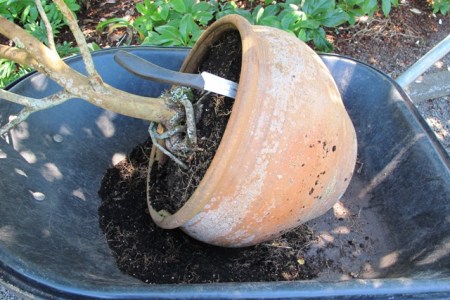
While round bellied pots are often more pleasing to the eye, you will save yourself a lot of trouble if you only plant short term annuals or leafy plants in them. More permanent woody plants fill up the space with dense packed roots and it becomes very difficult to extract them for repotting when the root mass is larger than the opening at the top of the pot. All container plants need repotting at least every two years to stay in optimum health (and who wants an unhealthy looking container plant on display?) but to extract one from a round belly pot requires cutting the roots with a knife until you have it small enough to pull out. Too often you can end up breaking the pot. Straight sided vase shapes or cylinders are a much easier shape to work with for woody plants.

First published in the Waikato Times and reprinted here with their permission.

But where are the hollyhocks?

Bragging rights on the home grown pineapple

Bragging rights on the home grown pineapple

“But where are the hollyhocks? I can’t find any hollyhocks,” the garden visitor said last weekend. I can honestly say that that is a first here. Nobody has ever commented on the absence of hollyhocks before. But it is true. We have none. I haven’t tried growing hollyhocks since the children were young and school gardens were still a part of the gardening calendar. The problem with hollyhocks is that they are very prone to rust in our climate which spoils the look.

There are, of course, many other plants we don’t grow. I can’t think that we have any petunias and gerberas are notable for their absence. Sweet peas we lack. Ditto tuberous begonias and we are distinctly light on fuchsias. Some plants we do not grow because we don’t like them, others because they don’t like us. Some are not worth the effort and presumably at least some are because we have never even thought of growing them.

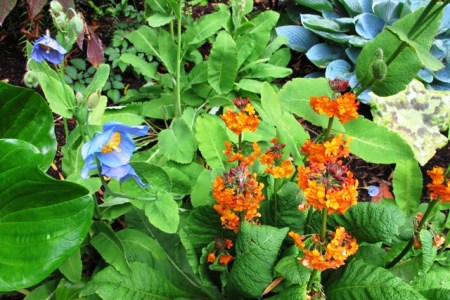
The cold border in the park with meconopsis and Inshriach primulas

The cold border in the park with meconopsis and Inshriach primulas

The challenge for many a keen gardener is to grow plants which are either very difficult or are well out of their natural zone. We certainly identify with this group. It is enormously satisfying to grow something which is not known in your local area. To this end, we are always trying to stretch the climatic boundaries and we do have options in a big garden. Mark put his cold border onto a south facing slope where temperatures are noticeably cooler and he has managed to get some of the plants which want a colder winter settled in. The blue poppies (meconopsis) from the Himalayas, less common but colourful Inshriach primulas from Scotland, the Chatham Island forget-me-nots and the deep coloured burgundy hellebores are all much happier in cooler conditions.

On the ridge above, the Marlborough rock daisy (Pachystegia insignis) and trickier forms of astelias perch in exposed conditions  compensating for our high humidity and mild temperatures. A different north facing slope gives us hotter conditions for the aloes and yucca plants that will rot out elsewhere.

Some highly desirable plants defeat us entirely. We’d certainly grow herbaceous paeonies if we could but they want low humidity, hot, dry summers and dry, cold winters to do well. There is no way we can simulate those conditions. Having had a Dunedin childhood, I loved the Bleeding Heart plant (now named Lamprocapnos spectabilis but formerly and widely known as Dicentra spectabilis). I bought several over a few years to try in different parts of the garden but they never returned for a second season. There was a little lesson there for me – just because garden centres sell a lovely looking plant in full flower does not mean that it is suitable for the local area. Oftimes they are shipped in from places where they do grow well. That is a lesson many others have learned, I am sure.

Where we draw the line is when it comes to having to spray in order to grow plants out of their normal climatic zone. We are not prepared to festoon sensitive plants in frost cloth either but that is because we can’t be bothered and we don’t want that ghostly presence of draped shapes in the garden. Chemical intervention is a step too far altogether.

I have never gotten over my shock when a very experienced gardener told me she kept her alpines alive in our conditions by drenching them in fungicide once a week. I can no longer look at her alpine area as an example of good gardening. Fungicides are not that good for the environment and in my opinion, good practice dictates they should only be used when absolutely necessary and not as a routine application. So no hollyhocks here – we are not going to spray to keep them healthy and we don’t want diseased plants sitting around festering.

If you are not a gardener who relishes the challenge of pushing climatic boundaries, then keeping to plants which are happy in your conditions is going to make life a whole lot easier. This does tend to mean you can’t have a sub tropical garden in Hamilton because winters get cold and frosty. Second daughter attended Waikato University a decade ago and she commented on the gardens she walked past which had clearly been “landscaped” in summer on a tropical theme. Come winter, the plants were blackened, looking very sad and often dead. If you are a novice gardener, take up walking. You can see much more on foot than you will ever see from a car window and noting what is growing well and is being repeated in gardens around your area is a good guide. It may also be an indication of what plants are available for sale.

For those of us who like a challenge, there is nothing quite like the bragging rights that come with… a pineapple! Yes, this was grown and harvested from our very own pineapple patch set against a warm brick wall. Not as sweet as a Dole one but not exactly a run of the mill crop for our area.

First published in the Waikato Times and reprinted here with their permission.