Ayrlies, by Beverley McConnell

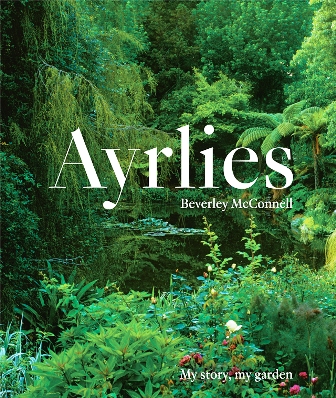
The subtitle of this book is “My story, my garden” and that pretty much captures the flavour. These are Bev McConnell’s memoirs and as both the author and her garden reach maturity, the timing seems entirely appropriate. Her garden, Ayrlies, is located at Whitford, south east of Auckland and over the past 40 years, both the garden and the gardener have earned a leading position. This is a book about a garden, not a gardening book as such. The author writes about her own experiences and while there is wisdom and advice contained in the text, it is not a manual or a reference book.

I have not read anything written by Bev McConnell before, so it was a pleasant discovery to find that she has an easy and very readable style. She is disarmingly frank, almost alarmingly so at times. Given that this substantial and beautifully presented hardback extends to 270 pages, it is just as well the text is engaging. The many photos cover from her early family life in Wairoa (a wonderful photo of her standing on her tricycle seat as a little dot around 3 or 4), through the stages of her adult family life and the development of a bare patch of dirt into the large and handsome garden that is now known as Ayrlies.

In the New Zealand garden scene, Ayrlies is unusual in that it has had skilled labour employed from the start while the owner has kept complete control of the design, the planting and the management and has been an active participant at all stages. It is more common in this country for the major private gardens to have been established on the smell of an oily rag without any permanent staff at all, or, in more recent times for a wealthy owner to have handed over the whole project to a landscaper and crew. Bev McConnell has as much dirt beneath her finger nails as any of the staff she has employed over the years, but she has been able to realise her visions with extra input. It is an enviable position to which she has responded by taking an active role in encouraging others to lift their own standards of gardening. Her own garden is as much about interesting plants and good combinations as it is about design. She has kept her focus on the beguiling complexities of good planting, demonstrated so ably by Beth Chatto in England whom she acknowledges as a major inspiration.

The chapter on her huge wetlands project is particularly interesting and it may be that this will prove to be one of her great legacies over the coming decades.

Ayrlies, by Beverley McConnell (Published by Ayrlies Gardens and Wetlands Trust; ISBN: 978 0 473 21451 7)

First published by Waikato Times and reprinted here with their permission.
The generosity of some gardeners and the vandalism by non gardeners

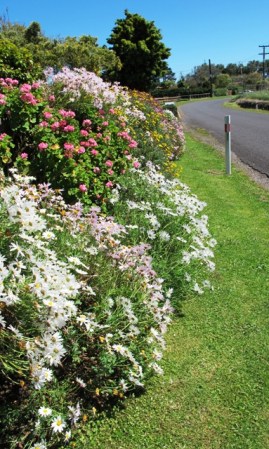
I smile each time I pass a property down our road. The frontage is a froth of flowers for much of the year. There is nothing choice. Most of them are common enough daisy bushes and pelargoniums which balloon out onto the road verge. It is just a delightful picture for the passing motorist – it being in a position where there is no foot traffic. What makes it a little bit special, to my mind, is that the sole reason for this planting is to bring pleasure to passersby. From my vantage point on the road verge, it looks as if the property owner would not really see this particular planting from their house windows or indeed from inside their garden. That shows a generous gardening spirit, in my opinion.
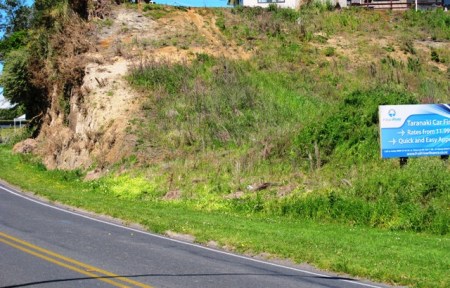
The contrast to the bleak hillside on the edge of my local town could not be more extreme. Until about two years ago, this hillside was fully planted in mixed trees and shrubs, many of which were flowering varieties. I am guessing the property was sold and that it was the previous owners who had planted it up two decades ago. We always enjoyed the roadside view, particularly because at the bottom, it had a well established specimen of our Magnolia Vulcan which the owners must have planted in a prominent position not long after we released it on the market. Being in town, the air temperature tends to be a degree or two warmer so this Vulcan would come into bloom every spring just ahead of the time it opens in our own garden. It was such a feature and was on the way to becoming a mature specimen.

Cleared entirely and left to weeds and erosion

Cleared entirely and left to weeds and erosion

The hillside is too steep to garden intensively or indeed to mow or graze, and it lacks sufficient space to be terraced so there is very little that can be done with it beyond establishing permanent plantings. It took a lot of plants to cover the area but over twenty years, they had grown to give an attractive cover which had knitted together in a patchwork of colour, foliage and flowers. It would have stopped most of the weed growth below, prevented the risk of slipping in rain and given an attractive drive in to reach the house at the top. It would also have required very little maintenance yet it brought a great deal of pleasure to passersby who stood to benefit the most. The house, perched on the top, looked over the plantings.

It must be two years ago now that I drove past as the hillside was being stripped. By stripped, I mean every tree and shrub was removed, even the Magnolia Vulcan at the base of the hill. My heart sank but I thought they must have plans to develop the property differently. Not so. After two years, all that remains are weeds, rank grass growth and clay. But wait – a billboard has appeared, advertising loans at 11.9% to people who cannot afford them to buy new cars. It’s a destructive travesty.

My guess is that new owners moved in and found the shrubs at the top of the slope were starting to block their soaring views across the town and maybe distant views of the river and sea. You have to understand that these are soaring views of a former freezing works town which is not noted for the beauty of its architecture. Rather than seeking advice as to how to frame views, to establish view shafts and to thin or selectively remove problem plants near the top of the slope, they went in and cleared the lot from top to bottom. Believe me, the house will have unimpeded views (and wind) at the top and the owners may never realise how much pleasure people used to receive because of the generous gardening spirit of the previous owners.

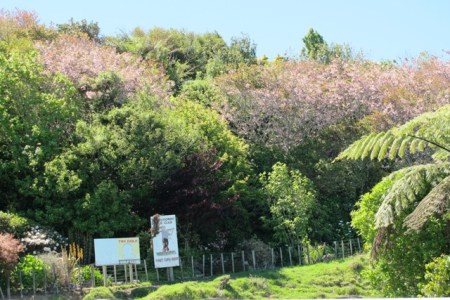
Fortunately, this planting facing State Highway 3 still grows and blooms

Fortunately, this planting facing State Highway 3 still grows and blooms

Fortunately a similar planting alongside the state highway survives. A different owner with another difficult slope of some area, she planted it around the same time. Many rhododendrons, camellias and flowering cherries grace this hillside along with a large specimen of Magnolia grandiflora at the base of the slope. Very little of it will be visible from the house and again it is relatively steep. It too has billboards but in this case they are faded old ones promoting the activity of golf, rather than the town’s newest finance company. Every day thousands of motorists pass the boundary and for three months in spring, many of them will notice seasonal blooms and maybe it will bring a smile to their day.

To me, that sets a standard for generous gardening, way beyond the sharing of cuttings and divisions. With no expectation of admiration or appreciation, these good folk create beautiful plantings in areas where they can see little from their own homes or outdoor living spaces. They are there to be enjoyed by passing strangers.

Plant Collector: Deutzia x rosea

Deutzia x rosea

Deutzia x rosea

Flowering deciduous shrubs are a mainstay of colder climate gardens but less popular in our temperate to warm climes. This means that many gardeners miss out on delights such as this little deutzia. In winter it is a bare bunch of twiggy branches, in summer it is an anonymous leafy shrub with smallish, pointed leaves but in late spring it comes into its own with a mass of small starry flowers. The flowers are comprised of five slightly pleated, bi-coloured petals which sit flat like a daisy with a centre boss of pale gold stamens. If you look closely, they resemble icing flowers or ones made from fabric. There are plenty of blooms held in clusters and it is very pretty and dainty.

Deutzias are a relatively large family of hydrangea relatives and most originate in parts of Asia which experience colder winters. They are cold hardy, unaffected by even heavy frosts. While there are a large number of different species and hybrids, D. x rosea is hybrid between gracilis and purpurascens. Like the majority of deciduous flowering shrubs, it prefers sunny conditions though it doesn’t seem to be too fussy on soils. I think it is best treated as a border shrub where it can shine when in flower and gently meld into the background when it isn’t.

Garden lore

The moment the trees are in bud and the soil is ready to be worked, I generally come down with a crippling muscular complaint as yet unclassified by science. Suffering untold agonies, I nonetheless have myself wheeled to the side line and coach a small, gnarled man of seventy in the preparation of the seed-bed. The division of labour works out perfectly; he spades, pulverizes and rakes the ground, while I call out encouragement and dock his pay whenever he straightens up to light his pipe. The relationship is an ideal one, and I know he will never leave me as long as the chain remains fastened to his leg.

Acres and Pains by S J Perelman (1951).

The narcissi flies are on the wing

The inoffensive adult fly (photo credit: Sandy Rae via Wiki Commons)

The inoffensive adult fly (photo credit: Sandy Rae via Wiki Commons)

The Nazi flies are on the wing. That is what we call the dreaded narcissus fly here. It lays an egg in each of the leaf crowns of the bulbs. That egg hatches in to a larva which wriggles down, enters the bulb and eats it from inside out. Narcissus fly loves daffodil bulbs but also attack a range of other bulbs, including hippeastrums, snowdrops, snowflakes and, apparently, hyacinths. Mark stalks them with a little sprayer of the insecticide, Decis, which is just a synthetic pyrethroid, similar to a strong flyspray. If you are not so inclined, remove the dead and withering foliage of daffodils now and pile a few cm of soil or mulch on top. It makes it much more difficult for the fly to find the crown of the bulb. The narcissus fly resembles a baby bumble bee.

The last day of Festival 2012


Tomorrow marks the final day of the Powerco Taranaki Garden Spectacular for this year. While our garden remains open, the special flavour of Festival ends tomorrow. This means that after that, Mark and I will not be standing in attendance at the entrance all day, meeting and greeting and answering questions. Nor will there be tea and coffee available at all times. And plant sales end for another year.

This morning dawned grey and quickly deteriorated to the worst possible conditions – windy, cold and with torrential rain. Frankly, we were astonished that over 60 determined souls braved the weather to turn up and visit the garden in the morning. But by lunch, in typical Taranaki style, the sun came out, the rain stopped and all the flower and the garden is looking its smartest.

We are open from 8.30am until 5.00pm daily. Admission to the garden during Festival is $12.00 or 3 x Festival tickets. Garden entry includes tea and coffee at this time. We are open from 8.30am with final garden entries at 5.00pm each day. Plant sales end tomorrow.

589 Otaraoa Road, RD 43, Waitara 4383, New Zealand
Email: jury@jury.co.nz | Tel & Fax: +64 6 754 6671

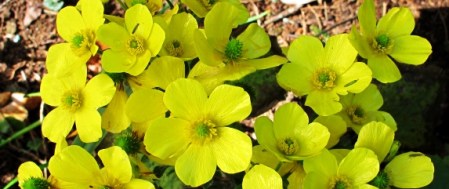
Not a common buttercup - Ranunculus cortusifolius from the Canary Islands

Not a common buttercup – Ranunculus cortusifolius from the Canary Islands