Powerco Taranaki Garden Spectacular

blooms

It’s festival time – the 25th anniversary of what is now known as the Powerco Taranaki Garden Spectacular (formerly the Taranaki Rhododendron and Garden Festival or variants on the same name). This is the single most important time on our garden visitor calendar. Please join us. The garden is looking its very best. Tomorrow (Saturday) we have Guitarra playing in the garden at 1.00pm. Don’t miss the beautiful blend of Spanish classical guitar with strong South American influences.

Tikorangi garden visitors October 2012

Admission to the garden during Festival is $12.00 or 3 x Festival tickets. Garden entry includes tea and coffee at this time. We are open from 8.30am to 5.00pm each day.

589 Otaraoa Road, RD 43, Waitara 4383, New Zealand
Email: jury@jury.co.nz | Tel & Fax: +64 6 754 6671

Meet the maddenii rhododendrons

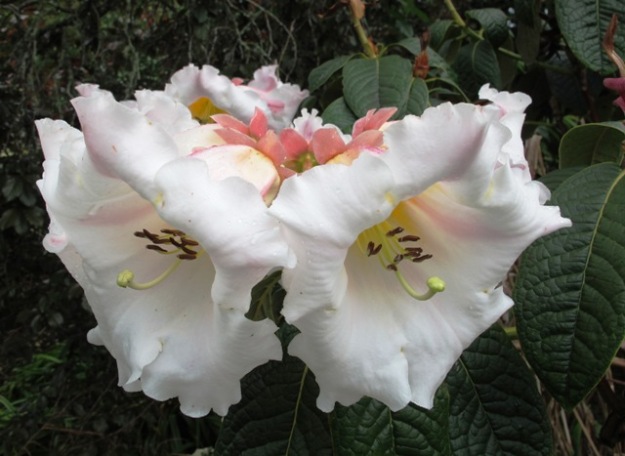
The Rolls Royce of rhododendrons - sino nuttallii

The Rolls Royce of rhododendrons – sino nuttallii

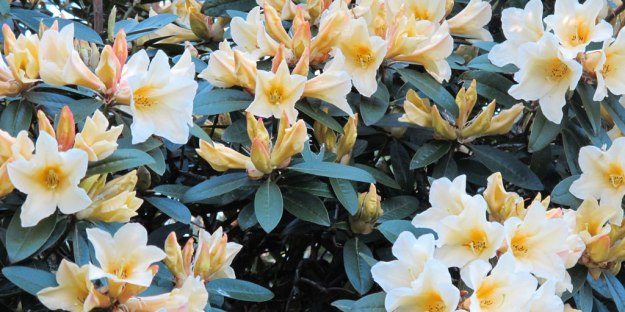
Allow me to introduce you to maddenii rhododendrons. We are pretty keen on them here, although you may not share our enthusiasm if you think all rhododendrons should have the tight ball truss of blooms which is usually regarded as typical of the family. Maddenias don’t hold their flowers in that style.

But the family does include the spectacular nuttalliis with their huge trumpets. I rate these as the most stunning rhododendrons of all with their flowers which look as if they have been cast out of wax and their wonderful, big leaves which are heavily veined – described as bullate foliage. There is nothing quite like them but they are not generally available on the market. They don’t produce much cutting material and they are not easy to propagate but many will set seed so, if you are really keen, you could try raising seed. Some of the hybrids can be found from time to time – Mi Amor and Floral Sun in particular.

There are two huge pluses for the maddeniis. Most are scented, some strongly so. R. polyandrum can waft out for a metre or two which is an indication of a strong scent. Many will pass the 30cm sniff test which is good. And if you are willing to risk the pollen on the nose, most have a sweet scent when you bury your face in the flower.

The second big bonus is that the maddeniis show much better resistance to thrips than most other rhododendrons. Thrips are nasty sucking insects that hide away beneath the leaves, sucking out the chlorophyll. This turns the leaves silver and once that has happened, they can never be turned green again though the new season’s growth will be green, at least until the thrips get hold. Over time, serious infestations can weaken a plant past the point of return. Very cold winters will kill the bugs off, but we don’t get cold enough here so there is not a whole lot one can do beyond spraying with insecticide or neem oil, or trying a cloth collar soaked in systemic insecticide wrapped around the main trunk. Or you can choose varieties which are more resistant.
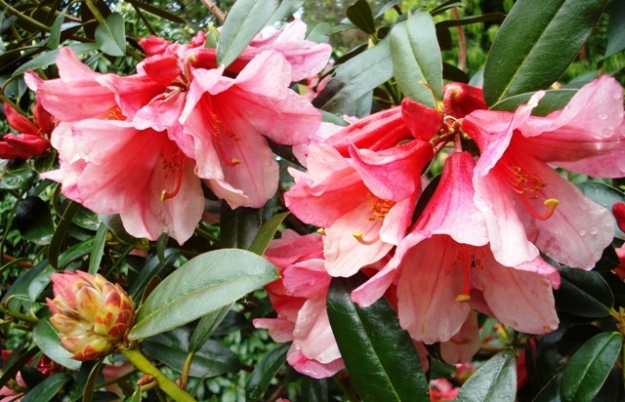
Bernice, as red as the maddeniis get

Bernice, as red as the maddeniis get

There is a preponderance of whites and pastels in the maddeniis and where there are coloured ones, they lean to the subtler, softer shades. In other words, there are no pure reds, purples, blues or oranges. We don’t mind because we can get the stronger colours in azaleas and other types of rhododendrons. Some of the hybrids flower so heavily that it can be like viewing a wall of bloom with barely any foliage visible at all.
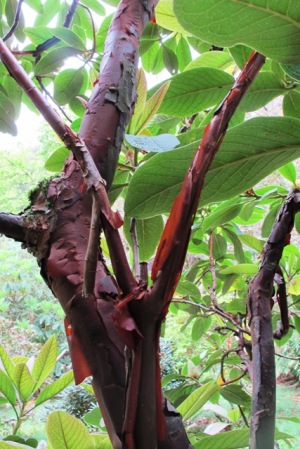
Wonderful peeling bark and bullate foliage

Wonderful peeling bark and bullate foliage

I should perhaps mention also that most of Maddenia types don’t make tidy compact little buns of bushes either. They are inclined to be more open in their growth – though by no means are all of them giants. Some can only be described as leggy, but all is forgiven when they flower. Besides, another attractive feature of these rhododendrons is the lovely peeling cinnamon bark many have. If they were bushy, dense plants, you would never see it.

Google tells me that this group were first introduced to the West in 1849 by famous plant collector Joseph Hooker – he who also visited New Zealand. For reasons which are not entirely clear, he named them after Lieutenant Colonel E Madden of the Bengal Civil Service. How random is that? Given that these rhododendrons are found in northern India, Burma, southern China and the milder areas of Tibet, maybe Lt.-Col. Madden was particularly helpful to Hooker’s expeditions.

Internationally the maddeniis are rated as subtropical and somewhat tender so they are the envy of gardeners from cold climates. Our climate in New Zealand is so temperate that you are able to grow most of the maddeniis in all but the coldest, inland conditions. They form the backbone of the rhododendron collection in our garden and, being later flowering than many others, are coming into bloom right now.

There is no simple way to determine which rhododendrons fall into the maddenii group. That is what books and Google are for. But ones you may find, or know of, include Fragrantissima, Elsie Frye, Princess Alice, Bernice, Moon Orchid, the aforementioned Mi Amor and the plant confusingly known simply as Rhododendron maddenii.

The problem is sourcing these rhododendrons. In fact the problem is sourcing any interesting rhododendrons at all in these days when specialist nurseries have fallen like flies. The best option for Waikato readers may be Rhodohill or Tikitere Nurseries in Rotorua. Failing that, try Trade Me where there is a South Island grower, RhodoDirect, producing and selling by mail order. I have seen them listing the lovely Floral Sun and there are other maddeniis in their range.
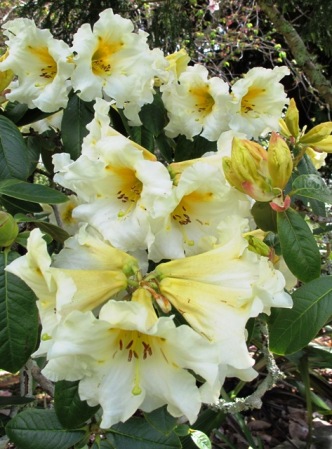
Our very own Floral Sun

Our very own Floral Sun

First published in the Waikato Times and reprinted here with their permission.

Plant Collector: Rhododendron Rubicon

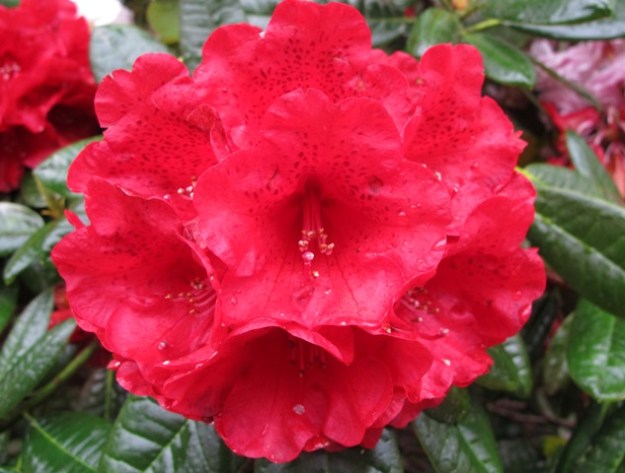
Rhododendron Rubicon - in our opinion, the best big red in the country.

Rhododendron Rubicon – in our opinion, the best big red in the country.

In the world of red rhododendrons, Rubicon stands clear of the rest – at least in my opinion. It is the purest of reds without that common tendency to develop pink tones as it ages, has lovely foliage and a very tidy, rounded habit. It is pretty much perfect in that big full truss class. I should perhaps have qualified my first sentence by saying in the New Zealand world of red rhododendrons because I don’t know how successful it has been overseas but it sure beats the imported varieties we grow. It was bred by the late Ron Gordon from Taihape and first became available in the late 1980s. It is a cross between Kilimanjaro and Noyo Chief and it is superior to both its parents though it was the latter which contributed the good dark, heavily veined foliage that is a feature of Rubicon.

The one downside for us is that Rubicon can get attacked by thrips – those nasty, leaf sucking critters which turn rhododendron leaves silver. Because our plant is in such a prominent position, it is one of the few Mark will spray here. He uses an insecticide but other people report good results using Neem oil to beat thrips.

Rubicon is widely available on the market in this country and is an essential in any collection.

First published in the Waikato Times and reprinted here with their permission.

Garden lore

It is obvious that close planting [of shrubs] gives a furnished look to a border almost immediately, equally obvious that it is wasteful and expensive.

The Well-Tempered Garden by Christopher Lloyd (1973).

Dead heading rhododendrons

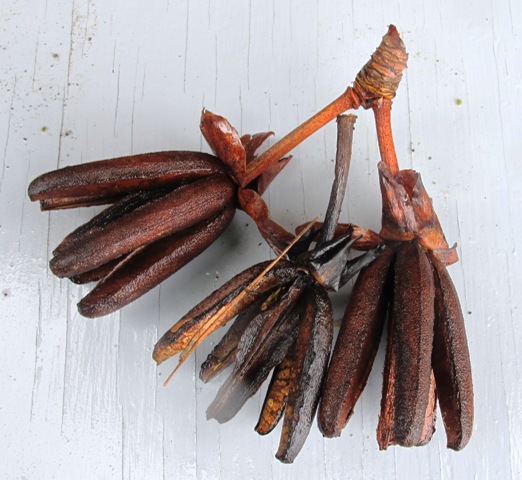
The usual advice is to dead head all rhododendrons. In fact, while they all look a great deal better for dead heading, it is really only necessary to do the ones that set seed. You will be able to tell by looking, if you didn’t do them last year, because they will have spent pods similar (but almost certainly smaller) to the ones shown in the photo. Some rhododendrons can set so much seed that they weaken themselves and eventually die. My neighbour swears by coating his fingers in olive oil before he goes out to dead head. It stops the gunky residue from making your hands sticky.

For the love of wisteria

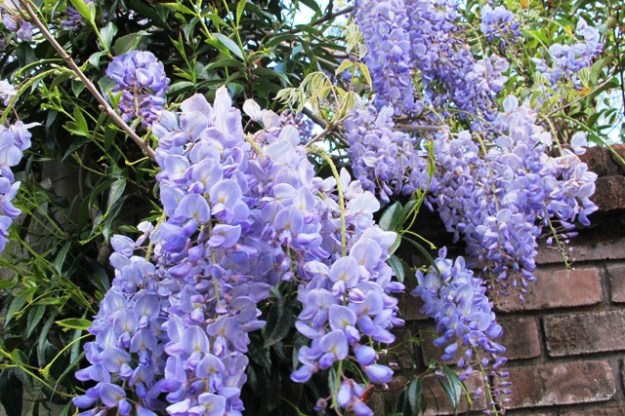
Blue Sapphire - a classic blue sinenis wisteria

Blue Sapphire – a classic blue sinenis wisteria

I am feeling the love for wisterias. This love does not last 52 weeks of the year, but when they are in flower, you would have to be lacking in all romance not to admire them. This week it is Blue Sapphire that is looking its very best. White Silk and Amethyst are just opening, to be followed by Snow Showers and Pink Ice. Even the very names are romantic and evocative.

If you have your wisteria beautifully trained and tied in across your verandah (best with an equally romantic looking old villa or cottage) where its long racemes of fragrant flowers festoon down, so much the better. All you need is the rocking chair with calico cushions to complete the picture. I don’t go there, because I know that in the 49 weeks of the year when it is not flowering, that plant is going to take on triffid-like characteristics and try to split the spouting and drive a wedge between the roof and the ceiling. The oh-so-lovely blue wisteria on the side of our house was eradicated years ago. I was too much of a novice to understand why Mark’s father took it out when it looked so beautiful in flower, but now I understand just how quickly a wayward tendril can leap into a gap in the roof tiles, thicken, harden and bingo, you have a broken tile before you’ve even noticed it got away on you.

One growing season is all it takes. Believe me. I have had the lovely Snow Showers split the plastic spouting immediately outside my office window and I prune thoroughly every year. By autumn, one stem had driven such a wedge between the spouting and the building that something had to give.

Snow Showers - a floribunda selection on our bridge

Snow Showers – a floribunda selection on our bridge

Growing wisteria takes a bit of work. You need to prune them and to train them and picking a suitable location is important. Currently we grow a couple over a wooden bridge (and they have made an attempt to split the bridge timbers), three up strings on a brick wall where they can do no harm beyond leaping into nearby trees if not supervised closely and the aforementioned one up a wooden wall out my office window. I have two waiting to be planted out and they will be going on freestanding metal frames which will support a canopy over time. A bit of forethought can save a lot of trouble later. Wisterias are not something you can plant and leave. I was once told that the largest plant in the world is a wisteria which has layered and leapt its way along 5km somewhere in China. I have no idea if it deserves the title of the largest plant, but I have little doubt that such a one exists.

There are two main groups of wisterias, the Chinese ones (“sinensis” which just means from China) and the Japanese ones (floribunda). The Chinese ones usually have finer leaves and they flower on bare wood before the spring foliage appears. As a relatively random piece of information, the Chinese ones twine anti clockwise whereas the Japanese ones twine clockwise.

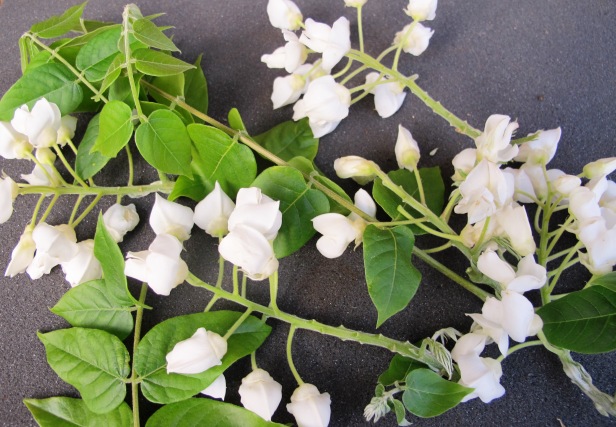
Wisteria White Silk

Wisteria White Silk

The floribunda wisterias flower as the new foliage appears but to compensate, they tend to have much longer racemes of flowers. Some can be 50cm or more and, as the plant gains maturity, the flowers just get better. White Silk (or Shiro Kapitan) is an exception with its short, fat racemes but it makes up in flower size and heavy fragrance what it lacks in festooning capacity. There are also North American species and I have yet to discover whether they twine clockwise or anti clockwise. The ones most commonly available on the market here originate from China and Japan. The flowers resemble pea and bean flowers and indeed wisterias are members of the legume family.

The trunks of these vines are borer fodder supreme. If you look at an old wisteria, you are almost certain to find extensive borer damage. They battle on remarkably well for quite a long time, but left untreated, sooner or later sections will die and snap out. It pays not to put all your trust in one central leader or even a central plait of three leaders. Sooner or later, the borer are likely to take them out so you want to be training the occasional replacement through as well.

Whenever you spot a borer hole or borer sawdust, treat it. Either cut it out or pump the hole full of insecticide (fly spray seems to work) or light oil such as a cooking oil. I favour CRC because the spray cans come with those handy little tubes for poking down the hole.

If you are willing to put the work into managing your wisteria, they will reward you in a most gratifying manner.

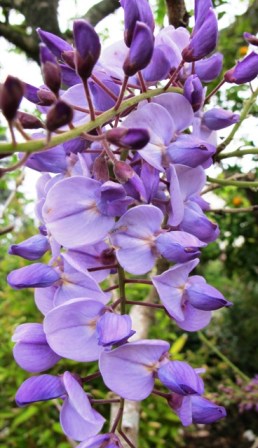
Wisteria Amethyst

Wisteria Amethyst

Help! My wisteria won’t flower.
1) Check for borer infestation and make sure the plant is still alive.
2) The sparrows may have disbudded it. Sometimes they develop a taste for the buds but you should see freshly damaged debris lying below.
3) The plant has been pruned incorrectly in winter. If you cut it back to a stump every year, you are cutting off all the flowering spurs. Sort out the main stems and then prune back all the side canes to three or four buds out from the main framework. That is where the flowers develop from.
4) You have bought a seedling instead of a named variety. Replace it.
5) You have a grafted plant and the root stock has taken over. We much prefer cutting grown wisteria so this problem does not arise. If you can identify what is root stock, remove it to allow the grafted variety to grow without competition. These days, most plants are cutting grown.

First published in the Waikato Times and reprinted here with their permission.