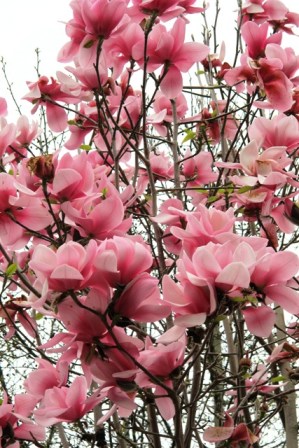
Lynda Hallinan’s year in her country garden

In my flu ridden state last week, I was so grateful to Lynda Hallinan. Her new book, Back to the Land – a Year of Country Gardening – made me laugh out loud on several occasions. She fair sparkles in this book.

Many readers will know Lynda Hallinan as former editor of the NZ Gardener magazine, now editor at large. In that role, she entirely repositioned the magazine to appeal to a younger demographic. She read the mood well and was at the vanguard of the renewed interest in growing food at home to the extent that I uncharitably took to referring to said mag as The Girls’ Vegetable Monthly. But readership figures showed that was where the interest lay and the very personal, anecdotal take on growing food was highly successful. Having met the author on a couple of occasions having had a few dealings with her, we have always known here that she is genuinely interested in a whole range of plants well beyond carrots. That is not always true of garden writers or editors, by any manner of means.

Her book is in diary form, covering from June 1, 2011 to mid May this year – a year in which she adjusted to life back in the country with baby and husband after years of inner city living as a single career woman. To coin a phrase of respect from my late father in law: “she’s a worker, I’ll give you that”. With a new baby, regular writing commissions plus some TV and radio work as well as personal appearances, she is out there gardening on a grand scale. There is a strong emphasis on edible crops but she is also developing a significant ornamental garden. She has a regular stall at Clevedon Farmers’ Market. And she cooks, preserves, pickles and makes various fresh beverages (many alcoholic). All this is managed with family support but without the whole machine of paid staff backing up behind which the likes of Hugh Fearnley-Whittingstall of River Cottage needs to keep his show on track.

As I was reading “Back to the Land”, I started making jokes to Mark about having found New Zealand’s potential answer to Martha Stewart. She is the doyenne of lifestyle, including gardening, in USA – aside from her unfortunate brush with insider trading which resulted in a short period behind bars. Her TV gardening programmes had Mark riveted for a brief time. He was in awe of her compost mountains. Martha, of course, is an expert on everything and does everything properly. “She had better hope,” I said, “that Our Lynda never takes up dog breeding or crafts”. That was before I came to the diary entry: “When I first became interested in gardening, the crafty cottage craze was in full swing. I embroidered pillows with pictures of herbs, made my own natural hand creams and grew swags of English lavender and statice to hang from the rafters to dry.” Right. I am now wondering if I should warn Lynda to stay away from the share market which was so nearly the undoing of her older American counterpart.

So what else did I like about this book? Of course the author can write. She has been a journalist and editor for years. But it was a pleasant surprise to find that, away from the limitations of magazine writing (word count, prescriptive structure and similar external requirements), she can write even better.

There is no commercial sponsorship or intrusive product placement. When the author recommends a product or a source, (which she does freely), the reader can reasonably assume that this is genuine and independent advice. A return to old fashioned credibility, one might say. All sources are acknowledged. In a book packed with practical information but in diary format, there are indexes at the back. Two indexes even – one for recipes and one for gardening. The recipes are wide-ranging and eclectic and it is the most seamless integration of recipes and gardening text that I have seen in any publication. The gardening practices are focussed on sustainability, not quick-fix modern consumerism. Don’t expect to find raised beds filled with endless heavy grade plastic bags of potting mix here.
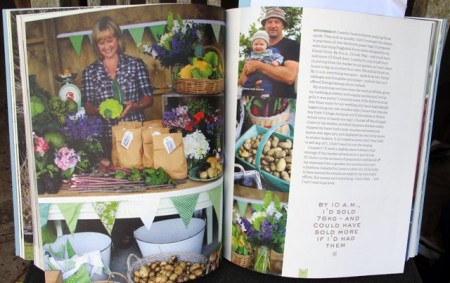
I haven’t even touched on the lovely photography by Sally Tagg. Some are illustrative, many are mood photos. Plant photos are captioned with names. The photos capture the spirit of what is a lifestyle book. The publisher is Penguin which means that the production values are high quality – at last they have the content to match (which can’t be said of all their recent gardening publications). The book evokes a slightly soft focus nostalgia although the content is a thoroughly modern take on old practices.

It is primarily aimed at women. My advice is that, if it appeals, go and buy a copy for yourself now (especially if you need cheering up) and then you will know if you want to buy copies as Christmas presents for others. The growing conditions described in the book are Hunua and will be very similar to much of Waikato.

Move over Martha Stewart. The new generation has come of age in the world of gardening and lifestyle.

Back to the Land. A Year of Country Gardening by Lynda Hallinan. Photography by Sally Tagg. (Penguin; ISBN: 978 0 143 56708 0)


First published in the Waikato Times and reprinted here with their permission.

Garden lore

I’ve noticed something about gardening. You set out to do one thing and pretty soon you’re doing something else, which leads to some other thing, and so on. By the end of the day, you look at the shovel stuck in the half-dug rose bed and wonder what on earth you’ve been doing.

Anne Raven Deep in the Green (1995)

wood ash

wood ash

Wood Ash

Wood ash is a traditional fertiliser but comes with warnings. The ash from your household fires is fine to use as long as you never burn plastics, polystyrene or tanalised timber in your fire. If you have a very efficient modern wood burner which doesn’t leave much ash, what it does leave will be heavily concentrated. Wood ash is alkaline (so acid loving plants won’t like it and if you add too much to your compost heap, it can alter the pH balance). It has good levels of phosphorus and is high in potassium but has no nitrogen. If in doubt, weigh 200 grams in a plastic bag and sprinkle that over a square metre. That will give you a rule of thumb for a light application. Near enough is good enough – it won’t matter if you up the rate. It seems a pity to waste a natural fertiliser when you can use it spread over lawns and garden, especially the vegetable garden, and get a bonus from your firewood.

Published in the Waikato Times and reprinted here with their permission.
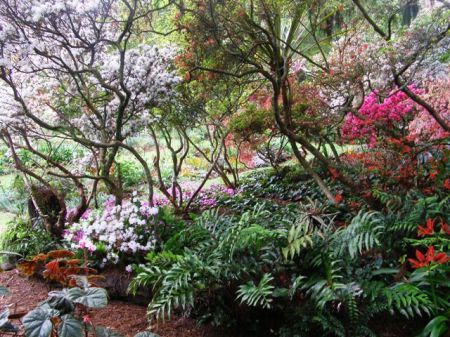
More Tikorangi tui – in Prunus Te Mara this week

Dealing with maturity (in garden terms)

First published in the spring issue of “Our Gardens”, the quarterly magazine of the Garden Clubs of Australia

Sculpted kurume azaleas

Sculpted kurume azaleas

In gardening terms, I guess most people would agree we are blessed. Our climate is mild, never very hot and never very cold. We have regular rain all year round, good sunshine hours and the soils are friable and volcanic. Added to that, we are fortunate to be on a family property where the oldest trees were planted by Mark’s great grandfather in 1880. These give a wonderful mature backbone to the garden and how obliging of him to have planted an entire avenue of our majestic native rimu trees.

Notwithstanding the big trees, the majority of our plantings date back to the 1950s and having a mature garden offers its own challenges. Finding space for new plants can be problematic, even though we have reasonable acreage (we open about seven acres to the public). But the biggest challenge of having a mature garden is to stop it all melding together and becoming walls of foliage which choke out the less vigorous plants. Increasingly we find ourselves doing more lifting and limbing, shaping and clipping.

We like to use plants as focal points and features. Our garden is light on ornamentation. You won’t find anything armless, legless or white lighting up a dark corner. We prefer to place garden seats where we will sit on them, rather than using them as focal points. When sculpture is used in gardens, we think it becomes the dominant feature, forcing the garden setting and the plants into the background. We want the plants to be the stars.

There is no shortage of candidates for clipping or shaping but we do not want the Italian formality where almost every plant is manipulated. This is not about topiary so much as it is about finding the natural shapes within the plants and featuring them.

Clipping Mine No Yuki

Clipping Mine No Yuki

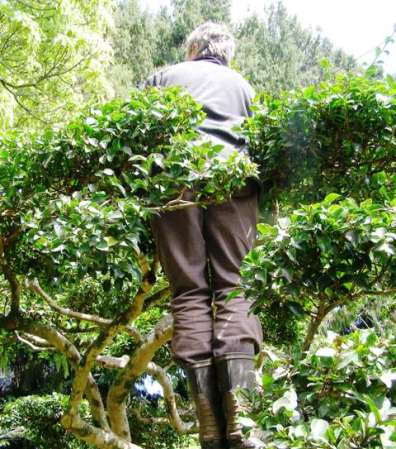
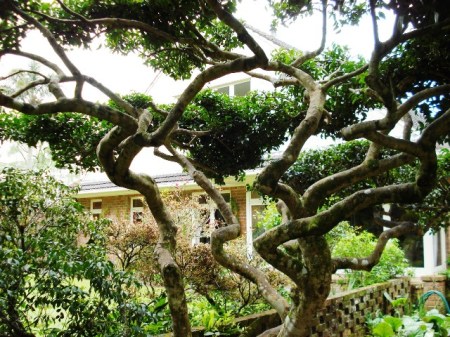
Maples can develop a wonderful form over time which just needs cleaning up. Loropetalums also clip and shape well. We keep our small flowered Kurume azaleas limbed up so that it is possible to look through them. The trunks naturally grow white lichen and, in season, the undulating tops of the azaleas form a carpet of colour, while we have species cyclamen planted beneath around the white trunks.

Camellias are wonderful for clipping because their growth rates are not too fast and, if you make a mistake, they will sprout again from bare wood. We have a massive plant of the white sasanqua, “Mine No Yuki”, which looks wonderful with its pristine white blooms until we have a heavy downpour to turn them to brown sludge. These days we regard any flowers as a bonus and the plant justifies its garden space because of its shape. We keep it tightly clipped into layered mounds – generally referred to as cloud pruning in a technique associated with Oriental gardens.

The finished product

The finished product

Fairy Magnolia Blush

Fairy Magnolia Blush

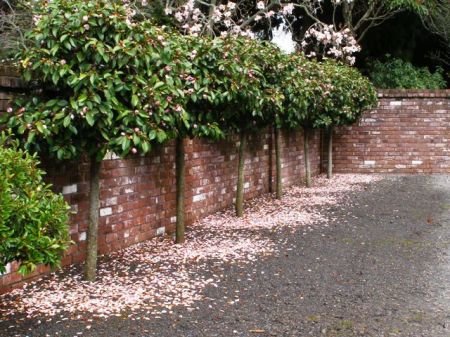
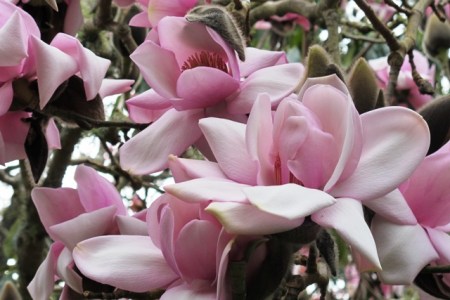
Michelias also lend themselves to shaping and the lollipop Fairy Magnolia Blushes at our entranceway are a more recent addition. A light pruning twice a year with secateurs keeps them to a tidy shape and we have been able to stop them getting too large.

It is all much more fun than weeding and gives us the detail and focal points we want.

Mark and Abbie Jury garden at Tikorangi, The Jury Garden in Taranaki on the west coast of the North Island of New Zealand. Like his father before him, Mark is a plant breeder, probably best known in Australia for his Fairy Magnolia Blush, Camellia Volunteer, Magnolias Black Tulip and Felix Jury and his joint venture plant with his father, Cordyline Red Fountain. Abbie is a garden writer for national and regional publications. Their garden opens for the magnolia display at the start of August and remains open until the end of March.
Website: http://www.jury.co.nz
Facebook: facebook.com/thejurygarden
Twitter: @Tikorangi

New post on Magnolia Diary.

Magnolia Mark Jury - what else could it be?

Magnolia Mark Jury – what else could it be?

Three years ago, I charted the magnolia flowering season here in a Magnolia Diary. Just posted is an update explaining why, despite raising hundreds of different magnolias over a period of 60 years here, we have only ever named eleven – eight of Felix Jury’s breeding and three of Mark’s (with a fourth in the pipeline). In the meantime, our magnolia display here goees from strength to strength, with both named varieties (our own, and others) and also-rans from the breeding programme.

Sweetheart is not one of ours, though we would be happy if it was

Sweetheart is not one of ours, though we would be happy if it was