More Tikorangi tui – in Prunus Te Mara this week
First published in the spring issue of “Our Gardens”, the quarterly magazine of the Garden Clubs of Australia
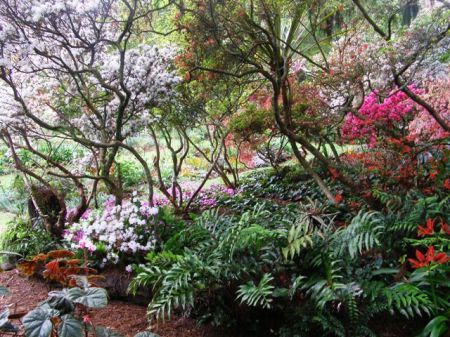
Sculpted kurume azaleas
In gardening terms, I guess most people would agree we are blessed. Our climate is mild, never very hot and never very cold. We have regular rain all year round, good sunshine hours and the soils are friable and volcanic. Added to that, we are fortunate to be on a family property where the oldest trees were planted by Mark’s great grandfather in 1880. These give a wonderful mature backbone to the garden and how obliging of him to have planted an entire avenue of our majestic native rimu trees.
Notwithstanding the big trees, the majority of our plantings date back to the 1950s and having a mature garden offers its own challenges. Finding space for new plants can be problematic, even though we have reasonable acreage (we open about seven acres to the public). But the biggest challenge of having a mature garden is to stop it all melding together and becoming walls of foliage which choke out the less vigorous plants. Increasingly we find ourselves doing more lifting and limbing, shaping and clipping.
We like to use plants as focal points and features. Our garden is light on ornamentation. You won’t find anything armless, legless or white lighting up a dark corner. We prefer to place garden seats where we will sit on them, rather than using them as focal points. When sculpture is used in gardens, we think it becomes the dominant feature, forcing the garden setting and the plants into the background. We want the plants to be the stars.
There is no shortage of candidates for clipping or shaping but we do not want the Italian formality where almost every plant is manipulated. This is not about topiary so much as it is about finding the natural shapes within the plants and featuring them.
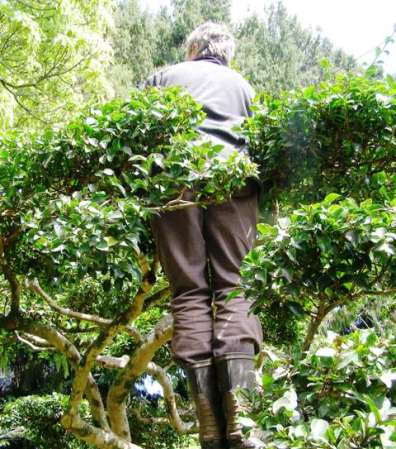
Clipping Mine No Yuki
Maples can develop a wonderful form over time which just needs cleaning up. Loropetalums also clip and shape well. We keep our small flowered Kurume azaleas limbed up so that it is possible to look through them. The trunks naturally grow white lichen and, in season, the undulating tops of the azaleas form a carpet of colour, while we have species cyclamen planted beneath around the white trunks.
Camellias are wonderful for clipping because their growth rates are not too fast and, if you make a mistake, they will sprout again from bare wood. We have a massive plant of the white sasanqua, “Mine No Yuki”, which looks wonderful with its pristine white blooms until we have a heavy downpour to turn them to brown sludge. These days we regard any flowers as a bonus and the plant justifies its garden space because of its shape. We keep it tightly clipped into layered mounds – generally referred to as cloud pruning in a technique associated with Oriental gardens.
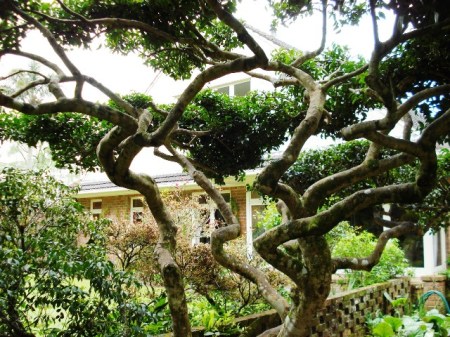
The finished product
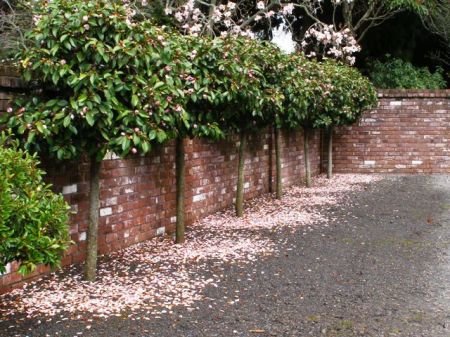
Fairy Magnolia Blush
Michelias also lend themselves to shaping and the lollipop Fairy Magnolia Blushes at our entranceway are a more recent addition. A light pruning twice a year with secateurs keeps them to a tidy shape and we have been able to stop them getting too large.
It is all much more fun than weeding and gives us the detail and focal points we want.
Mark and Abbie Jury garden at Tikorangi, The Jury Garden in Taranaki on the west coast of the North Island of New Zealand. Like his father before him, Mark is a plant breeder, probably best known in Australia for his Fairy Magnolia Blush, Camellia Volunteer, Magnolias Black Tulip and Felix Jury and his joint venture plant with his father, Cordyline Red Fountain. Abbie is a garden writer for national and regional publications. Their garden opens for the magnolia display at the start of August and remains open until the end of March.
Website: http://www.jury.co.nz
Facebook: facebook.com/thejurygarden
Twitter: @Tikorangi

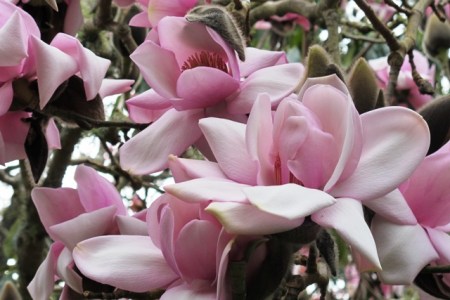
Magnolia Mark Jury – what else could it be?
Three years ago, I charted the magnolia flowering season here in a Magnolia Diary. Just posted is an update explaining why, despite raising hundreds of different magnolias over a period of 60 years here, we have only ever named eleven – eight of Felix Jury’s breeding and three of Mark’s (with a fourth in the pipeline). In the meantime, our magnolia display here goees from strength to strength, with both named varieties (our own, and others) and also-rans from the breeding programme.
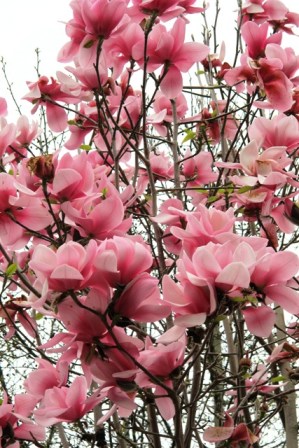
Sweetheart is not one of ours, though we would be happy if it was
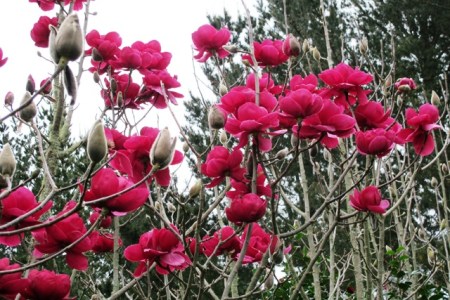
It might as well be Felix, but it’s not
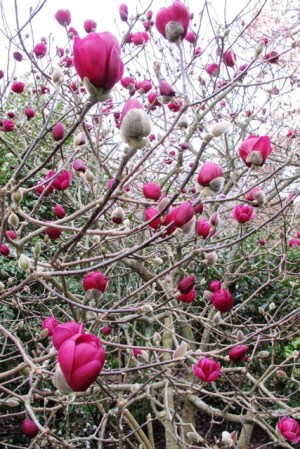
Baby Tulip – a small version of Black Tulip
Magnolia time. Many are surprised to hear that Felix Jury only ever named eight magnolias. Mark has only named and released three so far (with a fourth in the pipeline) despite raising and trialling hundreds. Why so few? We are picky. With the benefit of hindsight, we would probably have released only seven of Felix’s eight. Atlas was named for flower size but really is not up to the quality of the others in terms of long term performance.
We can do plenty of ring-ins, generic copies, slight improvements or variations. But while roses and camellias are like buses (there will be another one along in a few minutes), we see magnolias as being for the long haul. They are nowhere near as easily hiffed out and replaced and most people can only fit one or two into their garden. To name something new means it must be a breakthrough, a major improvement on what is already available. It takes years to trial and select a new magnolia and we like to be very confident with our releases. We took another walk around this afternoon, looking at the lookalikes. At this early to mid season stage, it is still the stronger colours that dominate. I will update as the pales and whites come into full bloom.
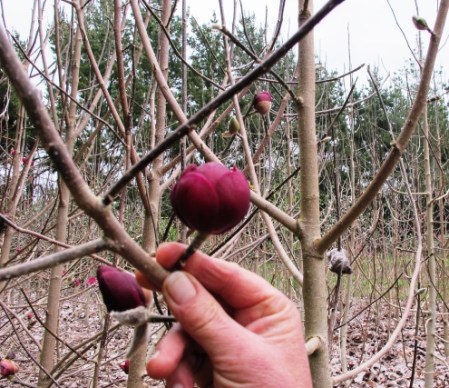
Or how about Bambino Tulip?
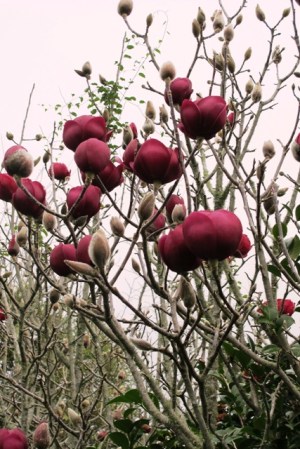
It’s not Black Tulip, but it might as well be
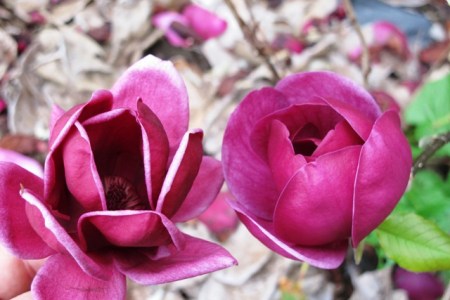
Genie to the left, our seedling to the right

Ruby
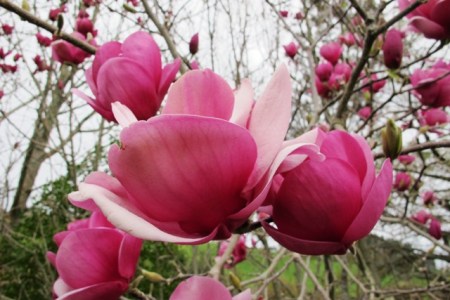
Our equivalent of Ruby
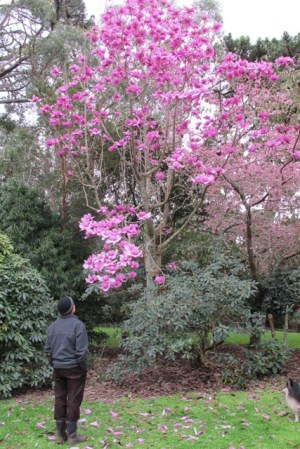
Lanarth sets the standard. Is this significantly better? Probably not.
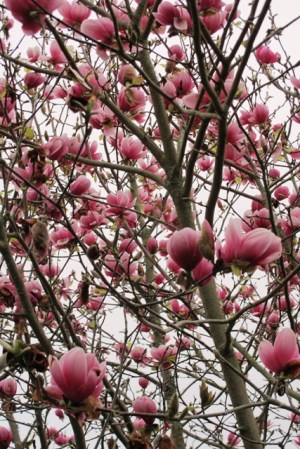
Plenty of generic soulangeanas here
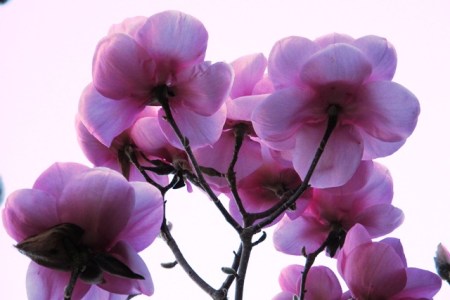
Too much like Iolanthe

But maybe there is a future in patio magnolias?
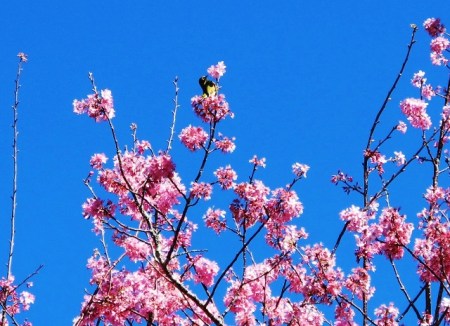
Perched on the very top – the dainty silvereye or tauhou
Fifty eight seconds of video, captured with much delight and good fortune, of kereru feeding on plum blossom. The colours of a Tikorangi springtime.

Magnolia Black Tulip
Somewhat slowed down by a bout of flu and heavy cold this week (the last time this happened would be over a decade ago), I have spent some time photographing birds and magnolias this week. Still tui in abundance, but also kereru, waxeyes (syn. silveryeyes or tauhou) and even the elusive bellbird, all feeding at the same time from Prunus Mimosa. The tui usually chase the bellbirds away. This must surely be one of the most beautiful times of the year here. If you use Facebook, *liking* our garden page will see the magnolia updates arriving on your news feed.
The garden is now open daily. No appointment is necessary. If we are not around, there is an honesty box.
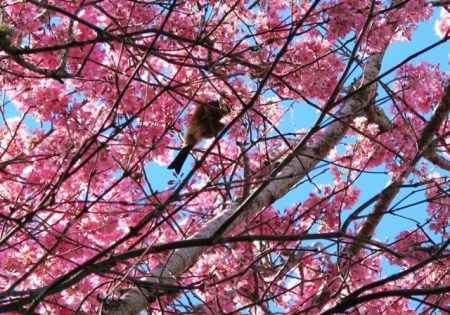
The shy bellbird or korimako
 Tikorangi The Jury Garden