Outdoor Classroom – how to sharpen garden tools

1) Every winter, the advice comes to sharpen and clean tools, but it rarely includes instructions on how sharpening should be done. There is no doubt that good tools with sharp cutting edges make gardening much easier. If you try it, you will believe it. Better quality tools hold a sharp edge longer.

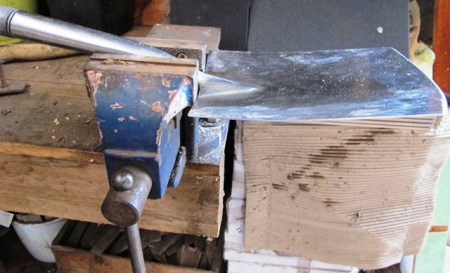
2) It helps to be able to hold larger tools firmly while sharpening and we prefer to do this in a simple workbench vice.

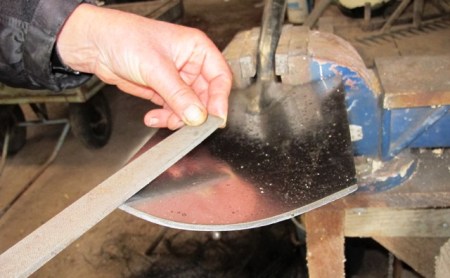
3) Only ever sharpen one side of a spade or push hoe – the side that faces upwards. With a push hoe, this keeps the blade flat to the ground with the cutting angle on the upper side. Spades cut better with one flat side and the upward or outward side bevelled and sharpened. We use a file to sharpen the blade. Home handypeople may go so far as to use an angle grinder but be careful not to overheat the garden tool or you will lose the temper (hardness) of the blade.

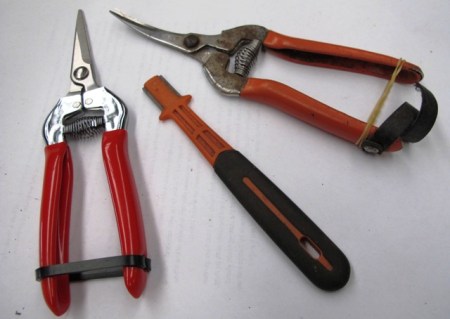
4) An oil stone is the best implement we know for sharpening secateurs and can be bought from a hardware store. Most secateurs are held together with a central bolt and nut. You have to unscrew this to take the blades completely apart. Some CRC or oil may help to loosen it. Do not lose the spring in the process.

5) Wetting the stone with oil, use a gentle circular motion to sharpen one side of the blade. Never sharpen both sides of the blade or you will find it no longer cuts (it is the same with scissors). Cutting relies on a sharp bevelled edge meeting a completely flat surface so always sharpen the side of the blade that is already bevelled. Where you have secateurs like these with one blade incurved, this second blade shown on the table will need to sharpened on a round stone or with a round file because it will not sit flat to this type of stone.

6) A quick-fix sharpen for secateurs and scissors can be achieved with this handy little tool from garden retail outlets. It is also the only way we know of sharpening cheap secateurs held together by rivet, or the grape snips with upward curving blades. Run it along the angled edge of the cutting blade about six times. Remember to sharpen only the bevelled side of each blade. This tool is made by Bahco though there are other brands on the market.

A little bit of Tikorangi at Clarence House

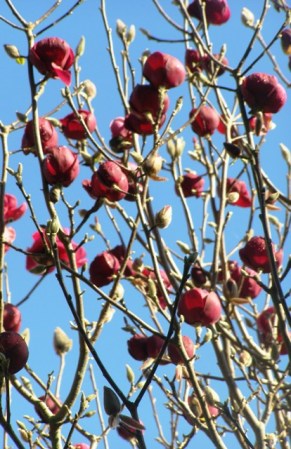
The promise of big fat buds on the magnolias just yesterday morning

The promise of big fat buds on the magnolias just yesterday morning

Latest posts: Friday 29 June, 2012

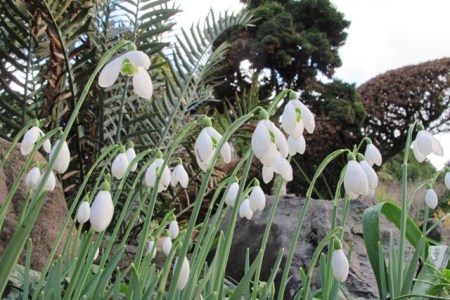
1) Snowdrop season has started!
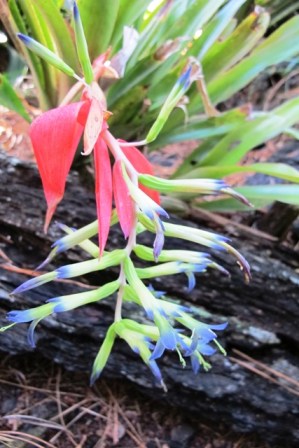
2) Not perhaps for everybody. The exotica of a bilbergia in Plant Collector this week. (Hint: it is a bromeliad).
3) Grow it yourself – whacking great Oriental radishes.

It may take a little while for the Black Tulip at Clarence House to reach this scale of display

It may take a little while for the Black Tulip at Clarence House to reach this scale of display

Tikorangi Notes: Friday June 22, 2012
Without a doubt, the highlight of the week was when it was pointed out to us that the magnolia planted by Aung San Suu Kyi at Clarence House, the London home of the Prince of Wales and Duchess of Cornwall, was in fact none other than our very own Black Tulip. The story came via The Telegraph complete with short video of the Nobel peace laureate and Burmese Opposition leader scooping three spade loads of dirt around the tree. Black Tulip is adjacent to another magnolia planted by the Dalai Lama in 2008.

Magnolia Black Tulip was bred here at Tikorangi by Mark. Last year, the Queen herself was given a presentation of Black Tulip, though it looks as if the Clarence House specimen may be slightly larger.

We are honoured by this international recognition, though Mark would have preferred them to have planted his Magnolia Felix instead. It appears to be performing very well in the UK and the Royals’ gardens are large enough to take large flowered magnolias.

More mid winter delight than harbinger of spring – galanthus (snowdrops)

Galanthus S Arnott is a wonderful performer here

Galanthus S Arnott is a wonderful performer here

It’s snowdrop time. Proper snowdrops which are galanthus. These are widely referred to as English snowdrops, though they are not. In fact they occur naturally throughout Europe and down through the Mediterranean. It is just that the English have made them their own and who can blame them? Snowdrops rank right up there beside daffodils for that feeling of seasonal wonder.

We lack the snow of course, so we don’t get the simple picture of the flowers appearing through melting snow. I assume this is why they are called snowdrops in common parlance.

We will never be galanthophiles here, though that has more to do with climate than anything else. We have a number of different types of snowdrops but most are very marginal in our mild conditions and we struggle to keep them going here so there is no point whatever in collecting as many different ones as we can and keeping them separate, as galanthophiles will. While there are only about twenty species, there are hundreds of named varieties. Most of these are species selections. In other words, while snowdrops will seed down in the wild, particular variations have been selected out and then propagated from that original bulb (as opposed to raised from seed which won’t keep the variation stable – most will revert immediately to the usual form). We could only look in awe at the fabulous prices paid for a very good new white and yellow snowdrop in the UK last year. It was knocking on the door of past times when the wealthy paid vast amounts for a new tulip bulb. While we have the old double variety, G. nivalis Flore Pleno, we have not sought the many variants on doubles. Flore Pleno is not flowering yet so I can’t photograph it but it looks a bit of a mutant and lacks the charm of the simpler, more natural forms in my eyes.

In this country, if you want to see snowdrops in all their glory, the place to go to is Maple Glen where Muriel Davison has built up extensive plantings in her large garden. Unfortunately for northerners, it is sited at Wyndham between Gore and Invercargill so few of us are likely to make it at the right time. Or time a late winter trip to the UK. For years I had a photo a reader sent me of a carpet of snowdrops (and we are talking bulbs in the magnitude of five to six figures all in bloom at the same time) beneath white barked birches somewhere in England.

So I know that our snowdrop efforts here are modest by those standards. But we have snowdrops, and quite a few of them now. The one variety that performs consistently well in our conditions, flowering reliably every year and building up readily, is Galanthus S. Arnott. Apparently it is equally good in the UK because it has been given an Award of Garden Merit from the Royal Horticultural Society.

The peak flowering season is not a long one. It is just enchanting while it lasts and snowdrops lend themselves to drifts in garden borders, on woodland margins, in our growing bulb hillside (coming through the grass) as well as being featured in rockery pockets. They flower at a time when there is not a lot else out. While typically regarded as harbingers of spring, they are more mid winter. We keep gently spreading them further afield in the garden. Many British gardens open in February for what is often called a snowdrop weekend. That is the aim here. It may take us another decade to get sufficient carpets of snowdrops to warrant declaring snowdrop weekend, but we could never be accused of taking the short term view of gardening. And we are well on the way.

Curiously with snowdrops, the practice is to lift, divide and replant soon after flowering. There aren’t many bulbs where you are advised to move them in full growth. In England they are often sold as “green bundles” when still in growth. I have taken from this that they are not fussy so I move them any time now – whether dormant or at any stage of growth. Typical of all bulbs, they need good drainage and reasonable light levels. Woodlands overseas are largely deciduous which means they have more light. Our dominance of evergreens in this country leans us more towards forest than woodland. That is why we go for planting the margins rather than the depths.

Finally, just for clarification, what is often referred to as a snowdrop in New Zealand is an entirely different family. The leucojum is much stronger growing, often found in old homestead paddocks, associating with daffodils. It has the little cup without the surrounding skirt of petals and is less refined than a proper snowdrop. Notwithstanding that, it is an under-rated garden plant with a very long flowering season. But it is a snowflake not a snowdrop.

Snowflake (leucojum) to the left and snowdrop (galanthus) to the right

Snowflake (leucojum) to the left and snowdrop (galanthus) to the right

First published in the Waikato Times and reprinted here with their permission.

Plant Collector: bilbergia

Bilbergia flowering in the winter woodland

Bilbergia flowering in the winter woodland

On a chilly mid winter day, there is nothing more exotic than a bilbergia flowering in the garden. It is a bromeliad, in case you can’t recognise it, and bromeliads can flower through winter when they look impossibly out of context and wonderfully bizarre.

Easily the world’s best known bromeliad is the pineapple, introduced to Europe from South America by none other than Christopher Columbus. All bromeliads are native to the Americas from Virginia south to the northerly reaches of Argentina, with most bilbergias coming from Brazil.

We have never had names on our bromeliads. This one may be Bilbergia distachia – although equally it may not. There are a fairly large number of species and named cultivars to choose from. Bilbergias often have quite a deep cone of foliage and their flowers are pendulous. The downside is that the flowers usually only last a few weeks instead of the months of some other types.

We like them through our evergreen woodland areas which remain frost free. Most are epiphytic, holding water in their vase shaped leaf rosettes and they are a really easy care plant. In more shaded areas, the foliage tends to become more muted but a plainer green backdrop highlights the exotic flowers wonderfully well.

Collecting bromeliads can become quite addictive. If you get keen, there are two comprehensive books on the topic by NZ author, Andrew Steens. Bromeliads for the Contemporary Garden will get you started, then you progress to Bromeliads, The Connoisseur’s Guide. We have a strong preference for using them in mixed plantings so there is not a whole stretch of just bromeliads looking spiky and alien. We find they combine well with clivias, ferns, orchids and other lush shade loving plants which provide a foil to show off their exotica.

First published in the Waikato Times and reprinted here with their permission.

Grow it yourself: Oriental radishes

Two weeks ago, I wrote about European radishes but considering how near our Asian neighbours are, we have been slow to catch on to the oriental varieties. Only the long white Daikon type is now sold widely in this country. According to the Kings’ seed catalogue, over 25% of vegetable production in Japan is radish of the Oriental types. These are larger growing varieties and therefore take somewhat longer to mature but they are still speedy at a two month turnaround from sowing to harvest. Being larger, they are somewhat easier to handle for the cooking process (certainly when it comes to grating into soups and casseroles) and perhaps more akin to a sophisticated turnip substitute for warmer areas where that crop is not suitable.

Oriental radishes are the same botanical family as more common European ones so they are a brassica and don’t want too much nitrogen in the soil. But being considerably larger root vegetables, they will need conditions which are very well cultivated and well drained to a considerable depth. A radish that is 40cm long is not going to like big clods of soil or compacted earth as it stretches downwards. If you can’t get that depth of friable soil, go for one of the squatter, rounder selections or shorter carrot-types rather than the traditional long white daikon. There are some coloured alternatives available as well.

Radish seed is very small and is scattered along the row and covered lightly with soil. You will have to thin after germination. These thinnings are edible so use them in salads or stirfries. Final spacings will depend on the variety you have chosen. Long thin ones will need to be around 10cm spacings, rounder, fatter ones require more room.

First published in the Waikato Times and reprinted here with their permission.