The Ornamental Edible Garden

The Ornamental Edible Garden

The Ornamental Edible Garden

Should you covet a garden which is both edible and ornamental, then this is the book for you. That said, the definition of ornamental is formal in design so you need to be leaning towards a graph paper garden with central axis, quadrants, focal points and geometric layout. You then add the soft furnishings of colour toned or contrasted plants, predominantly edible or medicinal but there is plenty of flexibility in the name of aesthetics. It is a gardening genre which is currently very popular and can be managed on any scale, from tiny to large.

Chapters cover design, construction, planting and both the theory and practice of pleasing planting combinations, plus basic information on growing a whole range of vegetables, herbs, fruit and ornamentals which may qualify. There are hints on soil management and pest control so it is pretty much a complete manual for someone wanting to try this style of gardening. You probably need to be a very tidy, precise sort of person. All the examples in the book are immaculately presented and groomed. If you are a more relaxed gardener, you may want to look at more laissez faire gardening styles.

Although it is a New Zealand publication, the content and style is international, so you won’t get specifics for our conditions. I would have liked to have seen some discussion on the pros and cons of hedging in the edible garden (read: root competition) and building materials get the once over lightly rather than helpful in-depth discussion. I could be a pedant on some of the detail. Rudolf Steiner was many things but I don’t think a horticulturist was one of them – he was a theorist. Not all chemical pesticides are systemic and there are increasing options which are highly specific as opposed to killing indiscriminately. But in the end, these do not detract from what is a useful, credible and highly competent presentation of a gardening style.

Gil Hanly is one of this country’s most experienced garden photographers and it is encouraging to see the publisher willing to commission both an author and a specialist photographer. The book is well organised and well laid out. It has all those things we used to take for granted – index, table of contents, tables of information and charts, well captioned photographs, botanical names – in fact sufficient detail to appeal to gardeners beyond the novice.

The Ornamental Edible Garden by Diana Anthony, photographs by Gil Hanly (David Bateman; ISBN: 978 1 86953 812 5) reviewed by Abbie Jury.

First published in the Waikato Times and reprinted here with their permission.
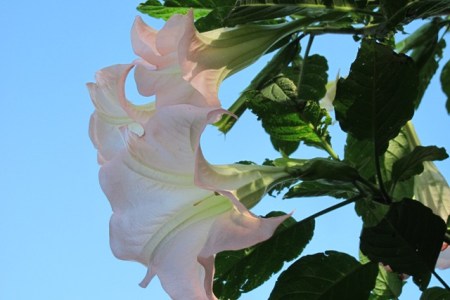
Brugmansia Noel’s Blush

Brugmansia Noel's Blush

Brugmansia Noel's Blush

The late summer sight of this brugmansia in full bloom is striking and the trumpets are a pretty peachy pink in colour. Each bloom can measure 25cm long and up to 20cm across which is on the large side. I was reading a description which said strongly scented which I can’t say I have noticed so I rushed out to sniff. No scent in the morning, I am afraid. It appears they are night scented which is an indication that pollination is carried out by night flying insects, usually moths. The plant itself is a big rangy thing of no beauty – you have to work at keeping it more compact and bushy if you want a tidy plant. Otherwise it is just an overgrown solanum which wows when in flower.

This particular one was named for the late Auckland gardener and plantswoman, Noel Scotting and it came into the country about twenty years ago. Brugmansias are all South American and there seems to be quite a bit of shuffling of species, even though there are not many different species to shuffle. I lean towards the likelihood of this being B. suaveolens from south east Brazil. Or it may be a hybrid. All brugmansias are frost tender.

Brugmansias used to be called daturas, to which they are closely related. They are also very toxic. South American tribes have long used them in traditional medicine for purposes as varied as treating dermatitis, arthritis, prophecy, a ritual hallucinogen and, most scary of all, apparently to discipline naughty children by opening them up to the voices of their spirit ancestors. It sounds like scaring them witless to me. All parts of the plants are toxic and fortunately synthetic illegal drugs have replaced their occasional recreational use which was all too often fatal.

The double white brugmansia featured earlier in this series.

First published in the Waikato Times and reprinted here with their permission.

Grow it yourself: asparagus

Asparagus is a long term crop. For me it ranks as my number one all time favourite vegetable so I am happy to see it in our garden but, as a permanent crop which completely monopolises its allotted area for a decade or even two, it might not be such a worthwhile option in small gardens. Added to that, you can’t start harvesting it for the first couple of years so it is not ideal if you plan on moving or you are renting. We once moved just as an asparagus patch was coming on stream and remain scarred by the experience.

Asparagus does not fit into the current no dig craze. It is a clumping, deciduous perennial and it needs to go into ground which has been very well prepared and which has excellent drainage. The usual recommendation is to dig very thoroughly, creating a trench and adding plenty of well rotted manure and compost. Make sure that you are not planting on top of fresh manure. Give it time to mature. The aim is to create a bed of fertile and friable soil. Asparagus is generally planted as divisions in winter, reasonably deep at 15cm and about 30cm apart. Don’t refill the trench completely on planting. Just put a few cm of dirt on top and keep filling as the fresh shoots grow, otherwise they may never penetrate the surface. It is not the easiest crop to get established but once away, all that is required is regular hand weeding and annual mulching with compost. The compost feeds the asparagus crowns and discourages competing weeds.

If the asparagus crowns you have purchased look very small (and we have had that experience), you may find it more successful starting them in pots until they look sufficiently vigorous to plant out.

First published in the Waikato Times and reprinted here with their permission.
Tikorangi Diary: March 30, 2012

The lovely autumn oxalis - O.eckloniana

The lovely autumn oxalis - O.eckloniana

Latest posts:

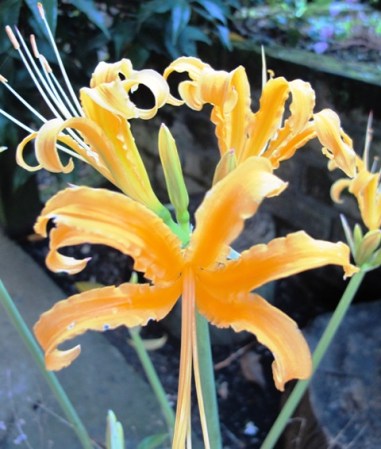
1) Lycoris aurea – the golden spider lily
2) I guess it was inevitable that the thoughts here would be directed to trees after the casualties of last week. We accord them a rather higher value than many New Zealanders who see them as a disposable commodity. Abbie’s column.
3) Grow it yourself: rocket. Merely a humble, quick growing brassica that has been elevated beyond its status in the lexicon of vegetables.
4) In the garden this fortnight and the talk is about sustainability and our guilt over the use of motorised equipment.

The clean up continues

The clean up continues

... and Oxalis massoniana

... and Oxalis massoniana

Tikorangi Diary

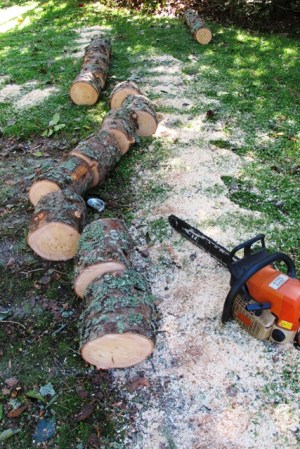
A magic week of weather has seen first Mark and then Lloyd out cleaning up the fallen totara and Picea omorika. It is done. I rather liked the piles of sawdust like a zebra crossing where the ramrod straight trunk of the picea was cut for firewood. While it looked wonderfully straight, the wood lacked heart and was pretty soft.

The pretty ornamental oxalis are all coming on stream. I used to pot some of each to sell but finally figured that too few people shared my pleasure in these autumn bulbs so it was a waste of time potting them. These days we just enjoy them ourselves. The nerines are starting but won’t peak for another week or two.

Plant Collector- Lycoris aurea

Lycoris aurea - the golden spider lily

Lycoris aurea - the golden spider lily

No, it is not a golden nerine in flower. Nerines do not come in yellow or gold and they hail from South Africa. The lycoris is a close botanical relative (both are from the amaryllidaceae family) but a distant geographic one. It comes from China through to Japan and is sometimes called the golden spider lily. Its native habitat is described as limestone country, which is interesting. Maybe it could be naturalised around Te Kuiti? It is a plant of the grasslands and forest margins in southern China and it has apparently naturalised in California.

The lycoris is not rare, it is just not widely available. But when you think about it, there are not many autumn flowering bulbs available commercially. Along with other members of the amaryllis family, it has a relatively large bulb although it prefers to be fully buried, unlike belladonnas and nerines which like to bake with their necks exposed. The lycoris does like a bit of summer heat to ripen the bulb which springs into growth in early autumn by putting up its flower spikes first. These will be followed by strappy green leaves which stay until the bulb goes dormant in late spring. It is renowned as an excellent cut flower.

It appears that lycoris was named for the Roman woman (not of noble birth) who counted various notable lovers including Mark Anthony. Aurea just means yellow.

First published in the Waikato Times and reprinted here with their permission.