Please, value trees

A totara, torn apart by strong winds

A totara, torn apart by strong winds

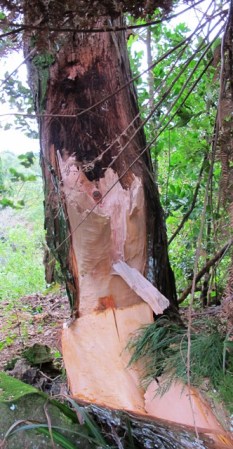
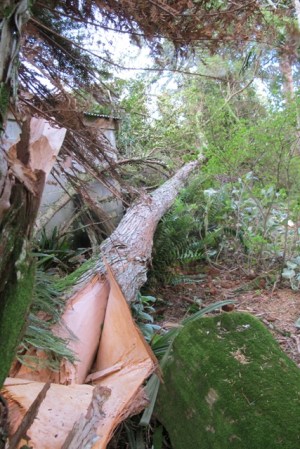
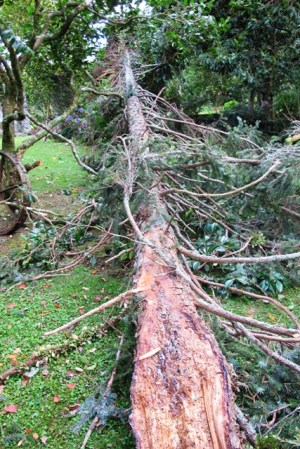
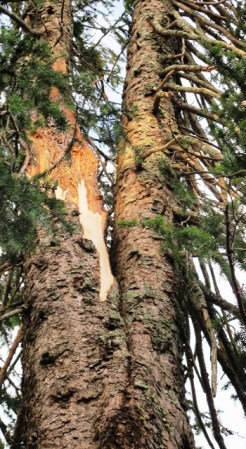
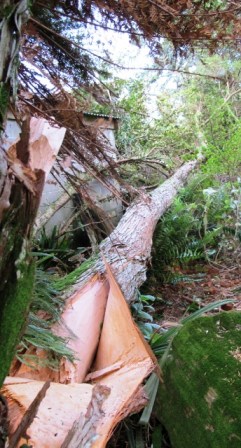
A fierce storm delivered us a sharp reminder last week. Avoid forked trunks in trees. Half a totara split out entirely. It had stood and grown for fifty years. Alas, early in life, the trunk had divided into two leaders and that meant a major structural weakness. The wind tunnel created as a result saw a triple trunked Picea omorika drop one of its leaders. It too was over fifty years old. Early intervention on both trees would have saved us a great deal of work and ensured that what remained was in better shape.

In years of retailing plants, I saw countless people debating over the selection of trees and seeking advice as to whether one tidy little specimen was going to be better than another equally tidy specimen of the same variety. It was very hard to sell a plant with what we call a hockey stick bend at the base. Sometimes this can occur with budded or grafted plants. I rarely bothered trying to explain that a hockey stick on a tree where the trunk is 2.5cm through will not be an issue at all when the trunk is 25cm in diameter. It may be true but it sounded too much like hard sell. The same goes for minor kinks in trunks on juvenile plants. They don’t look the best for the first year but it is not a long term problem. However, forked trunks are a different matter.
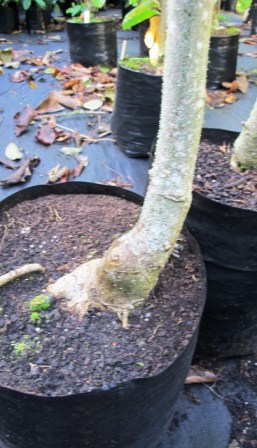
The dreaded hockey stick shaping

The dreaded hockey stick shaping

We are too cavalier in our attitude to trees in this country. Notwithstanding the customer angst about small imperfections, most people spend a great deal more time choosing the right carpet or curtains for their house than in deciding an appropriate variety of tree. Yet those furnishings will long have deteriorated to shabbiness and need replacing before a beautiful tree reaches maturity. You can’t magic up maturity in trees but they are frequently treated as disposable commodities. A combination of ridiculously cheap prices and extraordinarily rapid growth rates in this country has devalued them in the eyes of many.

That said, by no means are all trees equal. City council regulations which set a height above which resource consent is required before trees can be touched have an inbuilt contradiction. Such a rule catches all – trees worth protecting and valuing, trees simply planted in the wrong places and cheap nurse trees of neither long term value nor aesthetic merit.

There is no substitute for a little knowledge. Making an unwise choice may only cost a few dollars at the time of purchase but if it is a rapid growing, brittle variety or one that is shortlived in our conditions, you can pay dearly when it outgrows its allotted space or, in the case of filler trees, outlives its use. Not everybody has a handy person on site with chainsaw, trailer and mulcher and it is very expensive if you have to pay somebody to come in and do it for you.
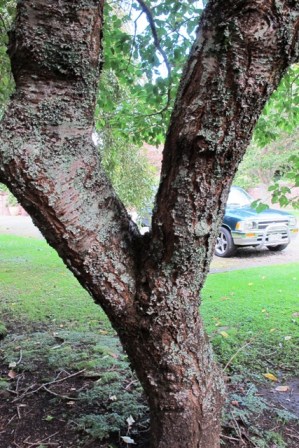
The forked trunk - an inherent structural weakness

The forked trunk - an inherent structural weakness

Similarly, planting trees and leaving them to their own devices can cause major issues further down the track. For the want of a five minute job keeping our Picea omorika and totara to single leaders some fifty years ago, we have faced a cleanup taking at least two days. Some trees naturally multi trunk like an overgrown shrub but most are better kept to a single leader. The sooner you carry out the shaping on such trees, the easier it is. At the really early stage, you can do it with secateurs. Select out the better or best looking leader and either remove competing growths entirely or shorten them to reduce competition for dominance. The longer you leave the situation, the more major the progression of tools becomes – to loppers, a pruning saw and then a chainsaw. Never having mastered the chainsaw, I am a strong advocate for a good quality pruning saw.

While some respond to these issues by deciding that trees are altogether too much of a potential problem and nothing will be allowed to grow beyond two metres in their garden, thank you very much, I would urge you to look beyond these gardening Philistines. I do not think any garden or landscape is complete without trees. It is just a matter of choosing the right ones appropriate to the situation and looking after them while they get established. Spend at least as much time on finding out about suitable selections as you would to choosing something major for your house. I try not to bag garden centre staff, but you might be placing altogether too much trust in many if you think they can give you expert advice on trees as well as on carrot seed. Either find someone who is genuinely knowledgeable or look to books. Some of the very best gardening books I know are about trees and one of the strongest and most knowledgable international horticulture societies is devoted to trees – the IDS or International Dendrology Society. The information is there to find.

Few of us will leave any legacy of note when we shuffle off the mortal coils. But good long term trees planted in the right situation and cared for during the early years of establishment are a fine legacy, to my mind.
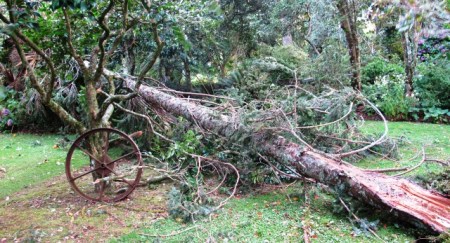
Felling of the Picea omorika by strong wind

Felling of the Picea omorika by strong wind

Recommended books on trees include:
New Zealand’s Native Trees by John Dawson and Rob Lucas (Craig Potton Publishing)
New Trees. Recent Introductions to Cultivation by John Grimshaw, Ross Bayton and Hazel Wilks (Kew)
Trees and their Bark by John and Bunny Mortimer (Taitua Books)
Trees and Shrubs for Flowers/ Fragrance/ Foliage. 3 volumes all by Glyn Church (Batemans)

First published in the Waikato Times and reprinted here with their permission.
Grow it Yourself: Rocket

How did we ever cope when salads were predominantly Iceberg lettuce? Now we expect a mix of leafy greens and the quick maturing rocket has become a bit of a star contributor with its peppery flavour. It is also frequently used as a generous garnish in modern cafe-style cooking.

There are in fact two plants referred to as rocket. The most common is an annual (Eruca sativa). It bolts to seed rather too quickly if grown in midsummer, but autumn and spring are perfect sowing times and you can expect to be harvesting in three to four weeks. Such a quick turn over crop is direct sown into the ground and some gardeners like to sow a small patch every week or two to ensure continued supply. It needs a regular supply of water (which is why it is not the best mid summer crop) to prevent it bolting to seed too soon and in the process getting unpleasantly bitter.

The other plant also referred to as rocket is arugula (technically Diplotaxis tenuifolia). The arugula is slower to mature (Kings Seeds says 55 days as opposed to about 28) and it is considerably slower to bolt to seed. Sometimes it is described as a perennial rocket but it is merely longer lived, rather than truly perennial.

Both forms are brassicas, originally from the Mediterranean. Being brassicas tends to mean they can get infested with white butterflies in summer but grown in the shoulder seasons, they are a tasty addition to salads. They are hardy, so planted now should hold well into winter.

First published in the Waikato Times and reproduced here with their permission.

In the garden this fortnight: Thursday 29 March, 2012

A fortnightly series first published in the Weekend Gardener and reproduced here with their permission.

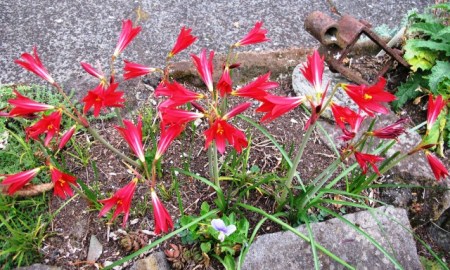
The little known Rhodophiala bifida

The little known Rhodophiala bifida

We keep talking about sustainable gardening here. For us, sustainable garden is twofold – both managing the maintenance of a large garden with a small labour input (wouldn’t we love legions of skilled gardening staff?) but also following garden practices which are not damaging to the environment. To this end we make our own compost, mulch heavily, use a mulcher mower, eradicate or control plants that threaten to become invasive, shun chemical fertilisers and hardly use sprays at all to keep plants healthy. We have a few plants of exceptional note that warrant a touch of insecticide, but generally, if a plant can’t grow well in good conditions, we will not persist with it. A few more roses are destined for the incinerator as I cull further. We do use glyphosate for weed control and Mark lives in fear that it may one day be ruled environmentally unacceptable because we would find it very hard to maintain standards without it.

The enormously useful leaf blower

The enormously useful leaf blower

But our biggest environmental footprint here is the internal combustion engine – the lawnmower, weed eater, mulcher, chainsaw, water blaster and motor blower (leaf blower). We console ourselves with the thought that we are only a one car household and that car often has only one outing a week so maybe that compensates for CO2 emissions. The motor blower is a huge timesaver for a big garden. We started with a cheap handheld one but progressed to a backpack model. It is possible to sweep and groom one’s way right around the garden at walking speed. That is an awful lot faster than doing it with a leaf rake, broom and barrow. As we hurtle at alarming speed from deeply disappointing summer into premature autumn, the blower comes into its own. Fine debris gets dispersed (it does generate dust) while larger leaves can be hustled into discreet areas to break down and rot.

The autumn bulbs are starting. At the moment the little known Rhodophiala bifida is looking terrific as are the red paintbrush blooms of Haemanthus coccineus (the plant many readers may know better as elephant ears). The lovely blue Moraea polystachya is coming into bloom, along with Cyclamen hederafolium and the early nerines are open. These seasonal delights offer some compensation for a summer which never really got going.

Top tasks:

1) As perennials pass over and many fall over, we need to do a tidy up round of the garden borders. Because our temperatures are mild here and we have soils which never stay waterlogged, we can and do lift and divide perennials most of the year. There is still time for plants to re-establish before winter temperatures stop growth.

2) Where repeated use of the blower has led to too much of a build up of debris (mostly in our hellebore border), I need to get through and rake off the surplus for the compost heap before we add this season’s leaf drop.

Tikorangi Notes: Friday March 23, 2012

A salutary lesson in why trees should never be allowed to fork close to the ground - half the totara split out

A salutary lesson in why trees should never be allowed to fork close to the ground - half the totara split out

Latest posts:

1) Ugni molinae or the New Zealand cranberry – a plant that every good family should grow. When it comes to encouraging children to venture out browsing in the garden, it ranks right up alongside fresh peas as a must. It is also easy care and a small shrub so once planted, it will last for years.

2) Clematis tangutica I was a little taken aback to discover that it is regarded as a weed menace in some areas. It has never been a problem here and instead is a source of pleasure in late summer with its lovely pure yellow flowers and silky, tasselled seed heads.

3) Lower maintenance gardening. I am unconvinced that there is any such thing as a low maintenance garden. There are certainly high maintenance gardens, moderate maintenance gardens and lower maintenance gardens but drop down below that and you end up with no garden at all. This week’s column focuses on lower maintenance options as befits a rental property.

4) The Easy Fruit Garden by Clare Matthews might make fruit gardening easy for gardeners in the UK but has little or no application here.

Tikorangi Notes:

At least the falling totara missed the garage

At least the falling totara missed the garage

The Picea omorika felled itself

The Picea omorika felled itself

Last week was all about Womad and the weather held for a magic weekend of world music in the beautiful venue of Pukekura Park. By Monday evening, the magic was all used up and a storm of reasonably impressive proportions hit. Even Spike the dog was unnerved when we heard the unmistakeable sounds of large branches cracking and breaking. In the morning, the damage was clear. A large gust had taken out half a totara tree which would be around fifty years old. The wind tunnel created then broke out part of a Picea omorika around the same age. In falling, the totara twisted a large amelanchier and some drastic remedial action will be needed to save any of it.

The clear lesson here is the need to keep trees to a single leader and a good shape from the start. Forked leaders create a point of weakness, even though it may take 50 years to reveal itself.

We escaped lightly. Friends around Oakura report greater damage. It is only a few weeks since Patea to the south bore the brunt of hurricane force winds. The mess here is largely superficial and with the very large trees we have here, we are relieved that it was not a great deal worse.

Damage to the multi forked Picea omorika several metres up

Damage to the multi forked Picea omorika several metres up

Grow it Yourself: Ugni molinae

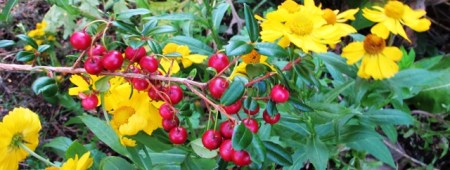
It is a very undemanding little plant to tuck in to a sunny spot in the garden - Ugni molinae or the NZ cranberry

It is a very undemanding little plant to tuck in to a sunny spot in the garden - Ugni molinae or the NZ cranberry

I have to use the proper name for clarity because this plant has five names. The most useful name is the New Zealand cranberry (though it is neither a cranberry, nor a native) because that is what it has always been known as in this country. These days you may find it sold as the Chilean guava – its common name internationally though in New Zealand we mean an entirely different fruit when we refer to Chilean guava. In Australia it is the Tazzieberry. Oft-times, it is referred to by its former name of Myrtus ugni.

Whatever. Grow one, especially in families with children. It is a wonderful plant for browsing as one passes and the fruit is ripe right now. The highly aromatic fruit is small and red like a proper cranberry but only in looks. These are sweet little morsels. The plant stays small, about a metre high, and rangy if you don’t clip and shape it. It is an evergreen shrub that you plant at the end of a row in full sun in the vegetable garden. It roots easily from cutting or is cheap to buy. Sometimes you will see it recommended as a substitute for blighted buxus hedging but it isn’t really ideal. It doesn’t like shade, it can get attacked by thrips (especially when in the shade or clipped tightly) and it can develop bare patches. I have seen handsome trained lollipop specimens in a designer potager but they would take regular work to keep looking that good. We just have a longlived and productive plant that hangs about beside the rosemary bush being undemanding, scruffy but fruitful every year. The fruit is sure to be healthier for feeding small children than packet raisins.

First published in the Waikato Times and reprinted here with their permission.