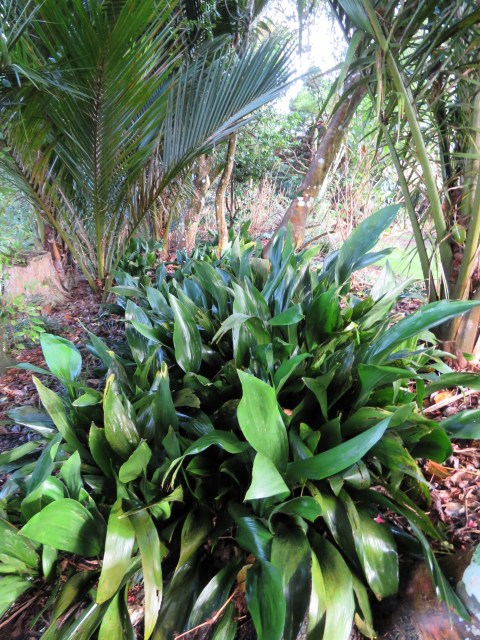
I was this number of years old before I learned that the large patch of healthy but utilitarian ground cover we have growing in one area of shaded woodland is in fact an aspidistra, probably Aspidistra elatior. It was our gardener Zach who told me and all I can say is that a garden apprentice who can teach you things is a treasure.
I had only ever known aspidistras from literature – characterised as a dull, often dusty plant languishing in a corner, sitting on a lace tablecloth in Victorian parlours. They are, I find, commonly referred to as the cast-iron plant because they are seemingly indestructible as a house plant. The Victorians favoured them because they tolerated gas fumes and coal smoke as well as low light levels and drought. They only required occasional dusting, really. It is just a shame they are, perhaps, a litttle… dull.
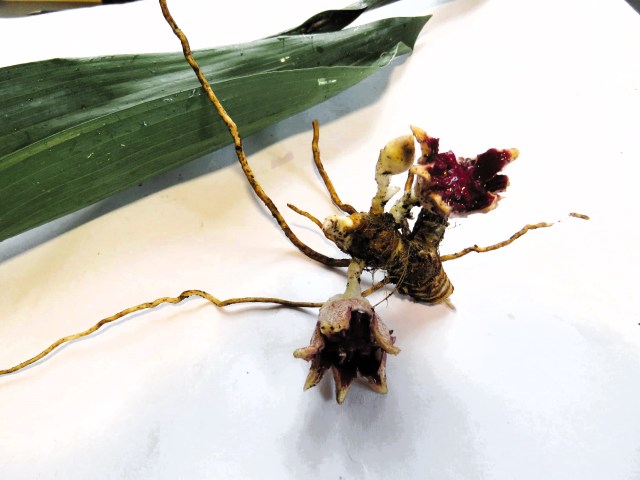
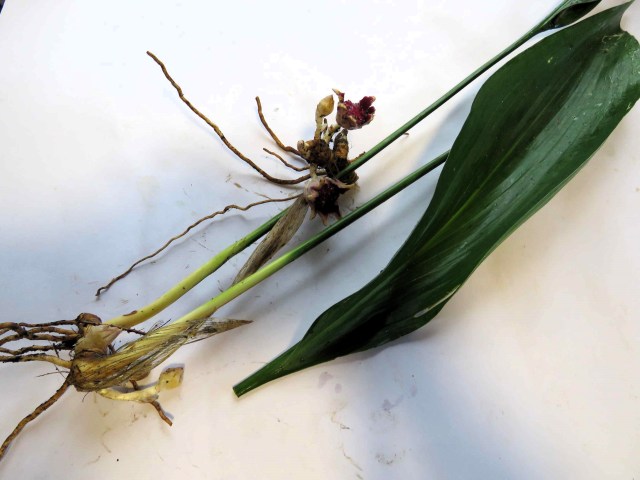
I had looked at this large clump of ours without ever really pondering what it was. I was more disappointed in the fact that I had never seen it flower. I imagined a plant with foliage like that putting up a white spadix-type of bloom, not unlike a peace lily. No, Zach, told me. The flower comes from the base and you have to ferret around the base to find it. No wonder I never saw it flower. The clump has always been one of those anonymous plants that is just there to furnish a space.
The aspidistra flowers are not what I expected
The flowers could be described as curious or, equally, underwhelming. They come up from the rhizome on stems about 1.5cm high and are a fleshy looking cup with a starry burgundy inner about 2cm across. They are very small. And shy. Interesting but never showy.
Aspidistras are a large family of forest-dwelling plants found throughout areas of Asia. In terms of woodland ground cover, they are useful, making a lush clump around knee-high to hip-high. Presumably they are not particularly tasty because the damage from slugs, snails and caterpillars is minimal. The old foliage dies off gracefully and they continue to look lush all year round with absolutely no grooming. All I have ever done is to pull out a bit debris that has fallen from above. In 40 years, we have twice taken bits off to spread a little further in that area – and once was this week. Otherwise, they have kept more or less to their original space, quietly minding their own business.
I am looking at them with more respect now that I have stopped hoping for some large white spadix-type blooms. It seems that as a woodland ground cover, they are as easy-care and accepting of benign neglect as they were in Victorian parlours. Just keep them out of the sun, is apparently the secret.
Growing from rhizomes, aspidistra are easy to divide but also obliging about staying where they are planted and not spreading far and wide
We had our arborist in again this week and there is nothing like getting some tree work done to refresh an area.
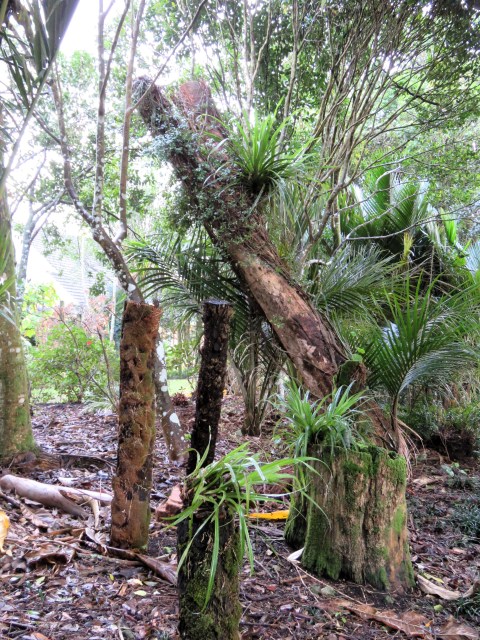
The leaning tower of gum and rātā which was rather larger than it appears in this photo
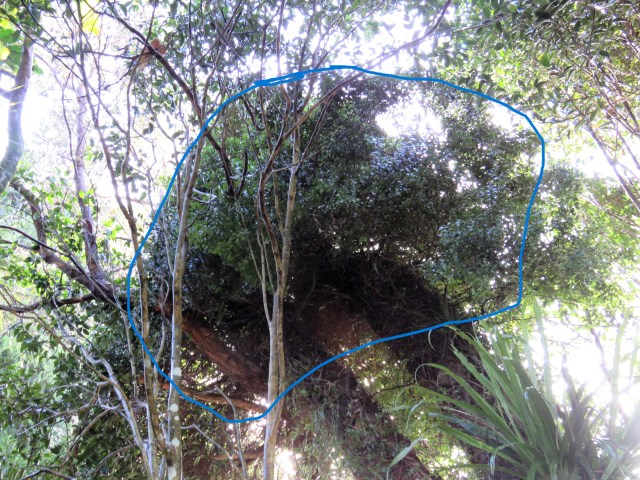
The catalyst was this leaning gum tree which carried the weight of a rātā vine. The host tree was in poor condition and the lean was certainly getting more pronounced. We worried that the weight of the rātā at the top of the tree would bring it all down, potentially bringing down other trees with it and, in the worst case scenario, cutting the power lines to the house. With increasingly frequent extreme weather events these days, we err on the side of anticipating risk and trying to avoid damage.
Circled in blue is the foliage of the rātā vine weighing down the twin trunks of the old gum tree. it looked to be a case of when, not if, it would fall.
Rātā vines climbing the old gum tree trunk
I just looked up rātā, which are a native plant. The Department of Conservation site tells me we have 11 species – 3 are trees, 1 shrub and 6 climbing vines. It is probable that ours was Metrosideros fulgens. It did bloom for us but was never as showy as its cousin, the pohutukawa and the flowers were always right at the top of the canopy so only visible from a distance.
We chose to keep some of the trunk to keep the rātā. It may still fall but it won’t cause much damage if it does.
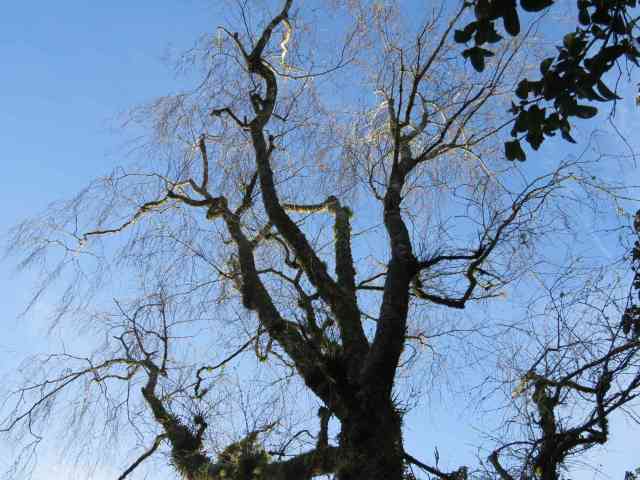
We chose not to fell the gum completely but left about 3 metres of it to keep the rātā. While here, we asked the arborist to drop the last remaining silver birch tree nearby which was not in good health. Once it was down, we could see from the stump that it was completely rotted out in the middle of the trunk with a hollow centre. Silver birches are not good in our climate and their only redeeming feature, in my eyes, is that beautiful tracery of the bare branches against the winter sky. And we dropped a third small tree that had died. It was one Felix had brought back from New Guinea in the late 1950s but it was never as interesting as the lovely Schefflera septulosa, Ficus antiarus and Rhododendron macgregoriae that we still have from that intrepid plant hunting trip.
The silver birch set against the blue winter sky, just before it was felled
Dropping trees lets light in again and opens up areas that then need a touch of renovation. In mature gardens, getting light back in to shaded areas is a constant issue and often requires some quite major work on large trees. Not many plants are happy to grow in deep shade, and few of those are desirable ornamentals.
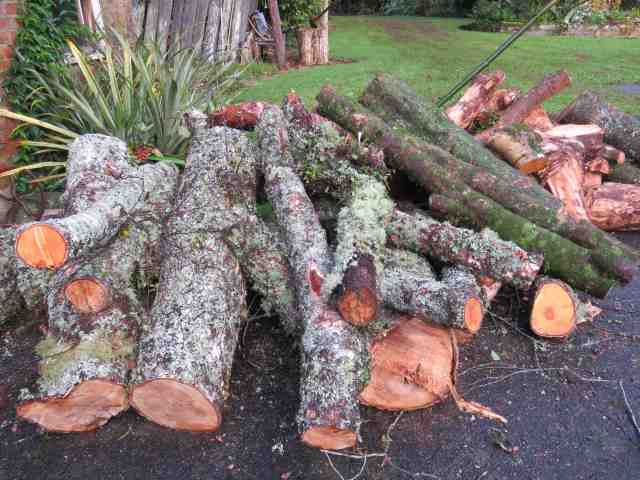
A mix of birch and gum for firewood and waste wood from the unnamed New Guinea tree
Our arborist is very good at cleaning up after himself so he left that day leaving clear space. Empty, but clear. Lloyd, bless him, removed the lengths of firewood to our enormous woodshed the next day and Zach moved in to replant. It was all done and dusted in a couple of days but, with more light, Zach and I are now turning our attention to somewhat messy areas beyond that immediate zone. Which brings me to Zach’s orchid structure.
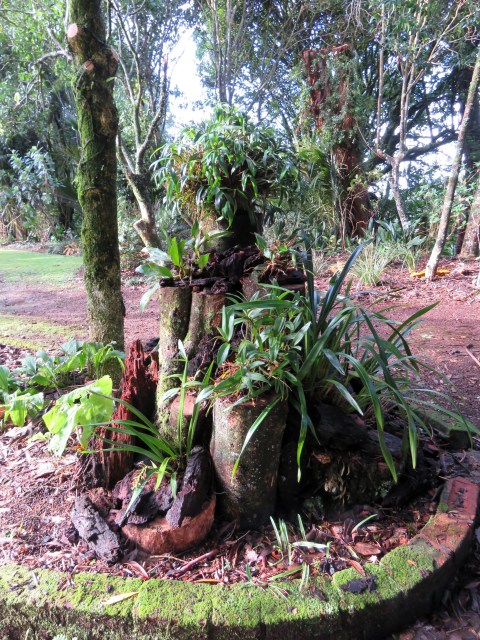
An installation of orchids that looks right at home from the start and adds a point of interest in an otherwise unremarkable spot
The wood from the felled New Guinea tree was too light to use for firewood. It needed to be stowed elsewhere to break down naturally and I suggested to Zach that he use it to make a base for some orchids as a punctuation point at the uninteresting end of an adjacent garden bed. Zach is a keen orchid man. A couple of hours later, I came back to find his construction which exceeded all my expectations. That is all waste wood, already filled with cymbidiums and dendrobiums which are divisions from other plants around the garden. What was a dull space is now a feature which will look charming as the orchids come into flower over the next months and already looks as though it has always been there.
Dropping trees is not a cheap activity but it opens up new possibilities.
A postscript, for those of you for whom chainsaws are a part of life. Our arborist used an electric chainsaw and he declares them to be an absolute gamechanger in every way – safer, quiet, much cheaper to run and a massive improvement in environmental terms. We are still using petrol chainsaws here but Mark was saying that next time we need to buy one, we will buy electric. I have heard others praise them but to have a professional give such a glowing reference convinced me they are the way to go.
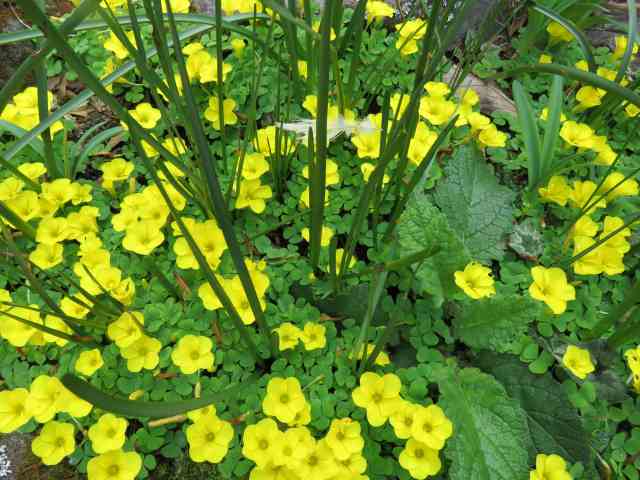
Sunny Oxalis luteola. These bulb oxalis only open their flowers in the sun.
It is easier to maintain specific plant collections when you have a nursery. In that situation, special plants are maintained under nursery conditions and given more individual attention and care than in general garden collections. We used to carry a large array of different bulbs when we were doing mailorder and they were repotted on an annual basis, or at least every two years. We only listed bulbs if we had enough stock reserved to keep going for the following years.
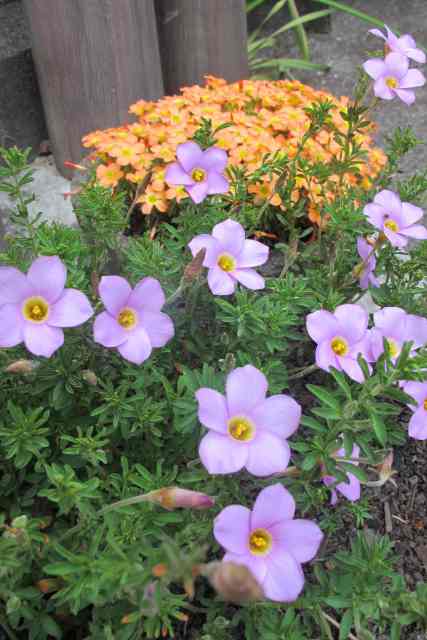
Lilac O. hirta with apricot O. massoniana behind
We put out our last mailorder catalogue in 2003 – twenty years ago – even though I still get email and phone requests from people wanting to order plants from us! In the years since, I have planted most of the good bulbs in the garden, scrapped some that may have been botanical curiosities to half a dozen afficionados throughout the country but were of little merit as garden plants and the rest have languished under a regime best described as benign neglect. Some have not survived this laissez faire approach but, with an extra pair of hands, we are starting to salvage what has.
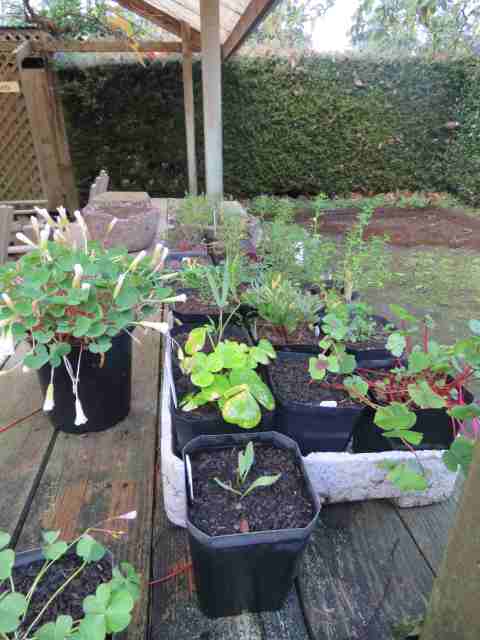
Zach’s oxalis collection is continuing to grow
Our gardener, Zach, is doing his apprenticeship and one of his modules is on plant collections. I suggested the ornamental oxalis as a well-defined collection he could assemble in one place. There is no doubt that most of these thrive and look their best in containers. I have never forgotten Terry Hatch’s magnificent display of oxalis in pots at Joy Plants and that must be 30 years ago.
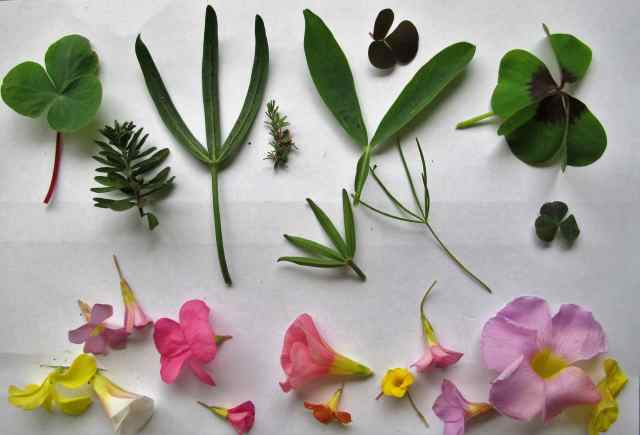
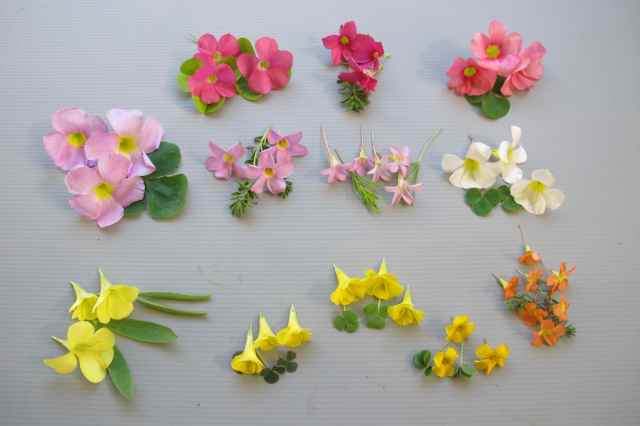
13 different flowers and 10 different examples of oxalis foliage.
For years, I maintained a collection of my favourite oxalis in pots to be brought out when they look their best in autumn and early winter. I hate plastic pots in the garden so they were all in terracotta, ceramic or vintage concrete pots and truly, I just got fed up carting these heavy pots out of the nursery and into the garden and then back again when they were over, not to mention the annual repotting. I gave up and planted them out and let them fend for themselves. The most invasive of them, I put in shallow pots and sank the pot in the garden, but I rarely repotted them.
One of the very best oxalis when it comes to good behaviour and generous flowering over a long period of time – O. purpurea alba
Zach has so far isolated 23 different forms of ornamental oxalis that grow from bulbs. Most are from the garden here and a few he has added from his own stash of plants at homes. (Note: he has just sourced another five from a local market, he tells me.) Amazingly, I think we only lost two varieties in the years between my getting them out of the nursery and him getting them back in again and they weren’t a great loss. I suggested that he also pot up the weedy ones we battle all the time. The creeping oxalis – O. corniculata – which we have in bronze and green is the worst and we have a pink one in a patch of grass that may be O. corymbosa.
O. bowiei
Then there are the more herbaceous oxalis. The best known of these is probably what we call a yam in Aotearoa New Zealand, although technically it is growing from a tuber. Commonly known as oca in Spanish, it is a food crop and one we grow ourselves, semi naturalised in the vegetable garden. Botanically it is Oxalis tuberosa.
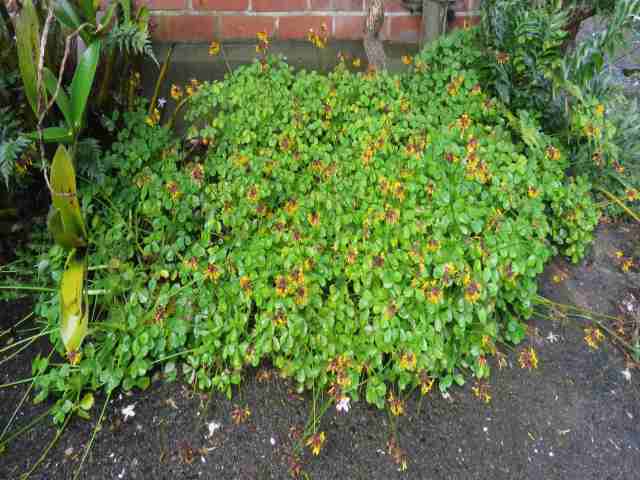
Oxalis peduncularis
We have Oxalis peduncularis growing in one of those awkward, narrow borders against the house and it looks and grows more like a succulent, flowering for most of the year. Now that I am getting my eye in again, I have spotted another plant that is like a dwarf peduncularis but I have never even thought about what it is because it has just always been there, in its place. It must be another oxalis.
The family is huge overall with somewhere over 550 different species in the wild across most of the world except the polar areas. I have only just discovered that we have a native one – Oxalis exilis. It is a small creeping one and I think it is probably one that I assumed was corniculata, too.
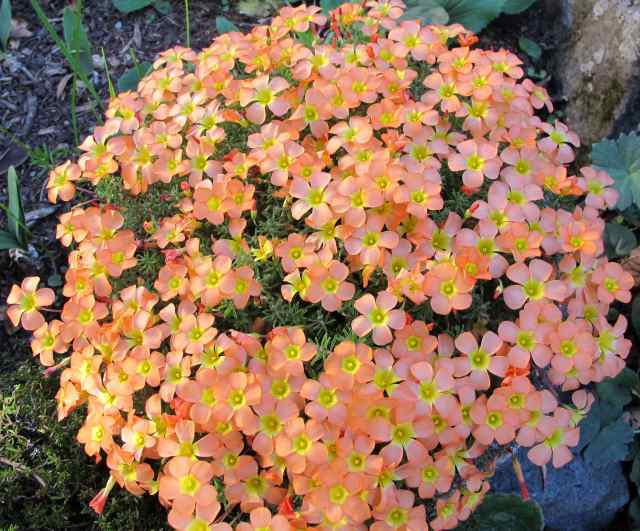
Oxalis massoniana – one of the prettiest in colour and because of its compact growth, it can form a tidy mound
The thing about plants is that the more you learn about them, the more interesting they get. There are many worse rabbit holes in life that one can go down than the intricacies of the oxalis genus. I can see that Zach’s oxalis collection will probably continue and expand long after he has fulfilled the requirements for his level 4 apprenticeship.
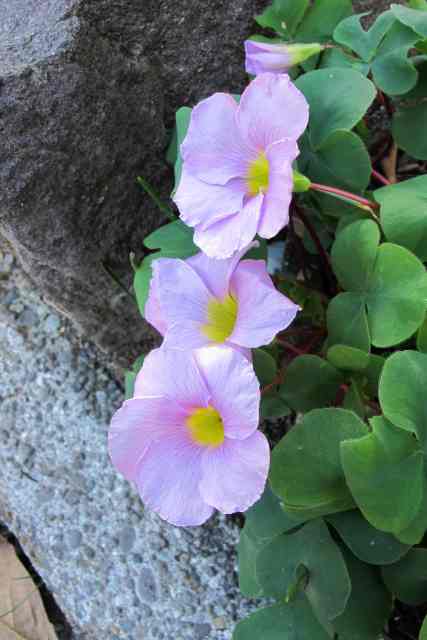
O. eckloniana – probably the largest flower one we have
I am wondering now whether I can get him onto isolating and sorting the intricacies of the lachenalia collection next. That went pretty much the same way as the oxalis collection when we retired from mailorder but is more complicated because of their readiness to cross with each other and produce natural hybrids. He doesn’t need to do it for his apprenticeship but I think he would find it very interesting and it would be satisfying to sort it out again. At least all the lachenalias are bulbs and there are only about 133 species so that makes it more tightly defined.
When the sun returned on Friday, I realised that it was not the rain that had dampened my spirits, it was the low light levels. Clearly, I was never destined to live in northern Europe where I am sure I would suffer from seasonal affective disorder for months every year.
Here in Taranaki, Aotearoa New Zealand, we sit at 39°S which is a similar latitude to California, Ibiza and Sardinia – or Madrid is the usual northern latitude comparator to our country. Not that our climate bears any resemblance to those locations. We are a long, thin country set in the middle of vast oceans which moderates our climate and brings us regular rain – too much rain of late. We have a very clear atmosphere and that clarity of light is apparent in every season where we live. At the winter solstice, we still get around 9 ½ hours of light a day and that is often bright light. No wonder I am accustomed to high light levels.
I have few photos of herbaceous dahlias but this one in an open garden in Canberra, trained, cosseted and protected by an umbrella amused me at the time.
The return of the sun had me out looking at the tree dahlias. These are difficult plants to accommodate in the garden but they certainly have the wow factor at this time of the year. All summer, I have seen friends posting photos of their prized dahlias and, while I admire their enthusiasm, the big, blousy, summer dahlias do not bring me joy. Too many murky colours and novelty forms for my personal taste. The tree dahlias are a different matter.
Dahlia imperialis
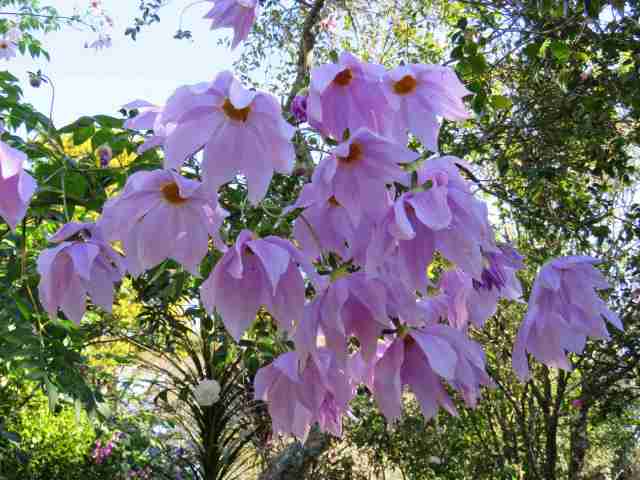
What is not to love about the soaring heights of D. imperialis lilac chalice blooms? When I say soaring heights, because we are growing them in semi shade, they can be stretched up to around 5 or even 6 metres.
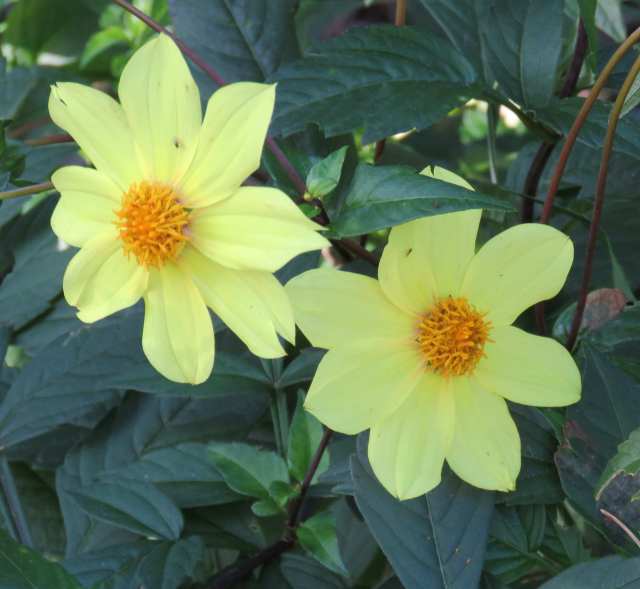
Dahlia ‘Conundrum’
D. imperialis is of course a species and the other species we have, D. excelsa, flowers even later in the season and grows even taller. It is not even showing colour yet. New Zealand plant breeder, Dr Keith Hammett, has done a lot of work over the years to create more amenable tree dahlia hybrids. We don’t have many of them and don’t have the right places to grow many more but I wouldn’t be without his yellow ‘Conundrum’ which flowers pretty much all summer and autumn coming into winter.
Dahlia ‘Timothy Hammett’
‘Timothy Hammett’, named for Keith’s son, is a beautiful and unusual shade of cerise-purple with smaller flowers. Because these tree dahlia blooms have visible central stamens and pollen, they are alive with bees and butterflies at a time when other food sources are getting sparse.
I watched the monarch butterfly flicking away the bee in an irritated manner
I have long since lost the name of the larger flowered, strong pink one we have – if it was ever named – but it is another worthwhile Hammett hybrid. If you want to know more about Keith’s tree dahlias, this article by him in the April Gardener is well worth reading. There is an impressive flower lay showing the range of colours he has reached in his breeding, starting from just four different tree dahlia species.
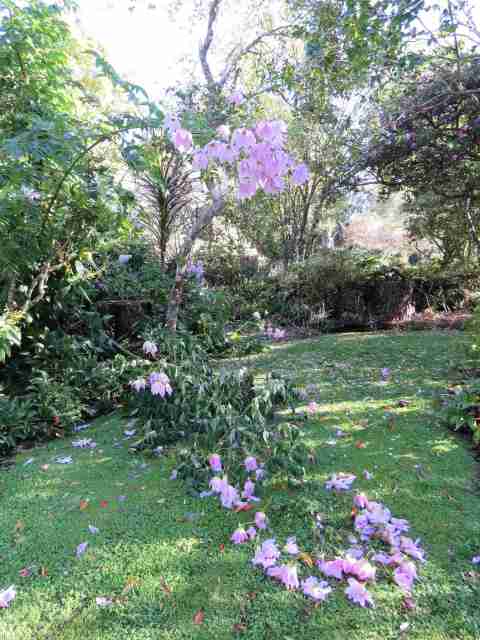
All too common a sight as one of the leaders falls over
I think we need to lift and divide our plants. This has not been done for many years and the tubers on some are very close to the surface. All we have done is to cut them down to the ground when they have finished flowering and reached their weather-beaten, scruffy stage – that is, if they have not fallen over with their own weight before then. They are brittle and vulnerable, especially the tall species. They are not exactly on a scale that I can stake, either.
A small but showy array
I think if we lift them and thin out the tubers, replanting them somewhat deeper than they have been, they may well reward us with sturdier growth and, hopefully, stay upright longer – or at least until they have finished flowering. Until then, I will just enjoy their glorious display as we count down to winter’s arrival. I prefer my life filled with light and colour.
In a week of more greyness and rain, the colour purple took my fancy this week. How pretty is my purple flower lay? I was surprised how many purple flowers I found in the rain and the first blast of winter cold. I included some pastel lavender flowers; had I extended into the pinker lilac hues, I could have doubled the number of different flowers.
It was not the coronation of King Charles that made me think of purple. It is the traditional colour of emperors, reserved for them because it was so difficult, tedious and expensive to extract the purple pigment to use as dye from snail mucus. Charles 111 may have many titles but emperor is not one of them, I think.
I saw very little of the coronation but it seemed, as the king changed his cloaks of many colours, that the colours of the British crown are more about red, white and royal blue with liberal lashings of gold.
No, it was the arrival of Mark’s Veitch Memorial Medal accoutrements. These were despatched by rather slow mail from London, on account of us not being able to travel to the official ceremony. Some of us remember when airmail was the expensive Fast Post option and the cheap alternative was slow boat. These days, airmail is a great deal more expensive but without the speed of delivery. Indeed, it can take as long as the old slow boat option. The certificate is impressive – a full A3 size. Oddly, because we are not given to public displays of such things, Mark felt it warranted hanging so it is destined to join the rogue’s gallery of family photos and pictures that adorn the private area of the spacious upstairs landing.
The purple boxes were discreetly impressive. One holds the medal while the other holds a golden and enamel lapel pin. They can go in the sideboard that holds his father Felix’s matching Veitch medal.
Mark is a reserved man but his delight was palpable.












 Tikorangi The Jury Garden