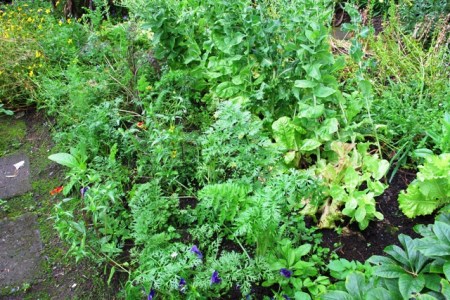
Plant Collector: Cyanella capensis

Cyanella capensis - described by Mark as appearing like a blue gypsohila in the garden

Cyanella capensis - described by Mark as appearing like a blue gypsohila in the garden

There is some debate as to whether this plant is accurately named as Cyanella capensis and whether that is in fact synonymous with Cyanella hyacinthoides, but there is no doubt that it has been a quiet star in the rockery for nigh on two months now. Many bulbs are a wonderful, quick, seasonal flash. Plants like the cyanella which just keep going week after week are considerably rarer.

The “capensis” part of the name gives a clue – South African again, from the Cape Province. It is not a big show-stopper. Like some of the species gladiolus and the ixias, the foliage starts to die off and look scruffy as the flowers open but in this case, the flowers have continued long after the foliage has withered away and disappeared. Each six petalled flower is about 15mm across, lilac blue with golden stamens and masses of them just dance on the leafless branch structure, reminiscent of a blue gypsophila.

We have had this cyanella in the rockery for many years now. I have ferreted around looking for the bulbs to spread further afield but clearly they are of the type which can find its own depth and in this case, that is deep. I have failed to find them. Apparently they are edible and somewhat oniony in flavour, also used in times past as a poultice, so they must be a reasonable size. I may have to have another dig to see. The flowers are pollinated by bees and can set viable seed.

There are different species of cyanella – about seven in fact – and we were given the yellow form, Cyanella lutea but it failed to last the distance with us.

First printed in the Waikato Times and reproduced here with their permission.

The Weird and Wonderful World of Show Vegetables

We are never going to get show vegetables out of our garden

We are never going to get show vegetables out of our garden

There is something wonderfully compelling about the bizarre, the obsessive and the freaky which may explain why even our daughter joined us on the sofa to shriek with laughter at the programme on the Living Channel last Sunday. It was all about growing and showing vegetables in the United Kingdom. Before any readers get defensive, I hasten to add that we have the utmost respect for the skills required and the proud tradition of competing for prizes in various vegetable classes. It is just a tradition which has largely bypassed us in New Zealand so we are bound to find the proud woman holder of the title of World’s Best Potato Grower faintly amusing.

Growing vegetables for show does not have a lot to do with eating them. In fact eating them was never mentioned. Growing 900 onions in the quest for the best sets of five perfectly matched specimens, each weighing 250 grams, does leave one with a rather eyewateringly large excess of produce for ahome grower. And what exactly are you going to do with the other 85 heads of celery which did not make the cut when you selected the best five to show? These are celery plants which have been grown entirely under cover, nursed, mollycoddled, blanched and fussed over until they can reach a massive 150 cm high or even more. They are hardly going to fit in the fridge. But once you have seen them being lovingly washed in a large bath of soapy water and gently groomed with a soft toothbrush, you realise this has nothing to do with home vegetable gardening. It is more akin the vegetable equivalent of the prestigious Crufts Dog Show but without the social pretensions.

There are rigid rules as to what is acceptable and what is not. Immaculate, matched onions are presented with a neat tie of raffia to hold the trimmed top tidily (which sparked a comment from the show host along the lines of: “Nothing finishes a perfect onion like a sheaf of raffia,”) but woe betide anybody who steps over the line to flamboyance. A modest knot may be required, a bow is enough to get you disqualified – or so the husband tells me from another show he watched.

Carrots and parsnips are popular crops but growing them takes special techniques and even then you may not get specimens with precision tapering, let alone perfectly matched sets of three identical specimens. Don’t be thinking that you can win with garden specimens grown in soils. These are grown in drums. First these drums are packed with coarse sand. A tube is then used to extract a perfectly straight column in the sand which is filled with the highest quality, fine garden mix. It has to be sieved garden mix because any untoward chunks could cause the plant’s roots to kink or bend. This is a serious business where timing, technique and crop management is critical. Carrots should have a nicely rounded base and are exhibited without their roots. Parsnips should be perfectly tapered and are measured and exhibited with the long tap root attached in its entirety.

We were riveted, as only holiday-makers on a bleak and windy summer Sunday afternoon can be, to learn that in order to clean and present your carrots or parsnips, you have to gently sponge them in a circular motion. If you rub them up and down, you will scratch the outer skin and cause blemishes. That is a piece of new information which just may or may not be useful at some point in my life.

Presumably it is the exhibitionists who grow the freaks. There was an earlier series on growing extreme vegetables – the parsnip, I was told, grew in a length of downpipe which ran three stories high. In this country, the giant pumpkin growing competitions are relatively common and most of us realise that said competitive pumpkins are not destined for the dining table, being of value only as stock food. Size and weight are everything in the freak classes. Beauty, uniformity and perfection count for nought.

Prize money does not count either. It is fame, glory and recognition. Most of the vegetable competitions in the UK (and there are legions of them) carry prizes of a few pounds only. The costs of competing are hugely greater than any financial reward – best grade seed only, packets of potting mix, washed sand, peat, special fertilisers and sprays and that is just for starters. Mark was a little put out to see that the competitive celery grower had a state of the art glasshouse which left anything we have here completely in the shade despite the fact that we have been professional growers of plants for the last few decades.

This is not to say that we don’t have competitions here. Mark recalls judging the vegetables at some gathering in Otorohanga where he was a guest speaker some years ago. I am sure I must have done it for the local Country Women’s Institute here at some stage. Maybe we are just of more pragmatic stock in this country. I am pretty sure that the vegetables I have seen exhibited here were actually edible and were grown in gardens. This is a very different kettle of fish to show vegetables.

First published in the Waikato Times and reproduced here with their permission.

Grow it Yourself – parsnips

Parsnips are not the most glamorous of vegetables, even less so when old and woody which is usually a sign of being dug too late. But I am very partial to a bit of roast parsnip and they add welcome variety in winter when veg can get a bit repetitive. We are doing a late sowing parsnip seed now for winter harvest. Others will have sown as early as last spring though they are not likely to harvest before winter. They will have considerably larger specimens by then, as long as they do not bolt to seed. From this you can take it that the timing is not critical. They take about four and half months to reach maturity so you can be eating them from July onwards if planting now. It is usual to leave them in the ground and dig as required. They go dormant over winter and frosts are said to enhance the flavour considerably.

The two critical issues are to use fresh seed (parsnip seed does not store well) and to avoid additional fertilisers. Nitrogenous fertilisers will encourage too much top, leafy growth and not enough root development. Fresh manures will cause forked and misshapen roots. Parsnips are a good option where you have taken out a heavily fertilised crop like leafy greens or even potatoes. Don’t add anything extra – there should be plenty of goodness left in the soil. Make sure the soil is well tilled and friable to allow the roots to grow straight. Seed is sown close to the surface and covered lightly. Once it has germinated and is growing away strongly, thin to at least 10cm apart in every direction to allow room to develop. Diseases are not usually an issue and while a few pests can attack parsnips (carrot fly, greenfly and wireworm), this is not usually a big problem.

First published in the Waikato Times and reproduced here with their permission.

Tikorangi Notes: Friday January 6, 2012

Latest Posts:
1) A cautionary tale about garden weddings and completely excessive rain (subtitled: “The Bride Wore Orange”).
2) Hydrangea Libelle (white and blue lacecap) in Plant Collector this week.
3) Grow it Yourself – New Zealand yams (which just happen to be different to what the rest of the world call yams, for reasons unknown).
4) Of day to day matters in the garden – container plants and why we are not fans of water retention crystals.

And not my work at all, but check out the poignant study of “Locksley Avenue – A Portrait of a Street” by Adrienne Rewi. If you have ever wondered what happens to gardens when people are forced to walk away, Christchurch has many such examples. It doesn’t take long for nature to take over, even in a dry climate such as that of Canterbury.

We just refer to it as The Trichocereus

We just refer to it as The Trichocereus

To be accurate, it is Echinopsis pachanoi (syn. Trichocereus pachanoi) and it is in full and fragrant flower again this summer.

A Cautionary Tale about Excessive Rain (subtitled: The Bride Wore Orange)

Did I mention the bride wore orange?

Did I mention the bride wore orange?

As a rule we don’t do garden weddings here but the request came from Second Daughter’s Best Friend so we made an exception on New Year’s Eve. It sounded like fun. The ceremony, cocktail party and dance were all to be in the one place, culminating in fireworks at midnight. Our greatest worry was the potential fire hazard if we had a dry spell. Ha!

The preparation was humming along when the rains started last week. We had the garden ready, edges and hedges sharp and the lawns mowed despite the rain. We just needed one dry spell of a few hours to do the final blower round to present it all at is best. The dry spell never came.
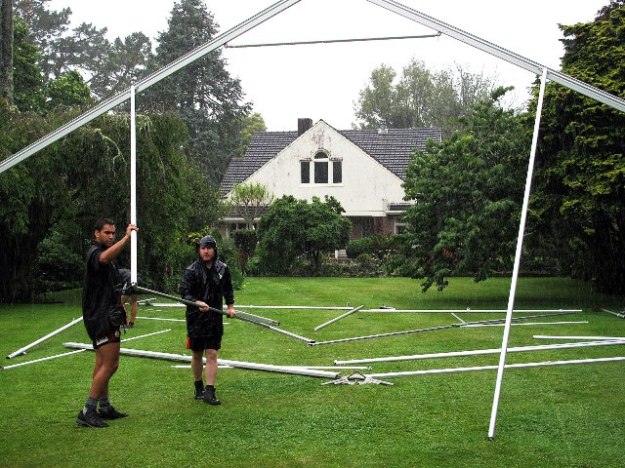
Just likeJust like putting up the family tent, really, but on a grand scale and without the arguments (even in the rain). Photo: Michael Jeans putting up the family tent, really, but without the arguments (even in the rains). Photo: Michael Jeans

Just like putting up the family tent, really, but on a grand scale and without the arguments (even in the rain). Photo: Michael Jeans

On the Friday morning, the marquee company came in. And the rains continued. In case you have wondered, putting up a large marquee (in this case 20m by 10m – we do have a large front lawn) is not unlike a glorified version of putting up the family tent but without the arguments. The marquee men were wet to the skin and had the second, smaller marquee up when the bride arrived to point out that the large one was not in the agreed place and it needed to be moved about two metres. To their everlasting credit, they moved it (in the rain) with remarkably good grace.

The second set of contractors was now on site to do the sound, lighting, furniture, stage and dance floor. They too were wet to the skin and amazingly good natured. But the wheels were starting to fall off. We couldn’t dress the marquee because 100% humidity meant tablecloths and seat cushions would all soak up too much moisture. Nor could the parquet dance floor go down. Practicing an aura of calm (after all, it wasn’t my daughter’s wedding), I told the bride’s mother not to worry and I would do it in the morning for her because the bridal party and family all had hair and makeup appointments.

In the morning, the rain was unrelenting. Now all the rain which would normally be absorbed into the lawn was being directed down the sides of the marquees and flowing like a small sea in underneath. Needs must. The dance floor was laid. I dressed the marquees. And as the rain got worse, the need for crisis management grew. We were doing a bit of reconfiguration using four extra small gazebos which was all we could rustle up. I established umbrella stations (we own quite a few brollies) for the dash between covered areas. The cake had to be brought in under an umbrella (couldn’t have the icing pockmarked). The band were loading in gear as fast as they could in the rain. We could at least park the caterers with undercover access though the bar staff were getting saturated moving alcohol and glasses to their location in a wheelbarrow.

By this time, I was soaked to the skin and dressed like an old tramp but abandoned all plans to find the time to get changed and flossied up (we were invited guests at the event) until after the guests had arrived on the three coaches. We have issues with the need to get large vehicles off our road here but are very experienced at managing our available space and can turn and park the largest coach. So did I need to meet prima donna coach drivers who tell me that I have no idea what I am talking about and there is insufficient space? No I did not. But rather than argue in front of guests (I was feeling at a sartorial disadvantage), I headed out to the road to manage any traffic there (it is designated petro chemical highway, is our country road) while the prima donna drivers disgorged passengers and then thought nothing of blocking both lanes as they fluffed around sorting out turning their coaches.

It was about this time, I noticed the rain had stopped. Such are the wonders of our drainage that we only need 20 minutes without rain and all surface water disappears.
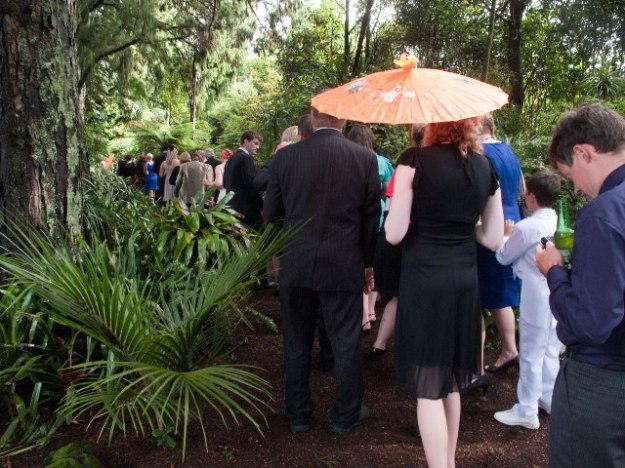
I had no idea the garden tour would be so popular

I had no idea the garden tour would be so popular Photo: Michael Jeans

Now, I thought, I shall go and have a hot shower. But no. Two late arrivals on the last coach had been flying for 20 hours and really needed to shower and change. Was that all right? Of course. Unfortunately for me, dear Reader, we may be a five loo establishment but we are a one shower household. All I could do was to change for the… wait for it… garden tour. When first suggested, I had scoffed. “People who come to events here are not interested in the garden,” I said. “They are here for the event and to party.” So I thought maybe 10 of the older guests would join me. In fact I had about 70 or 80. Given that they were teetering along in stilettos wearing cocktail attire, I only did the shortened tour of the top gardens but even so, herding up to 80 people along is a mission.
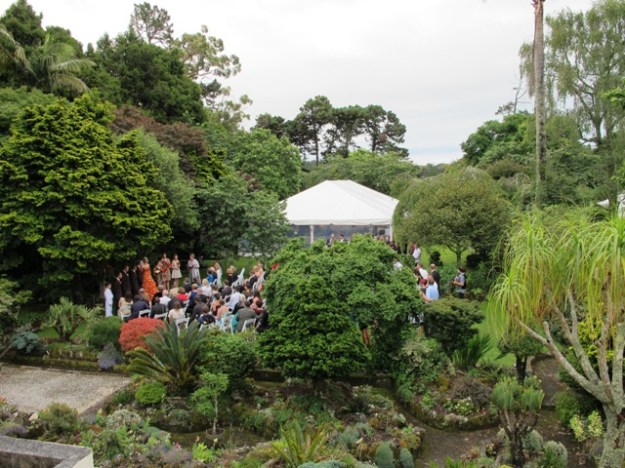
The rain stopped. It was a miracle. The ceremony could be held outside, as planned.

The rain stopped. It was a miracle. The ceremony could be held outside, as planned.

I finally got to shower and change. And the rains held off. The actual ceremony was, at the last minute, held outside as originally planned. The event ran seamlessly and everybody had a wonderful time and absolutely loved the venue. The fireworks at midnight were spectacular. Nobody wanted to leave so the band played on until 1.30am and I completely ignored the prima donna coach drivers who had to sit out on the road with their hazard lights on and wait for the extra hour. If they had been pleasanter earlier, I might have looked after them.

The torrential rains did not return until the pack out the following morning. Over 20 cm (8 inches) of rain we had in that period of under three days. But the lawns are fine. They will recover quickly.

I, on the other hand, have realised there are good reasons why we don’t do garden weddings here.

First printed in the Waikato Times and reproduced here with their permission.