Plant Collector: Hydrangea Libelle

Hydrangea Libelle

Hydrangea Libelle

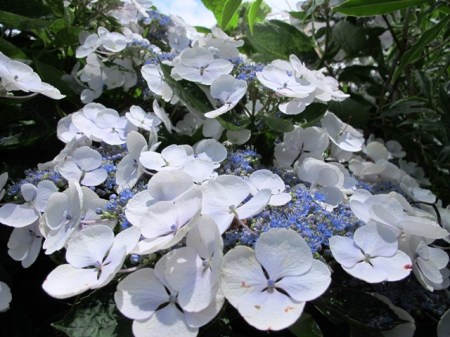
Were we to host garden weddings here (which we will not), I would be targeting white hydrangeas for easy care summer display in semi shaded areas. The compact white moptop Immaculata is very, very good but perhaps just a little clichéd in a bridal sense. Hydrangea macrophylla ‘Libelle’ is looking equally good this week.

Libelle is a large grower. This plant is well over two metres even though I prune it every winter and it is growing in competition with an adjacent tall hedge. Its flower heads are appropriately large and abundant. It is a lacecap which means it has a flat head. The true flowers are the small blue clusters in the centre. The outer rim of large, white individual flowers are sterile (which means they do not set seed) and technically they are sepals. The blue and white contrast is a very clean and attractive combination. Later in the season, the white will turn to pink tones in that olde-fashioned antique colour range that hydrangeas do so well.

Hydrangeas are a wonderfully obliging plant family that is often taken for granted. But after the unrelenting rains of last week, when pretty much every other bloom was sodden and disintegrating, the hydrangea flower heads just serenely continued as if nothing would bother them. They can last for a long time on the bush and make a splendid cut flower as well.

First published in the Waikato Times and reproduced here with their permission.

Grow It Yourself: yams

Clearly an oxalis family member - the New Zealand yam

Clearly an oxalis family member - the New Zealand yam

It is curious that what every New Zealander knows as a yam is only a yam in this country. Overseas, yams are an entirely different vegetable and our yams are called oka or oca. This does not matter unless you are using overseas growing instructions or recipes. Our yam is a member of the oxalis family – O. tuberosa – and we all know they are the reddish thumb-like, nubbly tubers that are delicious roasted but can be a pain to prepare if they are too small.

Our yams are a root vegetable from the highlands of South America. They are not difficult to grow but the yield rates can be disappointingly small. The best ever yams we saw were grown in a neighbour’s garden in Dunedin which is an indication that they are quite happy with cooler temperatures, though frost kills off the foliage. Grow them like a potato. Plant the tuber and as you see smaller nodules forming on the stems above ground, mound up the soil to encourage those nodules to develop into tubers. In warmer areas, they will grow all year and more or less naturalise if you allow them to (great if you are into one of the trendy food forests) but even so, they will appreciate a gift of compost mulch from time to time. They appear to be largely immune to pests and diseases but they do need good drainage.

Yams sweeten up if you leave them in the sun for a couple of days after harvest. Because they are thin skinned and don’t need peeling before cooking, they are vulnerable to damage during harvest and they don’t have the storage longevity of potatoes or kumaras. You can layer them in sawdust or newspaper if you want to hold them longer term.

First published in the Waikato Times and reprinted here with their permission.

In the Garden: January 5, 2012

A fortnightly series first published in the Weekend Gardener and reproduced here with their permission.
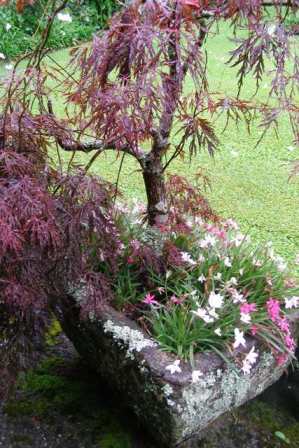
I am very selective about container plants these days

I am very selective about container plants these days

As summer takes hold, I am grateful that I have dramatically reduced the number of plants I grow in containers. I am not particularly reliable at hand watering and there is nothing worse than feature plants in pots, troughs or containers that stand out because they are gasping for water, drooping and defoliating badly. It is also very difficult to get water into potting mixes which have dried out completely because the water just flows straight through. A squirt of detergent can act as a surfactant and help water absorption. Because I only grow bulbs, the odd large bonsai or choice shrubs in pots, I never add water retention crystals. With our high rainfall, these products keep the potting mix too wet, rotting out the roots and the bulbs. This is particularly so in winter when plants don’t want to live with their roots sogging in cold, wet conditions. The only time I have used water retention crystals was in my hanging basket phase (it passed quickly) and when I tried seasonal pots of annuals – which also passed quickly. We went on holiday leaving lovely big pots of blooming pink petunias and blue ageratum and came back to pots of withered, dead plants. The water retention crystals were not enough. I decided then and there that I preferred a more permanent and sustainable style of gardening.

In issue 323 of the Weekend Gardener, I wrote about plunging pots to reduce watering requirements while still keeping individual plants featured. It only works if the pots are porous (I keep to terracotta) and they still need the occasional water but they are much easier to maintain over summer. I have found I need to keep an eye out for slug infestations around the plunged pots. They like the damp, dark conditions and can take up residence on the outside surfaces of the pots. I found an entire slug convention on one pot recently but at least it encourages them into one area for easy eradication.
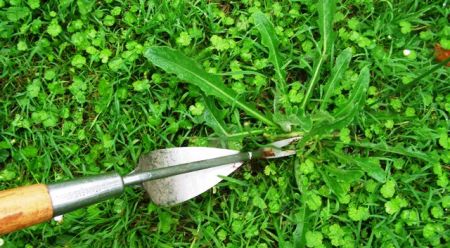
The peaceful, neverending task of hoicking out flat weeds

The peaceful, neverending task of hoicking out flat weeds

Top tasks:
1) Weeding is never ending. At this time of year, some of it can be done quickly by push hoe. If any weeds get away on us and set seed heads, we try and remove them from the area but the aim is always to get them before that stage so they can be left to wither and die in the summer sun.
2) The autumn bulbs will be starting to move very soon, putting out fresh roots. I need to thin the Cyclamen hederafolium, Colchicum autumnale (the autumn crocus) and check over the clumps of nerines (mostly sarniensis hybrids) before they are growing.
3) When I feel the need to do something quiet and mindless, I head out with the lawn tool to dig out flat weeds in the grassy areas of our park. It is a bit like King Canute holding back the sea but it makes me feel more virtuous than spraying and it is a soothing summer occupation.

Tikorangi Notes: Friday 30 December, 2011

Latest posts:
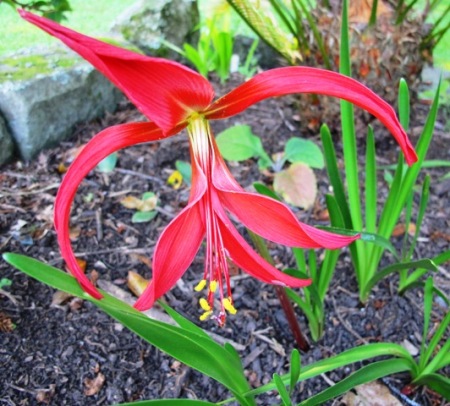
1) Finally found it – the proper Jacobean lily (though neither Jacobean nor a lily): Sprekelia formosissima
2) A touch of mea culpa on a very public spelling error – and a continuation of discussion on pohutukawa and other members of metrosideros family.
3) Grow It Yourself – or maybe not in the case of pizza counting as a vegetable in American school lunches.

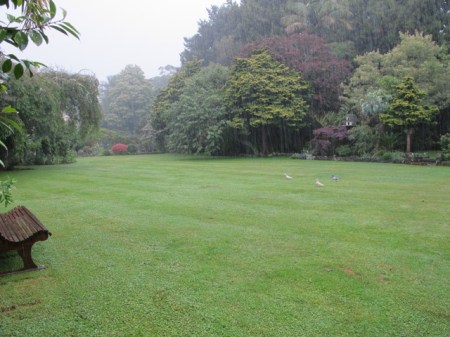
Wet pigeons, awaiting the erection of the wedding marquees on the front lawn this morning

Wet pigeons, awaiting the erection of the wedding marquees on the front lawn this morning

Tikorangi Notes:
The rain it raineth, unrelentingly alas. Mark’s pidgies are looking sad on the front lawn. I am merely contemplating the arrival of the marquee company, due any minute. On the bright side, at least the wedding party tomorrow did plan on two marquees and not trust to fine weather. And we have wonderful drainage so the grassed areas don’t get boggy and mucky. Add to that, we own a fair number of umbrellas. And it is not the wedding of one of one our own – though it is the daughter’s best friend. Maybe the rain will stop as the day progresses. Maybe the weather gods will smile and the forecasters have the timings wrong. Weather prediction in this country is a notoriously difficult activity, given that we are long, thin islands in the midst of vast oceans with competing tropical and polar air masses. But wait, do I detect a lightening in the sky to the north?
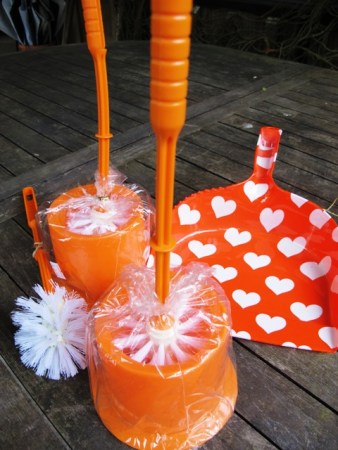
I am privy to all sorts of information about the wedding but my lips are sealed. All I can say is watch this space… The orange toilet brushes, dropped in yesterday by the bride’s father, rather caught my attention.

It would be so nice if the rains would stop. We will battle on otherwise – this is an unstoppable event – but it would be more fun if we were not making dashes around under umbrellas.

Plant Collector – Sprekelia formosissima

The Sprekelia formosissima or Jacobean lily

The Sprekelia formosissima or Jacobean lily

You learn something every day. This bulb is what is commonly known as the Jacobean Lily, even though it has nothing to do with the Jacobeans and it is not a lily. For years I have freely tossed the descriptor around, “it resembles a Jacobean lily”, thinking more of William Morris textile design than botany. And all the time, there is a wide level of agreement internationally that the Jacobean lily is Sprekelia formosissima. Added to that, when a species name is formasana or formasanum, it usually means that the plant comes from the former island of Formosa (now Taiwan). But the unwieldy formosissima means, loosely, beautiful. In fact it comes from Mexico.

It is indeed a beautiful flower with its rich red strappy petals and elegant form. A member of the amaryllis family, it is closely related to hippeastrums. It grows on quite a tall stem, around 30cm, with just a single flower per stem but fairly long lived. Aside from the genuine lilies, there aren’t a lot of bulbs that flower in early to mid summer. It is not particularly rare but it is one of those collectors’ items that is getting ever harder to source with the shrinking plant range offered for sale these days. If you find a plant with seed, it germinates easily when fresh.

As with all bulbs, the sprekelia likes well drained, friable soils and good light levels. It can get attacked by bulb fly (as can the hippeastrums) so we go for the woodland margins to outwit the sun-loving bulb fly. Despite its Mexican origins, sprekelia is regarded as half hardy which means that it can tolerate cool conditions and light frosts.

First published in the Waikato Times and reproduced here with their permission.