
Pohutakawa, maybe Scarlet Pimpernel, in Hamilton on Christmas Day (photo: Michael Jeans)
I have to start with a touch of mea culpa. I will never misspell pohutukawa again. It had never even occurred to me that I did not know how to spell it correctly. See, I had a Dunedin childhood and in the deep south, we probably had rata on our spelling lists rather than pohutukawa. At least that is my story. My only consolation in the matter is that my misspelling of the Maori name for Metrosideros excelsa apparently escaped the notice of everyone else involved with the production of the paper I write for, so I was not alone. But I was probably alone with my embarrassment. In case you missed it last Friday (before I corrected the website post), I turned the second u into an a.
As a peace offering, I give you a photo of a lovely pohutukawa in full flower at Millenium Heights in Flagstaff, Hamilton. The owner, Bronwyn, tells me it was meant to be a dwarf but it is already three metres high and it flowers profusely every year. When she said it was meant to be a dwarf, I thought initially that it might be one of the Kermadec pohutukawa (M. kermadecensis) which is sometimes used as a smaller selection – though only relatively smaller. However, I ruled that out because the Raoul Island pohutukawa flowers intermittently all year in dribs and drabs and it does not put on a mass display as shown. Added to that, it is more frost tender so it is never going to be happy in inland Hamilton. It is more likely to be a selection of the common form, M. excelsa. In fact it may even be the one named Scarlet Pimpernel (which was selected by my late father-inlaw). There is considerable variation within this species. If you start looking at trees you see over the next couple of weeks, you will pick huge variation in colour. Some look almost rusty brown from a distance, some deep red. The ones that stand out in the landscape tend to have orange tones to the colouring which gives vibrancy. It is called seedling variation – they don’t grow identical from seed. To get an exact clone of the parent, you have to propagate by cuttings.
The yellow pohutukawa are sometimes seen as a novelty. They are pretty enough in their own way but to my eyes they are nowhere near as spectacular as a good red specimen. The yellows are just another seedling variant of the same species, most common on Motiti Island. The reason you see them in mainland gardens and public plantings is because Duncan and Davies Nursery produced them commercially some decades ago – always the quest for the different and the new. It was that quest that also saw variegated forms offered for sale. These are not my favourite. I am not a great fan of variegated plants so I am unconvinced that a variegated form of our iconic pohutukawa was ever going to be an improvement on the usual forms in the wild. But because they were seen as different and new, they sold well for a while and there are big specimens around.
M. excelsa grows naturally as far south as Poverty Bay in the east and North Taranaki in the west. The pohutukawa that grows and flowers in the top of the South Island is a different species, M. parkinsonii. It tends to be rather more scruffy in its habit of growth.

The rata does not just go up, it goes along in every which way
It is of course the rata that is to the South Island what the pohutakawa is to the North Island, though we do have the northern rata as well. These are all the same family (so all metrosideros) but different species. Think of them being like cousins, perhaps. So the South Island rata is M. umbellata and the North Island rata is M. robusta. It is the latter that starts life as an epiphyte, living on a host tree that will ultimately die. The rata sends down roots that eventually reach the ground and develop into a strong vine. Over time, the vinous roots fuse together to form what looks like a trunk (called a psuedotrunk) so, by the time the host tree is strangled, dies and rots away, the rata can hold itself up. We have this rata here in the garden and we find that it does not just go up the host trees, not at all. In an hospitable garden woodland situation, there is little holding it back as it attempts to take over the entire area. I have to have words with it about its smothering ways. There is a limit to how much ground cover we want. Besides it only flowers on the tops and even then is but a shadow of the magnificent display the pohutukawa put on.
The southern rata is less determinedly epiphytic and can establish itself on its own roots in conditions which vary from nearly sub alpine to wet coastal forest. I recall as a child the excitement expressed by adults at the flowering of the rata in the wild, but it tends to be more a haze of red than an in-your-eye statement of summer and Christmas as with the pohutukawa. Unfortunately rampant possums have destroyed much of the impact of the southern rata in bloom.
Of the family, it is the good red pohutukawa or M. excelsa that remains my firm favourite.
First published in the Waikato Times and reproduced here with their permission.
-39.042098
174.300314
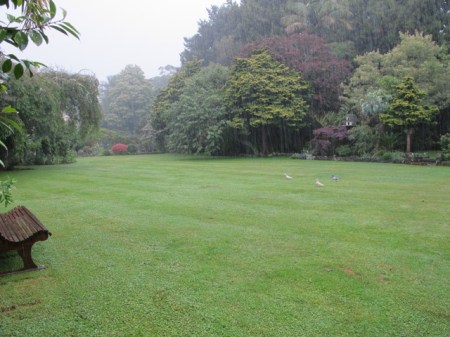
 The rain it raineth, unrelentingly alas. Mark’s pidgies are looking sad on the front lawn. I am merely contemplating the arrival of the marquee company, due any minute. On the bright side, at least the wedding party tomorrow did plan on two marquees and not trust to fine weather. And we have wonderful drainage so the grassed areas don’t get boggy and mucky. Add to that, we own a fair number of umbrellas. And it is not the wedding of one of one our own – though it is the daughter’s best friend. Maybe the rain will stop as the day progresses. Maybe the weather gods will smile and the forecasters have the timings wrong. Weather prediction in this country is a notoriously difficult activity, given that we are long, thin islands in the midst of vast oceans with competing tropical and polar air masses. But wait, do I detect a lightening in the sky to the north?

 Tikorangi The Jury Garden