Plant Collector – Rosa Roseraie de l’Hay

Rosa Roseraie de 'Hay

Rosa Roseraie de 'Hay

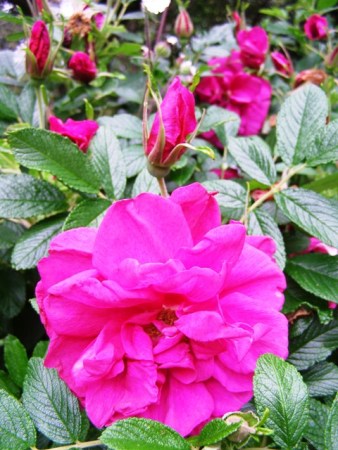
I think this is what is called an oldie but a goodie. It has been around since 1901 when it was bred in France and is still widely offered for sale. What is more, it has an Award of Merit from the prestigious UK Royal Horticulture Society. It is relatively large growing and tolerant of mistreatment, which is just as well because I planted it in the wrong place to start with and had to move it. In the two years it took me to find it a suitable forever home (as the Living Channel terms a permanent location), it just sat in our heap of old potting mix and it didn’t turn a hair.

The rugosas are a rose group from the coastal areas of China, Japan and Korea. They are renowned for being tough, hardy, tolerant of wide range of conditions (including salt laden winds) and high health. They don’t generally suffer from pests and diseases and stay looking good, even if you never spray. We even get the bonus of late autumn colour when the heavily ribbed and crinkled leaves turn golden yellow. The flowers are deliciously fragrant.

On the down side, they must be one of the prickliest of all the rose groups and they are not a good cut flower. It is hard to find the perfect plant. Rugosas are sometimes used for hedging and they will certainly provide a fierce burglar deterrent but you have to accept their winter dormancy when there are no leaves. Roseraie de l’Hay is sometimes optimistically described as purple or even red. Colour is subjective but I would call it indubitably deep cerise or crimson. If that is not a colour that appeals, the white equivalent which shares the same attributes, is the equally lovely and reliable Blanc Double de Coubert whose flowers are a bit like scented, crumpled tissue paper.

Roseraie can be translated as rose garden. The rose is named for the famed rose garden de l’Hay near Paris.

First published in the Waikato Times and reproduced here with their permission.

Grow It Yourself – capsicums

I have just been told He Who Grows the Veg here that he is not planting capsicums this year. He suggests I go and buy a plant or two if I feel I must have them. The problem is that capsicums need a long growing season in order to get a good harvest. That means a good four months of continual warmth. Even cold nights will set them back. You can hurry them along by planting them into black plastic or using a cloche but the resident veg gardener does not like them enough to lavish the same level of care that the rock melons get. Best guess is that most of the lovely big red, yellow and orange capsicums you see in the supermarket are grown in glasshouse conditions.

It is too late to start them from seed now, so if you want to grow them you will have to buy plants. Seed has to be started under cover in late August or early September. Capsicums are in the same family as tomatoes (solanum), but require more heat. They like similar conditions – full sun, plenty of warmth, friable soil full of humus and a position where they don’t dry out. Plant them about 50cm apart. Room for good air circulation can help reduce leaf diseases. You will get larger fruit if you thin the crop. Most capsicums start off green and can be picked at that stage. As they ripen, they can change through to yellows, reds and oranges. It is because these are riper that they taste sweeter and milder.

Paprika is, of course, ground mild capsicums – presumably at the point where they have ripened to red. Chilli and cayenne pepper are ground hot capsicums which we normally call chillis. Some chilli varieties are just hot selections of the same species as capsicums (C. annuum) while some are different species. They grow in the same way with the same heat requirements. If you like fresh chillis, they make a decorative container plant but you need to be reliable with summer watering.

First published in the Waikato Times and reproduced here with their permission.

Fruit by Mark Diacon

Presumably the average British gardener is either more intelligent or better educated than here. Which is to say that the Brits don’t feel the need to dumb down gardening books to the level of a novice 12 year old and pad them out with lots of super size glossy photos. What is more, they are even allowed an index. This is River Cottage Handbook No.9 – which means it is from the machine behind Hugh Fearnley-Whittingstall. This modest handbook has a mass of good information on growing and caring for fruit trees. The problem is that it is for England which means hardy crops, a reversal of seasons and recommended varieties which are entirely different to here. Common crops here like feijoa, persimmon and citrus are not included at all. So it is not a complete reference for this country but it will tell you a lot of what you need to know about some mainstream crops and the technical information is underpinned by that charm of River Cottage, including a recipe for classic Eton Mess (mashed fresh berries and meringue pieces in sweetened cream).

Fruit by Mark Diacono (Bloomsbury; ISBN: 978 1 4088 0881 8) reviewed by Abbie Jury.

Gardening is not exempt from fashion trends

We are hoping the next garden fashion may be the revival of romantic naturalism

We are hoping the next garden fashion may be the revival of romantic naturalism

I was reading an interesting review on line when I came across the following comment: “… New Zealand gardens are getting more conservative with time”. I have not gone back to the original source yet, so will not attribute the comment except to say it is apparently local to Hamilton. It certainly gave us food for discussion here.

Are our gardens getting more conservative and less adventurous? On balance, the unanimous opinion of two was: probably not. We are currently in the meshes of a deeply conservative garden fashion where mini Sissinghursts are all the rage (clipped buxus hedges and balls, white standard roses or bay trees, the odd limbed up hornbeam that claims to be pleached) but it is only a fashion. It too will pass.

What has changed, we suspect, is disposable income, the trickle down of wealth and status to the hoi polloi and the linking of garden to fickle fashion. In other words, the democratisation of gardening. In centuries past, garden fashion was dictated by the rich and powerful across the globe. From the Islamic water gardens, through the classic revival of Italy, the British landscape tradition of Capability Brown, the Arts and Crafts revival in Edwardian times – none of it had anything to do with the common people.

Now we have a whole breed of property owners, some of whom are gardeners, who want an outdoor environment which complements their lifestyle, marks their social position and brings some level of reward in pleasure or productivity. And just like everything else, the cycles have sped up. Clothing fashions change. Colours change in interior design. Why would we expect gardening to be timeless?

The gardening genre of suburban Sissinghurst

The gardening genre of suburban Sissinghurst

Some of us can remember the conifer garden of the seventies – the first instance of a mass fashion in gardening that I can recall. It wasn’t just conifers. It was the meeting of small conifers and the easy-care pebble garden that gave us a certain genre which is widely regarded with horror these days.

We were already in the plant nursery business when flowering trees and shrubs took a dive in the eighties. It was the time of the cottage garden, filled with a froth of annuals, perennials and roses. Anecdotally, we attributed it to the sharemarket crash of the time. Back in those days, you could buy three or four perennials for the price of one good tree or shrub. The price of woody plants has never recovered and these days you can pay about the same for a good perennial as you do for a woody plant which has taken at least five times longer to produce.

But cottage gardens are not low maintenance and in due course they morphed into the short-lived fashion of minimalism – large rocks, ground cover scleranthus and three vertical plants, one of which should be a sanseveria or yucca. That was a fashion driven by a new breed of landscaper who knew about design and space but not plants.

Somewhere along this timeline, natives became the vogue and we saw a fair number of Idealistic Young Things who would only buy a plant if it was a native.

Then we had the tropical garden – lots of palms, clivias, vibrant vireya rhododendrons and that burgundy aeonium with the unpronounceable name (Aeonium “Zwartkop” and I don’t think I ever spelled it correctly in years gone by). The trouble is that most of us do not live in tropical climes and those tropical gardens didn’t take winters too well.

The Auckland bromeliad garden has survived a little longer and is still de rigueur in some circles – for all the world the conifer garden of the new millennium. The overseas trend of prairie or meadow gardens has largely bypassed us in this country. It is damn difficult to do a prairie garden unless you live in prairie conditions with dry, hot summers and dry, cold winters.

Enter the edible garden and the Bright Young Things who would only buy native plants in the past decided they would only buy a plant now if it was edible. Raised beds, nasty mulches of used woollen carpet, no dig gardening, watered down organics – aiming for self sufficiency in food has never been easier, or so it is widely claimed. I know I am not alone when I say many of us have tired of vegetables dominating the gardening media. There are not many aesthetics when it comes to vegetables which are utility things at best.

Gardeners who weren’t into growing vegetables followed a parallel path with their recreations of suburban Sissinghurst, sometimes adorned by a pretty potager if they wanted to adopt both fashions. Even the gals at the New Zealand Gardener appear to think that vegetables have passed their peak and they are onto new branding with Grandma’s flowers – from dahlias to rhododendrons if recent pieces I have read are any guide.

The hope here is for the next fashion trend to be sustainable gardening and to see a revival of romantic naturalism replacing suburban Sissinghurst. Gardens don’t freeze in time any more than their owners do but by definition, few people are trend setters and most people are followers of fashion.

First published in the Waikato Times and reproduced here with their permission.

Tikorangi Notes: Friday November 25, 2011

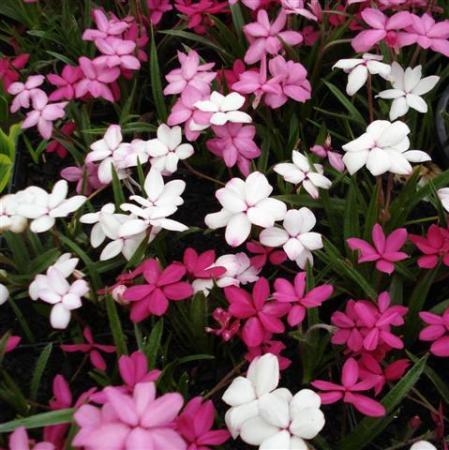
It is rhodohypoxis time

It is rhodohypoxis time

Latest Posts: Friday November 25, 2011
1) Why would gardening be exempt from fashion? Abbie’s column. It never has been before, but in keeping with modern times, the cycles of fashion are moving ever faster.
2) Yet another lightweight NZ gardening book. Even indexes are expendable these days, apparently.
3) Plant Collector this week: Dracophyllum latifolium or neinei, a seriously cool small tree and a native at that.
4) 100 Gardens by Jamie Durie (Australia’s pin-up boy of landscaping). More about ideas for outdoor spaces than gardening as such.
5) Grow it Yourself – melonsthis week. Preferably rock but water will do at a pinch.

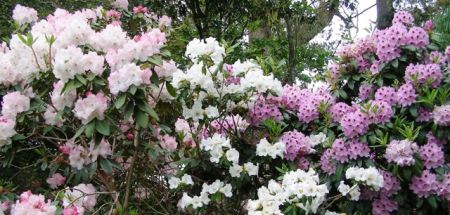
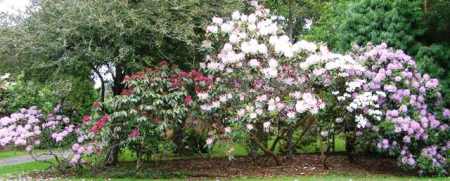
Rhododendron Elizabeth Titcomb to the left, Blue Pacific to the right and R. lindleyi (Ludlow and Sherriff form) caught in their cleavage, as Mark describes it – though nearly strangled might be a better description.
Our unusually cool spring is continuing here, which does at least mean that the spring flowering has been extended way past the usual time. At least the roses have finally opened. We are not the greatest of climates for roses – they don’t appreciate our high humidity – so the first spring blooms are all the more welcome as the bushes are still full of healthy, lush foliage. As the season progresses and black spot strikes, the plants start to look ever more sparse. One can spray roses, of course (and many do) but we choose not to. If a rose plant can not survive and perform without spraying, it ends up in the incinerator.


From left: Caroline Allbrook, Olin O. Dobbs, Elizabeth Titcomb, R. lindleyi and Blue Pacific – a swathe of pink and purple across one side of our carpark.