Fairy Magnolia Blush picked for success in Australia

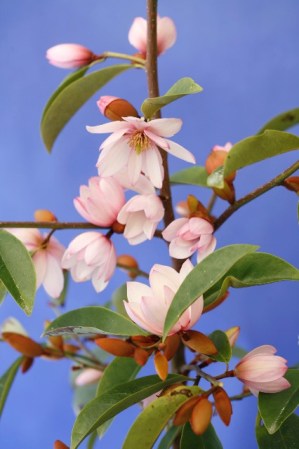
Fairy Magnolia Blush - Mark Jury's pink michelia

Fairy Magnolia Blush - Mark Jury's pink michelia

Australia’s leading garden magazine and TV programme, Gardening Australia, has named Mark’s new Fairy Magnolia Blush as one of its top ten selections for plants for the future in Australia. This is in addition to naming the Jury-bred Cordyline Red Fountain as one of the top twenty plants in the past twenty years. Gardening Australia is currently celebrating its own twentieth birthday.

Fairy Magnolia Blush is the first of a new series of michelias released by Mark, the result of a plant breeding programme over many years. It brings a distinct pink colour into a plant which is usually resolutely white or cream. It is an evergreen plant which clips easily and can be kept compact.

Blush is readily available from plant retailers in New Zealand.

On the case with Grandma’s violets (subtitled: it is hard to find the perfect groundcover).


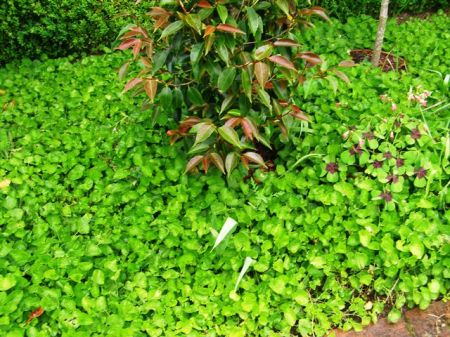
I see it was only a little over two years ago that I gave the death sentence to Rubus pentalobus (commonly called the orangeberry plant because few of us can recall its proper name) and chose Grandma’s violets as a ground cover instead. In fact they are more likely to Mark’s great grandma’s violets because they date back to the 1880s house site and have gently survived paddock conditions there ever since. Once divided and planted into the garden, they have taken off with alarming vigour. Sweetly scented and charming though they are in flower, they were starting to overwhelm everything in their path.

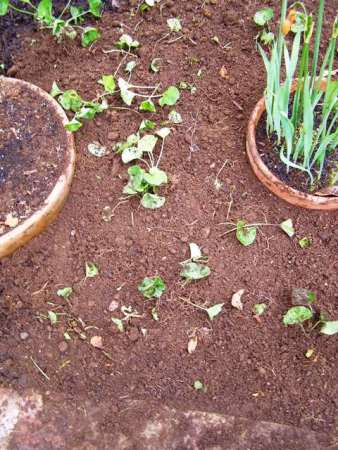
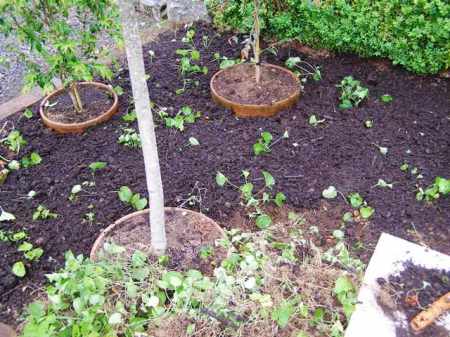
Last year we tried thinning the patch and it was a surprisingly difficult task because the violets had formed an impenetrable mat. I figured this year it would be easier to dig the entire patch and replant small divisions. Digging is only difficult when the ground is heavily compacted or with a blunt spade. Using a sharp spade, I cut the violets into squares as one does with turf. Each square was easy enough to lift.

I raked over the bare soil to level it. Some of the clumps I had dug fell apart quite readily, giving me small divisions to replant immediately. Others, I pulled apart as required, spacing at around 15cm intervals.

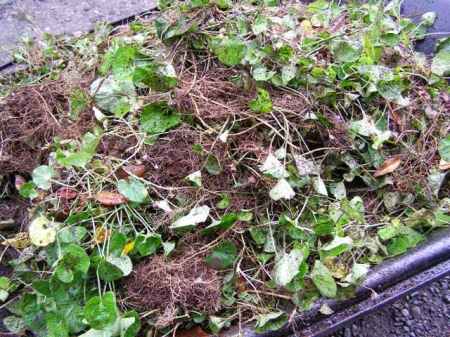
There was a large surplus of violets. Not every plant is precious. This barrowload (one of several) is destined for the compost heap.

A final topdressing of compost feeds the soil, reduces water loss from the poor stressed plants and makes the whole area look more attractive. There is an open verdict here as to whether I want to persist with a groundcover that looks as if it will need drastic digging and dividing every year. I will make the call next spring.

Tikorangi Notes: November 11, 2011

How curious is Hippeastrum papilio?

How curious is Hippeastrum papilio?

Latest Posts: 11/11/11

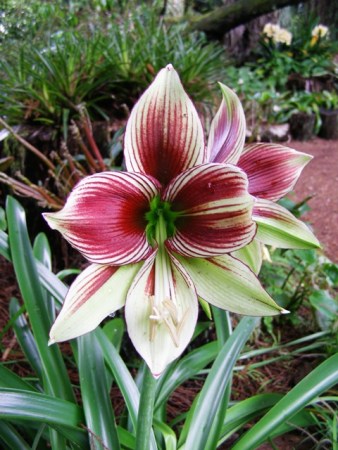
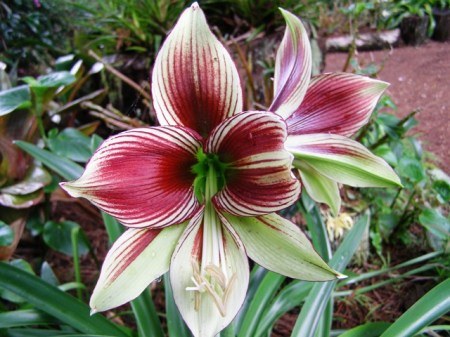
1) The exotica of Hippeastrum papilio in flower this week. To me it looks more like an orchid than a butterfly.

2) So you think you might like to open your garden to the public? Abbie’s column (based on 24 years of experience here).

3) Grow it yourself – parsley, a vegetable garden staple of underestimated value.

4) Cordyline Red Fountain receives high praise in Australia.

5) In the Garden this fortnight – the first of a new series written for the Weekend Gardener, detailing what we have been up to in our garden.

Tikorangi Notes: 11/11/11

Rhododendron Ivan D Wood

Rhododendron Ivan D Wood

With the end of our garden festival (formerly the Taranaki Rhododendron and Garden Festival but these days the equal mouthful of Powerco Taranaki Garden Spectacular), we woke up on Monday feeling like zombies. Ten days of standing on concrete and meeting and greeting of visitors takes its toll when the pressure comes off.

Dichelostemma Ida Maia

Dichelostemma Ida Maia

Our flowering remains late but no doubt the season will catch up soon. The curious Dichelostemma Ida Maia (formerly a brodiaea) has been attracting frequent comment and Rhododendron Ivan D Wood is justifying its place with its annual flowering – lovely colour range but the foliage is pretty unappealing for the remaining 50 weeks of the year. It wants to live in a colder climate than ours.

We are stripping out the retail area and are no longer selling plants, though the garden remains open. The plant sales list has been taken off this site until next September or early October. We will not be selling again until Labour Weekend next year when there will be a two week period of sales. We have just had enough of selling plants and would rather enjoy gardening and gardening conversations.

It was undeniably pleasing to see Gardening Australia name Cordyline Red Fountain amongst their top 20 plants in the last 20 years. Equally pleasing to see Fairy Magnolia Blush named amongst their top 10 recent picks for long term success.

Plant Collector: Hippeastrum papilio

The exotic looking Hippeastrum papilio

The exotic looking Hippeastrum papilio

Papilio is Latin for butterfly, though it would be a pretty spectacular butterfly to rival this lovely bulb from Brazil. I think it is more orchid-like in its markings and colouring of burgundy, green and cream. In fact it is positively exotic and is a showstopper if you can get it flowering in the garden.

Hippeastrums are often misnamed as amaryllis. They belong to the Amaryllidaceae family but that does not make them amaryllis – that would be like saying parsley is the same as carrot because they come from the same botanical family. H. papilio is a species (which is as it occurs in the wild) although much hybridising has been done within the wider hippeastrum family to get spectacular named cultivars for showy pot plants. It grows from large bulbs and there are usually two flowers to each stem, each bloom being about 18cm across and held up well, without needing support.

The biggest problem here is the dreaded narcissi fly which lays its eggs at the base of the leaves. The larvae hatch and burrow down, eating the bulb from inside out. For this reason, we grow H. papilio as a woodland plant in a raised bed rich in humus. The narcissi fly seem to prefer the sunshine. The raised bed means excellent drainage which solves the other problem which is the bulbs rotting out in wet and cold winter conditions. We find it is largely evergreen here, keeping its foliage all year in normal conditions.

The bulbs are large and slow to increase so best left undisturbed for several years. H. papilio is sometimes offered for sale in garden centres but be prepared to pay a fair amount for it because it can take several years to get the bulb to flowering size.

The other hippeastrum species that we have great success with in the garden here is the beautiful winter flowering H. aulicum, also from Brazil.

So you want to open your garden to the public?

A welcome sight perhaps, carloads of garden visitors, but by no means a certainty

A welcome sight perhaps, carloads of garden visitors, but by no means a certainty

Spring in New Zealand sees the main flurry of garden visiting. If you have been out and about with friends recently and one is starting to make dangerous comments like: “My garden is as good as this one,” or “I have got one like that but mine is better,” maybe: “My standard Icebergs are more advanced than hers,” be proactive. It may be kinder to take your friend to Harvey Norman and persuade him or her to buy a new home appliance instead. Opening your garden to the public is a time consuming, expensive and demanding activity.

Many open garden circuits are of short duration with all proceeds going to charity. Clearly this motivation is entirely above reproach and we will just set it to one side as not being relevant to this discussion.

But too many garden openers are under the misapprehension that they can make money by opening. Experienced openers will tell you that in many cases it actually costs you money because you go to a great deal of time and expense preparing your garden, often buying expensive potted colour to plug gaps which you would otherwise have ignored. The bottom line is that there are too few garden visitors in this country to make it financially viable. To get more than just a few visitors, you need a brilliant location (preferably main road close to a population centre, right on a tourist route and featuring a castle), usually allied to an established reputation which takes years to build and a very good garden. Added attractions are advisable, whether they be a cafe, craft shop, plant sales or major events. If you go in for added attractions (which can certainly contribute a great deal to financial viability), don’t delude yourself into thinking that visitors are all coming to enjoy your garden. In reality your garden simply becomes a pleasant venue and many visitors come for the attractions, not to see your gardening efforts.
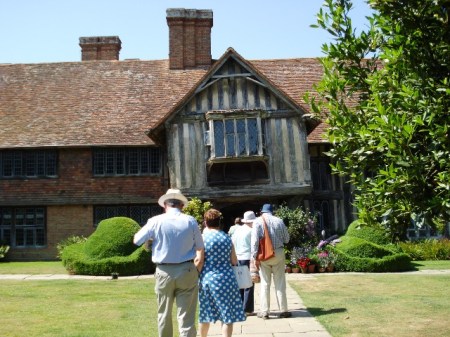
Don't expect the sort of visitor numbers Great Dixter gets

Don't expect the sort of visitor numbers Great Dixter gets

So what are the main reasons for opening besides charity? At its best, positive affirmation of one’s efforts. At its worst, ego. Garden openers’ egos can be a scary force to encounter and the whole exercise can turn a perfectly pleasant Dr Jekyll of a gardener into a Mr Hyde garden opener.

If you are contemplating opening your own garden, the first piece of advice I would offer is to go out and look closely at other people’s gardens – not critically but comparatively. You need to work out where your garden fits in and what you have to offer that is better, more skilled or more interesting than what is already out there.

The second step is to come home and look critically at your own garden, trying to assume the persona of an outsider looking for the first time. Over the years, we have met many gardeners who expect visitors to see their garden through the same eyes as they do. You know your own garden inside out. Often you envisage the potential when plants grow and fill out. The mistake is to think that the first time visitor will also see your dream. They won’t. They will see the reality on the day. You need to take off rose-tinted glasses to see that reality for yourself.

If you have children still at home, they won’t thank you. We always had two flat rules for the kids: no loud music and no loud arguments. But I do recall Second Daughter saying plaintively one busy week: “And you could tell visitors they don’t have to wave to me through the window when I am having breakfast.” That would the 11.30am weekend brunch when she was still in her dressing grown.
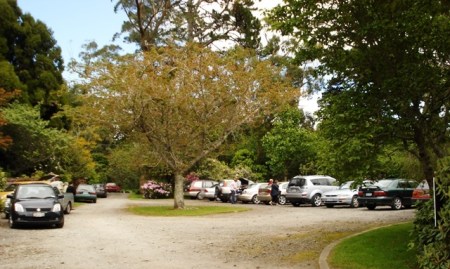
If you are determined to open, presentation becomes a key issue. Open gardens are finished and presented to a higher standard than your average home garden. All that lawns, hedges and edges stuff has to be done well and maintained at that standard. Established weeds are a no-no as are unsightly areas of wasteland. Visitor safety can be an issue, especially when the average age of garden visitors usually works out somewhere over 60 (which means a fair proportion will be decidedly elderly). Access to a toilet and safe parking are additional factors, as is the personal touch of meeting and greeting visitors. Opening your garden these days requires a whole lot more than just sticking out an icecream container and collecting the money.

That said, our experience of opening for many years is enormously positive. We can count on the fingers of one hand the attempts at plant theft over the years (the loss of the unripe seed on Mark’s Paris polyphylla was particularly galling). There is the odd person who tries to sneak in without paying but we have become pretty good at dealing with that (it is so embarrassing but it should be embarrassing to the guilty party, not the host). Only once have we ever caught an old biddy going through the house (shameless, she was!). The vast majority of garden visitors regard it as a privilege to be able to come into a private garden and behave accordingly. Though I should add that we are a more expensive garden at $10 for adults. The cheaper you are, the more riffraff you will attract.

In the end, it is enormously affirming to have garden visitors who really enjoy the environment you have created and who are unstinting in their expression of appreciation. In New Zealand, that has to be the main reason for opening. If you are thinking about it for any other reason, you may be better off going to try some retail therapy instead.

First published in the Waikato Times and reproduced here with their permission.