In Praise of Plunging

First published in the Weekend Gardener and reproduced here with their permission. 
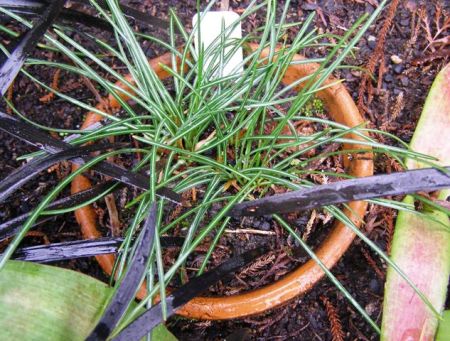
Plunging is a gardening technique that has been around for a long time but is not often seen in New Zealand. It is simply burying a porous pot in the ground so that only the lip is visible. Traditionally, in the United Kingdom, it was often done to stop the roots of the plants from freezing in cold winters. It also stopped terracotta pots from shattering in severe frosts. It is also done to equalise moisture and to stop plants getting either waterlogged or too dry. If you visit the alpine houses at the RHS Wisley Gardens, you will see that all the alpine treasures are grown in pots which are plunged into beds of compacted sand.
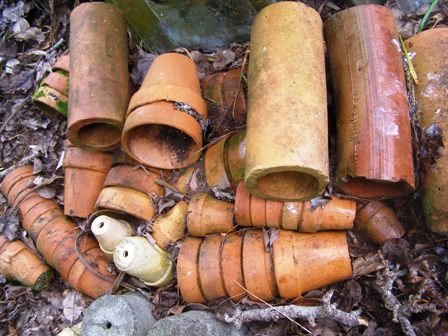
Plunging is a technique I have been using around our garden for a variety of purposes. It is important to note that it only works with porous pots. Fortunately, I inherited a collection of aged terracotta pots and drainage pipes in various sizes which fit the bill. If you use glazed or plastic pots, the water cannot move between the surrounding soils and the plant’s roots in the pot.
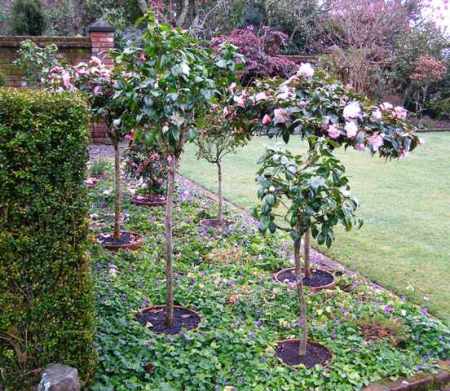
1)      I had some rather special camellias which blew over every time it was windy and which dried out too quickly in summer because I was erratic with watering. They were also getting too heavy to move easily and root pruning and repotting became difficult as the plants grew ever larger. I did not want to plant them out in the garden because I still wanted to feature them as a group. Plunging the pots into a border was one solution. They never blow over. They do not need anywhere near as much hand watering because the moisture from the surrounding soil keeps the pots damp and cool. They remain featured as individual plants. Where some were badly root-bound, I cut off the base off the pots to allow the roots to get into the soil. The remaining plants are treated as container plants and repotted every two years with fresh mix.
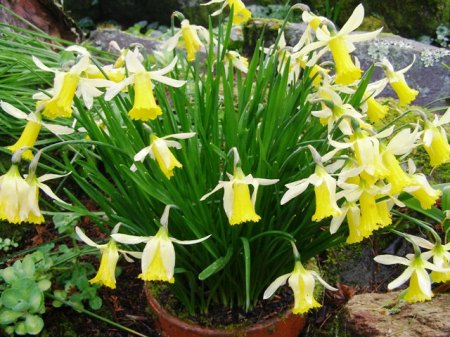
2)      I frequently plunge pots of seasonal bulbs to add colour and interest in key spots. When they are past their best, they can be removed out of sight and replaced with something else instead. This particular pot is Narcissus Twilight, One of Felix Jury’s cyclamineus hybrids.

3)      Plunging is one way of keeping track of special plants, especially bulbs which are easy to lose when they are dormant.
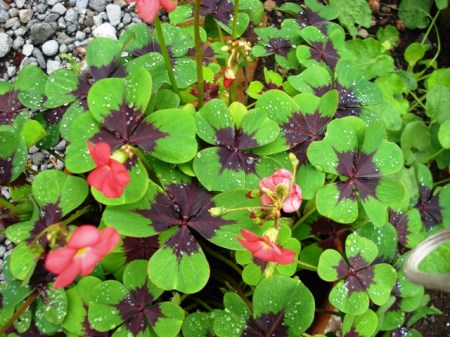
4) Equally, plunging can be used to keep invasive plants confined. It won’t work where a plant spreads by setting seed but it is successful in keeping runaway plants under control. Most of the mint family have this tendency, as do many of the ornamental oxalis.
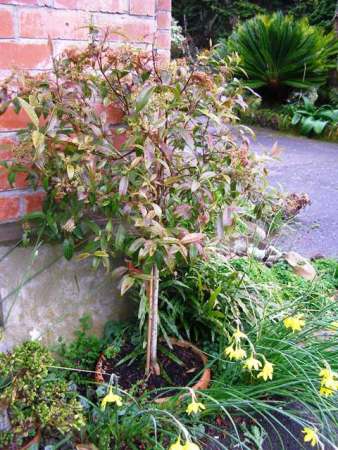
5)      Plunging can be used to restrict growth and to keep plants reduced in size, so it is a rough form of bonsai. I wanted this deliciously fragrant lemon myrtle (Backhousia citriodora) by the house but left unchecked, it would become a tree. Similarly, I have plunged a pot of rosemary to check its growth and also because the position near the back door was in heavy soil which this Mediterranean type of shrub would not enjoy. The pot gives it hotter, drier conditions.

Plunging is essentially container growing in the ground.

Points to remember:

  • Plunging does not eliminate the need for all watering in summer. It merely reduces it. Plants still require watering every pots every two or three days in hot, dry weather. Making sure there is a gap between the level of the potting mix and the top lip of the pot makes watering easier and any water which drains straight through is still going to be available in the surrounding soil.
  • It is important to remember that plunged pots are still container plants so they will need repotting from time to time and they will need feeding in between. All container plants should be repotted in fresh mix every two years with slow release fertiliser.  That fertiliser can last about nine months. Topdress after that as required.
  • If plants start to look deeply stressed with yellow leaves and poor performance, it is likely that they have either run out of food or they are root bound. If the plant starts to drop leaves and look utterly miserable, check that it has not blocked the drainage holes with thick roots. When this happens, the pot becomes a reservoir for water and the plant starts to slowly drown. It will die if left unattended.
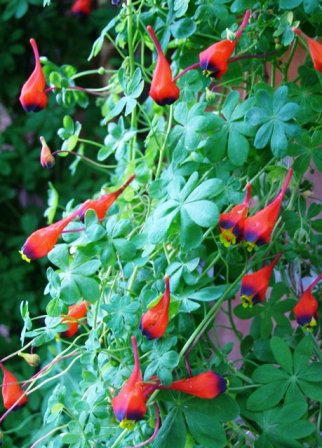
Plant Collector: Tropaeolum tricolorum

The dainty climbing delight of Tropaeolum tricolorum

The dainty climbing delight of Tropaeolum tricolorum

It does not, alas, have a common name but give yourself a huge pat on the back if you immediately identified it as a member of… the nasturtium family. I guess if you took the common nasturtium (Tropaeolum majus) and scaled it down, you might see a faint similarity. Or maybe not. The flowers are tiny but oh so exquisitely detailed and abundant. Shaped perhaps like a 2cm long Chinese lantern with a tail or spur, they are orange red, tipped navy blue with a yellow frill. Tricolorum (or tricolor) means three coloured, of course. The lobed leaves are similarly dainty.

This is a plant from Chile and Bolivia which grows from tubers resembling baby potatoes. It is dormant in summer and autumn, coming into growth in winter and putting on its peak flowering in early to mid spring, after which it dies down very quickly. It is a climber so it needs something to cling to but because it is so light and with a short season, it doesn’t smother any plants it climbs up. We grow it in abundance in two of the narrow beds beside the house which are always problematic because they are so dry beneath the eaves. It has not been as happy in woodland areas so we think it needs good light levels. It certainly does not want to be in wet conditions or it will rot out when dormant. T. tricolorum should not be confused with its thuggish cousin, the red Tropaeolum speciosum which seeds down and is reputed to be a noxious weed in Scotland as well as being a problem in some NZ gardens. Any plant that can be a weed in Scotland and New Zealand is dangerous. We have never seen our tricolorum set seed although there are internet references to growing it from seed. We find it increases gently from the tubers. There are, by the way, over 80 different species in the nasturtium family, all from South America.

First published in the Waikato Times and reproduced here with their permission.

Yates Vegetable Garden by Rachel Vogan.

There must have been a secret memo that went around NZ publishers of gardening books and most acquiesced. Henceforth, gardening books should be chatty, friendly, folksy wolksy and not too technical. This book fits those criteria, as have too many other recent publications. So this book is probably adequate and user-friendly for absolute beginners. By the time you have enough experience to spot the shortcomings, you will probably have learned enough not to need it any longer. Just don’t make the mistake of thinking that it is from the same mould as the earlier Yates Garden Guides which were the bible for NZ gardeners over many decades, just as the Edmonds Cookbook was the kitchen stalwart. This is not. Aubergines are listed under E (for egg plant). Sweetcorn can be grown in old recycling bins and dropped over to the neighbours to look after if you are going away for the weekend. Melons can be sown as late as January in warm climates (Bali, perhaps?). Product placement by the sponsor is intrusive.

Maybe one day soon, NZ publishers will realise it takes quite a bit of experience and knowledge to be able to sift through information and distil it down to its simplest, most user-friendly form. Friendly enthusiasm is not sufficient.

(Harper Collins; ISBN: 978 1 86950 928 6).
First published in the Waikato Times.

Managing meadows or drifts of bulbs

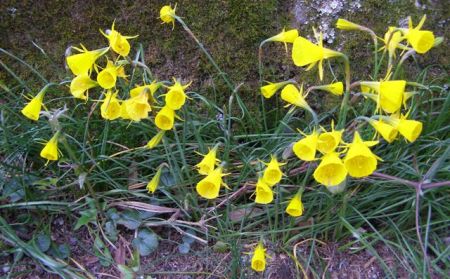
The bulbocodiums are the highlight of the narcissi world this week

The bulbocodiums are the highlight of the narcissi world this week

We are bulb fanatics here. It doesn’t matter how large or small your garden, there is always space for bulbs. They mark the progression of the seasons in a wonderfully detailed manner, often little pictures of ephemeral delight. We have been charting the narcissi here this year, tracking which ones flower for long periods of time and which ones give us a succession of blooms to extend the season as others are just finishing. We don’t grow many of the big, show daffodils, preferring instead the dwarf and miniatures, both species and hybrids. It is the bright yellow hooped petticoat type that are the showiest at the moment (bulbocodium citrinus). The best early variety, flowering over a long period, has been Peeping Tom. The single best mid season variety has been the cyclamineus hybrid, Twilight.

Now the erythroniums or dogs tooth violets are opening, as are the veltheimias (big bulbs which resemble lachenalias on steroids), the early arisaemas are through the ground and the bluebells are coming into bloom. Early to mid spring is peak bulb time and that is because we do best with South African bulbs whose growth is triggered by the autumn rains. It is not that the autumn rains are significant here. Most of us get winter rain, a great deal of spring rain and some summer rain too. It is more a case that the autumn rain bulbs are in full growth during our rather wet winters so they don’t rot out as readily.

Bulbs are easiest to manage in pots and in designated areas such as a rockery. Sometimes I combine the two and plunge the pot to sit flush with the soil level in the rockery (a good technique for confining invasive bulbs as well as keeping track of vulnerable treasures). They can be a bit problematic in garden beds and borders where it is all too easy to find their location by severing them with the spade.

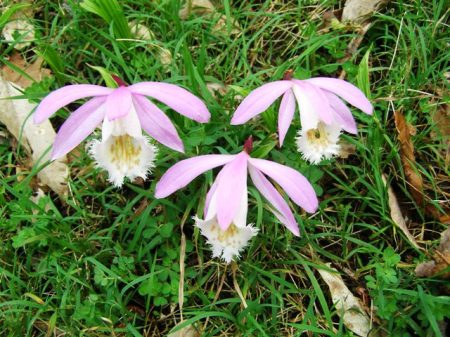
Not perhaps the most obvious candidate for Mark's hillside of naturalised bulbs - pleione orchids

Not perhaps the most obvious candidate for Mark's hillside of naturalised bulbs - pleione orchids

But the real challenge here is to extend the meadow drifts of bulbs and that has taken a great deal of thinking and planning. It all comes down to grass growth. Areas of the country which are suitable for intensive dairy farming tend, by definition, to have more fertile soils and an abundance of grass growth for most of the year. Most bulbs naturally grow in opposite conditions – often dry and poor ground – and are triggered into growth by seasonal change. Romantic woodland drifts occur in open, deciduous forests where enough light gets through during winter to allow the bulbs to flourish while in summer, a canopy of foliage creates shade which reduces rampant grass growth which can choke the bulbs. After years of experimentation, the lessons we have learned include:

1) Only plant bulbs in areas which won’t need mowing during their growth season. This can be easier said than done with bulbs which coincide with the spring flush of the grass. We have been working on extending the bluebell drifts but have taken care to site the bulbs closer to the trees and shrubs, so to the side of the main mown areas. They still look as if they are drifting naturally but it is a managed drift.

2) Don’t use bulbs which are going to need frequent lifting and dividing to keep them flowering well. For this reason, we have pretty well given up on the big daffodils. They look great for one or two seasons but in our conditions, it is all downhill from there to the point where they can be mostly foliage with very few blooms. They do better in harder conditions.

3) Control the grasses. Mark (the husband) has gone to considerable lengths to eliminate strong growing grasses from his bulb hillside in favour of the weaker growing, fine native grass, microlina. We can get away with only needing to weedeat the microlina occasionally so the bulbs are not disturbed and we can manage a succession over several months.

4) It takes a lot of bulbs to get a drift. Many hundreds of bulbs, not tens. We multiply ours by dividing existing clumps but also gather our own fresh seed each year to increase the numbers.

5) The most successful bulbs so far are: bluebells (also pink bells and white bells), colchicums or autumn crocus, cyclamen species (hederafolium, coum and repandum), proper English snowdrops (galanthus) and some of the dwarf narcissi. Pleione orchids and assorted lachenalias (especially the more desirable blue ones) take a bit more work but are worth the effort. All except the pleiones disappear entirely below ground when they are dormant.

6) Large bulbs which grow with their necks above ground include the belladonna lilies, crinums and veltheimias. These can never be mowed over or walked on so have to be placed in areas which don’t generally grow grass. This means they are not suitable candidates for meadow drifts.
There are those for whom gardening is all about controlling nature and those for whom it is about emulating nature and managing it. We fall into the latter category. Meadow bulbs and drifts of spring delights are an important ingredient for us.

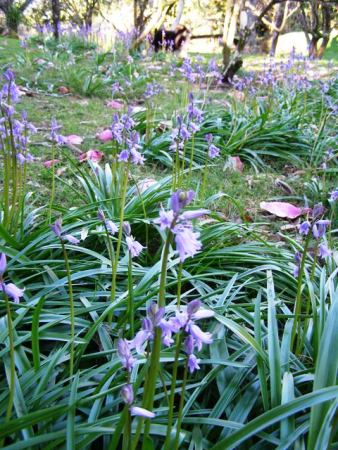
Managed drifts of bluebells

Managed drifts of bluebells

First published in the Waikato Times and reproduced here with their permission.

Grow it Yourself: Peas

Peas are a marginal crop in mild climates. They tend to be much more reliable and productive in cooler areas. The frozen products in the supermarkets are ridiculously cheap to buy and of very high quality. So the reasons to grow peas at home are less related to quality and volume and more related to life’s simple pleasures. The satisfaction of picking fresh peas to serve with Christmas dinner is an adult pleasure. The opportunity to browse fresh peas in the garden, popping them from the pod straight into the mouth is a delight that every child should experience and one that does not wane with age. Raw, fresh peas don’t last well so are rarely nice if you buy them. You need them straight from the plant.

If you want peas for Christmas, sow them straight away. They take about three months to mature. The seed is the dried pea so they are large and are sown direct into well cultivated soil, about 5cm apart. Cover the area. The birds will destroy the germinating crop as soon as it bravely pokes its shoot above the ground. We use low chicken netting hoops for peas and various other germinating crops. Other people string cotton across the patch, cover with a cloche or even raise in seed trays under cover to stop the ravages of our feathered competitors. Once the plants have reached about 10cm in height, they are generally safe but soon they need some support to cling too. Even dwarf peas benefit from support. We tend to use a length of wire netting with a wooden standard (or post) every few metres. This can be rolled up when not required and used repeatedly. The supports need to be about a metre high. We do not spray peas at all. Ever.

While you may read the advice that peas are predominantly an autumn crop, our experience is that applies best to colder climates. It may be relevant if you live in areas like the King Country with its cooler autumns and winters but in mild, humid areas, autumn sowing is more likely to be a waste of effort as peas are vulnerable to mildew. We have given up on autumn crops but will sow from June to late September. So don’t delay. You will have harvested them by the end of the year and can use the area for a late crop of corn.

First published in the Waikato Times and reproduced here with their permission.