Tikorangi Garden Diary number 2, June 3, 2011

A magic run of autumn weather has seen all three of us out in the garden every day. Temperatures remain very mild even though we are now technically in winter. I am nearing the end of my marathon on the Avenue Gardens – another two weeks of reasonable weather and it may be done. We are not big on measuring (and counting plants does not even enter our orbit – we can never believe people who boast that they have 245 roses or 415 rhododendrons. Who can be bothered counting?). But reading a brag book boast by somebody else, I had to pace out the Avenue Gardens to see if I was exaggerating my current task. It measures somewhere over 4300 square metres which I think converts to over an acre of intensive garden. No wonder it is a major task.
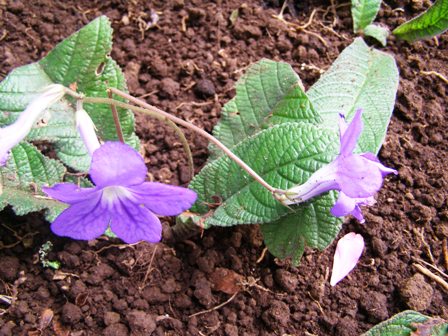
Dividing the streptocarpus

Dividing the streptocarpus

Today has been lifting and dividing streptocarpus – members of the gesneriad family. We are not big on bedding plants here but the streptocarpus survive well in reasonably hard, woodland conditions. They have tiny root systems and seem to muddle on very successfully despite benign neglect so I am hoping they may thrive in freshly tilled soils. They are frost tender and more commonly grown as house plants (like their siblings, gloxinias) but add a touch of the exotic as garden plants.

Mark has been doing a weeding round. He is the Chief Weed Controller here and takes his role very seriously. In a large garden, weed control is the first line of defence against the encroaching wilderness that hovers forever on the boundary, waiting to make inroads. We admit to using glyphosate. There is no way we could maintain the garden without it. The push hoe is fine in summer for the veg garden and for emergency intervention, but glyphosate is indispensable. Mark lives in fear that research may one day rule that it is unsafe, but as long as we can believe that it is not an environmental threat, we will continue its use. The aim here is always to avoid any going to seed. Good weed spraying should be as close to invisible as possible, which means getting the weeds when they have just germinated and never, but never, spraying edges. Various edging tools were designed to get clean, crisp edges, not weedkiller which leaves an unsightly dead fringe.
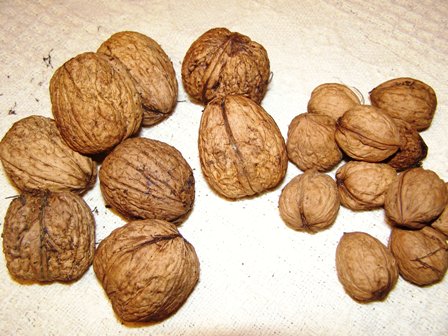
Bigger is better when it comes to walnuts. Standard walnuts to the right, what we think is Freshford Gem to the left

Bigger is better when it comes to walnuts. Standard walnuts to the right, what we think is Freshford Gem to the left

We are drying walnuts and have a good crop from our large walnut this season. As far as we know, it is Freshford Gem, an Australian selection. It is far more rewarding to work with big nuts, rather than the standard size so if you have a choice when it comes to buying trees, chose the ones that boast very large individual nuts.

I was just ever so slightly put out this morning to read the garden pages of our local paper (until last week, I contributed the bulk of copy) and to see that my beloved Plant Collector column has been replaced with indecent haste – by a shopping reporter. Sigh. Gone is the freedom I had to write about any interesting or appealing plant, regardless of whether it was available to purchase or not. Now garish synthetic clogs are the order of the day. It must be a sign of the times. The Philistines have taken over.
Garden Diary – the first entry May 28, 2010

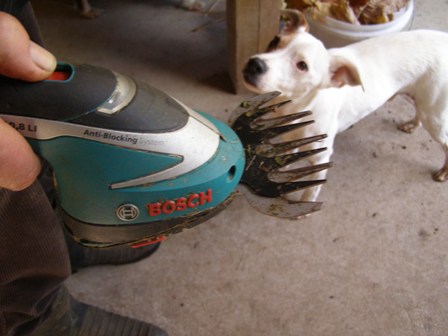
Mark covets the neighbour's wife's toy - her Bosch trimmer

Mark covets the neighbour's wife's toy - her Bosch trimmer

Ha! I knew I loved writing, but I didn’t realise quite how much until I stopped the weekly routine. So herewith the first of a new series. Instead of casting around each week to dispense advice on what readers should be doing in their garden, I thought instead I would record what we have actually done.

Mark has been playing with a new toy which belongs to Lloyd’s wife (Lloyd being our neighbour, friend and one remaining staff member). I don’t think his wife knows they are over here but despite initial scepticism, these battery powered clippers by Bosch have proven to be so useful that I can see Mark needs a set for his birthday. He has spent hours cutting back the long grass from the bulbs he has naturalised in the park (dwarf cyclamen, dwarf narcissi, snowdrops – galanthus – lachenalias and more). The clippers are much faster to use than snips and have saved a major flare-up of his RSI. He is besotted with them and loves to demonstrate how easily they cut back spent perennials and seed heads as well. To me, they resemble hairdresser’s clippers. Not that I have anything against hairdressers.

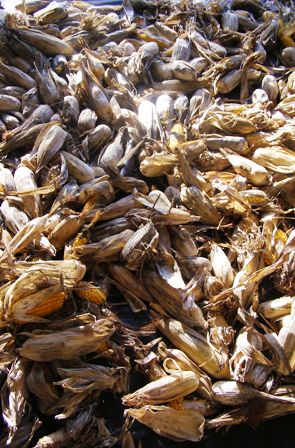
Drying the maize crop for the pigeons

Drying the maize crop for the pigeons

In the edible garden, which is entirely Mark’s domain here, he has been continuing his nightly rat and mouse bait round to combat the growing population. He gathered the maize which he grows to feed his pigeons (I call him the Jack Duckworth of Tikorangi) and has it spread out to dry. He continues to eat fresh sweet corn every day for lunch. The walnut harvest is being dried, the last of the tree-ripened apples were gathered this week but there is a major failure in the vegetable garden. He did not follow the advice we dispensed weekly a couple of months ago and there is a dearth of green vegetables. I have had to buy some – the first vegetables we have bought for close to a year.

Lloyd has spent much of the week weed-eating areas which we can not mow. If he times this autumn round well, grass growth slows so much that it does not need to be done again until we open the garden at magnolia time. An amazingly mild autumn may upset this routine. Grass growth continues unabated.

Our most reliable Friend of the Garden, Colin, has been up for the week. He likes to escape his retirement village (widely known in this country as a Home for the Bewildered) and spend an intensive four days in the garden at least once every six weeks. As a retired horticulturist, he is one of the few people we trust with areas full of treasures so he has done a major clean up of Mark’s cold border in the park – just in time as the trilliums are pushing through.

I am continuing my major revamp of the Avenue Gardens – this week a badly overgrown area of choking and choked perennials which has involved some pretty heavy digging. I have taken out the lot, divided them and discarded large quantities which are surplus to requirements before replanting in freshly dug ground. I have also been dividing and potting Soloman Seal (polygonatum multiflorum) to sell during our annual garden festival at the end of October and digging and dividing some large clumps of a particularly good variegated form of Crinum moorei. We know only too well that one of the drawcards here is our ability to offer plants for sale that can’t be found elsewhere.

For any local readers who noticed the article that replaced me in the Taranaki Daily News on Friday:
1) The unnamed vireya photographed was Golden Charm (one of ours, bred by Felix Jury).
2) The advice given to cut your luculia back to half a metre high after flowering only applies to Luculia gratissima (Early Dawn is the common sugar pink one in flower now). If you do that to Luculia pinceana types (Fragrant Cloud is the spectacular, heavily scented almond pink one most commonly available), you will kill them. We prefer to let Early Dawn grow. It forms a graceful under-storey large shrub.

Tikorangi Notes: Friday 27 May, 2011

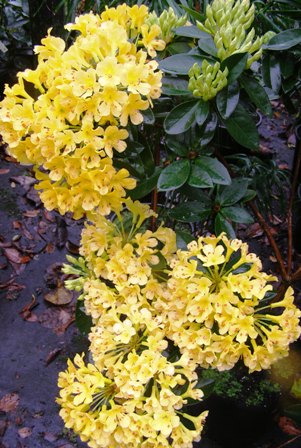
Vireya rhododendron Buttermaid, flowering with great enthusiasm

Vireya rhododendron Buttermaid, flowering with great enthusiasm

Tikorangi Notes: Friday, 27 May, 2011

As autumn closes into winter here, the days are shorter and we are getting plenty of rain but it is hardly cold yet – daytime temperatures are still in the late teens. The beauty of vireya rhododendrons is their ability to flower randomly throughout the year, even at times when there is not a great deal else in bloom. Buttermaid is one of Felix Jury’s early hybrids (aurigeranum x macgregoriae). In a world of big, fragrant, luscious blooms and heavy felted foliage, Buttermaid is destined forever to be the bridesmaid at best. However those showy big-bloomed types rarely, if ever, put on a mass display like the unpretentious Buttermaid. After decades of growing and experimenting with vireyas, we are increasingly of the view that healthy characteristics and flower power matter more than fragrance and individual flower size.

Says it all, really, though the joke of the setting will only be understood by New Zealanders

Says it all, really, though the joke of the setting will only be understood by New Zealanders

Latest Posts:

1) The end of an era.
2) Hollywood, Wellywood, Tikowood – a visual joke that will bypass those not in New Zealand this week.

The end of an era – but another door will open

The steady flow of posts on this page has been the material I wrote for our local newspaper – the Taranaki Daily News. That all stopped in its tracks this week. After 14 years, I am no longer their garden writer.

While a little surprised at this sudden turn of events, the relief was instant. I realised that I had become bored churning out an endless flow of material to agreed formats. It is time for new challenges. In the short term, this means that there will not be the three new articles every Friday. Without the discipline of a newspaper deadline, posts will be random. But I am a compulsive writer and exploring other outlets, so something will continue, even if I am not yet sure what that will be.

In the meantime, I have had a lovely week in the garden, beavering away on a particularly troublesome border. To be free from deadlines has been liberating. I will not miss trying to come up with fresh ways of reminding people what to do in the garden week in and week out, 52 times a year. Over morning coffee (with home baking here, as a rule) I would pose the question to Mark and Lloyd every week as to what we should be doing and most weeks they would look back at me with blank looks. And I was running out of ideas for Outdoor Classroom.

I will miss doing Plant Collector and my column, particularly Collector which is fun to write so that may well continue. A number of people subscribe to this website and receive new posts direct to their email address. There is no charge to subscribe so if you have been in the habit of visiting each week, you may prefer to sign up, while posts are less predictable. Mind you, it looks better on the website than it does in email format.

Best regards,
Abbie

You can design your own

Strictly a joke for New Zealanders, this one. Tikawood perhaps?
Tikorangi The Jury Garden