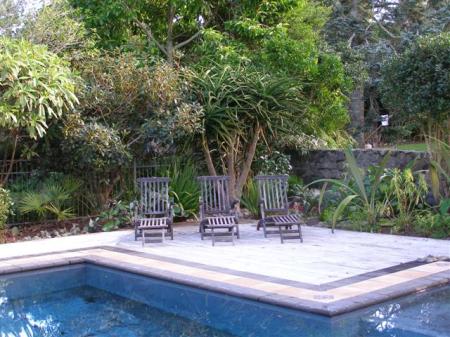
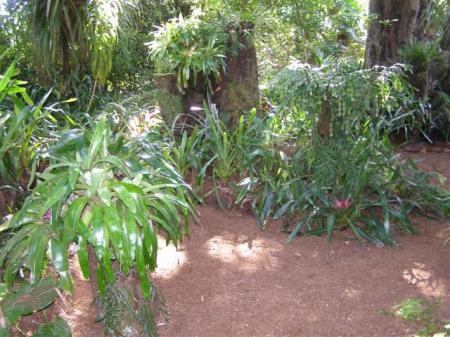
Enchanted by the native orchids growing wild at The Garden House in Devon
Surely the two most romantic sounding gardening styles are meadow gardens and woodland gardening. Woodlands will have to wait because summer is for meadow gardens, though not without difficulty in our climate.
Meadow gardens are based on the attempt to re-create and manage the wildflower meadows and we don’t have these in abundance in this country. Generally, one seems to go to Western Australia to catch the blooming of the wildflowers and that, I am told, can be a hit and miss affair. Timing is critical and some seasons are much better than others. In New Zealand we have natural alpine meadows (the Mount Cook lily, gentians and the like) but in such difficult, inaccessible and vulnerable environments that they do not lend themselves to garden tourism. Countries with naturally occurring wildflower meadows share several things in common – a much harsher, drier climate, and a lack of intensive, pastoral farming. Intensive dairying and wildflower meadows are an oxymoron. And most such areas will have an abundance of annual native flowers which leap into growth en masse, usually triggered by seasonal rains. Our native flora is unique and fascinating but not rich in pretty flowers of the field. So, by definition, wildflowers in this country tend to be invasive weeds. The lupins of Central Otago and the perennial sweet peas of Marlborough are a case in point. As indeed are gorse, broom, Kelly thistles and ragwort, all of which can have a blooming season which is showy. Not for us, thank you, and more than one New Zealander has been shocked to see gorse used as a garden plant in the UK.
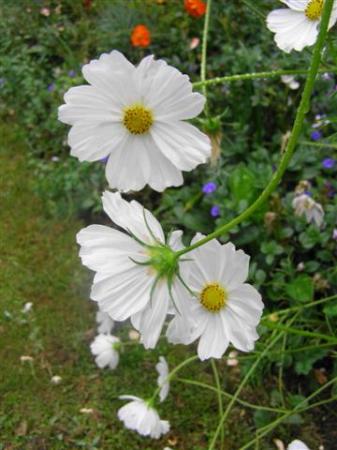
Simple flowers like this white cosmos look best in meadow-style gardening
All our garden plants, of course, originated somewhere so plants such as the species cyclamen, the deciduous ground orchids like dactylorhiza and anacamptis, even the Black-eyed Susans, echinacea and cosmos are native wildflowers somewhere. Just not here. I have never seen the North American prairie gardens, nor the wildflowers of South Africa but it was exciting (believe it or not) to see the ground orchids that we treasure as choice garden plants growing wild in England and in Italy.
Having decided that naturalised wildflowers in this country are more often noxious weeds, how about the controlled alternative of the managed meadow garden? Bad news. All the characteristics which make Taranaki prime dairy country mitigate against meadow gardens. Our grasses grow too well, our soils are too fertile, on top of that we fertilise too heavily, our rains come too readily all year round and our temperatures are too even. The grasses will swamp out all but the most aggressive of the wildflowers. Gardeners right on the coast in the north and in the drier south in the Hawera to Waverley stretch may have more success because their conditions are a little harsher. But it is not just conditions that one needs to get right. Meadow gardens require a bit of an attitude shift, we now realise, and it is a theme that we keep returning to in discussions here. Weeds. Meadow gardens require a high tolerance level for weeds and that is a problem for most New Zealanders. We have an ingrained antipathy to them. The worst crime an open garden can commit is to have weeds. Whether this is a reflection of our farming background, of the DOC position (our weeds are all introduced plants) backed up by our local councils, our high tolerance level for the use of chemicals in gardening and agriculture (and indeed in conservation), or an innate value placed on tidy suburbia, we do not like weeds. Because meadow gardens rely on letting plants grow naturally, you can’t control weeds. Once you start intensive control and management, your meadow garden becomes a cottage garden, and that is a different kettle of fish altogether.
We may need to reconsider our antipathy to weeds. Mark recalls the late Peter Winter, one of our leading environmentalists locally, commenting that the riparian plantings being fostered so actively by our regional council and indeed by Fonterra, are a positive move but that we will have to accept that a certain amount of weed growth is inevitable. The riparian plantings are the ribbons of mixed plants being established along all waterways, fenced off from stock. Done properly, they will filter run-off from farm land and reduce the amount of nutrient being washed into waterways. But they are not going to be a healthy environment if farmers expect to keep them weed free which, for the vast majority, will mean the repeated use of chemical weed killers.

A field of flowers in its first season
But back to meadow gardens. It is the very simplicity of the meadow garden that lends it so much charm but it takes a little more skill than just standing and broadcasting a meadow mix of seeds in early spring. Amongst other things, the birds will pick off a fair portion of the seed and the germinating plants unless you take precautions. Then there are strategies for managing a succession of flowers through the seasons from spring to autumn and to ensuring that the garden lasts for more than one year. If you are willing to kill out all the grasses and competing plants before you sow a very generous amount of seed, you can manage a field of flowers in the first year. By the second year, the grasses will have crept back and the weeds will also be germinating and seeding. Weaker performers in the mix will have been beaten out by the competition. It will be more akin to the wildflower environment and it will have rank and unkempt times of the year.
If you want to try a meadow, pick an area which is in full sun and with poor soil. Don’t feed it at all. You want the plants to flower and seed, not to make a lot of leafy growth so they need to be on the stressed side. At the end of the season, you mow the meadow (one man went to mow, went to mow the meadow…) and leave it all lying on the ground for two weeks to allow the seed to fall out. Then you rake it all up because you don’t want to fertilise the ground by letting the clippings rot down. And you live with the weeds which will also be colonizing the area. The meadow should come back into growth when triggered by seasonal change. That is the theory of it, more or less.
We would love to grow a meadow garden but each time we look at it again, we figure the climate and conditions which make it possible for us to grow lush and verdant gardens mitigate against the meadow concept. It is why we continue to work on naturalising selected plants in designated areas instead. It is not at all the same thing, but it is what we can manage here.