Plant Collector: Rhododendron Loderi Venus

Loderi Venus - still at the top of its class

Loderi Venus - still at the top of its class

If ever there was a good reason to learn to graft plants at home, it is the Loderi rhododendrons. These used to be widely available in the days when specialist rhododendron nurseries produced a huge range and when customers understood that sometimes special varieties need to be grafted, so were willing to pay a premium. These days there will only be one or two places in the whole country still producing these lovelies, which can’t, in the main, be grown from cutting.

The Loderi group date back to the turn of last century when Sir Edmund Loder of Leonardslee near London crossed fortunei with griffithianum. The results were rather large trees with exceptionally large flowers, fantastic fragrance and reasonable hardiness. Despite the passage of over a century, little has been produced that is the equal, let alone an improvement, in the big, fragrant class of rhododendrons. This one is Loderi Venus. Unfortunately our mature Loderi King George bit the dust when one a huge Lombardy poplar landed on top of it but Mark is hoping that his emergency grafts will take so that we can keep it represented in the garden. Venus has the best pink colour of the group and is a picture in full flower.

In the Garden this Week: November 5, 2010

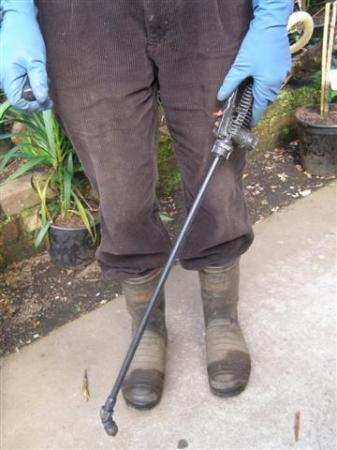
· Narcissi fly are on the wing, circling in search of somewhere to lay their eggs. It is the hatched larvae which will burrow in and consume bulbs, causing the damage from inside out. The flies start circling in the heat of the day. Mark can be found in our rockery stalking them individually with his little sprayer of Decis, which is a synthetic pyrethroid. The non chemical alternative is to stalk them with a fly swat in hand but you have to be very quick to get them. Removing spent foliage and mounding the soil a little deeper over the bulbs will also help protect them. Narcissi (daffodils) need 65 days of growth in order to make the bulbs strong for next season so as long as you recall seeing the foliage emerging by late August, it is safe to strip it off now. Narcissi fly attack daffodils, hippeastrums, snowdrops, snowflakes and quite a number of other bulbs growing in sunny positions. The offender looks like an inoffensive small blowfly but with a yellow lower abdomen.

· In the vegetable garden, leave the brassicas now til the end of summer (that is the cabbage, broc, cauli family) because the white butterfly will decimate summer crops but you can be planting pretty much anything and everything else now – lettuces and all salad veg, peas, green beans, runner beans, cucurbits, main crop potatoes, kumara, yams, tomatoes. If space is very limited, go for quick turnaround greens and higher value crops rather than those that take up a lot of space (in other words lettuces and capsicums rather than gherkins and pumpkins).

Keep your push hoe sharp for good results

Keep your push hoe sharp for good results

· Stay on top of the weeding. Regular push hoeing before plants have a chance to set seed is very effective, especially done on a hot, sunny day so the weeds wither and die quickly. Push hoeing also keeps the soil tilled and friable. It is easier if you keep your push hoe sharpened – you can do this with a file from time to time.

· If you have not covered your strawberries yet, you are risking your harvest. The birds don’t understand about waiting until they are ripe – as soon as they showing any sign of red, they will be into them. Use bird netting held up with cane hoops or something similar. Laying straw or dried grass beneath the plants helps keep the fruit clean and reduces the chances of rotting if we get a wet spell.

· Water container plants daily now unless we get rain. A little often is the mantra.

· Coating your fingers in cooking oil before going out to deadhead rhododendrons stops the sticky goop on your fingers.

· If you have small children in your life, plant a few sunflower seeds with them and go for the giant heads. They will need staking and tying in due course but it is a pretty amazing experience for little ones to see plants which will grow quickly to three or four metres and have a spectacular flower head. They won’t forget it.

The Final Countdown to Festival for 2010, Friday November 5

Jazz in our garden last Friday

Jazz in our garden last Friday

At Te Popo, inland from Stratford, Flynn the Wonder Dog from 2009 (he who excelled at guiding visitors to the extent that he had his very own individual photo in the programme this year) had thrown in the towel by last Sunday. He is just so over it all this year. Apparently he looks down the drive and sees visitors arriving, sighs and goes back to bed. This is a terrible disappointment to his owners, Bruce and Lorri Ellis, but what can you do about a dog with a low boredom threshold?

Also near Stratford, June Lees at Cairnhill Garden knew that her cat Smudge was near delivery and tried to keep her shut away in peace and quiet but Smudge had her own ideas and insisted on company. June moved her bed to the back of their meet and greet area and on Sunday all went well and June and Colin, along with their garden visitors, were delighted at the safe arrival of four lovely kittens during the afternoon.

Still on an animal theme, in Manaia, Irene Taunt was very excited to receive a special feathered visitor. A kereru came to visit and watched her doing her morning clean-up round. In her twenty years of living there, Irene has never seen a native wood pigeon in her garden before and any native bush is many kilometres away. No doubt she is hoping it will find good reason to stick around. Guavas – we swear by guavas which kereru adore eating. They don’t mind if plants are native or not, as long as they are good to eat.

Southwards in Hawera, Jennifer Horner loved the fine weather last weekend and enjoyed the visitors from all round both islands and as far afield as Canada, but she was very pleased that it was the day before Festival that the bee swam passed by. The mind boggles at the potential for complete disaster of a bee swarm meeting a coach tour in a garden…..

A bee swarm, however, was a small concern compared to the potential disasters waiting for Maree Rowe at Havenview Vegetable Garden on Kent Road on the same day before Festival started. The Targa rally car driver who crashed into their barberry hedge was unharmed, as was Maree’s helpful dad who was rolling the driveway to compact the freshly dumped metal fines when his vehicle slipped off the edge, landed in the drain and Maree and her sister had to lean on the side of the ute to stop it rolling on to a particularly large boulder while her dad clambered out the passenger side door. These two minor incidents paled by Maree’s close shave as she was cleaning the stove in her little campground, to see flames and smoke as the califont which supplies the hot water caught fire. With flames coming out the sides, a locked door on the cupboard and no key on her, Maree had to do a superwoman number and pull the door open, only to realise that the gas was still turned on and the gas bottle was still attached in this little inferno. Hosting hundreds of garden visitors was probably a doddle after all that.

In Hawera, Mary Dixon (Mary’s Place) is wondering how one knows when it is time to give in and call it a day. She derives so much pleasure meeting interesting visitors from around the world and from the positive reinforcement they give her but, as with a number of senior gardeners, she worries about whether carrying on may mean that her gardening standards drop without her knowing it. It is perhaps a good reminder why it is important to revere our senior gardeners and to make sure that we visit them this year, rather than assuming they will be around indefinitely.

The final two jazz and wine evenings for this year both take place in New Plymouth – at Wintringham this evening and at Ratanui tomorrow evening. The charming and mellow music from Ross Halliday and Juliet McLean is a real highlight and should not be missed as it makes a wonderful combination with the ambience of gardens in the early evening. It is best to contact TAFT in advance for tickets on 06 759 8412. Garden workshops tomorrow do not need prebooking – catch plantsman Vance Hooper at Magnolia Grove on landscaping with cacti and succulents at 1.00pm or Mark and yours truly here at Tikorangi at 10.00am on using plants as focal points and accents in the garden.

Tried and True: Lachenalia aloides

Lachenalia aloides

Lachenalia aloides

• The easiest lachenalia to grow.
• Widely available, from many other gardeners if not from every garden centre.
• Bright winter colour.
• Often sold as Lachenalia Pearsonii.

In the gloom of winter when the main colour comes from pink camellias, the early flowering lachenalias ring a colour change to orange and red. Whether you consider this form of aloides to be garish or cheerful depends on your personal taste. It is the most common lachenalia in New Zealand and is often referred to as Pearsonii. It has two strappy leaves per bulb, usually with burgundy spots. These are South African bulbs which thrive in areas which have winter rainfall although even the toughest aloides will not want to be out in hard frosts. Lachenalias have a long dormancy period so are easy to lift and divide.

Try underplanting citrus trees to repeat the colour, or we find it also combines well with the green, mounding hillocks of our native scleranthus biflorus. It will combine equally well with any predominantly green scene to add a bright spot.

Tikorangi Notes: Friday October 29, 2010

Latest posts: Friday October 29, 2010

1) Sumptuous nuttalli rhododendrons are coming into flower, particularly the appropriately named Floral Legacy.

2) Countdown to Festival – the penultimate episode for this year as our annual Taranaki garden festival starts today.

3) Our tips for garden tasks this week.

4) Outdoor Classroom this week is about rhododendrons – common problems and suitable remedies.

Even at 7.30am, the lilac flowers and adjacent apricot azalea are a delight this week in our driveway
Even at 7.30am, the lilac flowers and adjacent apricot azalea are a delight this week

Tikorangi Notes: Friday October 29, 2010

Mark's hybrid arisaemas are a real feature

Mark's hybrid arisaemas are a real feature

Today is the first day of our annual garden festival – an event which delivers a hefty portion of our annual visitors in a busy 10 days. All around our province, gardens are groomed, swept, weeded and trimmed in preparation and garden owners are waiting to meet and greet. At this time of the year it is mostly the maddenia and nuttallii rhododendrons in flower for us, along with the deciduous azaleas. Mark’s arisaemas make pretty unique bedding plants throughout, the rhodohypoxis make carpets of colour and the roses are just opening.