- Southwards in Hawera at Puketarata, Jennifer Horner has been looking on the positive side and enjoying those spring days which have been lovely (as opposed to sodden). While the early daffodils and Magnolia Vulcan are looking a little weather beaten, (though Jen says Vulcan has been spectacular this year), Rhododendron Bibiani is in full flower and has escaped damage and the pretty Prunus Awanuis are just opening. The lawns have responded most gratifyingly to an application of potash and Jennifer is feeling that she is on top of the pruning, fertilizing and mulching but the vegetable garden is calling.
- Also down in Hawera, one of Festival’s most experienced openers, Mary Dixon is dashing out in between the showers trying to get jobs done – weeding, moving plants, deadheading and getting rid of the winter moss buildup. She is still worried about the possibility of late frosts, so is cautious about rushing to fill the gaps left by earlier frost damage. However the delight of the early spring display of magnolias, flowering cherries, daffodils, violas and pansies, different hellebores and primulas more than compensates. Mary gardens for twelve months of the year but likes to have her garden peaking to perfection for Festival at the end of October.
- Moving northwards, June Lees of Cairnhill Garden, Stratford has been waging war on liverwort, the bane of all our lives in our climate. She is hoping it will be invisible by the time Festival opens. June is also having fun with her new playhouse, as she calls her tunnel house. It may seem an extravagant home for her hanging baskets, but it has made life much easier for both June and said baskets. In the past she has had to house them in her glasshouse where she kept bumping into them so leading her to move them out too early to the patio. So at this stage, her new tunnel house gives room for a glorious line of hanging baskets and no doubt, over time, June will find a whole host of other uses for her tunnel house and she will wonder how she ever managed without it.
- Joyce Young has been in Festival for a very long time indeed but more recently has moved to a small garden in town – a mere 480 square metres, she says. This is an interesting opportunity for Joyce to manage a sustainable gardening model from scratch. She has installed a rain water tank with gravity fed soak hoses to water her vegetable garden – the gentle soaking is far kinder and does not lead to as many mildew problems as overhead watering. Her worm farm has been in operation for a full two years and while her three bin compost system is a commercial structure, it is an efficient and simple option for a retired person for whom the manual labour of a more traditional compost system is a challenge. Joyce is well known for her pottery (particularly pukekos) but of late she has been really enjoying getting to grips with painting with pastels and has just moved on to flower subjects – magnolias, this week.
- Also in New Plymouth, David Clarkson and Valda Poletti at Te Kainga Marire are despairing at the damage being wrought on the black mamaku (ponga) tree ferns, they say by the dreaded Indian mynah birds. Apparently they eat the unfurling leaf buds and the neighbours’ pongas have already succumbed to sustained attack. David and Valda are fighting off the mynahs to try and save their 30 year old pongas, moving Valda to express the wish that people would stop encouraging these pest birds by feeding them household scraps.
- Here at Tikorangi, the mynah birds are a minor issue and the pongas are perhaps too plentiful but we could have done without the ginormous Lombardy poplar that crashed to the ground without warning in our park. At about 80 years old and 80 feet tall, it was perhaps fortunate that it fell inwards to our property and not outwards to the road. It is such a shame that poplar wood of no value either for firewood or timber but in its descent to ground level, it clipped the Magnolia campbellii which is now about half of its former size and magnolia is a good timber. Our rhododendron Loderi King George also bit the dust but considering the size of the tree, the damage was not too bad overall. Now that it is all cleaned up, we are looking at an unexpected new area to plant up.
Abbie Jury and Chris Sorensen make a simple worm farm
A step by step guide by Abbie and Mark Jury first published in the Taranaki Daily News and reproduced here with permission as a PDF.
New Outdoor Classrooms are uploaded fortnightly.
Tikorangi Notes: Tuesday 14 September 2010
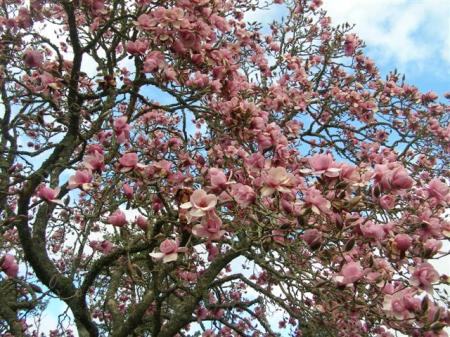
The original Magnolia Iolanthe is a sight to behold in full bloom
There will be no updates for the next three weeks owing to the fact that I am flying to Spain and Portugal today and Mark, who remains behind here at Tikorangi, is computer illiterate. New posts are all scheduled for www.abbiejury.co.nz and will appear each Friday as usual, but linking through to each from this site was one task too many to complete before I left.
In the meantime the garden is open daily and the magnolias and spring bulbs are looking splendid. Mark will be available for plant sales on Fridays and Saturdays as usual but he is less enthusiastic at other times unless by appointment. I plan to be far away eating tapas and drinking sangria in a country I have not visited before, although the thirty six hours it takes to reach Madrid from here has to be endured first.
Plant Collector: Tulipa saxatilis

Plant Collector: Tulipa saxatilis
I am not a great fan of the common tulip and even less so of the novelty forms so prized in colder, northern European gardens. But get back to the original species, (how they occur naturally in the wild) and it is a different matter altogether. This very pretty tulip is a combination of soft lilac with a yellow throat which is not the world’s most obvious colour scheme but generally the colours of nature do not clash. It hails from the island of Crete (the home of Zorba the Greek) though apparently it is also found in Turkey. In their natural environment, these are wild flowers and if you have ever visited the Greek islands or the coast of Turkey, you will know that conditions are hard with poor stony or clay soils, very low fertility, drying winds and next to no rain for most of the year. These are not conditions that we can replicate in the garden here but Tulipa saxatilis is not too picky and has thrived in our rockery for many years. With open conditions and excellent drainage, it is genetically programmed to be a survivor.
This is an early spring bulb, so it starts to grow in winter (triggered by autumn rains) and flowers in early spring for a period of several weeks. Each bulb puts up a stem which flowers its way down in succession so you get several blooms per bulb. It is a good example of a bulb which will find the depth it is happiest at in the soil so it will often drag itself down quite deep and it is a rarity amongst the tulips because it runs below ground. Because the foliage doesn’t hang on very long, it lends itself to being co-planted with a summer perennial which is dormant when the tulip flowers. We have had a dwarf species oenothera, better known as Evening Primrose, interplanted with our main bed of Tulipa saxatilis for many years and it comes into its own as the tulip goes dormant.
Tikorangi Notes: Friday September 10, 2010
LATEST POSTS
1) There is clearly no Dutch blood running in my veins. I am not generally a tulip fan but I am happy to make an exception for the Cretan species, Tulipa saxatilis which has just come into flower.
2) Taking a second look at camellias as garden plants despite the ravages of camellia petal blight – Abbie’s column (and de facto instalment on the Camellia Diary).
3) Garden hints for the second official week of spring – but we know that spring is well advanced here.
4) Counting down around the province to our annual Taranaki Rhododendron and Garden Festival.
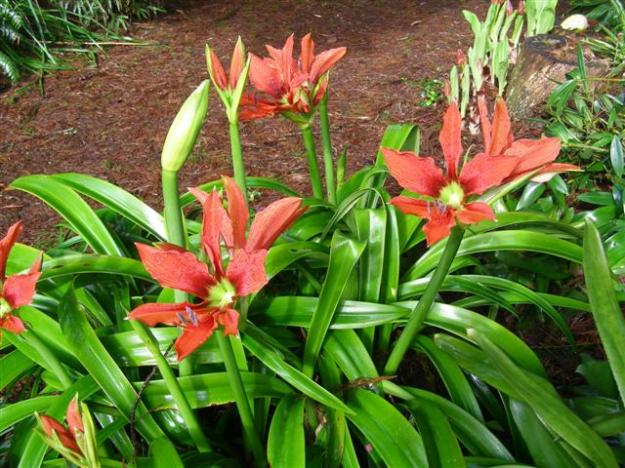
- Big clumps of Hippeastrum aulicum are just coming in to flower in our woodland
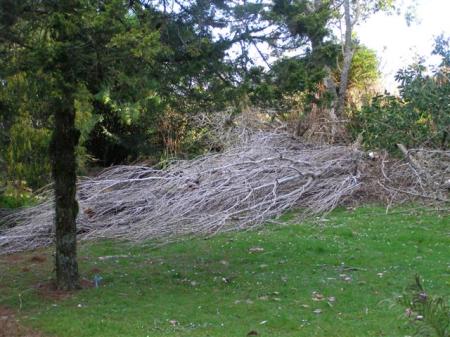
- Eighty feet of fallen Lombardy
TIKORANGI NOTES:
The sad sight of a very tall Lombardy poplar lying on the ground has preoccupied us this week. We were standing in the shed last Friday watching a sudden wind hit our huge pine trees and as it was calm on the other side, we briefly thought that maybe one of the dreaded little tornadoes that can wreak havoc here was hitting us. Mark was wondering if he should shut the roller doors of the shed – is it better to close a building off or to allow air flow in a tornado? Fortunately it was not a tornado but it was quite fierce, very shortlived and so noisy that we didn’t even hear the tree fall. We found it the next day, upon the ground. All 80 plus feet (about 25 metres or so) which can make quite a mess. The toll included a big Loderi Rhododendron King George and about half of the Magnolia campbellii which is fifty years old. It has opened up our view of Mount Taranaki a little more but we are sad about campbellii and King George. We don’t care about the poplar which is no loss, but now we are worried about the remaining two poplars of similar stature.
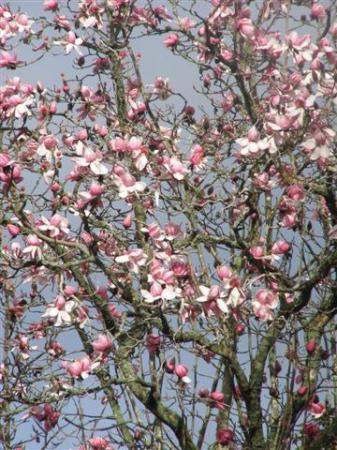
- Half the campbellii – killed in action
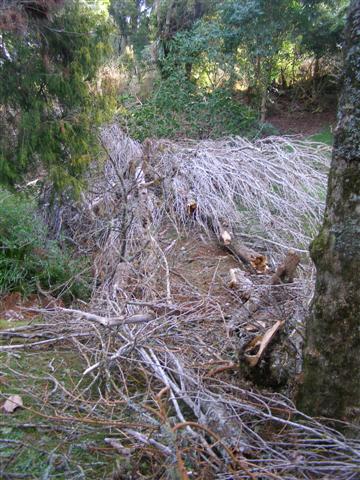
- Shame the poplar is no good for firewood

