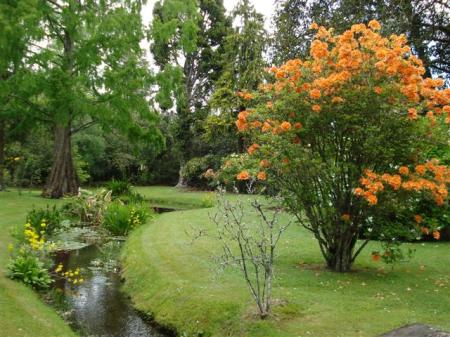
Lifting and limbing allows us to garden below our avenue of huge rimu trees, now 130 years old (which is very old for New Zealand gardens where there is a widespread apprehension of anything older than about 20 years)
In one of those rash moments when our annual garden festival was a long way out, I volunteered to take a workshop here in our garden. These are fast becoming a feature of our event. The popularity of workshops suggests a growing demand for quality information. Predictably, muck and mystery (as English garden writer Alan Titchmarsh used to call compost) attracted the largest number – presumably those driven by a desire to demystify the secrets of making the good stuff. I say predictably because compost is closely tied in to the Great Vegetable Garden Boom still in full swing. But all workshops attracted good attendances and all but one were based in festival gardens.
Several of our attendees commented later that one of the unexpected bonuses of coming to our garden festival here was the presence of knowledgeable gardeners who are available and willing to share ideas, name plants and give good advice. It is one of the characteristics that set us apart from other such events around the country. Back in the early days of our festival when most gardens were free and there were many more open gardens, there was little expectation placed on garden owners. They weren’t even required to be there. In fact, some just left the gate open when they went to work. I always wondered why there weren’t more burglaries because I felt sure that any burglar worth their salt would have cased out the joints. But maybe forward planning is not a mandatory qualification for your average burglar and thief. That aside, there is something slightly disturbing about not being formally invited onto private property to look around the garden and quite often garden visitors would comment that they felt very uncomfortable looking around where there was nobody home and they left quickly. It is all a bit like snooping into your host’s private cupboards or drawers.
It was precisely because of this, the requirement that every garden be hosted was brought in some years ago. Nowadays we expect a great deal of our garden openers and most in fact deliver even more than is expected of them. Not only do they have to get their gardens up to opening standards (and pretty well without exception, our garden openers are their own toughest critics and have lifted standards higher every year), but then we expect them to front up to the public and meet and greet and chat to them for ten days on end. There are other festivals where this does not happen, where the garden owners are not visible or available. The Trinity Garden Festival in Auckland (which doesn’t seem to be running any longer) was the most often cited event – students employed to do the gate and a completely impersonal experience with nary a gardener and garden owner in sight. But it is not just that our gardeners are available, it is also that they are voluntarily up-skilling themselves so that they are more knowledgeable hosts. It is one of the defining characteristics of our festival and a reason why it has run without interruption for 22 years and is apparently going into another growth period.
I started by saying it was a rash impulse which saw me offering to take a workshop here. It always looks a long way out when you agree to do something but it is a bit like an exam – some of us don’t start worrying until it is almost upon us. It actually takes quite a bit of thought and discussion to marshall one’s ideas and key points and it may even be harder to make a casual workshop coherent than it is to present a formal lecture. Whatever, we chose the title of Taming the Wilderness and then started worrying about what direction to take it. I am not going to try and summarise all we covered but it was interesting that for us, personally, there were three critical points.
- If you have a property with large trees and shrubs and you are not sure what is what, seek out some good advice as to which plants are special so worth saving and which are the long term trees. You can’t buy maturity and too often, ignorance sees some pretty special plants lost forever. At the risk of making enemies, tree surgeons and arborists tend to be the people you seek out when you have decided which trees you want saved and which ones felled. They should do the work safely and efficiently for you but by no means are all these people knowledgeable about tree varieties. You need a plantsperson or dendrologist for this and the really able enthusiasts are often found in the voluntary or amateur sectors.
- Lift and limb. Gardening is about working with nature. Just by cutting off the lower branches of trees, you can open up an area to light and air movement. You don’t have to return a tree back to juvenile size if it is too large. You can celebrate the stature of large plants by managing the lower metres of trunks and canopies so you can garden below, rather than growing dense forest. At our workshop, Mark did a memorable demonstration of lifting and limbing – showing what a difference dropping merely a couple of large limbs can make, creating vistas and views and opening up around the plants.
- Reclaim space around individual plants. Much of the appeal of juvenile, freshly planted gardens is that each plant stands alone in its own space. As gardens grow, plants become intertwined and thugs can dominate. Over time, plantings can become forests or hedges. To reclaim a sense of managed garden, create space around individual plants by judicious pruning and thinning. It is also better for plant health.
In a place with some very large trees and a well established garden, we are constantly working to hold the forest and potential overgrown wilderness at bay and to keep a sense of garden and open space within that mature framework. It is simply what we do here.