All About New Zealand Plants by Dave Gunson

I was going to be a little kind at least about this book which tries to make information on some of the plants growing in New Zealand available in a form suitable for people aged about 6 or 7 years on though to inexperienced adults. I could almost accept the random selection of plants which ranges through kauri and pingao to gorse and macrocarpa without ever discussing the difference between native and introduced plants, at least not that I could find. I was starting to have some issues with the classifications. It is pretty dodgy listing clover under Weeds but it just bizarre to put moss and lichen in the weed category. But it was when I looked at the pages on the so-called Penwiper Plant, Vegetable Sheep and the Mount Cook Lily that I immediately dismissed this book out of hand. Raoulia eximia is sometimes referred to as vegetable sheep, but that does not mean it is okay to rename it as that and completely ignore its proper name. There are a host of different plants internationally described as penwiper plants, but the main one we have here is Notothlapsi rosulatum. But don’t expect this book to tell you that because it has dumbed everything down so there is to be no botanical naming, even at the bottom of the page. The Blue Swamp Orchid – which orchid is it? Don’t expect this book to tell you that but it will tell you which tree is most likely to shout “Boo!” at you. Bah humbug. I hope New Holland’s other titles in their All About natural history series are better than this one.

(New Holland, ISBN: 978 1 86966 251 6)

Flowering this week – bluebells and blue lachenalias

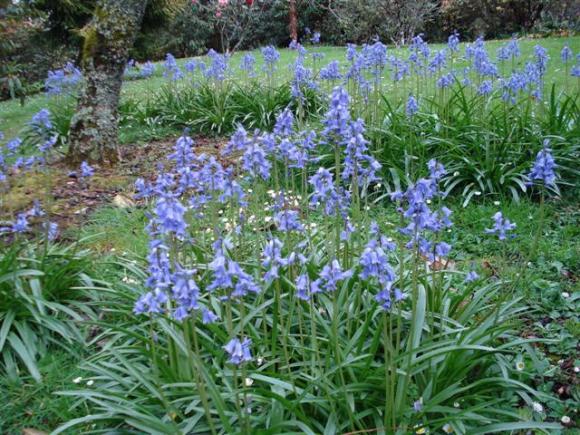
Bluebells (more correctly hyacinthoides, used to be scillas and even endymion)

Bluebells (more correctly hyacinthoides, used to be scillas and even endymion)

Wordsworth waxed lyrical over his sea of golden daffodils (long finished here and hardly a sea) but it is the haze of bluebells that is pleasing us this week. The desirable bluebell is the English one, Hyacinthoides non-scripta, which is scented and less inclined to be as over enthusiastic as the larger growing Spanish one (H. hispanica). But they are reportedly struggling to keep H. non-scripta pure in the UK and odds on what we have here are various Spanglish forms of natural hybrids. Bluebells also come in pink and white although they do not then become Pinkbells or Snowbells. The other colours have some novelty value, but for large scale drifts you can’t beat the beautiful blue. In the UK where their woodland is far more open than our forest, it is hard to surpass the romantic sight of a copse of white barked birches with a blue carpet below. Here we have to naturalise on the margins where there is sufficient light but the bulbs are not competing with full on grass cover which overwhelms everything.

If you really want to sort out the origin of your bluebells, the English ones have cream anthers whereas the Spanish ones always have blue anthers. Apparently. Presumably if you have both blue anthers and cream anthers in your patch, you have Spanglish bluebells. And in case you are too embarrassed to ask what an anther it, it is the pollen bit on the end of the stamen in the centre of the flower.

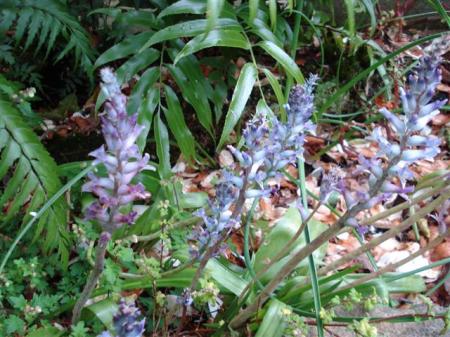
Probably lachenalia orchioides var. glaucina

Probably lachenalia orchioides var. glaucina

Bluebells are easy to naturalise and have a simple charm. Blue lachenalias take considerably more effort to build up and are much fussier about position, but have a great deal more status value. We find mutabilis is the easiest of the blue lachenalias, bur orchioides var. glaucina is showier. Over the years we have collected as many different blue and lilac lachenalias as we can find but they tend to be a little promiscuous and it is likely that we now have the species mixed. We certainly have the labels mixed. The blues flower later, are more frost tender and somewhat fussier than some of easier red, orange and yellow forms (aloides, reflexa, bulbifera and the like).

Separating the genuine enthusiasts from candyfloss fashion gardening

Christmas must be close. The New Zealand garden book market has sprung into life and vegetable gardening is still red hot. Two titles landed simultaneously, both veg garden guides and both by younger women who represent the new face of gardening in this country. Auckland landscaper Xanthe White gives us a month by month guide for the novice vegetable gardener while Auckland food writer and keen vegetable gardener Sally Cameron gives us the Tui version of the famed Yates Garden Guide, though focused only on vegetables and herbs.

The NZ Vegetable Garden is a solid book, designed to be used repeatedly (good PVC plastic cover). Yes it is sponsored by Tui but that is generally unobtrusive. The text avoids the cult of the personality so the book may well have some longevity on the shelf because it is a genuinely useful guide to growing vegetables and herbs at home. It contains most things you are likely to need to look up on both individual crops and on the wider management of the edible garden. Of course one can go through and pick holes and criticize individual details but the bottom line is that this is a pretty comprehensive, well organized book with good layout and helpful photos. It is a reference book and it avoids dumbing down or over simplifying the subject. There is a bit of crossover into the kitchen which is entirely appropriate – handy instructions on sprouting your own beans and one tasty but practical recipe per vegetable or herb. Sally Cameron’s last book, Grow It, Cook It, was a more personal effort. As I recall, I commented at the time that it was better on the recipes than the veg growing side. I wouldn’t say that about this book which we will be keeping on our own garden reference bookshelf.

I have one pedantic niggle. Last time I looked, the adjective from fungus was fungal, upon occasion even fungoid. Fungous is something that has the transitory nature of a fungus. So the useful chapter on fungous diseases should really be on fungal diseases. But they can change that on a reprint and this book may well prove to be worth its salt as a useful reference and therefore run to reprints.

Organic Vegetable Gardening has the look of a book dreamed up by the publishers. I am not sure how long the lead-in time is but I am guessing eighteen months to two years. So if you imagine up on the top floor of Random House Publishing, the editors and managers met and the conversation may have run as follows:

“Item 5 on the agenda: Christmas 09. Wot’s gonna be hot for 09?”
“I have a list here. Home mechanics. Making new clothes from old. Surviving the property crash. Return to floral art. Organic vegetable gardening…”
“That’s a good one. Organics are hot. Vegetables are hot. Great idea. Now who can we get to do it and give us a fresh face which appeals to both Gen X and Gen Y?”
“How about Xanthe White? Good designer. Young, trendy, lovely smile. Won a silver gilt at Chelsea, don’t you know. Now the pin-up girl for motherhood. Smart too, and can write.”
“Great. But does she know anything about growing vegetables?”
“What does that matter? If she doesn’t know anything, she can do it on the run and record progress as she goes. I can see the press release now: walk alongside Xanthe as she learns…”
“Hasn’t that been done already? Don’t Lynda Hallinan and the gals at The Gardener have that area pretty well sewn up?”
“Well, yes and no. They are moving on. They are hardly novices any longer. No, there is going to be an empty space there. Let’s give Xanthe the role.”
“But how about the organics side? Does Xanthe know about organics?”
“Look, what is Google for? Besides we are all organic at heart, aren’t we? Organics is as much about what you leave out (the toxins and chemicals) as about what you actually do.”
“Great. All go. Sign Xanthe. Now what sponsors do we have for this book and what sponsors is Xanthe likely to be able to bring on board with her?”

The result is learn how to garden one step behind the charming Xanthe, who is undeniably somewhat glamorous in a wholesome new age sort of way, but a book driven by the cult of the personality, intrusive product placement, and superficial, with no depth of experience in either organics or growing vegetables. So we have advice such as that on digging. “Never dig any deeper than 10cm unless preparing for a very specific need, otherwise you will upset the natural structure of the soil.” Pardon me, but didn’t I just read about Xanthe gardening in raised beds with soil mixes (Daltons Lawn Mix, shipped in from Matamata, no less) and composts brought in from elsewhere? Where is the soil structure she wants to protect? And if you garden on poor soils, are you not trying to alter the soil structure for better outcomes?

I am not confident about the advice on composts either. Do people really need to be told not to put metals or plastics in their compost bin? Let alone painted timber. “No, Phil, you can not put the old weatherboards in the compost bin. Hire a skip.” And if you are going to put a blanket ban on adding any manure from animals which eat meat, this rules out Grunt, the ever useful pig compost, ZooDoo, and chook manure. Poultry are not vegetarian. But honestly, how many new veg gardeners from Ponsonby and Grey Lynn are going to pile the kiddies into the people mover of a weekend and drive out to the country to slip a few dollars into the hands of some friendly farmer (just look for the one wearing an old straw hat, chewing on a piece of hay and speaking in the thick accent as befits Friendly Yokel) just so they can buy some wholesome horse or cattle manure for the compost heap at home (page 61, I kid you not).

There has been some heavy criticism here of the claim in the book title to be organic. It is fine to write a book aimed at young women from St Heliers and Grey Lynn who probably drive SUVs but want a potager and a home orchard. It is not fine to reduce organics to the same level. We are keen to see organics demystified, separated from the flakey side which confuses faith and good practice and given some clarity of thought. Alas this book reduces organics to cliché.

But spare a thought for poor Xanthe. Presumably the crop of books for the 2010 Christmas market is well underway already. Odds on Sally Cameron will have been given the topic of a manual on caring for the home orchard. All those multitudinous fruit trees sold over the past couple of years will be needing some attention by then. The topic should sit well with Sally’s style and Tui’s sponsorship. And Sally can do splendid seasonal recipes to go with harvests.

I had already predicted that Xanthe’s allocated topic for next year would likely be the low maintenance productive garden, notwithstanding the fact that vegetable gardens and easy care are mutually exclusive concepts. The October copy of the The Gardener magazine arrived, in which Xanthe has a page where she solves readers’ design problems. There is the letter: “We live on a lifestyle block with four young kids and don’t have much time for gardening. But I’d love to have fruit trees and veges. I want a funky, colourful, edible jungle … but it would need to be low maintenance.” Funky? Colourful? Edible jungle? But low maintenance? Xanthe is a professional landscape designer with an established reputation. I sure hope she is paid well to deal with this type of candyfloss fashion gardening.

The NZ Vegetable Garden, Sally Cameron (Penguin, ISBN 978 014 320228 8)
Organic Vegetable Gardening, Xanthe White (Godwit, ISBN 978 1 86962 1551)

October 2, 2009 In the Garden

  • We did warn that the magical dry and early spring was unlikely to continue. The chillier temperatures this week are a reminder of why not to rush out too early planting cucumbers, tomatoes, aubergines and their summer companions. By all means sow seed of them into pots and keep them under cover, or buy baby plants from the garden centre and pot them on to get a jump start in a few week’s time. But you won’t gain anything by rushing to get them planted out too early. You are more likely to lose the plants.
  • If you have a cloche, you can use it like a mini glasshouse in situ. We are enjoying fresh greens (lettuce and leafy greens) from under our cloche and one big advantage at this time of the year is that the leaves are very clean – free of both mud splash and insect damage. Apparently cloches are incompatible with dogs which are accustomed to agility work and to racing through the training tunnels. We merely have to keep the cat out as she is inclined to think that Mark has just made her a nice, dry and private toilet area.
  • If you have planted peas, you will have to stake them. We often use relocatable frames which consist of two hardwood posts with some netting stretched between. They can be rolled up when not needed. You can weave quaint structures which are more ornamental, but the peas don’t mind either way. At least they twine and hold themselves up.
  • One of the key skills in the vegetable garden is keeping a succession of crops coming, to ensure continued supply. Lettuces, beans, brassicas and green leafy crops such as spinach are all best sown or planted in small numbers each fortnight.
  • As deciduous fruit trees come into first leaf, a copper spray is timely and will reduce many fungal and bacterial problems. You can often get away without doing anything further to the trees this season but that first application of copper is beneficial and justified.
  • Time is running out for hard pruning of trees and shrubs. You really want this done before the plant has put on its main spring growth. You can keep giving plants the hairdresser’s trim any time but radical restyles (as in hard pruning) need to be timed well.
  • It is the optimum feeding time for the ornamental garden. Some people feed their entire garden every year. We target our use of fertiliser a great deal more selectively but we do ladle on the home made compost, using it as mulch. Key beds will get mulched every year.

A friend who shall remain anonymous felt a little short changed by the recent TV programme which promised to show him how to grow his own drugs at home. I think he was hoping for something a little more risqué than a home cure for athlete’s foot (aloe vera and lavender, was it?) Being responsible gardeners, we will not be alerting readers as to what they can grow at home that is legal, but we will comment that there is not a wide range and there are good reasons why they have not been a runaway success in the drug world. Mostly they are highly unpalatable. Some are inclined to result in death.

Magnolia Diary 13, September 29, 2009

Click to see all Magnolia diary entries

Click on the Magnolia diary logo above to see all diary entries

The deciduous magnolia flowering is over for another year - the perils of building our swimming pool too near the original Magnolia Serene

The deciduous magnolia flowering is over for another year - the perils of building our swimming pool too near the original Magnolia Serene

The deciduous flowering is over for another year. On a grey day, it can seem a little forlorn. Fortunately, we have other strings to our bow so from here we move on to rhododendrons, and the bulbs are still in full flight. The michelias flower on, and on and on in fact – quieter performers than the deciduous magnolias but more staying power.

In our park, our large Magnolia nitida is in flower, though all but enthusiasts may be a little underwhelmed by the modest yellowish inflorescence. We have it planted beside a very large talauma and a rather large Mangletia insignis (about 40 feet or 12 metres high) which makes an interesting group for dendrologists.

In summer we will return to this diary with some seasonal photos, including Michelia alba which we carefully planted by the swimming pool because its summer fragrance is divine. Alas it is so vigorous and it is gaining stature so quickly that we are wondering if we made a mistake.

Drunk and in possession of wings - this tui was not a happy camper

Drunk and in possession of wings - this tui was not a happy camper

Finally, nothing to do with magnolias but this tui was not a happy camper yesterday. Our native tui feed on nectar and as it ferments, they can at times be found drunk and vulnerable. This one was wobbly, disoriented, land-bound and even retching. Fortunately tui seem to recover more quickly than humans and when we returned to check a few hours later, there was no evidence, either dead or alive. We hope this is a sign that he recovered sufficiently to fly to safety.