In times of trouble, you will find me in the garden

That is an old stone mill wheel from the ninteenth century, repurposed these days as a bird bath

It has been a difficult week in New Zealand. I recall commenting here to an Irish reader (*waving to Paddy*) that if anybody can get rid of Delta, we will. This week brought us the distressing realisation that we almost certainly can’t. Gone is the dream of the return to level one this summer – level one being no restrictions on day-to-day living bar those pesky border controls. Like many others, we were plunged into a state of deep anxiety. All due to just one case entering the country and now spiralling ever larger, creating the whack-a-mole situation we are now in.

I have to grit my teeth with those who declare ‘we just have to learn to live with it’. I don’t think learning to live with Covid looks like they think it does. It does not mean a return to life as it was with some people getting a bit sick and a few dying – but, presumably, nobody known to those advocating this course of action. Learning to live with Covid means living with ongoing anxiety, wearing masks, using sanitiser, scanning, restrictions on movements and gatherings and playing whack-a-mole all the time. Learning to live with Covid means an indefinite extension of the current status quo.

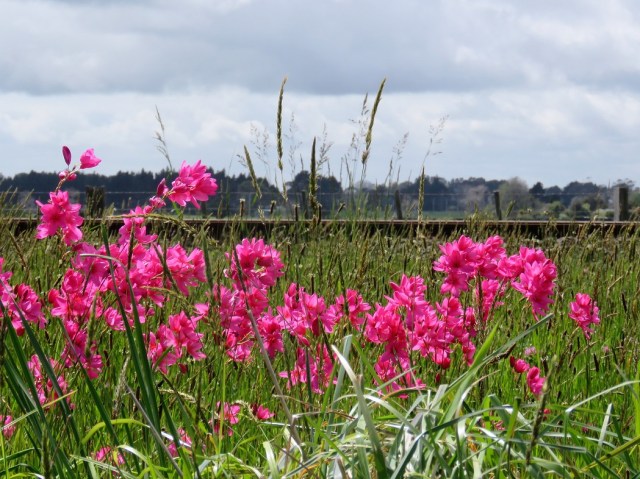
Scadoxus puniceus

The only path out of this is very high vaccination rate. Please, if you haven’t been vaccinated yet, get it done now. Ignore that small group of very loud, insistent anti-vaxxers. Surveys show that there aren’t that many of them, statistically speaking (somewhere between 4 and 7%?) but too many of them seem pretty determined to keep their ‘freedom of choice’ by attempting to abuse and verbally bludgeon everybody else out of exercising their freedom of choice.

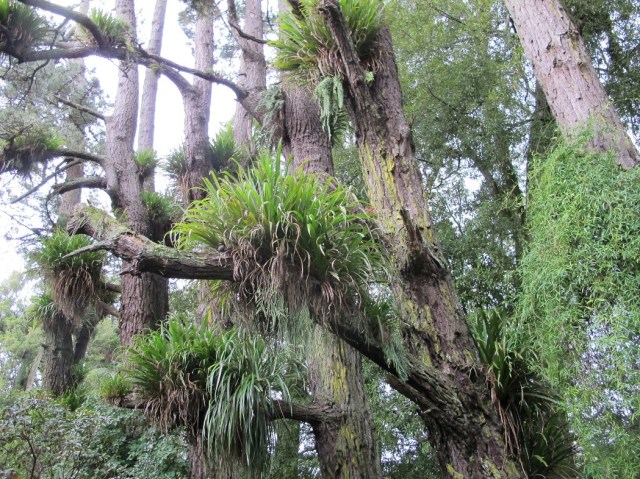
Crinum moorei at the front, which will flower white later in the season, dendrobium orchid, clivias, bromeliads, Scadoxus puniceus and the wedding palm – Lytocaryum weddellianum – in a tiered woodland planting beneath giant rimu trees

What does this mean for our garden festival, scheduled to start on October 29? Goodness only knows; we certainly don’t. We were headed for one of the largest attendances ever with coach tours and ticket sales setting new records. That seems unlikely now.

I see three possibilities. The first is the best-case scenario where travel restrictions are lifted to the north of us and we plough ahead but with masks, sanitiser and physical distancing. This is also the least likely scenario.

The second scenario is the border remains in place on our main northern access to Taranaki and numbers are hugely reduced as a result. In which case it will all be much quieter and lower key.

The third is that Covid reaches Taranaki in the next few weeks and all events are cancelled but I figure we cross that bridge if we come to it.

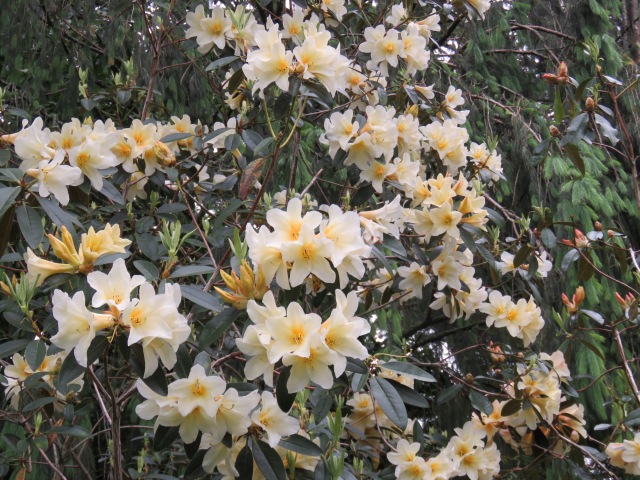
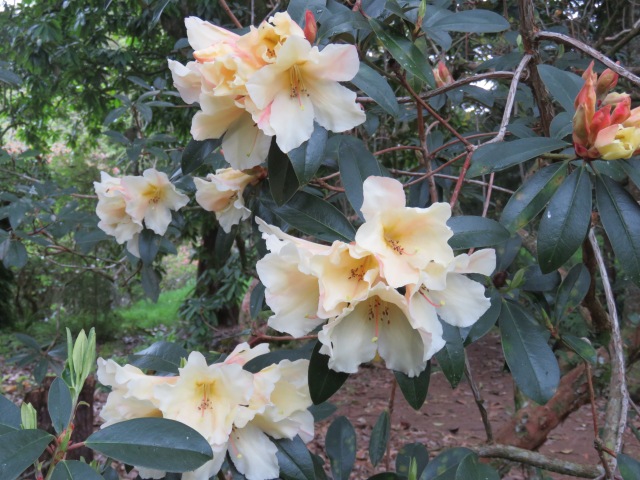
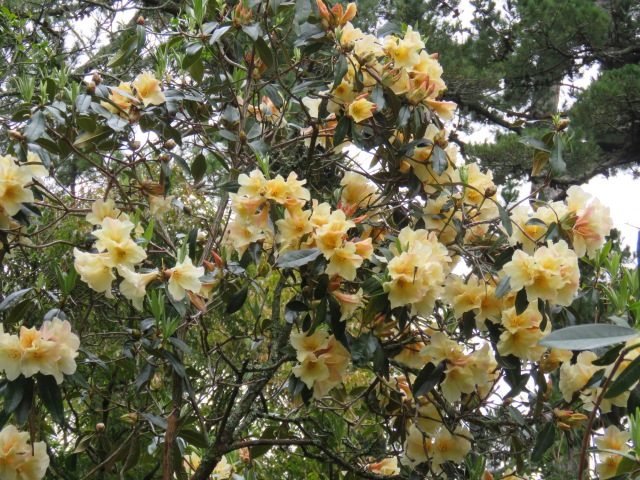
Seedling vireya, very scented, which seems to be predominantly R. konorii growing beneath pine trees
Pleione orchids have a shorter season in bloom but are so pretty

It all makes planning very difficult here. When we know we are opening the garden, there is a lot of extra garden grooming that gets done – titivating, one might call it. It takes a lot of time to titivate a garden the size of ours and we don’t do that final flourish if it is just for our own pleasure.

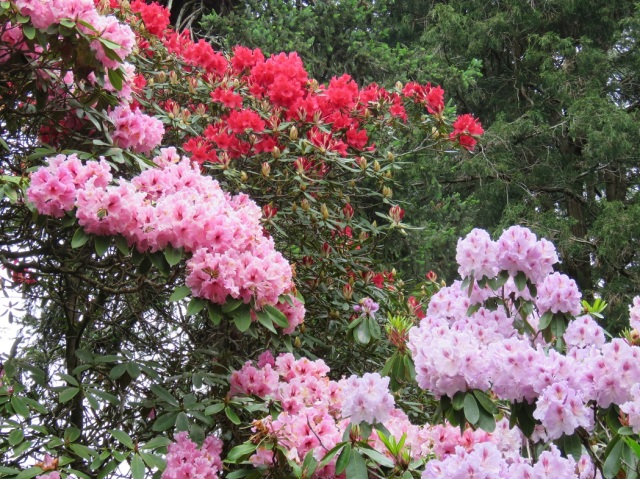
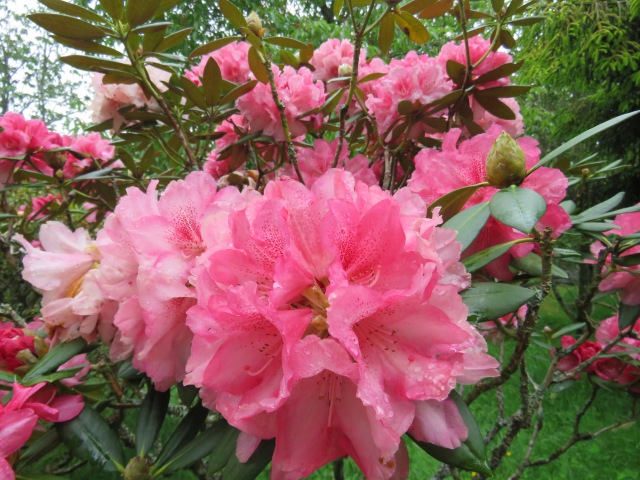
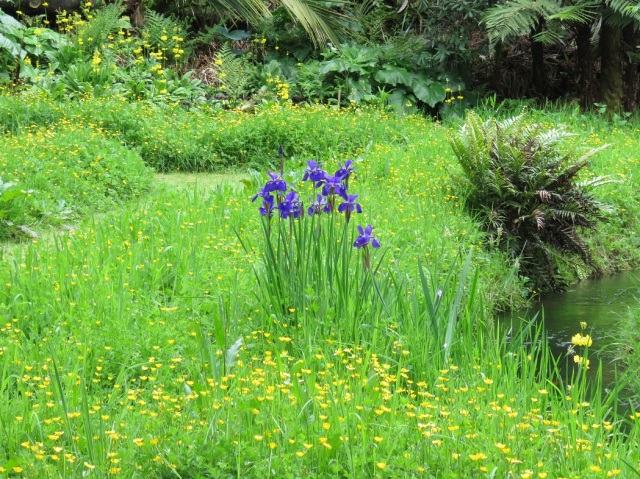
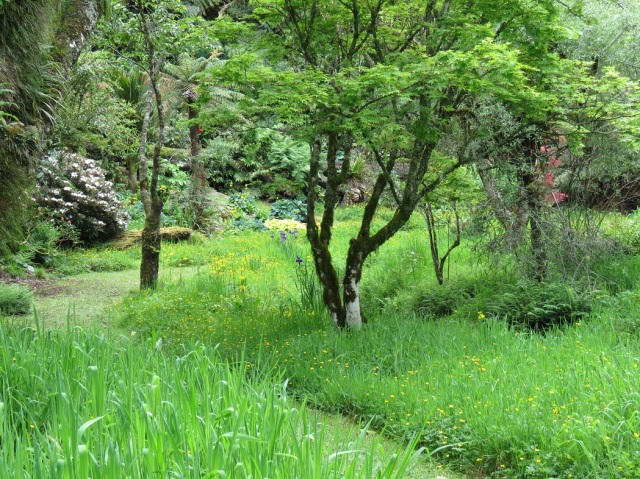
Colourful woodland on rainy morning this week to lift the spirits

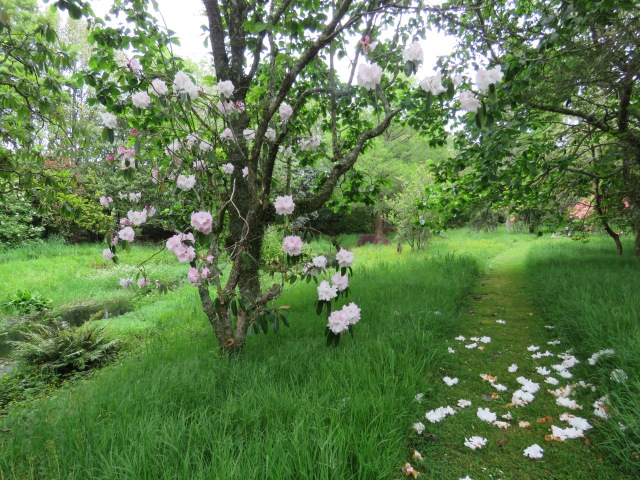
But if it all turns to custard, there are many (many, many) worse places to be than here. The colourful woodland this week soothes my soul and relieves my own anxieties. Woodland gardening does not generally conjure up colourful visions bar maybe a sea of snowdrops beneath bare trees if you are British, or perhaps large drifts of bluebells or hellebores.

Finally getting Mark’s neglected orchids out of his Nova house and into the garden in lengths of tree trunk with the centre rotted out
We are big fans of the dainty dendrobium orchids from the Bardo-Rose group

We like highly detailed woodland and it certainly is looking very pretty this week. We achieve this by lifting the canopy of our tall trees to let filtered light in below. Over the years, low branches have been removed to keep the lower trunks clear for maybe the bottom four metres or so. These days we do more thinning at ground level than planting and we use various strategies to ensure that plants can grow despite the massive root systems on the trees. Zach has been planting out some of Mark’s neglected orchids – mostly dendrobiums in the Bardo-Rose group – in hollowed out tree rings this week. These stump lengths are from the silver birch we dropped a few weeks ago. The rotten heart of the tree tells us we were right to fell it.

We do not get florist-quality blooms outdoors but the cymbidiums last a long time in the garden and add glamour
Cymbidium with Helleborus sternii. I would like more cymbidiums but need plants with smaller flowers. Those bred for cut flowers tend to be larger and can look out of scale in the garden.

Our interest in orchids is basically on plants we can grow outdoors in the garden so mostly pleiones, cymbidiums, calanthes and dendrobiums in practice. I like the little dendrobiums the best but the cymbidiums add a touch of glamour.

Clivias in orange, red and yellow, we have in abundance
Mark’s peach hybrids add variety but this one seems reluctant to hold its flower spikes upwards

Quite a few years ago, Mark did some hybridising with clivias to try and get some peach coloured ones. He rather lost interest but I planted out the best and they are coming in to their own. I wish this one held its flower up better but it is a pretty, pastel variation on the many oranges, reds and yellows we have. Last time I looked, there were quite a few international breeders working on peach tones and then on white and green flowers but I have no idea if these are commercially available here yet.

Wherever you are, stay sane as well as staying safe. These are trying times we are living through. I will be hiding in the garden somewhere, maybe taking photos to share.

Missing tools and found umbrellas

From a few years ago. The red and white umbrellas are still in use

Ha! My reference in my last post about having lost not one but two flax-cutter tools spawned a few replies. Most people, it seems, lose trowels, weeding forks and secateurs in the garden. One person owned up to managing to mislay a spade for quite some time as well.

The bucket on the left holds my tools currently in use. Other bits and pieces are stored where easily accessible.
The simple Wonder Weeder but not. alas, the one I mislaid this week

I try. I really do. I keep a tray of small garden items on a bench and take what I need from there and place them in a bucket to carry around the garden. Still, I managed to misplace a handy little weeding implement we know under its original brand name of ‘Wonder Weeder’ in this country. No matter that I realised within five minutes that it was missing in a confined area, I have yet to spot it. I am confident that it will reappear, that this is a case of not being able to see for looking. This is better than Mark who has put down his good secateurs and our brand-new pruning saw somewhere and has yet to locate them again. (Note: he has since found them in the grape house.)

I am generally well organised indoors and ours is not a household of odd socks waiting for their mate to reappear. However, I would like to know where sunglasses go to hide. I think I have lost three or four pairs in the garden and Mark sheepishly went to buy himself another couple of pair when he lost the last of his. Only one has ever reappeared so somewhere there are six or seven in concealment.

By the time I exhumed it, only the rake head was left

It does, however, allow me to dredge out a couple of old photos. The first was a rake head, exhumed from a patch of clivias I was dividing. Well, I assume it was originally an entire rake left there in error when the first plantings were done more than a decade earlier. I take no responsibility for that because I didn’t do that planting.

The case of the missing hedgeclippers was finally solved

But truly, the best and funniest example is the missing hedgeclippers. “I wondered where they had gone,” said Mark a year, or maybe two later. Clearly, he always meant to go back and do some more pruning on the Magnolia laveifolia at the time but by the time he needed the ladder elsewhere, he had forgotten about the clippers. They made a good nesting platform.

Another example of online shopping in these days of pandemic

Mark and I lead a life filled with umbrellas. This has a lot to do with the both the climate and the geography of our property. It is a fair distance out to the letterbox and similarly, the distance from the house to the all-purpose shed we are in an out of all day long is far enough to get drenched in a downpour. Mark always reaches for an umbrella, not a raincoat, when he is heading across the road to move the electric fences for his steers or to inspect his trial plants. We have umbrella stands on both the back doorstep and at the shed. Even operating off about eight in regular use (plus my good one in the car and the folding umbrellas for travel), it is still possible to run out at one end or the other. It is also very handy to have plenty of umbrellas when the garden is open and that time is looming large. So, I was delighted when my new supply arrived this week.

The glory of the new umbrella haul

Briscoes’ sale brollies, of course (that is a reference which will only make sense to New Zealanders) but are they not a pretty combination this time? The little penguin one is a present for my grandson. The clear one is because that style is handy when leading tours around the garden on a rainy day (and I have a few of those tours coming up).

For I have measured out my life, not in coffee spoons, but in brollies and lost sunglasses.

Prickly matters

I have, as we say, been ‘doing under the rimus’. “It looks like you have vacuumed it,” said Zach and I was gratified because it is a big job on one of the key areas of the garden. The pressure is on, you understand, with just under five weeks until we open for the Taranaki Garden Festival.

Not, as we thought, a billbergia but Aechmea coelestris var albomarginata

We have our fingers crossed that Auckland will be out of Level 3 so able to travel (looking good, Aucklanders, on Friday’s figures! The rest of us around the country are holding our collective breath for you. Well, most of us around the country).

Neoregelia

Cleaning up under the rimus is painstaking work but it only needs that level of attention once a year so I generally describe it as low maintenance. I go through and pick over every plant to remove the debris that falls continuously from the trees above and to groom each plant. We are not talking a small area – maybe 100 metres long and varying from 10 to 30 metres wide. The debris is being removed by the wool bale load even though we leave the rimu needles to provide the path surfaces.

Vriesea

It is a complex planting but bromeliads feature large. It is not that we have a choice collection of bromeliads. Our interest lies solely in them as garden plants in a shaded, borderline-sub-tropical situation so that limits the range we can grow. Broms are a huge family and largely from the tropical areas of the Americas. The best-known bromeliad is of course the pineapple. I have something of an aversion to prickly plants and many broms are prickly. Their flowering, while undeniably exotic and interesting, doesn’t make my heart sing like some other plants. So my knowledge of them is limited to caring for the ones we have and I have never felt motivated to get to grips with the whole plant family, botanically speaking.

Nidularium probably procerum, I am told by one who knows more about these than I do

Most of the varieties we have flower and then put out one or two fresh shoots to the side while the flowering centre starts to whiff off and die, sometimes very slowly over a period of two years or more if left alone. Once they start to discolour, I go through and cut them off which stops the clump from looking too crowded.

A particularly prickly aechmea

The very best implement for this is what I now see is named a ‘flax cutter’ – a small curved, serrated blade that is extremely useful for many garden tasks but probably not cutting flax. It is handy for cutting down grasses and faster than secateurs for deadheading perennials that need flowering spikes cut off. I had to go and buy a new one this week. I lost my good one somewhere amongst the bromeliads. I then went and found my old one and promptly lost that too. You would think I might have learned by now to keep better track of garden tools. This one came with a nice ash wood handle but I spray painted it before I even took it out to the garden – blue, because we had a can of blue spray paint on the shelf. I will not lose this one, I have vowed to myself.

Arm puttees and the new flax cutter

The second piece of vital gear is arm puttees. The alternative is that the prickly bromeliad leaves will shred the skin from the top of the garden gloves to the elbow. I speak from experience here. My arm puttees are simply the sleeves cut from an old denim shirt, elasticated at both the wrist and the elbow. They are worth improvising if you are dealing with prickly plants.

DIY garden kneeling pads

While on handy hints, I can highly recommend cutting kneeling pads from the high-density foam mats sometimes used as yoga mats or sleeping mats for trampers. One came into my possession and I can see it will last me for years. I simply cut it to the required size with what we know as a Stanley knife which is just a larger box-cutter. I find the kneeling mats sold in garden supply shops way too small but these I can make in a size that suits me. They cushion the ground and keep my knees dry, as long as I keep to the mat.

A billbergia

I had a mental debate with myself as to whether I could post my few photos of those currently in flower in the area where I am working without naming them – by general group if not cultivar. Well, we have long since lost the cultivar names. I have never committed bromeliad groups to memory but I feel I am lowering standards if I don’t name plants here so feel free to correct me on the classifications. We are by no means certain on them. Postscript: I have done a round of corrections on the photo caps after receiving advice from a reader who knows a whole lot more about bromeliad botany and nomenclature than we do.

What we refer to as an FIK but I am now told is Aechmea pineliana
No prickles! Aechmea gamosepala X ‘Cappuchino’

When the detail brings delight, not the devil

Tulipa saxatilis and simple cream freesias in the rockery this week

Bulbs play a major role in our garden. We use a huge range of bulbs, many no longer available commercially. Some never were readily available. Very few of those we grow are the larger, modern hybrids which are generally what are on offer these days. We prefer the simpler style of the species or at least closer to the species.

Added to that, seventy years of intensive gardening across two generations has built up the numbers most satisfyingly. Most of our cultivated gardens have bulbs incorporated in the plantings. Or at least bulbs, corms, tubers or rhizomes to cover the range.

Erythroniums

We have a fair few that are fleeting seasonal wonders in our climate but we just adjust our expectations. The cute erythroniums – dog’s tooth violets – are maybe a 10 day delight and can be taken out by untimely storms but that is just the way things are.

Meet Beryl. Narcissis ‘Beryl’ with cyclamen, nerines and even a Satyrium coriifolium in the bottom left corner

I don’t grow any in containers now although the same can not be said of Mark. His bulb collection is currently sitting in limbo for us all to see the scale as his inner sanctum – his Nova house – is currently being relocated. He hasn’t taken good care of them in recent times but he is determined to keep some of the rarer, touchier varieties alive. It is possible to maintain a more comprehensive bulb collection if you are willing to faff around with growing them in containers in controlled conditions. I am not so dedicated. My interest wanes if we can not grow them in garden conditions.

Gladiolus tristis popping up unexpectedly in our parking area

It is the random bulbs beyond the gardens that are currently bringing me pleasure. Some of these have been planted. Some have popped up from our nursery days. When trays of bulbs were being repotted, Mark had a strict rule that fresh potting mix was to be used (granulated bark was our chosen medium). Hygiene, he would explain. The old potting mix was spread around the place and at times it had seed or tiny bulbs within it. I am guessing this is how the Gladiolus tristis, a species gladiolus, came to be at the base of a cherry tree. I certainly don’t remember planting it there and I can’t recall it flowering before.

Ipheions at the base of an orange tree

When we plant bulbs beyond the cultivated garden areas, we try and select spots where they can establish in fairly undisturbed conditions. At the base of trees is good, as long as there is plenty of light. Around old tree stumps, on margins that don’t get mown often, or in little spots where we can walk past and be surprised to see them in bloom.

Trillium red with bluebells down in the park meadow
And trillium white with Lachenalia aloides tricolor and snowdrops to the right on the margins by a stump

We have rather too many bluebells now, to the point where I often dig out clumps to reduce overcrowding. The Spanish bluebells or the ones that are crosses between the vigorous Spanish and the more refined English species are definitely rampant, bordering on weeds. That sea of blue is very charming in their flowering season but sometimes it is the one seedling escape flowering bravely on its own that makes me smile as I pass.

The simplicity of a self-sown bluebell
Common old Lachenalia aloides where a tree stump used to be

It is both the transient nature and the detail that makes bulbs so interesting in a garden context. Far from simplifying our own garden as we age, the more we garden, the more we like to add fine detail. That is what keeps it interesting for us.

Bluebells and narcissi at the base of gum tree
Narcissus bulbocodium with bluebells

Staying local in my neighbourhood

More about the bridge further down the page

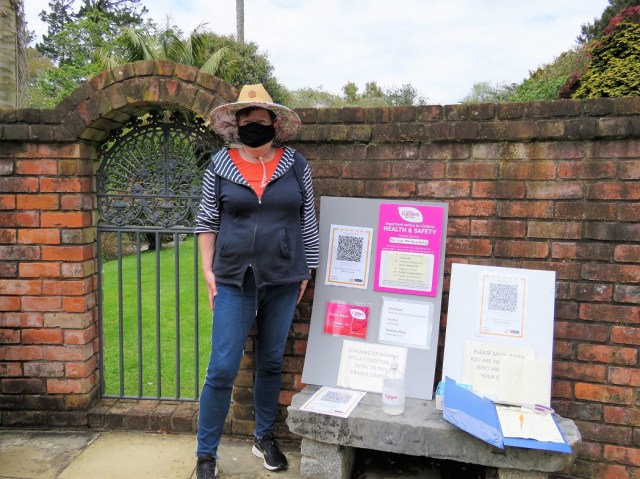
Our world has shrunk again to a very small, very local area. Mark left the property this week for the first time since the Delta Covid outbreak started on August 17. To be honest, I wasn’t sure how he would cope with this new era of compulsory mask-wearing and scanning but he managed just fine. And if my Mark can cope with masks and scanning, so can everybody else. I know the rest of the world has been masked for the better part of the last 20 months but it is very new here, though I had our range of reusable, pretty masks at the ready.

On my weekly shopping trips (I am not just the designated shopper here, I am and always have been pretty much the only shopper), I have been amazed at the exceptional levels of compliance in our local areas. Everybody is not only masked, scanning and maintaining physical distancing, they are doing it with patience and good grace. Melbourne son keeps saying to me that New Zealanders are compliant people. I was surprised when he first said this because I do not think that we have a particularly compliant culture. Upon reflection, I don’t think what is happening here is unquestioning obedience. I think it is more about a shared vision and a strong sense of community and for that, we can thank the very clear messaging and communications from our government.  

Fingers crossed that this Delta incursion over our border can be eliminated in good time so that our garden festival can go ahead in just over seven weeks. I am hoping we can do it without needing to mask but, if necessary, we will mask and not complain.

In the meantime, special thanks and acknowledgement to Aucklanders. Yet again, Auckland is bearing the brunt of lockdown measures to keep the rest of the country safe and free from Covid and it is really hard. The rest of us need to be very grateful to them. The alternative of having Covid running through our country is grim, indeed.

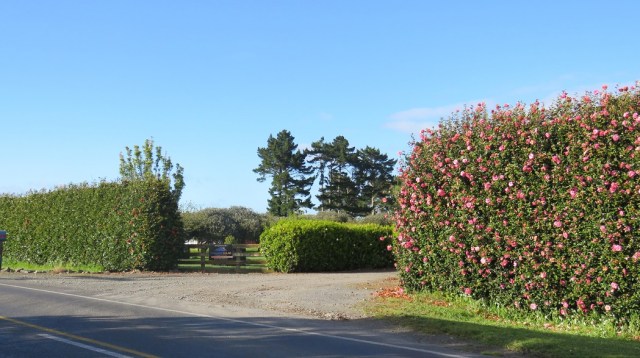
My eyes have been focused locally on my once-a-week trip out to get essential supplies. Somebody had been clipping hard but with great precision on this driveway sited on the crest of small hill across the river from here. I don’t even know what those trees are. I didn’t get close enough to inspect but they certainly make a sharp statement. Are they incongruous in their rural setting or a really interesting contrast? I lean to the latter.
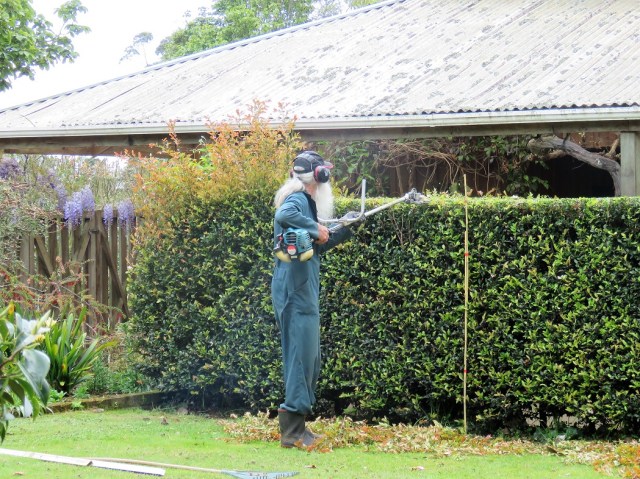
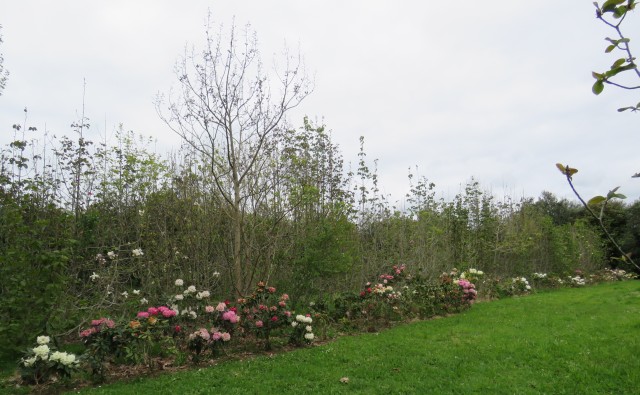
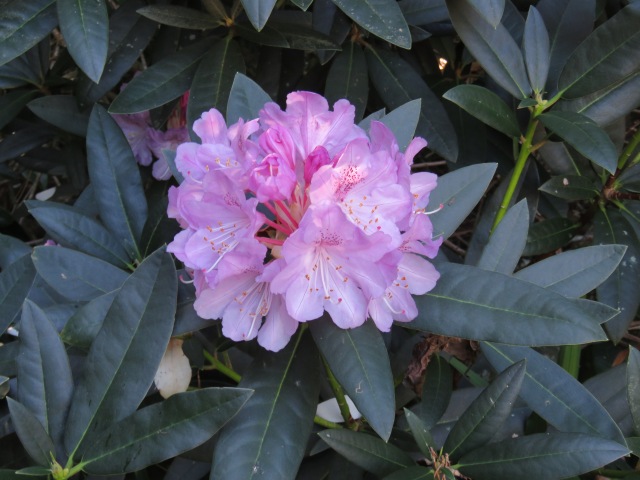
Rhododendron Kaponga

I spotted this red rhododendron last week and went back to have another look yesterday because I regretted not stopping at the time. Last week it was glowing brightly in the light, not quite so much yesterday but still bold and vibrant. It is a local selection of R. arboreum which is named ‘Kaponga’, renowned for its high health. When it comes to rhododendrons, those big ball trusses are not my personal favourite, but I couldn’t fault this handsome plant. The fact the property owners stained their fence dark rather than leaving it in its tanalised state helps show off all the plants to advantage.

In my local town, I stopped to photograph this handsome pair of red cordylines (cabbage trees) which look very sculptural in front of a fairly plain house. There are a number of named red forms available, but they are generally just selections of our native C. australis ‘Purpurea’. True, close up the foliage looks as chewed as all other NZ cordylines but that is because it is a native moth whose caterpillar munches on the leaves.

Almost opposite was a new garden which was really quite amazing. I think we could describe it as largely Italianate with a touch of pre-Raphaelite. I will say no more except to note that it has been constructed and furnished with much care and attention to detail and is clearly a source of pride to its owners.    

You do need to line up carefully. There is not a lot of room to spare.

Finally, back to the bridge at the top. It is the historic Bertram Road bridge, not far from us. I have a bit of a thing for bollards so I was delighted to find @WorldBollard on Twitter. It is the official account of the World Bollard Association (who knew?) and clearly over 30 000 other people have an interest in bollards, too.

There are eight bollards standing guard and all of them look something like this. Oh, the stories they could tell.

Bollards play an important role on this bridge. When it was restored and reopened to vehicle traffic, maybe back in the 2000s, the bollards were not quite as resolute as these current ones. But a stupid driver of a heavy transport truck thought he would ignore the warning signs and take a short cut over the bridge, demolishing the sides and a fair amount of the decking. Personally, I think he was lucky to get the truck off the bridge without it collapsing into the river because he far exceeded the allowable weight.

When the bridge was reinstated, the bollards were moved in to narrow the space further. Judging by the state of them, they have inflicted quite a lot of damage in the last few years as people have found their vehicles – particularly the modern twin cab utes – are too wide to fit. They are renowned too, I am told, for taking out wing mirrors.

It is just a question of lining the car up to stay very close on the driver’s side, keeping very straight and taking it slowly. Personally, I have never even brushed one of those bollards. Our Sydney daughter declared she would not be risking it herself when I took her over the new narrowed version on her last trip home.

From our neighbourhood to yours, stay safe. Fingers crossed for positive progress this week on dropping Covid case numbers down to low single figures.

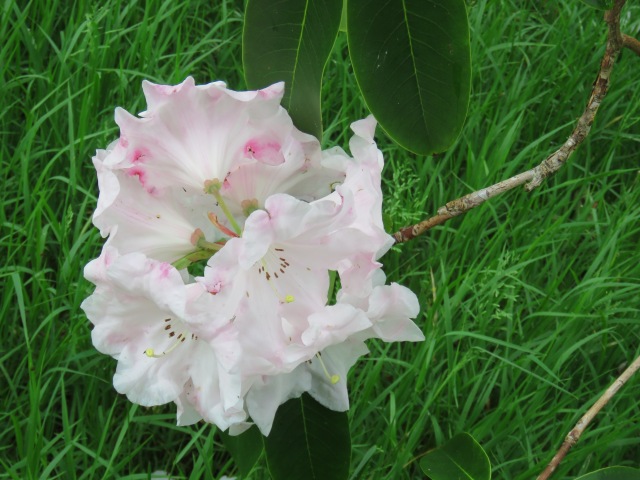
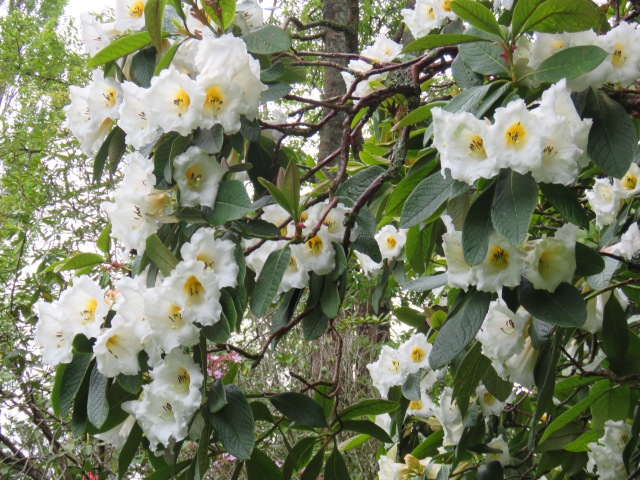
Magnolia Milky Way – a Felix Jury hybrid – out the front of Pat’s place on the drive home
  • For overseas readers: we had one Covid incursion that escaped our border quarantine and that one single incident has so far produced 902 community cases. We know they all came from that one single infection because all cases are genomically sequenced in NZ. New daily infections had dropped to just 11 on Friday so Saturday’s 23 cases were a disappointment. That is over the entire country but we want it back to zero again. We are playing the long game here, playing for time to get the population vaccinated and also to see how Covid is going to pan out internationally before we risk opening the border without the current tight quarantine. ‘Learning to live with Covid’ still looks pretty undesirable when we have been so successful in learning to live without it.
Milky Way again