A latter day Don Quixote

I get a fair number of emails from strangers. Too many are people trying to order plants from us – I have complained about this before; then there are a whole lot from people who think that research on the internet comprises finding somebody who might know the information, locating their address and sending an email along the lines of ‘please tell me all you know’. I admit I delete most of these. I no longer feel obligated to reply to every email. Then there is the spam. Initially, I thought the email I am about to share was spam but as I read through, I realised not. It is, I think, a combination of trying to order product from us which we don’t have and never have had, a ‘tell me everything you know’ (which is actually nothing on this topic) AND an offer that is, the sender thinks, too good for me to refuse.

A single photo and mention of parasol mushrooms from 2014

As far as I can make out, the only reason I was singled out for this attention is because back in 2014, I wrote a piece about autumn fungi which included a photo of parasol mushrooms.

Do not spoil the big reveal. Hold back your impatience. At least speed read the body of the email before you scroll down to the photos at the bottom that the writer included, showing the glory of the HUGE container filled with beautiful plants located in such a prominent place that it is admired by thousands of people. It is worth the wait.

“Congratulation!

You have a chance to join a charity project which is seen by thousands of people of general public and you can have a sales promotion, for free, of your mushroom business:

I am an owner of a huge container of beautiful plants located in a public place, in the front of the entrance of Balham library in London, quite close to the Waitrose supermarket, so, thousands of people are passing by my huge container and enjoying the plants’ beauty.

I do this my private charity project to support the beauty of plants.

Please, SEE the pictures in the attachments.

Right now, I am going to add to my plants, beautiful Parasols, Macrolepiota proceras, on the corner of the huge container under the pine tree, (SEE the pictures) to be very visible by the thousands of people of general public so that they can be enjoying the beauties of the big beautiful Parasols, Macrolepiota proceras.


I am not any expert about any plants. I just want people can enjoy the beauties of plants. So, please, can you send me already prepared, ready to grow, cultivation kit, that can be transferred directly into my top soil which I have in the huge container, fruiting in about two months?

I mean the special substrate which is already mixed with the Parasols? Just to make a hole in the top soil in my huge container and to put into there your special substrate which is already mixed with the Parasols? I suppose, about 3 kilograms and fruiting in about two months?

Because this is a charity project, and because I am not any charity organization, I just am a person who is doing a good deed to support the beauties of plants, I can pay the total price up to £10 including the postage. (My budget is very narrow because I am going to add many more plants.) Or, I would appreciate if you can send it to me for free.


In return, I can place on my huge container a sign where will be written something like this (or suggest your text):

THESE BEAUTIFUL PARASOL MUSHROOMS WERE
DONATED
BY:
www………………….
TO SUPPORT THE BEAUTY OF THE NATURE.
You can order these beautiful mushrooms or/and many other mushrooms on the website above!


If you do not have the power to make the decision, please, forward this email to the owner /  director / manager of your business. Many thanks!

If you cannot provide the one, please, can you send me a link to a web page where they can sell the one what I am looking for? Many thanks!


Many thanks for your reply


J***
London, Balham”

Behold the glory of the container. Is this not a triumph of naïve optimism?

Am I feeling a little guilty about gently mocking this person’s efforts, worried they may read this post? Well, yes but as he or she clearly never read the content of the first post that led them to contact me, the chances of them reading this one seem remote.

Mrs Wang’s garden

Photo credit: Alden Williams/Stuff

A sad story came out of Christchurch this week. Mrs Wang, an elderly woman aged 80, had a thriving vegetable and herb garden she had been tending for ten years out the back of her home, a charmless block of four social housing units. She came home to find the landlord, a charitable housing trust, had sent in a digger to destroy her garden and level it, to be sown back into grass. ‘Acting on complaints,” they said, from another resident.

Mrs Wang was clearly distressed. She was growing traditional Chinese vegetables and herbs that are not easy to source in New Zealand and they were gone. That is the short version. You can read more here.

The social housing trust went into immediate defensive mode when the story broke, issuing one of those apologies that isn’t really an apology because it is immediately followed by self-justifications and then an attempt to occupy the higher moral ground. We made a mistake in not warning her the digger was coming in, they said, but they would put it right by installing raised vegetable beds for the use of all the residents this very week.

This defused some of the criticism, especially from those who do not garden. After all, who would not be thrilled to get that symbol of the middle classes, a raised vegetable bed?

Where to begin? Did the trust ask all residents if they wanted to have their own raised vegetable plot? Is all that stood between the complaining resident and a thriving vegetable garden of their own the absence of a raised bed?

Gone, all of it, when really, it was just a corner of the shared back yard. Photo credit: Alden Williams/Stuff

I have no inside knowledge but it seems likely that Mrs Wang is a first generation Chinese New Zealander. I say that because when her plant list came down social media, she had clearly written it in Chinese and she was growing traditional foods and medicinal herbs from China.

If this is the case, then Mrs Wang was born into a time and place where famine was a massive issue. In the land of relative plenty where we live, ripping out a productive garden seems like vandalism. To somebody for whom the Great Famine of 1959 to 1961 (or 1958 to 1962, depending on which historian you are following) is a part of her living memory and her dual heritage, such wanton destruction must be beyond comprehension.

Back to raised vegetable beds. They have their place, particularly for gardeners with mobility issues or where the ground is somehow unsuitable for cultivation. But commonly, they are an affectation, an attempt to pretty up the productive garden, maybe emulate the potager style made famous by UK gardener, Rosemary Verey. They are not often favoured by diggers, by those for whom cultivating the soil and building up the richness is an integral part of gardening. Mrs Wang spent ten years working that ground. I am betting she is a digger, a cultivator. And diggers don’t have raised beds.

But the Ōtautahi Community Housing Trust is going to give her one and the cynic in me says that is more about them pretending to be contrite and putting things right with one hand while exerting an iron fist of control with the other. See, with a raised bed, they can insist that is the only area she is allowed to use. It defines the space and stops her expanding. Because it is better, in their eyes, to have a bleak area of mown grass with a shared clothesline holding pride of place.

There were so many better – and cheaper – ways to deal with this situation. A mediator could have helped broker a compromise between the unhappy residents (was there even more than one?) and Mrs Wang. It would have saved a lot of distress and distrust, not to mention bad publicity for the social housing trust that is the landlord. And my goodness, if I ever hear judgemental comments about how the poor should be growing vegetables again, I may make a very terse reply. Mrs Wang did until last week.

We have only been to China once but here you see a private vegetable patch being grown on public land beside the river in Jinghong City. Why waste good, productive land when the alternative is low grade grass?

Redoing the auratum lily border

Also known as the golden-rayed lily of Japan

The lily border is a great delight from mid-January on when the enormous blooms put on an entirely OTT display and the scent hangs heavy in the air. I planted it four years ago and looked at it this summer, thinking it needed a bit of attention. There were two or three areas which looked a bit sparse and others with a multitude of smaller bulbs starting to compete in the crowd. I shall lift and divide, I thought. I knew it would be a big job and thought maybe a solid week or ten days would do it.

Some thirty lineal metres of lilies

More fool me. The lily border is about 30 metres long and up to 2 metres wide. A few days in and I worked out I could achieve about 1.5 lineal metres a day. I had a lot of time to do the maths, you understand, and the time stretched out on account of my two trips to Tauranga and a week off with cataract surgery. It became a very boring exercise and it was through gritted teeth that I persevered until I reached the end this week.

What was moderately interesting was analysing the bulbs I lifted. I planted them all as single bulbs at about 20 centimetre spacings coming up to four years ago. That meant a lot of bulbs. Say 50 square metres all up at 25 bulbs per square metre – up to 1250 bulbs. Even if it is only 40 square metres of actual area in bulbs, that is a 1000. I didn’t buy them. Mark did some controlled crosses, picking good parents, raised the seed and put them in his vegetable patch for future use.

Ready to split down the middle, with two stems that flowered

Some bulbs had not increased much and were just setting babies on their stems. Some had clearly grown from seed in the first year or two before I started deadheading the border to reduce seeding.  Others were large bulbs with two flowering stems last summer and clearly ready to be split apart.

A full cluster of bulbs formed over just four years
You can see some of the small bulbs which would have developed into another ball of congested bulbs

Others had become clusters of bulbs sticking together like a soccer ball, yielding 12 to 15 bulbs from medium small through to large. They were remarkably impressive for just four years. Mark tells me this is the end result of those bulbs that set lots of babies down their stem, usually just below the level of the soil down to where the flower stem emerges from the bulb.

I split all the multiplying bulbs apart, replanting just the flowering sized ones into the freshly dug bed, each covered with a generous scoop of compost before returning the soil and then the aged mulch that I had raked to one side before digging. I aimed to get the bulbs fairly deep – up to 20cm down because if they are planted deeply, they are better at holding themselves up without staking. There is no way I am going to be staking 1000 lily stems. We retain the spent seasonal foliage on site to replenish the soil so I stripped any remaining leaves and cut most of the stems into short lengths about 5cm long so that they will rot down quickly. We finished it off with a tidy top layer of wood chip.

The smallest bulbs were discarded. The smallish ones that will take another year or two to flower, I gave away until I could find no more takers. Zach planted the rest of the littlies back in Mark’s vegetable area for me. It is my emergency supply, I told him and he laughed. Having just planted five rows – fairly short rows, I admit – he felt I should have plenty for any contingency.

Very bare, but done and tidy, in anticipation of next summer

We were served Lilium brownii in China when we were there in 2016 but I had not realised until Mark asked me to do a net search that all true lilies are edible and L. auratum is a traditional food in both Japan and China. With so many auratum bulbs here, we tried one. I broke the bulb apart into its component scales,  washed them thoroughly, tossed them in olive oil and roasted them. They are perfectly edible, texturally similar to chestnuts and with a flavour best described as inoffensive. They might be more exciting in a stir fry, preferably with added garlic but they are not sufficiently tasty for me to want to add them to our diet on a regular basis.

In fact, all parts of the lily are edible but I will not be harvesting the fresh shoots as an early summer green and eating the massive flowers seems a bit daunting. But should we get hit by famine, it is comforting to know that we have a generous additional food source here we can harvest at will.

I am a bit unconvinced at the thought of eating the flowers

A road trip: from Tikorangi to Tauranga and back. Twice.

Destination Tauranga

Family matters have necessitating me driving to Tauranga twice in the past couple of weeks and on each of those four road trips, I have been struck by how interesting our northern entrance (and exit) is in terms of landscape. The same can not be said for the road to the south, unless you are a keen dairy farmer, but that northern access will never get boring for me. Sure, the roads are not streamlined highways but I don’t mind the twists and turns because a lower driving speed gives more opportunity to take in the surroundings.

For those who are geographically ignorant of this area, Tauranga is about four and half hours drive time and takes me from the farthest reaches of the west coast northwards and right across the island to the east coast.

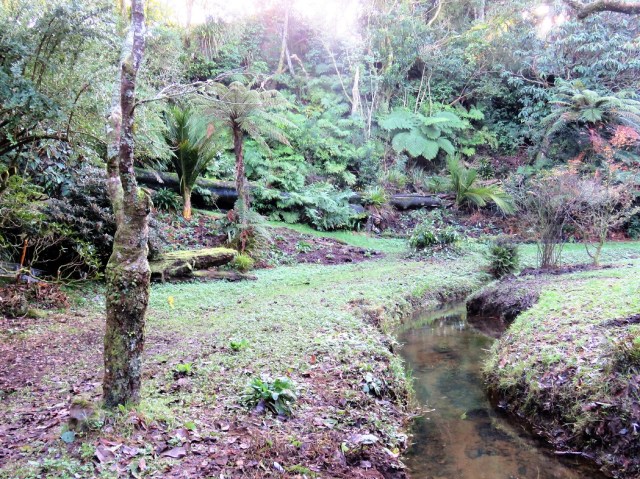
Native tree ferns and nikau palms in the regenerating bush

From the Uruti Valley just up the road from us and Mount Messenger (more hill with windy road than actual mountain), we enter ponga – native tree fern – territory but I didn’t stop to photograph them until I reached Tongaporutu. There, the regenerating native bush has a heady mix of nikau palms and pongas which are distinctively New Zealand in flavour.

Tongaporutu and the typical black sands of Taranaki

The view of the Tongaporutu tidal estuary is one that is near and dear to my heart. Mark’s parents built a bach there back in the late 1950s which we took over for a number of years. A bach, you may ask? A bach is the North Island term for what is called a crib in the South Island – modest precursors to what is now known as the more upmarket holiday house. This is an area that I know well. You may notice the black sand – iron sands are a feature of the Taranaki coastline. The sand gets so hot in summer that all locals know to wear footwear and – I am not exaggerating – if you take your dog to the beach with you, you have to carry the poor dog over the dry sand to avoid burning the pads on their feet! On sunny days.

The folded hills of Rapanui, just north of Tongaporutu

I love the folded hills just north of Tongaporutu and never more so than in the early morning or late afternoon light.

The Awakino River. The little hut by the riverside is a whitebait stand. You can see the spread of pampas grass across the river flats.
It should be our native toetoe, not Argentinian pampas, seeding down with the native tree ferns.

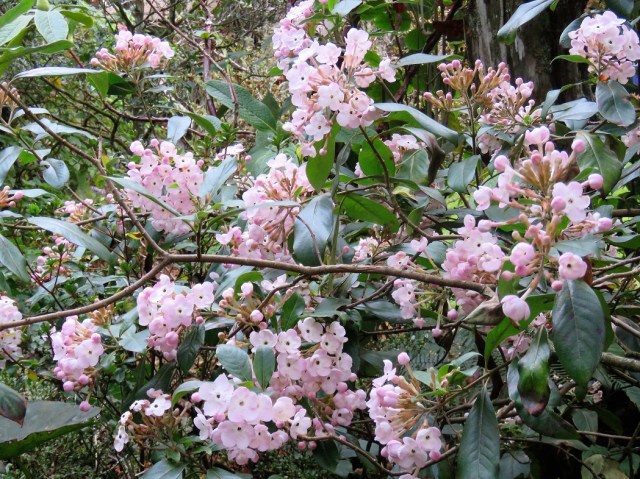
Let’s talk about Argentinian pampas grass. Again. I saw them flowering all the way from Taranaki to Tauranga and there is no doubt that those fluffy duster blooms are gloriously eyecatching at this time of the year. But goodness, it is a dangerously invasive weed. From memory, I think the Taranaki Regional Council had an eradication policy on it several years ago – as in, it was illegal to even have it growing. But it seems they gave up on that as an unrealistic goal and these days it is just banned from propagation and sale, as opposed to requiring compulsory removal. You can certainly see the effects across the countryside, nowhere more so than on the hillside immediately south of the Mokau bridge. It is rampant.
Rampant pampas just south of the Mokau bridge
Pampas has taken hold even on cliff faces

One popped up in my twin borders here and I have no idea where it came from because there are certainly none of the cream form growing anywhere near us. Presumably the seed blew in from quite some distance away or it may have come in with another plant. I dug it out as soon as it became clear what it was. While we grow some ornamental plants that environmental purists raise their eyebrows at (campanulata cherries, agapanthus, Stipa tenuissima, Lilium formasanum, for starters), they are all plants that we can and do control from spreading. Pampas grass is in a different league altogether. It doesn’t matter how pretty it is in flower and seed head, we don’t want such a dangerously invasive plant in our garden.

Once through the Awakino Gorge, we leave the coastal forest and sea behind to head inland and the countryside changes dramatically. This photo doesn’t do justice to what suddenly appears as big country, called the King Country – sparsely populated hillsides receding into the distance as far as the eye can see. It is a grand landscape in its own style.

The papa rock, or blue grey mudstone, of coastal Taranaki changes to the limestone rock of Waitomo. I have never heard the name of this limestone valley with its distinctive cliff faces and rock formations just north of Mahoenui, but I always look forward to it. In another life, I would love to have bought a tract of land here simply to plant and landscape an appropriate garden around those strong rocky features. That might have been a fun project.

The railway cottages of Te Kuiti

Next up is Te Kuiti, a small country town where I always stop for a coffee at Bosco’s. It being a two hour drive from here, it seems the right time to break the journey. Besides the coffee, it is the line of original railway cottages that grab my attention. It started as a railway town and these cottages were built up and down the country by NZ Rail, in its heyday.  

These days, Te Kuiti prefers other branding removed from its railway history. From the north, it declares itself as the shearing capital of the world which is a fair indication that its farming history lies in sheep, not cattle. From the south, however, it lauds its most famous son – Colin Meads. He was one of our most revered rugby players. I always notice this sign and finally, in the interests of research, I turned off the bypass to go and find the statue. It was a little… smaller than I expected. But I am not a follower of rugby.

Rugby legend, Colin Meads
The giant pukeko has a much smaller sign pointing in its direction and is not signposted from the main road

To be honest, I like the giant pukeko in Otorohanga, the next town up the line, more though I didn’t get the angle quite right to show the scale. You have to go on the heavy traffic bypass to find this unexpected sight. The pukeko is an Australian swamphen. It is uncertain whether it introduced itself to these isles or whether it was brought here by the first Maori who arrived in canoes but its arrival dates back many hundreds of years. Today it is equally admired for its gawky character and remarkable survival skills and loathed for the destruction it can cause in gardens and in agricultural situations. We have a little pukeko colony in the North Garden and I like them for both their character and the fact that they live in the ornithological equivalent of a village and raise their young in creches where responsibility is shared amongst the adult birds.

Fairly typical Waikato

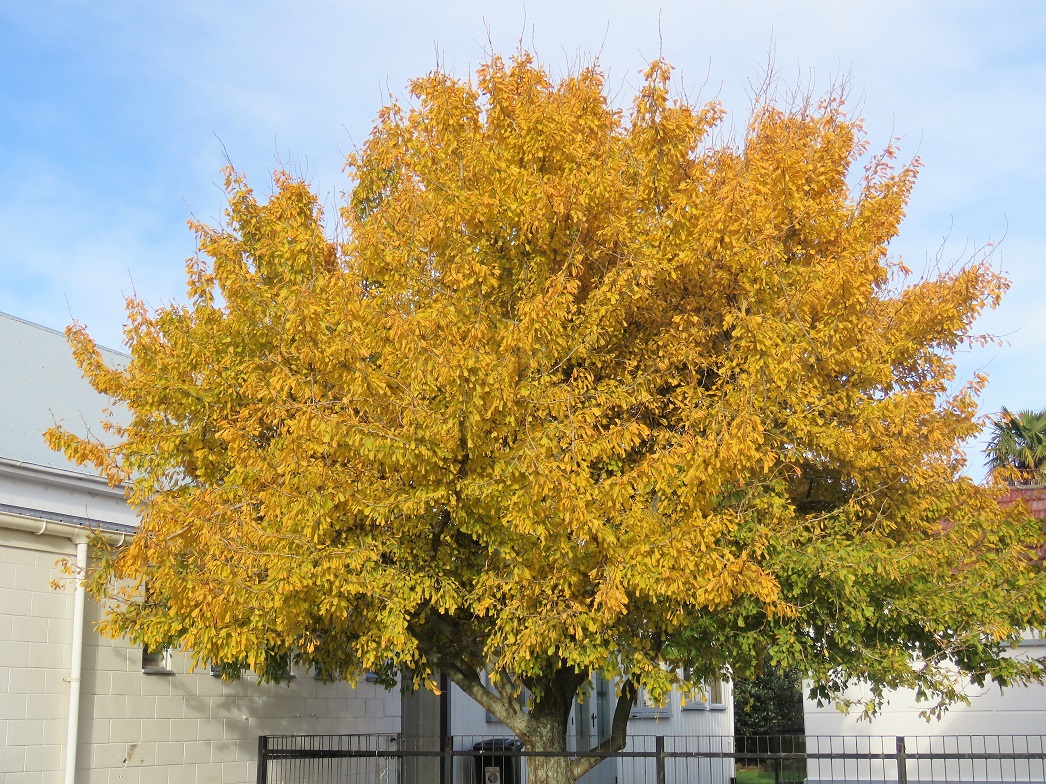
And so to the Waikato where the landscape becomes quite tame and managed again (dairy and equestrian country) and the autumn colours are beautiful at this time of year. Being inland, they get cooler nights and the sharp drop in temperatures which triggers deciduous trees to change colour. The roads are straighter, wider and better formed as befits the sharp increase in traffic density. From here, I concentrate more on safely negotiating the heavy traffic than in observing the passing countryside.  
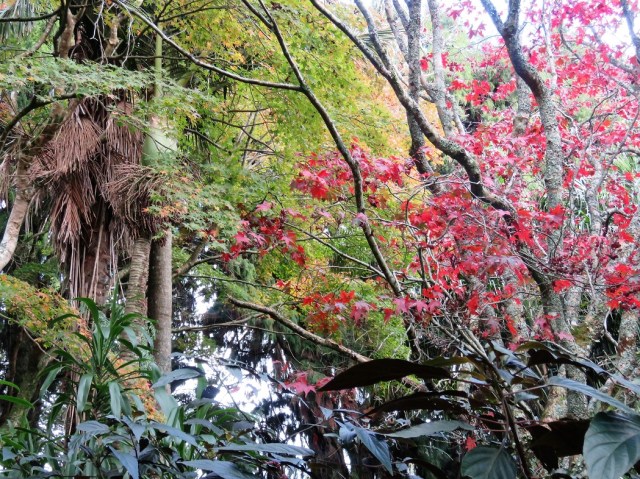
On the return journey, I breathe again and relax as I turn off the busy roads to head down the more interesting roads home.

Daphne in white

Daphne Perfume Princess White

A new release! It has been a while since the last new Jury plant hit the garden centres (though there are more in the pipeline) but the latest one is here, albeit only in New Zealand at this stage. What is it? A pure white daphne – the white form of Daphne ‘Perfume Princess’.

Our new white daphne – ‘Perfume Princess White’

Had it been me naming this new daphne, I would have called it Daphne Snow Princess but it wasn’t which is why it is Daphne ‘Perfume Princess White’ which is at least descriptive. And it is true that it is like ‘Perfume Princess’ except in colour so it has the very long flowering season, the ability to flower down the stem, larger individual blooms, fragrance, vigour and health of its older twin sibling.

The original Daphne Perfume Princess, showing the typical colouring of D. odora

New Zealand gardeners love their white flowers but the rest of the world tends to prefer colour, especially those who live in areas which are under snow in winter.

I am told it will be available in Australia towards the end of the year and other countries will follow as stock is built up.

Just a reminder that this is a non-commercial site and if you want this plant, you will need to go to your local garden centres. We stopped mailorder in 2003 and stopped selling any plants at all in 2010. As we are removed now (retired) from production and distribution, I can’t even tell you which garden centres near you currently have it in stock (yes, I do get asked this sort of question on a frequent basis). All I can say is that if you are keen to get a plant, you are more likely to find it in one of the mainstream garden centres, rather than smaller specialist ones or nurseries. And supply will be limited in this first year of release. It is worth having, though. I can say that, at least.

Postscript: Sorry to sound grumpy. It is true, I do get a bit grumpy answering emails and phone calls from people who assume that because I write about a plant, they should be able to order it from us or, failing that, I can advise them where they can source it. Even from overseas, at times! What is it, I wonder, about my site that makes people think I am trying to sell them stuff?