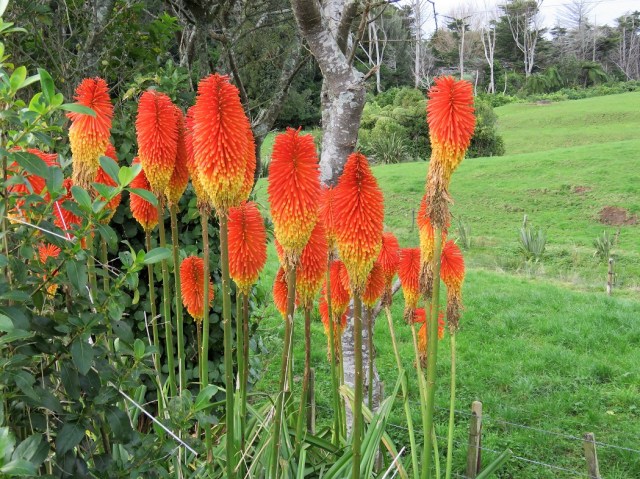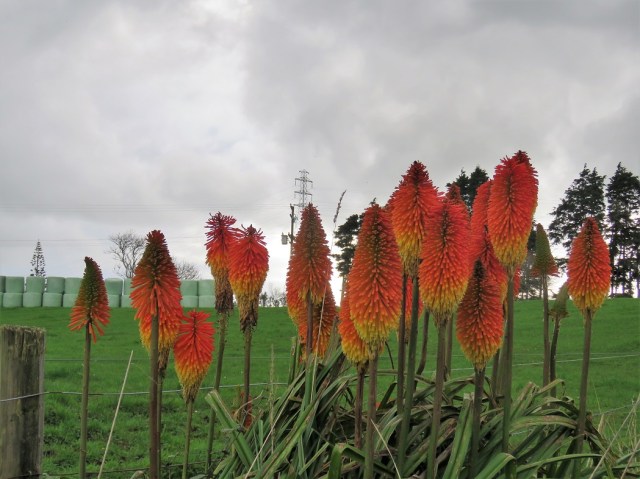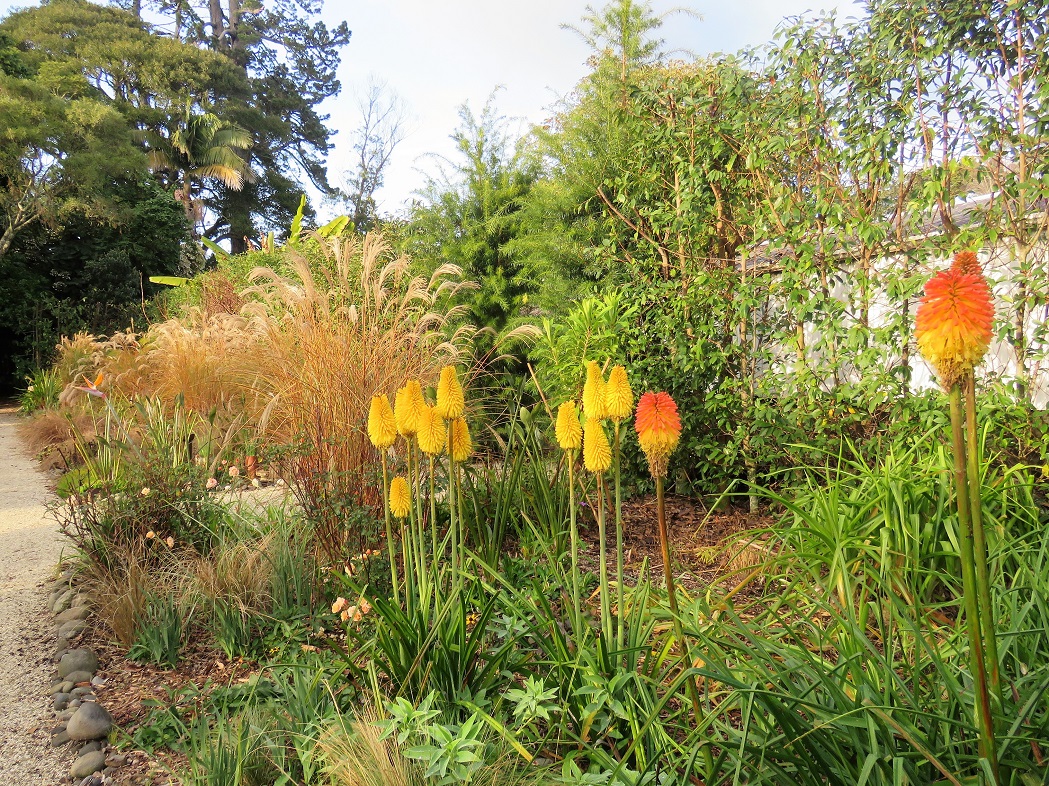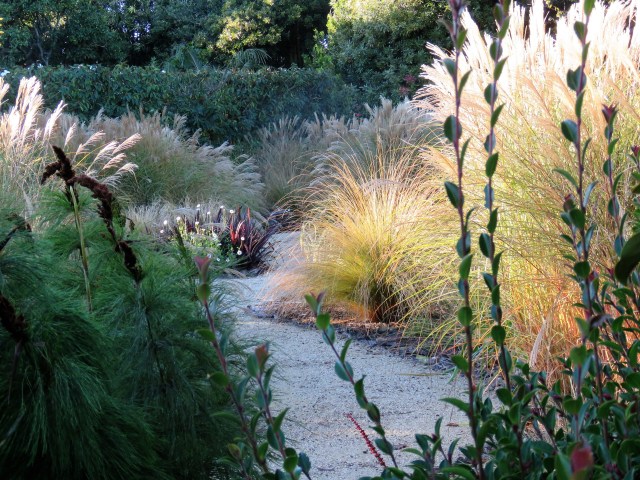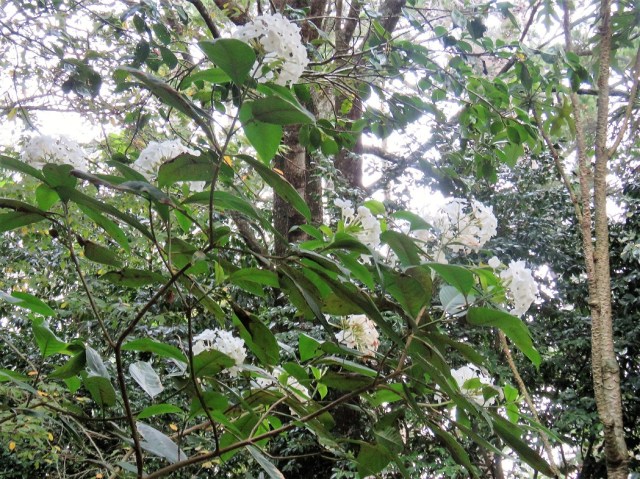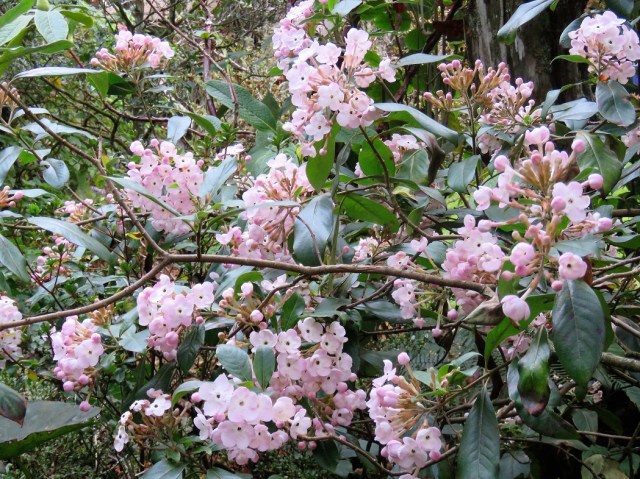
The three stages of feijoa season: from anticipation to desperation.

The teaspoon is there for scale. These are good-sized fruit.

We had lunch with friends last week and she of that household was determined to rehome surplus feijoas with us. In vain did I assure her that we have a more than bountiful supply at home, the moment we admired the generous sized fruit from one of her trees, she was loading them into a bag for us. As we left, she spotted more fruit that had fallen and was busily gathering them. “She left no feijoa uncollected” would be an apt epitaph, I decided.

Feijoa sellowiana is native to temperate South America but is probably the home fruit tree most universally grown in this country – sometimes described as either the most democratic or most socialist fruit. This is because once the fruit starts falling, it comes in bucket loads. At the start of the season, enterprising children often bag them and leave them out in an honesty box for passers-by. This is the seasonal phase of feijoa anticipation.

Soon the anticipation morphs into phase two of feijoa abundance. The fruit has a short shelf life and is not suited to transportation so efforts to grow it commercially have generally been less than successful but this rarely matters because it crops so heavily and is so widely grown that there is only a market for the first fruit of the season. During the abundance phase, busy little Squirrel Nutkins around the country are freezing stewed fruit, dehydrating it, baking feijoa muffins and loaves and making feijoa chutney. Newspapers and social media are full of recipes to use up the surplus.

All too soon, a condition best described as feijoa desperation takes hold as our nation reaches the point where you can’t even give the fruit away. This is certainly true in the North Island and the upper South Island. I am not sure how widely grown they are further south but they have a wide climatic range and will grow in most temperate areas.

For those wondering what to do with some feijoas, I can recommend the following recipe which came down my Facebook feed. I failed to note whose recipe it is but I am pretty sure it came from a leading yoghurt supplier – maybe Anchor?

Frozen feijoa yoghurt

1 ½ cups frozen feijoas

2 frozen bananas

1 cup yoghurt

½ tablespoon maple syrup.

Whizz it all up in a food processor or blender.

That is it. That is all you need to do. Eaten straight away, it is like a delicious soft-serve icecream but without the high fat and sugar content. Frozen for two hours, it is more like a firmer icecream. Frozen for longer and it sets rock solid so you need to take it out of the freezer to soften. My advice is to free flow the fruit on a tray, not, as I initially did, freeze them stuck together in a container. It is easier on the food processor.

At least, in our act of culinary appropriation, we have not renamed the feijoa. This is not true of the tamarillo, also from South America, (Solanum betaceum), the kiwifruit from China (actinidia) and the ‘New Zealand cranberry’ which has no relationship at all to actual cranberries but may instead be Myrtus ugni syn Ugni molinae or Psidium littorale – both from South America.

For overseas readers who have not encountered our fruit of NZ socialism, I am not sure how to describe the taste of feijoas. How would you describe the taste of an apple or a pear? A feijoa tastes, fruitily, like a feijoa.

Casper’s cactus

As it was in better days. It always was a bit motheaten in appearance, being well out of its climatic zone but it persevered down the decades.

It is a cactus. Well, mostly was a cactus now but we will get to that. It is a particularly prickly cactus and we have no idea at all of its name or botanical history. Presumably it came from somewhere dry and desert-y, maybe southern USA? It has sat in the narrow border outside the laundry window as long as Mark can remember and he was born here.

Over the years, his father Felix had tied it to the wooden window frame and festooned it with old horseshoes and stirrups which we left in place – a nod to his history on the farm that he managed with horses, never a tractor.

When we moved into the house in 1997, it was a great puzzle to us how our cat, Casper, was getting onto the roof and in through our upstairs bedroom window.

Generic Jury Ginger Cat (photo credit: Michael Jeans)

Casper – still referred to as Cassy-purr on account of his excessively loud purr – was a characterful little cat. This is not a photo of Casper. He came before digital cameras. This is actually his successor, Buffy, blockading the stairs that the dogs may not pass. But in the days when we still had cats, they were all ginger. As far as I am concerned, cats should be ginger so they were somewhat clonal. Buffy can serve as Generic Jury Ginger Cat.

I walked around the house trying to work out how Casper was climbing onto the roof to get access to our bedroom window but there was nothing that looked climbable. I told the children that I would give five dollars to whomever solved this mystery. Elder daughter was reversing the car out one day and in the mirror she saw Casper, shinning his way up the cactus. To this day, I do not understand how he managed to do it without getting the pads on his paws pierced by the very fine, sharp prickles but he kept using that cactus as his personal access route until he met an untimely end on the road. It has remained Casper’s cactus to us.

Beyond motheaten and shedding sharp spines in abundance

Of late the cactus has been looking sadder and sadder and has become somewhat hazardous, shedding bits of its outer layer, with the fine spines still attached, onto the path below. It always was somewhat dangerous in that location so close to the path, but as I pulled the spines out of my feet whenever I ventured out without shoes on, I decided we needed to clean it up. As we looked closely at it, it was clear that most of it was now dead.

A shadow of its former self and on its last chance to decide if it wants to live or die. At least we can now paint the laundry window frames and wash the windows

Donning leather gloves, I cut it back it back to live stems. There is not much of it left. Some of the tips were still alive and I have put them to one side for Mark to grow again, if he gets around to it. I do not like prickly plants. I do not like them at all. If the rest of the remaining plant dies, I will not mourn its passing. It is only of passing historic interest, really. Besides, the laundry window frames have not been painted since we moved in to the house, and probably not for a long time before that.  Repainting them is on Lloyd’s to-do list at last.

Why is it dying? Mark thinks it likely that one of the stems had grown to a point where it was catching drips from the spouting and channelling the water down the length of the plant to the roots.  Such a death is most likely to be a change in the drainage. Whatever, after about 70 years, it seems to have had enough of us.  

Remembering Lara Bingle

Work is underway on taming the Wild North Garden in readiness for finally opening it

It is official. We have agreed to open the garden again but just for the ten days of the Taranaki Garden Festival – Friday 29 October to Sunday 7 November. I wasn’t at all sure we would during the months of preparation last year which took a high toll, but the addition of a new member to our team makes it all look more manageable. Besides, we want to show off our Wild North Garden, a 4 acre extension to the garden that has been in development for the last 30 years.

Last year was the biggest year ever for the Festival, exceeding all our expectations with New Zealanders on the move. It may not be very different this year as offshore travel remains extremely restricted. The full programme won’t be released until July but the initial information can be found on the Taranaki Garden Festival website.

At its best, the Wild North Garden can be very pretty but had grown steadily wilder until recently

The news of the trans-Tasman bubble opening this week is exciting for us personally. At last, we can plan on seeing our three children and only grandchild this year, after a long gap. All are currently living in Australia. For overseas readers, the trans-Tasman bubble is the first major quarantine-free travel bubble between two countries with no Covid in the community. If it works out and proves that we can keep NZ safe, I am assuming travel may open up again to other safe countries – many of our Pacific Island neighbours, Taiwan and Vietnam – later in the year. I do not think we will be opening to the rest of the world any time soon.

Mark and I are not rushing to book tickets to Australia just yet. We would like to be vaccinated first (I think our demographic is scheduled for next month) and we want to see what happens when there is a community outbreak either side of the bubble. This will happen and when it does, flights will be frozen and borders closed in a flash. Being stranded across the ditch (as the Tasman Sea is oft referred to here) for an extra 3 days would be fine but if it stretches into many weeks, that would be problematic. We have waited over a year already, we can wait another couple of months until the picture is clearer.

The bubble, however, will not just reunite families. It is also to kickstart tourism on both sides and it may be that some Australians would like to come over for our Taranaki Garden Festival.

So who is Lara Bingle, you might ask? For some reason, her name has stuck in my memory. She is the charming young woman in a bikini asking ‘So where the bloody hell are ya?’ at the end of the only Tourism Australia advertisement I remember. It came to mind as I was thinking about whether Australians may come over to our garden festival. The idea that it would be ripe for a spoof in the garden is one of those ideas that may have sounded better after a couple of glasses of wine.

Notwithstanding that, we would love to welcome any Australians as well as New Zealanders who wish to come and see us at the end of October. Going into public situations with no need for masks or physical distancing, no restrictions and no fear is a privileged position for those of down here in the South Pacific.

The Court Garden this week in autumn. It will look very different again in November when we reopen for ten days only

The Pink Pampas

The pink pampas, botanically Cortaderia jubata

I think I might do an extra post about the pink pampas, I said to Mark this morning. He immediately burst into the opening bars of the Pink Panther theme which others of a similar age are likely to remember as well as we do.

Pink Panthers aside, I was a bit surprised that I had not previously noticed the pink pampas on the roadside bank of a neighbour down the road and around a corner. It is Very Pink, so much so that it looks as though it has been dyed.

South American pampas is not such a common sight here these days on account of it being on the National Pest Plant Accord and banned from commercial propagation and sale. I think it may even have had a compulsory removal order on it for a few years to try and curb its spreading ways. It became very popular as a farm windbreak a few decades ago – cheap, quick growing and edible for stock so they could keep it in check. It was a shame the stock could not control the airborne seeds and, given the razor-sharp leaves, I am surmising they probably only ate it if they were very hungry. Pampas also adds greatly to the fire risk in summer or autumn droughts.

The few in evidence these days are testimony to its persistent weediness. If not kept in check, they will spread further.

The pink or purple forms are Cortaderia jubata while the creamy white fluffy plumes are Cortaderia selloana so different species, but both South American. New Zealanders often confuse them with our native toetoe grass which used to be classified as a member of the cortaderia family but has now been moved to the austroderia family. We have five different species of toetoe which are native to this country.

Indubitably pampas

They are actually quite easy to tell apart. The toetoe flowers in spring, holding its ageing flowers through summer whereas the pampas flowers in autumn. The toetoe has arching stems and the flowers all fall to the lower side, somewhat like tasselling or fringing. The pampas holds its flowers upright and they are fluffy plumes all round like feather dusters. Anything pink or purple is a pampas.

Toetoe, or NZ austroderia

The bottom line is that pampas is bad in this country, toetoe belongs here. That is still a startling synthetic shade of pink pampas down the road, though. These days, I sniffily describe such things by the epithet of ‘novelty plants’.

The tall and the short of it

I struggle to appreciate bedding plants. I really do. To me, they belong in dated floral clocks and on traffic islands. Maybe in the occasional garden bed in public gardens to appeal to older folks who have not updated their ideas since the 1960s.

I don’t have many photos on file of bedding plants but these two are from RHS Wisley, south of London and they are certainly not representative of 99% of those magnificent gardens. But there are requirements for such places to be all things to all people. That Is Enid Blyton’s Famous Five clipped amongst the blue which speaks volumes about the age demographic for that particular garden. To this day, it worries me that George on the right looks from behind as if he is having a pee.

Mark is inclined to dismiss the scaling down of plants, rendering them more suitable for suburban gardens. Our garden is anything but suburban but, by all means, if your garden is smaller and you crave a suburban look, stack it with these compact versions of the original. He doesn’t often name-drop, my Mark, and usually only in private but he reminded me that he had discussed this very matter with the late Beth Chatto when we met her and she was in complete agreement with him. He felt vindicated.

The compact form of helianthus is a named variety, though I have mislaid the name.
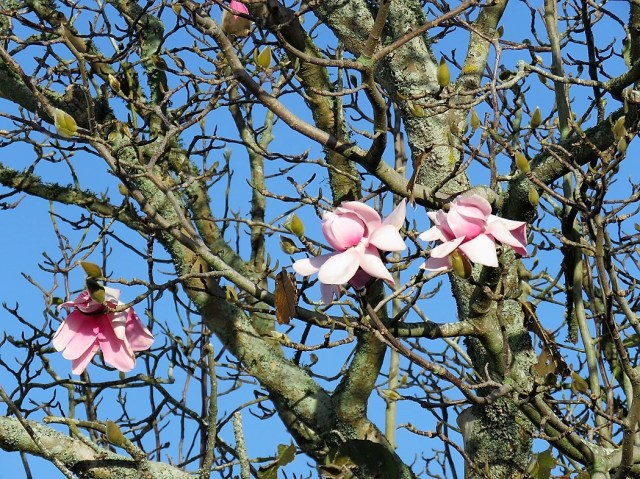
The larger form of helianthus, rangy, brittle but with a grace and presence I prefer

I was thinking about this because the helianthus are in full bloom. One day they were just the promise of buds showing, the next day they were in flower – one of the last of the summer glories. The common sunflower is a member of the helianthus family. Until this year, I had only seen the compact form of helianthus bloom here and very showy it was. Then my gardening friend, Susan, gave me some of a large form which I put into the Court Garden. I had been waiting for it to bloom, worrying as some of the outer stems snapped off from their weight. It is not a tidy plant, but look at it. It is glorious in its late summer raiment of garish yellow. I love it at this time of the year. And I love the big, rangy form, brittle though it is, more than the tidy, compact form.

The carpet of blue asters which I refer to as ‘the Kippenberg aster’ because I will never commit its full name to memory

Don’t get me wrong; the scaled down version is very good and it has its place in the garden but the bigger, more open form delights me more. The lower version is knee-high on me, the taller one is shoulder height. So, too with the asters. I have used the compact little blue carpet aster which I think bears the full name of “Aster novi-belgii ‘Professor Anton Von Kippenberg’ “ – sounds like those extended names given to miniature horses. In fact I have two carpets of it in the Wave Garden where it is much loved by the bees and the butterflies. I say carpets because, at its best, the plants form a carpet of blue at about 30cm high.

We have a number of taller asters and this gentle cloud of small blue flowers is likely a species, or close to it, It is certainly less obedient but I like its grace and lightness in the garden.

I haven’t come to grips with the aster species (Michaelmas daisies) but Kippenberg is either a dwarf species selection or a dwarf hybrid, probably the latter. The other asters we grow are much taller and rangier – think chest or even shoulder height and I have used them more extensively because they blend well with other plants rather than being best as a mass carpet.

I have noticed with both the aster and the helianthus that the dwarf versions mass flower in one hit. All the blooms open at once, which is very showy but once they are over, that it is for the season. The rangier, taller versions set flowers down the stems which come out in sequence and so give a longer season in bloom.

We only have one dwarf dahlia and it is banished to an insignificant spot
We do, however, have plenty of these larger growing types and our preference is for single blooms

I am not sure about dwarf dahlias. Years ago we were given a little red one and while it is a tidy little plant and it blooms well, I do not find it charming. I much prefer its larger, less controlled relatives.

So too with alstroemerias. Yes, the big ones can be problematic. They need support and they are inclined to spread rather enthusiastically. Unless you dig out every last bit of their fleshy roots, they also stage a second coming. But I like them.

Very (very) compact. Barely ankle height.

I was given one of the compact new dwarf varieties. Okay, it flowers very well over an extended period and it is easy to divide and increase. But it is so stunted, to my eyes. So… tidy. I don’t dislike it so much that I have dug it out – yet – but I would never buy one.

It comes down to taste and garden style in the end. We have plenty of space. In smaller gardens, just beware of stacking too many of these tidy, compact, scaled-down versions in unless you like the traffic island look at home.

If you only have a small area and are looking for inspiration on how to create a garden that is less suburban and constrained in style, you may enjoy having a look at Christchurch gardener, Robyn Kilty’s site. She has managed to fill her small spaces with a garden that looks deceptively free, graceful and exuberant while not being wild or out of control at all. It takes more skill to garden in this style but it can be done in smaller spaces.

Look at all the buds still to open down the stems of the helianthus