The tall and the short of it

I struggle to appreciate bedding plants. I really do. To me, they belong in dated floral clocks and on traffic islands. Maybe in the occasional garden bed in public gardens to appeal to older folks who have not updated their ideas since the 1960s.

I don’t have many photos on file of bedding plants but these two are from RHS Wisley, south of London and they are certainly not representative of 99% of those magnificent gardens. But there are requirements for such places to be all things to all people. That Is Enid Blyton’s Famous Five clipped amongst the blue which speaks volumes about the age demographic for that particular garden. To this day, it worries me that George on the right looks from behind as if he is having a pee.

Mark is inclined to dismiss the scaling down of plants, rendering them more suitable for suburban gardens. Our garden is anything but suburban but, by all means, if your garden is smaller and you crave a suburban look, stack it with these compact versions of the original. He doesn’t often name-drop, my Mark, and usually only in private but he reminded me that he had discussed this very matter with the late Beth Chatto when we met her and she was in complete agreement with him. He felt vindicated.

The compact form of helianthus is a named variety, though I have mislaid the name.
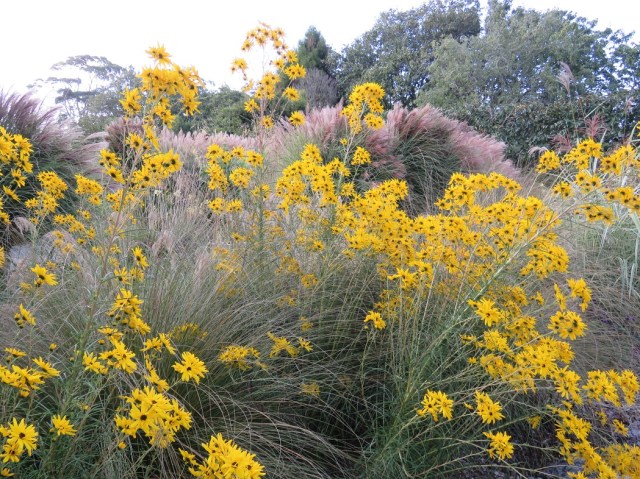
The larger form of helianthus, rangy, brittle but with a grace and presence I prefer

I was thinking about this because the helianthus are in full bloom. One day they were just the promise of buds showing, the next day they were in flower – one of the last of the summer glories. The common sunflower is a member of the helianthus family. Until this year, I had only seen the compact form of helianthus bloom here and very showy it was. Then my gardening friend, Susan, gave me some of a large form which I put into the Court Garden. I had been waiting for it to bloom, worrying as some of the outer stems snapped off from their weight. It is not a tidy plant, but look at it. It is glorious in its late summer raiment of garish yellow. I love it at this time of the year. And I love the big, rangy form, brittle though it is, more than the tidy, compact form.

The carpet of blue asters which I refer to as ‘the Kippenberg aster’ because I will never commit its full name to memory

Don’t get me wrong; the scaled down version is very good and it has its place in the garden but the bigger, more open form delights me more. The lower version is knee-high on me, the taller one is shoulder height. So, too with the asters. I have used the compact little blue carpet aster which I think bears the full name of “Aster novi-belgii ‘Professor Anton Von Kippenberg’ “ – sounds like those extended names given to miniature horses. In fact I have two carpets of it in the Wave Garden where it is much loved by the bees and the butterflies. I say carpets because, at its best, the plants form a carpet of blue at about 30cm high.

We have a number of taller asters and this gentle cloud of small blue flowers is likely a species, or close to it, It is certainly less obedient but I like its grace and lightness in the garden.

I haven’t come to grips with the aster species (Michaelmas daisies) but Kippenberg is either a dwarf species selection or a dwarf hybrid, probably the latter. The other asters we grow are much taller and rangier – think chest or even shoulder height and I have used them more extensively because they blend well with other plants rather than being best as a mass carpet.

I have noticed with both the aster and the helianthus that the dwarf versions mass flower in one hit. All the blooms open at once, which is very showy but once they are over, that it is for the season. The rangier, taller versions set flowers down the stems which come out in sequence and so give a longer season in bloom.

We only have one dwarf dahlia and it is banished to an insignificant spot
We do, however, have plenty of these larger growing types and our preference is for single blooms

I am not sure about dwarf dahlias. Years ago we were given a little red one and while it is a tidy little plant and it blooms well, I do not find it charming. I much prefer its larger, less controlled relatives.

So too with alstroemerias. Yes, the big ones can be problematic. They need support and they are inclined to spread rather enthusiastically. Unless you dig out every last bit of their fleshy roots, they also stage a second coming. But I like them.

Very (very) compact. Barely ankle height.

I was given one of the compact new dwarf varieties. Okay, it flowers very well over an extended period and it is easy to divide and increase. But it is so stunted, to my eyes. So… tidy. I don’t dislike it so much that I have dug it out – yet – but I would never buy one.

It comes down to taste and garden style in the end. We have plenty of space. In smaller gardens, just beware of stacking too many of these tidy, compact, scaled-down versions in unless you like the traffic island look at home.

If you only have a small area and are looking for inspiration on how to create a garden that is less suburban and constrained in style, you may enjoy having a look at Christchurch gardener, Robyn Kilty’s site. She has managed to fill her small spaces with a garden that looks deceptively free, graceful and exuberant while not being wild or out of control at all. It takes more skill to garden in this style but it can be done in smaller spaces.

Look at all the buds still to open down the stems of the helianthus

When life requires ladders

Pruning the Prunus Awanui has been a two ladder job for Mark this week, involving one of our old A-frame ladders and the extension ladder at the back.

Ladders feature remarkably large in our life here and not just because Mark and I are of shorter stature. Lloyd is tall. Many of our plants are much taller than he can reach. For many years we have operated on four aluminium ladders – three typical A-frame type and a full extension ladder. A few months ago, Lloyd stopped a pruning job halfway through and said that he did not feel safe continuing with it because of the state of the ladders. Lloyd is not one for complaining so, on the rare occasions when he red-flags a workplace safety issue, we take it seriously. Besides, we knew our ladders had become dodgy and rickety.

The new platform ladder
A platform ladder has a comfortable platform at the top

It has taken a couple of months, some research and many discussions but the first two of three new ladders arrived this week and it is ridiculously exciting. This is what is called a platform ladder. Now any of us can feel quite safe standing on the top rung because it is a larger platform with a safety bar on a very sturdy base. We bought the tallest one because it is the higher jobs that had become problematic here but I can see that this ladder may also give new options for my garden photographs. I may finally be able to get some elevated vistas of the summer gardens, particularly the Court Garden. It is heavier than a straight A-frame ladder but still light enough for me to move short distances on my own although I think it will be Lloyd who uses it the most.

Look at the view from the top!

The second ladder has yet to arrive. It is what is called an orchard ladder with just three legs, the back one of which is a prong. This means it can be located closer in to the plants and will do less damage in a garden because it is only the front two legs that need to be placed with care and it can be used safely in areas with more slope. We have gone for the tallest option again. We had been thinking about buying one for several years but even before it has arrived, I can see how helpful it will be. Mark is particularly looking forward to this one.

This is the orchard ladder we have on order

We will still keep the rickety A-frames and the extension ladder. The A-frames are lighter and easier to move around for small jobs, as long as we are mindful of their limitations.

While I was busy learning about ladders, I bit the bullet and found another shorter ladder, primarily for indoor use. It was way cheaper than the other two ones, says she justifying what feels like an extravagance. A snip at just under $80. Being of shorter stature, kitchen stepladders have always been a part of my life but even so, I cannot reach the top cupboards without bringing in a taller ladder. In a house with a high ceiling stud and five of the downstairs rooms having cupboards right to the ceiling, it does mean that anything on the top shelves languishes there, ignored and probably useless, except for once every five years or so when I might remember something or wipe down the toppest of the top shelves. No more! All is now within my reach. I wonder if it is time for me to declutter?

A corner of my kitchen (yes, those are old fashioned pullout bins on the right) with the rather large new ladder which will need to be stored away in a handy cupboard and brought out as needed.

True, I bought it online and I may have hesitated had I seen it in person. It is a little larger than I had anticipated. Quite a bit larger. To balance out the extra height, it has a wider base. Note, it is another platform ladder which is helpful because these are way more comfortable to work from. Clearly it will not replace the modest, utility kitchen steps that we use every day so I must keep those, too.

When I was a child, we used to have just one type of flour for cooking. Now we have six on hand at all times (wholemeal, high grade white, ordinary white, self-raising, cornflour, spelt flour and tapioca flour). We probably only ever had one ladder too, and that would have been a solid old wooden one in those days. Now we have a ladder for almost every occasion.

ACC* would be proud of us.

Footnote: For overseas readers, ACC is our Accident Compensation Corporation – a longstanding, taxpayer-funded body that acts as an insurance company paying out on a no-fault, no-blame basis for medical and related costs – including wages and loss of income – for all injuries and accidents. It is not a perfect system and we all like to moan about it but it has freed this country from the litigious nature of many other countries. ACC also likes to educate us on dangers around the home and unsafe ladders feature regularly.

A quick garden update. Zach has reached as far as the bamboo grove in the Wild North Garden and we now have a path through it which I found quite exciting.

Mark’s low meadow (formerly the front lawn) had finished flowering so Lloyd ran the mower over it for the first time in over three months. I expect we will have a lawn back soon and that will continue until late spring this year when Mark will want to grow it again.

The grass report

I feel sufficiently confident to give an interim report on the grasses I have used in the new Court Garden although it will take another few years before I can give a definitive verdict. These are bigger growing grasses because we had the space and I wanted an immersive effect that wraps around when we walk through the area.

The site is the hottest area in our garden but, being lowered, it can also be frosty in winter. Cold air flows down to lower levels to settle. The ground is typical free-draining, Taranaki volcanic soils that do not become water-logged and never dry out entirely. We haven’t added any fertiliser and once planted, we never water. The area is mulched with wood chip.

Chionochloa rubra – commonly known as red tussock but this form is only brownish red in winter

Chionochloa rubra – NZ native so evergreen. It takes first prize for graceful form because it fountains out from a narrow base and that form makes it a real star in the winter garden. Its flowering is relatively insignificant but I don’t have to groom the plants to remove dead sections. We started with just one plant and I kept dividing it, which it does easily. I have never lost a plant. It needs space to be able to appreciate the graceful form and the best plants are now 120cm high with a spread up to 2 metres.

Chionochloa flavicans, sometimes sold as ‘miniature toetoe’ though it is a different family

Chionochloa flavicans – also a native, sometimes referred to as ‘miniature toetoe’, so evergreen. At its best in spring but holds its showy flowers right through until autumn. Rabbit fodder when young. Has the reputation of ‘whiffing off’ unpredictably and it certainly doesn’t appreciate being crowded by other plants. Again, we started with a single plant and kept dividing. I have overplanted it so will lift the lot shortly and split the plants, replanting fewer and at wider spacings. I am hoping that by dividing, it will stimulate more growth and delay any inclination to ‘whiff off’. Plants are now about 75cm high and up to 140cm wide.

Anemanthele lessoniana or NZ wind grass, sometimes gossamer grass (you can see the ethereal flowers in pink tones) in the borders before I moved it over to the Court Garden
Anemanthele after moving – it turns golden under stress and it was still hot weather when I moved these plants but I expect them to recover

Anemanthele lessoniana – another native – so evergreen – with a vase shaped habit of growth and more colour variation in the foliage. Lovely in bloom with a cloud of fine flower heads. I had this in the twin borders but the plants were getting too large so I have now moved them to the Court Garden. When stressed (and my plants have often been stressed as I have lifted and divided them to increase the number from the original three), it turns an attractive gold but I will need to groom the foliage to remove dead thatch when the plants make fresh growth. It has reached about 90cm high and up to 140cm wide.

The tall plumes are the austroderia – NZ toetoe and a better choice than Argentinian pampas

Austroderia fulvida – toetoe so another evergreen native.  Very large growing and too early for me to comment on its longer term performance. I bought three small plants through Trade Me and they have already reached 1.7m high and 2.4 metres wide.

Stipa gigantea I have referenced countless times. It, too, is evergreen in our conditions and I  give it the occasional groom (by hand or with a leaf rake) to remove dead foliage. Excluding the tall flower spikes, it is about 80cm high and 160 cm wide as it matures. It divides and increases easily so just start with a single plant but you do need a certain critical mass to have sufficient to share with the sparrows. We found the pesky birds stripped the blooms in the first season and the whole reason for growing this grass is for its showy, long-lived flower spikes so that was disappointing. This year we have had plenty to share with the birds. The foliage has a glaucous tint which is a contrast.

Calamagrostis ‘Karl Foerster’ to the left with the plumes still looking good after four months

Calamagrostis ‘Karl Foerster‘ – I have written about this before. It is such a strong grower, spreading at an alarming speed, that I reduced it down to just six plants which I am hoping I can keep in check by root pruning on an annual basis. By root pruning, I mean getting a very sharp spade and cutting back the size of the clump without digging it all out. That way, I can get the spreading fresh growth off it. This works because it makes its new growths on the outside of the clump. It is evergreen in our climate but the foliage looks pretty scruffy by the end of season. I am pretty sure I cut it back hard last winter so the spring growth was all fresh and lush. It is one of the first grasses to flower in spring and those lovely plumes hold all summer and into autumn. It is all about the plumes because the foliage and form are nothing remarkable.

That is what I think is ‘Overdam’ in the front right, Stipa gigantea behind

Calamagrostis ‘Overdam‘. At least, I think it is Overdam. It was given to me. It is strong growing too, but not as threatening as Karl. It has the same lovely plumes but the bonus of clean, variegated foliage which stays looking fresh through the season, somewhat like a lower growing variegated miscanthus, though it spreads sideways rather than up. It will likely need root pruning, too.

Miscanthus is a lovely grass from spring onwards but the glow of those white plumes in the low winter sun is nothing short of amazing

Miscanthus sinensis ‘Morning Light’. Look, we started with one plant in the garden years ago that just sat, grew annually and fell apart because it needed dividing. As soon as I started dividing it (done variously with a sharp spade, an old handsaw or a small axe), it responded by growing with huge enthusiasm. I overplanted badly and need to take out at least half of the plants but as it is all about the plumes in late autumn and early winter when they glow white in the low sun angles, I will wait. The plants are around 1.7 to 1.8 metres high with flower spikes on top of that so it is very tall. If it is divided often enough, it will stay together – falling apart from the middle is a sign it needs dividing. It is fully deciduous, fine leaved and variegated. Mark is sure that the old foliage has potential for thatching but he has yet to test this theory. This is the only grass that I have spotted seeding down so far but the seedlings are easy to pull out when small.

Miscanthus ‘Morning Light’ on the right, giant miscanthus on the left

Miscanthus whatever whatever – may be just a larger growing form of sinensis with a wider leaf but it should be called Miscanthus giganteus variegatus. The leaves are wider and with a most attractive, clean variegation but the vigour and size is daunting. We ended up digging out three massive plants because I couldn’t hold them together and, as they fell apart, they blocked the path entirely. This is a triffid of a grass. Gardening friend, Susan, suggested that maybe the way forward is to do the Chelsea chop on them – cut them back to ground after the first big flush. I think she is right and I will be cutting them back to ground level about mid November. The second flush of growth should be more compact and shorter. If I can’t keep them under control this way, they will have to go. The plants are too big for me to lift alone and I don’t want to commit to plants that need lifting and dividing annually.

Just too big – they grew even larger and floppier after I took this photo

Lomandra We had a named variety in the garden but I found a better option to replace it with. I rate lomandra as one of the world’s more boring plants and I suggest you leave lomandras to supermarket carparks and roading roundabouts. We have more interesting and attractive native grasses without having to resort to this utility Aussie in NZ gardens.   

Here endeth the interim grass report. Except to say that I am moving and dividing some now because we still have at least six to eight weeks of the growing season left before temperatures drop and growth slows or stops over winter. That said, I have done this in winter and we can get away with it but it is not recommended in less benign conditions where the plants may just sit and decompose in sodden, cold soils.

The Court Garden after its second summer

August 2018

I am turning my attention back to refining the new Court Garden. How did we manage before digital cameras? They make it so easy to track change. This was where we started with a blank canvas.

August 2019

A year later and I had done most of the planting and the steps were in place. If you look carefully, you may see some little spots of yellow. I drifted many dwarf narcissi through to add early spring interest. This winter will be my last chance to locate them and remove them before they are forever swamped in the grasslands.

October 2020

This is how it looked when we opened for the garden festival last spring, when we had completed the paths. It was the first viewing by members of the public and most visitors loved it.

March 2021

This is the same view, four months later. The growth has been well in excess of what we expected. This is the result of planting into fresh ground although the soils would not have been particularly fertile after being under nursery weedmat for three decades. We have not fertilised anything. Nor did I use compost to enrich the soil. We did, however, cultivate the ground before planting and mulch afterwards. While planting, I squished a gazillion grass grubs that I unearthed as I went.

Chionochloa rubra

Despite my best effort to get the spacings right as I planted. the mistakes are now clear, mostly because I underestimated how large the plants would get. You can see from the markings on the path, how far out the grass stems are sweeping. I am fine with a bit of softening overhang but I also want to be able to walk through without getting wet legs. I need to move the right hand chionochloa back half a metre. Fine tuning, I call it.

Stipa gigantea and ox-eye daisy at the beginning of November

Again, thanks to digital photography, it is easy to track plant combinations through the seasons. I have been surprised that some have held for a good four months. This is just a simple combination of Stipa gigantea (golden oat grass) and ox-eye daisies as it looked when we opened the garden at the beginning of November.

Stipa gigantea and oxeye daisies in mid December

The same view in December. Aren’t those simple daisies simply glorious? As this mass display passed over, I cut them back to the rosettes at ground level.

This is the same spot in February. The daisies are having a second flush and i think if I get my timings right, it may be possible to get a third flush each year. The stipa has also held onto its sterile flowers and I did not expect these to hold for over four months.

Stipa gigantea and Verbena bonariensis in mid December

Back in mid December, I was delighted by the chance combination of a Verbena bonariensis that chose to seed in this spot by Stipa gigantea. I even took a short video of the gentle movement which was everything I aimed for in this garden but my tech skills let me down sometimes and I can’t work out how to upload it to this platform.

Same plants in late February

This is the same scene, two and a half months later. Still pretty, albeit past its fresh flush.

NZ toetoe and Chionochloa flavicans at the start of November

Who still declares that our native plants are boring? Mark said we must have our native toetoe in what is essentially a grass garden. I bought three plants on TradeMe (our equivalent of Ebay) and from memory, I think they are Austroderia fulvida. We have five species native to this country. The smaller plants are Chionochloa flavida, often sold as ‘dwarf toetoe’ although they are a different plant family.

Four months on

Four months later, the flower plumes are still holding, albeit a little tired as we go into autumn. This is not unreasonable on their part.

I think I am ready to give an interim report card on the key plants used in this garden but that will have to wait for another post. It will take another few years before I feel confident to recommend based on longer term performance but some trends are already clear. Pretty much all the plants used are readily available in this country.

From a tsunami threat and Covid to calliandra and Mark’s low meadow

I would like to suggest that Dudley is asking NZers not to be grumpy moaners but really he was wondering whether it would be worth the effort to follow me down to the Wild North Garden. Not one for wasting energy, he decided it wasn’t.

It has been a discombobulating week. Not at a personal level, but nationwide. The tsunami threat on Friday rather capped it off. In a country where the majority of people live within a few kilometres of the coast, the potential catastrophe of a tsunami on the scale of the 2004 Boxing Day one in the Indian Ocean is very real. Three large earthquakes to the north of us were seen as having the potential to create such waves.

For overseas readers, this resulted in major evacuations across wide areas (“get to higher ground or head inland”), a general warning to coastal residents around the rest of the country and wall to wall coverage on all major media for several hours. Fortunately, the threat passed with no tsunami –  just some unusual wave and current activity – and we all learned that our Civil Defence protection is efficient and effective in the face of real threats. That, at least, is reassuring.

Calliandra flowering this week with ox-eye daisies and Stipa gigantea in the Court Garden

As we are coming up to the first anniversary of Covid in NZ, Auckland is just coming out of another week of Level 3 lockdown. This is comparable to the general level of lockdown in many other countries but somewhat short of the Level 4 lockdown of last year when we managed to get the country Covid-free. It was also for one week only, to isolate the latest community cluster which has been kept to just nine people – against all odds given that it is the highly contagious UK strain. The thing about lockdowns is that they bring out the best in many people and the worst in a strident few and that makes them even more wearing.

Honestly, NZers whinging about being ‘sick of lockdowns’, ‘suffering from Covid fatigue’, and bleating that ‘we can not keep yo-yoing in and out of lockdowns’ are so selfish when you look at the rest of the world, most of which has been in some form of lockdown for the better part of the last year. The whole world is ‘sick of Covid’ but it is not going to end any time soon and we NZers have had more freedom than almost every other country. But there is a price to pay for the freedoms we take for granted and that price is doing what is required to keep Covid out of our communities.

Just please, stop complaining, grit your teeth and keep your eyes on the goal of a return to those freedoms of activity and movement over the next week or so. And keep watching what is happening in the rest of the world and be grateful for where we are.

When everything looks to be going to hell in a handbasket there are still flowers – the pink candyfloss calliandra

I was delighted to see the calliandra in flower this week. I wasn’t sure how it would perform in a garden situation here, given that it is native to Arizona, Texas and Mexico and that it was a very neglected specimen when I planted it. Now I feel I should go and retrieve the remaining neglected specimens languishing in an unloved state in the former nursery area. Maybe I could revive them and have more of these starburst wonders in the hot Court Garden.

We have a large front lawn, now Mark’s low meadow

Mark was almost chortling in delight – except that he is not generally a chortler- at the candyfloss piece about letting your lawns grow on TV’s Seven Sharp show this week. Mark asked Lloyd to stop mowing our large front lawn after Christmas. Lloyd is too discreet to express an opinion on this matter but I suspect it galls him to look at it as he mows the other lawns. Mark was curious to see what would happen if we let it grow and he is quite delighted by what he calls his ‘low meadow’. The quail, who enjoy the clover, are equally pleased. There are areas carpeted in white clover flowers and yellow from the lotus major but more patches than carpets of blue from the self-heal (Prunella vulgaris). I was hoping for more blue.

Equal parts lotus major, clover and lawn grass with some self heal
It would have photographed better had the grass on the mown paths and edges been caught rather than left to lie

After a few weeks, I asked Lloyd to mow a strip around the edges and paths through the middle and that gave it a more acceptable definition – more meadow than neglected, rank grass. There is still an open verdict here on the merits. It is certainly more environmentally friendly. As far back as 2006, I have been writing about the environmental travesty that is our obsession with ‘perfect’ lawns. We will mow again when the flowering finishes and the first cut may be more like making hay. In the meantime, it is not a look that will appeal to everybody but we are interested in experimenting with gentler ways to garden. And at least we are in good company with this concern.

We are in good company – the best in fact. RHS Rosemoor Garden in Devon where they have stopped mowing all the grass all of the time.