Generally unenthused by green flowers and other garden observations

Mark has never been a fan of green flowers. I asked him why and he replied with utter simplicity, “because I like colour”. As I have observed before, green is colour neutral in a garden situation. Maybe Hippeastrum papilio passes muster because it has quite a bit of red in it and has some hefty flower-wow-power but his preference lies with the glowing red of H. aulicum.

Hippeastrum papilio

I am pleased with H. papilio. We started with a single bulb and now have two good sized patches of it with a profusion of flower spikes this year – at least a dozen on the point of opening in one area alone. It is just patience, time and lifting and dividing that gets a single expensive bulb to a significant block – or an extravagant budget if you want a quicker response. We grow our hippeastrums in woodland conditions because the narcissi fly stay out in the sun so the bulbs don’t get burrowed out by narcissi fly larvae.

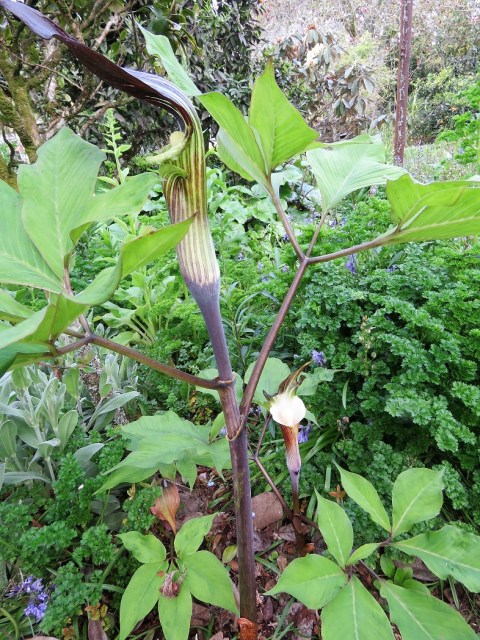
We have plenty of green hellebores – Helleborus ‘Sternii’, H. argutifolius and H. foetidus feature heavily in the woodland Avenue Garden – some green arisaemas and a single green orchid but generally I see Mark eyes glaze over with disinterest when green flowers are praised by others. He will go as far as white fading to green or white with streaks of green – but predominantly white, thank you.

Helleborus sternii
I think I was having difficulty getting a good photo in the garden of Helleborus foetidus and, to be honest, it looks more exciting staged
Just the one green orchid but it has a certain grace and style
Yellow clivias, we have a few. Quite a few really.

Some readers may remember when the first yellow clivias became available here, retailing for up to $50 a plant, as I recall. I think about this as I pull out the self-sown seedlings and discard them as surplus to requirements. If you want to raise plants from seed, if the seed is yellow, the plant will flower yellow. Red seed gives orange or red flowered plants. Now the fashion appears to be for the new green flowered varieties, but not here, for reasons already stated. I wouldn’t mind some richer yellow ones but I have only seen one in another garden. The pale yellows can be a bit insipid en masse but really sing when combined with orange and red clivias. Pretty peach clivias would also be a nice addition and are now available but haven’t come our way yet.

The trimming of the Podocarpus parlatorei in the summer gardens

Our focus is entirely on getting the garden ready for opening. Mark is trimming the Podocarpus parlatorei to pillar shapes and he is welcome to this job. It has to be done with secateurs and loppers more than clippers to get the main shape formed. Hopefully it can be done with electric clippers in the future once the shape is defined and the plants have bushed out so it is foliage that needs to be trimmed and not woody branches. The top knots are because he wants to stretch them over to form an archway in time. There are six of them and as the chief shaper is currently incapacitated by a bad shoulder and a cracked rib, it is taking him some time. Notice the old shade cloth spread beneath to capture the mess. Lloyd does the same when he is trimming hedges. It only takes a moment to spread a drop sheet (old sheets or curtains do the same job) yet it makes the clean-up so much faster.

My goal today is to finish down in the park. It is all about tidying in that area, but selective tidying because we like a looser, more natural look in that area. Then it is back up to the top gardens for the final round with fingers crossed that we get no major storms between now and October 30.

Down in the park tidying up so I get to enjoy the wisteria, bluebells and rhododendrons
Rhododendron ‘College Pink’ is both very large and very pink
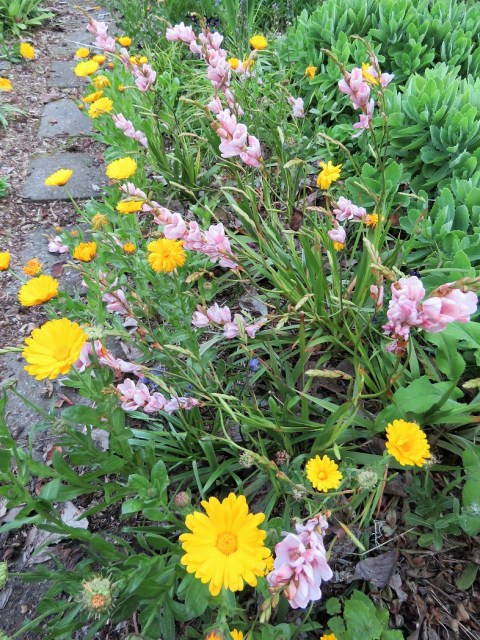
Following the pink theme, ixias in the new borders
Finally, the bird bath – well used, particularly by tui. It is the outer mill wheel from a grain mill. I used to worry that it wasn’t level until Mark pointed out that is to that small birds can also use it without fear.

Counting down to Festival – 25 days to go

This image has an empty alt attribute; its file name is img_7791.jpg
Admiring the scale of the Monstera delicoosa climbing a massive rimu tree

We had a film crew in this week, complete with *actors*. The garden was just a venue – the filming is for a major community funding trust but it was more fun than I expected. I was impressed by the gusto shown by the willing participants, if somewhat amused to hear one admiring the ‘snowdrops’ as he walked past a pretty clump of white Dendrobium (orchid) ‘Bardo-Rose’.

In the sunken garden they whipped out their phones because, as they declared, that is what garden visitors do nowadays and how right they are. I don’t do Instagram because it is geared to mobile phones and we lack phone reception here so I continue to use a camera, not a phone. But here we have the videographer filming the visitor photographing the other visitors photographing the blue Moraea villosa.

I was riveted by the drone and hope we may get to see the drone footage at some stage. Now I know who to get in to do some drone footage next year when the magnolias are in full bloom – a time when I am guessing we would be looking our most dramatic and colourful from above.

What was particularly affirming was the wildly enthusiastic response to the new summer gardens where we finished the paths this week. I look at this area and I see gardens filled with plants that I hope will do a whole lot of growing before we open in a month. They looked at the whole and went ‘wow’. One of the crew declared that it reminded him of Hamilton Gardens. This was a compliment. I do not doubt that for a moment. I was just a bit taken aback because I had not thought we were emulating the themed gardens that are enormously popular public gardens in the city of Hamilton. We are a private, domestic garden. This has been achieved on a shoestring budget by three people, albeit with a lot of experience.

Trilliums in meadow conditions

Sometimes I feel as though I am living with a pixie. In this case, a pixie who has been out planting trilliums in the meadow. It is of course Mark who has both raised the plants and then planted them. Last year I spotted a couple. As I tidy up the park in preparation for opening, I must have come across about 20 of them this week.

We have trilliums in the garden. Growing them in long grass is an experiment but so far it is working and they are continuing to get a little larger each year, rather than fading away.

There is a lesson in this. If you want to experiment with choice plants in a meadow, it helps to raise them yourself. You wouldn’t want to be buying a score – or more – of them to experiment with.

Oh look! How very 2020. My 1950s washing line (a single wire held up with a bamboo prop) with washable facemasks hanging like bunting and two linen tea towels that were sold as a fundraiser in aid of the Australian bushfires last summer. It is not that we are wearing masks at this time, but that our scientist daughter has crafted masks for her parents in two styles with added, optional, washable filters. I was washing them before putting them safely to one side – prepared, just in case.

For overseas readers, NZ has reachieved its status of no community transmission, with any Covid cases caught in quarantine at the border – so most of the country is free from all restrictions on movement and crowd sizes again. We have our fingers crossed that we remain free from any Covid cases in the community for the garden festival at the end of the month and hopefully well beyond. If one is going to be confined to one’s home country with no overseas travel, New Zealand seems to be one of the best places to be at this difficult time. May you all stay safe, wherever in the world you are.

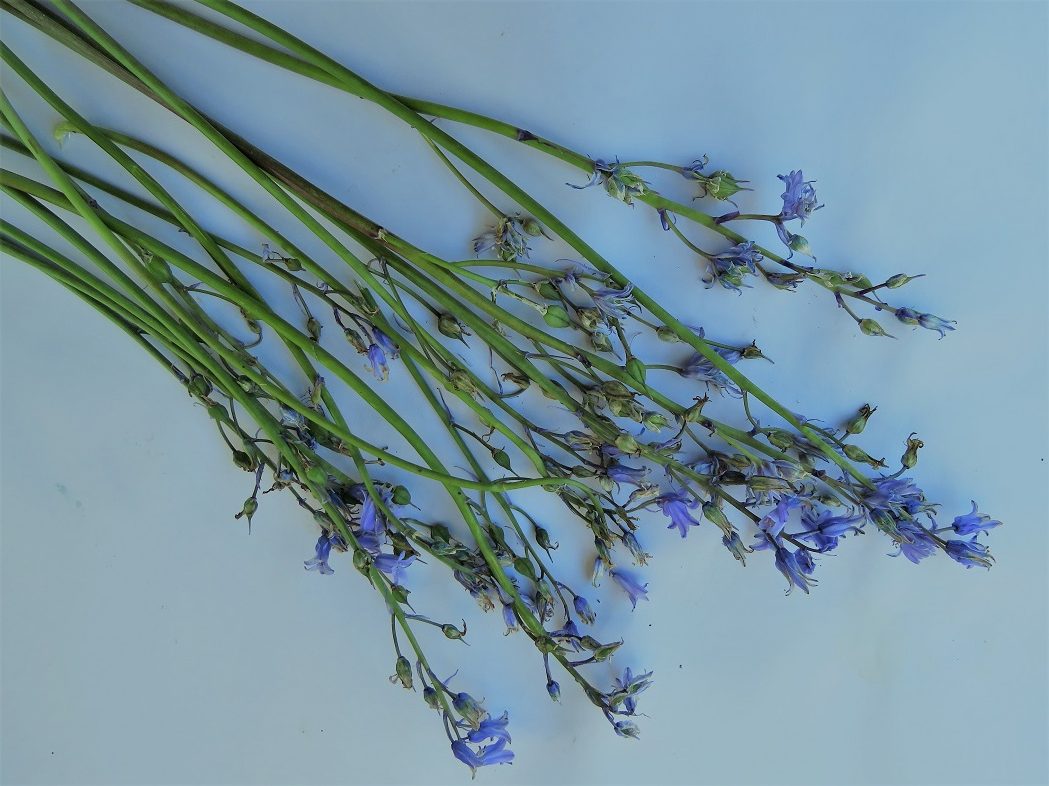
Finally a few photos of the season. I struggle to get good photographs of the swathes of bluebells here. We are just past peak bluebell and they are so pretty even if the Spanish bluebells and hybrids are inclined to be so enthusiastic that they border on being problematic in some areas.

I finally got down to tie in the wisteria to the high bridge. They are quite a bit reduced in size this year as a result of the work we undertook on the bridge but still very pretty. I use black twine because, of all the ties I have tried over the years, synthetic black twine lasts the longest and is the least distracting the eye.

Rhododendron Noyo Chief

We flower rhododendrons more or less from August to the end of November. This is Noyo Chief. It is an undeniably handsome red, even if big reds are not my personal favourite. It is certainly a good performer on a healthy bush and what more can one ask?

Golden orbs

This image has an empty alt attribute; its file name is img_7832.jpg

Every time Edgeworthia gardneri blooms and I sniff the waxy, golden orbs of fragrance, I remember a customer from our mail order days. One who put the cuss into customer, as Mark is wont to say.

New Zealand Gardener magazine carried a full-page photo of a single golden orb and the accompanying text named us as one of very few suppliers of this plant. It is not common in NZ gardens and not that easy to propagate. A full-page photo should give a hint as to the problem. It was considerably enlarged in the image.

A reader rang, desperate to order one of the few remaining plants we had. One of the staff took the call and didn’t check to make sure she knew what she was buying. I am not saying Mark or I would have checked, but we might have. The staffer instead sold her an additional random plant as well to meet our minimum order of $35 and her plants were packed and despatched.

I have no idea what the woman’s name was but I can remember she lived in Palmerston North (here’s looking at you Palmerstonians – she was yours, all yours). On receipt of the plant, she rang to express her extreme disappointment. The flower, you see. She had no idea the flower would be so small. It looked much larger in the photo. I mentally sighed and agreed to take the plants back if she returned them in good condition. She had clearly destroyed our packing because in due course, the plants arrived back in a carefully constructed cardboard cage, with windows and air vents, even. As I recall, it cost her $27.50 to send us back $35 worth of plants. I deleted her from our data base.

Edgeworthia gardneri is the tall, willowy, multi-stemmed shrub behind the orange clivia

But every year, as I enjoy the plant in bloom, I smile wryly at the thought of what she missed out on because it is lovely. It is willowy in its growth so light and graceful, adorned by many golden orbs with good scent in late winter and early spring. It is evergreen and hails from the forests in the Himalayan foothills and is, I have just discovered, just as good if not better for the making of high quality paper as its better known, deciduous, shrubby cousin, Edgeworthia papyrifera syn chrysantha (which bears the common, though inaccurate, name of the yellow daphne).

It is just that the flower heads are the size of pingpong balls, not tennis balls, or maybe even the larger ball size used in softball and baseball.

Spring pinks

Pink froth of Prunus Awanui  currently at its peak

I am a big fan of pink and not just in flowers, but my theme this week came because of two pink plants in bloom.

The balls of viburnum are at the front of the vase

The first is one of the Virburnum × burkwoodii cultivars. I am not sure which one it is but we have it planted beside the drive where it is largely anonymous for 51 weeks of the year. In the 52nd week, it opens its flowers to rounded balls of exquisite fragrance – strong enough to hang in the air several metres away. We would be lucky to get a full 7 days out of it but I am sure it does better in other climates – it probably wants it drier and colder. I picked a few balls to put in a vase with pink bluebells and late flowers of Mark’s Daphne ‘Perfume Princess’ (which still has flowers and has had since late March). It was lovely but the viburnum flowers promptly died overnight. They last longer than that on the bush, though not by much.

The view with our morning cuppa

Magnolia Serene

A prodigious carpet of petals beneath

The second pink to give me daily delight is Magnolia ‘Serene’ – bred by Felix and the marker of the end of the deciduous magnolia season for us. As we sit having our morning cup of tea, it is framed in the corner window of our bedroom. Not this morning, though. With daylight saving, it was a bit dark at 7am to see it so that may herald the end of that particular seasonal pleasure, too.

Rhododendron Coconut Ice

I am not the world’s biggest fan of the ball truss type of rhododendron but ‘Coconut Ice’ was looking particularly pretty earlier this week. Sadly, it is browning off already. Flowering is an ephemeral pleasure. Mark observes that the delight of rhododendrons lies in watching the buds for a long period of time before finally opening over a period of a couple of weeks. There is then a week, maybe 10 days, of full glory – sometimes cut shorter by an ill-timed storm – and then it is time to dead head it. In practice, we don’t dead head all our rhododendrons – just those that set large amounts of seed which can weaken the plant over time.

My rhododendron preference is for those with looser trusses that are sometimes so abundant that they can cover the plant.

Rhododendron Anne Teese

It took a couple of goes for Mark to remember the name of this beauty – Rhododendron Anne Teese. It is an Australian-bred hybrid coming from the Teese family (in this case the father, Arnold) who are well known through their nursery, Yamina Rare Plants in Monbulk, Victoria. Mark thinks it was named for the mother, presumably married to Arnold. Whatever, it is very lovely and I would be happy to have it named for me. It is a Maddenia hybrid (R.ciliicalyx x R.formosum) so scented and with a heavier petal, more weather resistant than ‘Charisma’, a similar R.ciliicalyx selection that used to be widely available here.

Rhododendron Floral Gift in a swathe of bluebells

With one notable exception – Magnolia ‘Felix Jury’ – Mark doesn’t name his cultivars for people. Or when he does, it is by oblique reference at best so an in-house tribute only. So this, his most fragrant rhododendron is ‘Floral Gift’, not ‘Abbie Jury’. It takes a while to get established but it is lovely and can be seen performing really well at Pukeiti Rhododendron Gardens. There are a whole lot of hybrids in this genre of scented, white flushed pink loose trusses; the best known is ‘Fragrantissimum’.  What sets ‘Floral Gift’ apart is the large flower and the very heavy petal texture giving it good weather resistance.

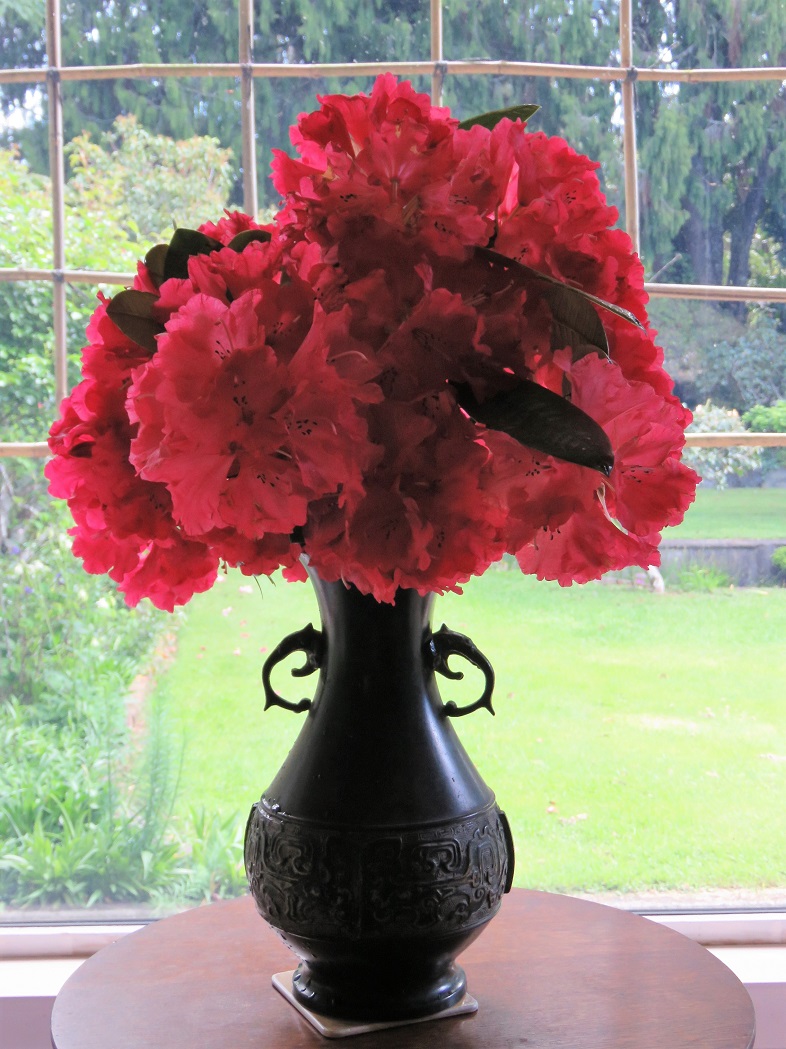
The reason I often reference weather resistance is because our spring flowering coincides with the spring equinox when we get the most unsettled weather, as evidenced this weekend – which, for us, means very heavy rain and wind which can wipe out fragile flowers in a matter of hours. And a few more pinks to finish off – this is one of the Dendrobium ‘Bardo Rose’ group of orchids which thrive in our open woodland areas. They flower for a long time and the scale is right for detailed woodland plantings – by which I mean, not as big and dominant as the cymbidiums.

Fairy Magnolia Blush

Fairy Magnolia Blush has a good, long flowering season, currently at its most charming stage of peak bloom. More lilac than pink, it is pleione orchid time. This is another group from the orchid family that thrives in pretty laissez-faire woodland conditions (in other words, benign neglect) but the flowering season is much shorter than the dendrobium ‘Bardo Roses’.

And the final bar of pink can be left to the evergreen azaleas. We have so many different ones that we get many months in flower but they are currently at their showiest.

Counting down to festival in the new world of Covid

Prunus Awanui in flower this week as we pass peak magnolia and go into the next phase of spring

As a nation, we are collectively holding our breath to see if we are indeed safely back to the status of zero Covid cases, except those caught and isolated in border quarantine. Just one community case in five days and counting now, this second time round. Our team of five million that saw us achieve this status the first time round has had some defections. Hopefully, the mob of doubters, conspiracists and anti-vaxxers is small, though very noisy. Obsessed only with their own *rights*, they have no concern for the safety and well-being of others and are swallowed up by their own crusade that Covid doesn’t exist, that it is no worse than the common flu, that it is a man-made virus being used by Bill Gates and his cohorts to take over the world (never mind that these positions are contradictory), that our government is lying to us, that it is somehow tied up with the 5G network and probably chem trails, that the Covid vaccine will be mandatory (it won’t) – all because they don’t want to wear masks on public transport and maintain physical distancing while we stamp out the latest flare-up. Sigh.

Mark’s Rhododendron Floral Sun never fails to lift my spirits, even more so this week in such uncertain times

It is not helped by a prolonged election campaign where some of the opposition parties are hellbent on undermining confidence in the government and community response to Covid. Let not the fact that NZ is a shining star internationally with its Covid response and that we have fewer restrictions and a safer environment than almost every other country in the world at this time get in the way of their narrative that  it is a ‘shambles’, ‘incompetent’, a ‘failure’, an example of ‘gross mismanagement’ and all the rest. Some even advocate opening the borders and ‘learning to live with Covid’, though they seem to be unable to come up with international examples of countries managing to live comfortably with Covid on the loose in the community.

New Zealand – we done good. We are on track to eliminate this latest outbreak. The election will be over in a month. Our lives will return to the comfort of level one freedoms in this new reality that Covid has brought to our world.

‘Back in the day’, as is said, I used to write a regular piece for the local paper called ‘Countdown to Festival’ and I still look back at that series with some fond memories. It was just an assemblage of snippets from local gardeners describing their preparations for the annual garden festival and, from memory, the paper paid me the grand sum of $35 a week for it. It comprised garden hints from gardeners all around the district, some quirky anecdotes and painting small word pictures of the characters who were beavering away to get their gardens to opening standard.  I think it had a quirky charm as well as some handy advice but it all stopped when I left the Taranaki Daily News and went to write for the Waikato Times instead.

The pretty path down to the park by my washing line, The white on the left is fragrant Rhododendron veitchianum, colourful azaleas in the centre and pretty Magnolia laevifolia ‘Velvet and Cream’ on the right

My mind went back to that series because we are now totally focused on getting the garden ready for opening on October30. Hopefully, we will be in level one which, in NZ, means no restrictions at all (life as usual but with no overseas tourists) but I am assuming we can still go ahead at level two, if need be. Mostly that means physical distancing and some controls on numbers, but presumably without coach tours owing to distancing not being possible on most coaches. Note to self: buy hand sanitiser – that public health symbol of Covid – and investigate registering for QR code. Even I, an occasional mobile phone-user at best, use the Covid app to scan into all shops and businesses. It is much easier than manually signing in. Frankly, it feels weird to be contemplating getting all visitors to the property to scan or sign in but this is our world now.

Lloyd can be spotted at the back of the photo with the tractor, our fancy lawnmower towing a large trolley, screeding tool, shovel, rake, barrow and plate compactor. This is not a job for the fainthearted.

The compacted ‘terrazzo’ look

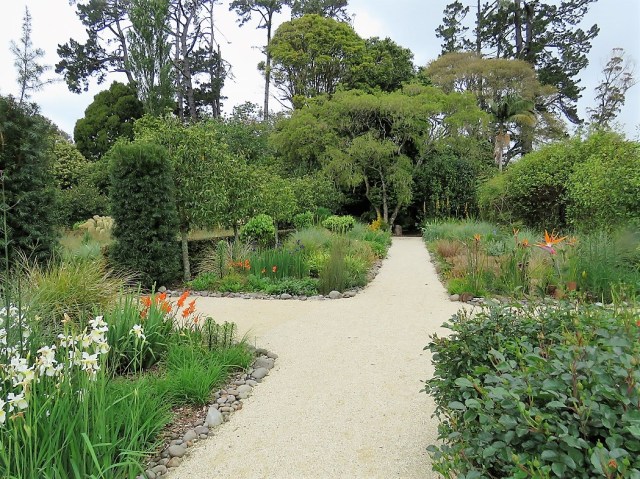
With our lives becoming so much more home-based, local and smaller – holding the chaos of the world at bay – the garden has become even more important. This week, I ordered the first truckload of the top layer for the paths in our new summer gardens. Ten cubic metres or fourteen ton to start with and we will need at least as much again. It is not cheap so there was some nervousness but we are pretty excited at the effect of this crushed limestone and shell mix (I did say our world had grown smaller!). Lloyd is spreading it by barrow, shovel and rake,  screeding it and then using the plate compressor to compact it as he goes. A torrential downpour was a good test. It compacts suffciently firmly that the torrent of ground water did not wash it away and the surface is so smooth that it can be swept or cleaned with the leaf blower. The rain brought the whiter fines to the surface so the finished effect looks more like the terrazzo kitchen benches of long ago. After building up to this for so long, it is positively thrilling, I tell you.

I think the uppermost two topknots on Mine No Yuki need to removed entirely but that can wait if we run out of time

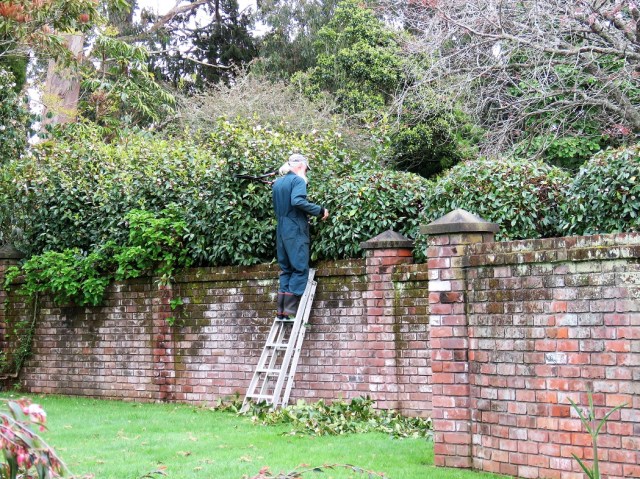
Lloyd has also been clipping our shaped and cloud pruned camellias this week and will start on the hedges soon. In the meantime, Mark rather defies my work schedule but has been painstakingly giving the geriatric apple trees a major and considered prune. Next up, the two avenues of Fairy Magnolia White and the punctuation points of Podocarpus parlatorei in the new gardens are awaiting their annual trim. Mark is by far the most skilled pruner here.

Mark has done the first four geriatric apple trees but there is a whole lot more pruning waiting to be done and I am not yet seeing him show the signs of urgency I am hoping for

I am here, there and everywhere. Garden grooming is my strength. Attention to detail. At least it gets me all round the place. We have passed peak magnolia, the snowdrops have long finished and the dwarf narcissi are all but over. Now it is bluebell time, Japanese cherries, rhododendrons, evergreen azaleas and mid spring bulbs. The plants and the seasons are not disturbed by Covid.

The mid spring bulbs are starting – Moraea villosa and sparaxis

The freshly laid paths in the Court Garden look a little stark but we are confident they will mellow and soften quickly. The initial stage is preternaturally tidy.