When 1+1 equal more that 2. Magnolia parents and offspring.

I added a postscript to last week’s post about blind pruning camellias. After comments on that post, I added in chainsaw pruning tips (cutting back overgrown camellias to ground level or just above) and a word of caution about hygiene with cutting tools. You can find it at the end of the post if you are contemplating more extreme, less refined pruning.

Today’s post is heavy on photos. Magnolia photos to celebrate the season. I haven’t sat down before and collated images to show the parents of our named cultivars, lined up alongside their progeny. When Felix started crossing magnolias back in the early 1960s, he wanted to see if he could get the cup and saucer flower form of M. campbellii, that would flower from a younger age, on plants that would stay smaller and with more colours.

Magnolia Mark Jury  with a larger, more robust flower and longer flowering season than either of its parents.

He didn’t start with many options. There were not many different magnolias available in NZ at the time – nothing like today’s range – but he had a unique tool in his kit. That was the magnolia he named for his youngest son, Mark Jury.

Magnolia sargentiana robusta on the left, ‘Lanarth’ on the right, the parents of ‘Mark Jury’

More Mark

‘Mark Jury’ came to him from Hillier Nurseries as a seedling of ‘Lanarth’ (M.campbellii var mollicomata ‘Lanarth’, to be precise), costing 18 shillings which was quite a lot back in the 1950s. When it flowered, it was not ‘Lanarth’. Discussions with Hilliers – slow discussions by hand-written letters as was the way back then – determined that it was most likely to be a cross between ‘Lanarth’ and M. sargentiana robusta. It proved to be an important breeder parent for him.

Magnolia ‘Lennei’ alba crossed onto ‘Mark Jury’ was one of his first efforts. (For the technically minded, ‘Lennei’ is more correctly M. X soulangeana ‘Lennei’, itself a cross of M.denudata and M.liliiflora).

It resulted in the beautiful ‘Athene’

‘Lotus’

and ‘Milky Way’.

Swapping to the pink form of ‘Lennei’ crossed on to ‘Mark Jury’, he raised and named

Atlas

and Iolanthe. This particular cultivar is one of the enduring stars in Felix’s collection.

The picture on his use of M.liliiflora is not as clear. He had the dark form of M. liliiflora ‘Nigra’, a paler pink form of the same species and, it seems, a liliiflora hybrid in the garden and over time, he grew somewhat hazy in his recollections of which plant in the garden he used for which cross. One or other form of M liliiflora crossed with ‘Lanarth’ gave two notable results.

The first was ‘Apollo’.

The second was the colour breakthrough in ‘Vulcan’ that paved the way for a multitude of magnolias into the future, getting to the red tones.

Again, an unspecified form of M.liliifora but crossed this time on his old favourite ‘Mark Jury’ resulted in one named cultivar of note.

Magnolia ‘Serene’.

When Mark moved in to the next generation, starting by using Felix’s hybrids, it was his cross between ‘Atlas’ and ‘Vulcan’ that closed the circle his father started.

Magnolia ‘Felix Jury’ was what Felix had been wanting to see if he could reach and he lived long enough to see it happen. It does of course have ‘Mark Jury’ in its parentage through ‘Atlas’. To be honest, the flowers do not always look this red. I took this photo last week and we admit that it is ‘Felix’ at its most sublime.

Mark has had one notable success with his yellow crosses – ‘Yellow Bird’ with ‘Iolanthe’. ‘Yellow Bird’ is not evergreen – it just flowers at the same time as its new leaves appear in our climate and its flowers are small but a good colour. He was pleased to get a smaller growing tree that flowers on bare wood and that has been named ‘Honey Tulip.

‘Honey Tulip’ is a good stepping stone. Mark’s dream is to get the equivalent of ‘Iolanthe’ – a large cup and saucer bloom in pure yellow. Whether he has enough years left to achieve this is as yet unknown. It may fall to the next generation of hybridists to realise that vision.

The difference between clipping, hacking and blind pruning

Camellia yuhsienensis – not self grooming but apparently resistant to camellia petal blight. To save you the bother of contacting me: no, we no longer sell any plants at all these days and I think it is unlikely that this particular camellia is still commercially available in New Zealand.

‘Blind pruning’ is not, as some might assume, an activity carried out by the visually impaired. An old horticulturist introduced me to the term years ago. Essentially, it is pruning that is carried out so that the end result does not show evidence of it, even though it can be quite extreme. Skilled and careful pruning, as opposed to clipping or, at its worst, hacking. It is a higher-level skill.

I lacked confidence in my ability to carry out extreme pruning without making it obvious so usually left it up to Mark but this year I doubted that he was going to work to my timetable and told myself I can do it. Camellias are obliging plants to work with because if you get it wrong, they come away again with new season’s growth able to sprout from bare wood.

Clipping is done with hedge clippers. We do it with our camellia hedges and with some shaped camellias. It is what gets the sharp definition. The first shaping takes skill – and time – but from then on, any reasonably capable person with a set of sharp clippers can maintain that shape.

Before…

After. Definite hacking on the middle plant but that was the only option to get back the shape I want

Extreme cutting – hacking, as I call it – is unsightly until the fresh flush of growth covers the bare ends but it is sometimes the only option. In this border, I wanted to get the middle camellia, ‘Spring Festival’ back to a mounded growth sitting lower than the four standards behind it. With very little foliage left in the middle of the bush, there was no alternative to extreme cutting and now is the time of the year to do it because it will put on a flush of new growth very soon. It won’t flower well next year but should hit its stride again in 2022.

The four standard camellias behind are all Mark’s hybrid ‘Pearly Cascade’ and they needed more love. Between the two photos, I have removed at least a third of the growth and they look better for it. You would have to look close into the plant to find the fresh cuts because it is not obvious to view. That is blind pruning, as I understand it.

Before…

… and after

The feature camellias in the sunken garden area have not had my attention for the last two or three years and they did not look lovely this year. This is ‘Pearly Cascade’ again, grown au naturelle rather than the grafted standards in the earlier border. It is a pretty enough little camellia although the flower is not by any means unique. It is very like ‘Nicky Crisp’ in bloom. It was as much the habit of growth that encouraged Mark to name and release it. It keeps excellent foliage in full sun and stays low with arching, spreading growth rather than shooting upwards. This plant must be 15 or 20 years old and has just received the odd passing nip and tuck to keep it to size.

But that spreading foliage is dense and doesn’t allow spent blooms to fall. Breeding for self-grooming – where a plant drops its spent blooms – was a big focus for Mark’s camellia breeder Uncle Les and his father, Felix. It stops that ugly look where sludgy brown blooms stay on the bush. But when the foliage is too dense, the blooms can’t fall and that has become even more of problem with rampant camellia petal blight.

‘Pearly Cascade’

Mark is unusually derisive (he not a man much given to derision) about the idea of ground cover camellias or michelias. Both are heavy blooming plants and when they are spreading, as ground cover is, there is no way those spent blooms can fall so they just congregate as a mush on top.

I started on this plant by nipping back the top to the height I want, followed by shortening the sides. This is all work done with secateurs. Then it is an exercise in delving into the body of the plant and reducing the dense growth – taking out wispy branches, short growths and badly crossing branches first and then selecting which remaining stems are superfluous and can be cut back flush to the trunk. It is precise work and it takes time. There is much stepping back to look. In the end, I reduced the plant by about 50% and it looks a whole lot better for it.

Before…

The two C. yuhsienensis were more of a challenge. They had grown huge without us really noticing, larger than we want in this area. This is a beautiful species but it is not self grooming at all. Mind you, with all those spent blooms still on the bush, we examined them and can report that it appears to be impervious to camellia petal blight so that is a bonus.

… and after

and the matched plant on the other side

I needed the kitchen step ladder and a pruning saw as well as secateurs but the approach was the same – reduce the height, narrow the spread and then thin the middle. Even I was surprised by how much I removed but the plants look a whole lot better for that. Looking from above, I can see that I need to remove more from the right-hand side of the one at the front to get a better balanced plant. The four lollipop camellias – another compact cultivar of Mark’s that we call ‘Pink Poppet’ but never released commercially, still need to be trimmed but they are a hedge clipper job. They get shaped like an umbrella or mushroom because we want that flattish, curved shape rather than round top-knots.   The tops are currently out of proportion to the stems on these grafted standards.

Those are piles of prunings lying on the grass beside the four plants trimmed so far

Mark’s advice, given to me often down the years, is not to keep lifting and trimming up plants. Over time what evolves – and we have a few examples of these from my earlier efforts – is a plant with bare legs that looks as though it has been grazed by stock up to the level where they can no longer reach. That is why the top down, outside in and then thinning the interior works better to retain a more natural form. If you plan to keep a plant clipped or trimmed, longer term it is easier if you keep the height down to what can be managed without a ladder.

It took hard pruning to achieve this shape, now it is maintained by a simple annual haircut with sharp hedge clippers

Clipping gives sharp definition, at least for a couple of months after the annual trim

Postscript

I didn’t set out to write a definitive piece about pruning camellias but will add two points and links to earlier advice on chainsaw pruning.

Firstly, if you are ever pruning camellias with variegated flowers and foliage (often showing as mottled yellow and green leaves but not every leaf will be mottled), you are likely pruning a camellia which has a virus that causes such variegations. Make sure you disinfect your cutting tools afterwards, before touching any other camellias or you risk transferring the virus. Virus is not always bad but it will weaken the plant and you probably don’t want mottled foliage throughout your camellias.

The mottled leaves and the irregular variegation on the flowers are a good indicator of the presence of virus

Secondly, if you are going to do the chainsaw massacre number and cut a camellia off close to the ground, we recommend cutting about a metre up and leaving some framework to the plant. If you cut it off close to the ground, it will re-sprout as a thicket and you will never get a good-shaped plant out of it, though you will be able to clip to a mound. If you leave some branch structure and a central leader (main trunk), you will get a better-looking plant in the long term.

Now is the time (late winter to early spring here) to carry out such extreme pruning so the fresh growth that will sprout soon can be made on the bare wood.

This piece from 2016 shows the results of chainsaw pruning six months later.

Back in 2011 when I used to do step by step sequences for the newspaper, I covered hard pruning of camellias. My photography has improved a bit since then but the information is still relevant.

Simple things – appreciating primula species

Many square metres of Primula helodoxa

Mark wasn’t particularly optimistic about the primula seedlings we were given some months ago. “We can’t do primulas well,” he said. I went away and thought about this and came back to him, pointing out that we can do Primula helodoxa rather too well, Primula obconica has stayed in one patch of garden for at least two decades despite minimal attention and the annual Primula malacoides pops up prettily around the place and would pop up everywhere if we didn’t restrict its spread. What he meant, I figured, was that we have not succeeded with the choice species like Primula vialii and the Inshriach hybrids which brought a range of different colours, did well initially and then just faded out.

Primula denticulata in the recently planted perennial meadow of the Iolanthe garden

More than one flower spike is forming in many of the plants which is a good sign.

This new primula is a wild form of  P. denticulata, so nothing too out of the ordinary or fussy.  It put up its first flowers a few months ago and, to my delight, is a pretty lilac blue. I am very hopeful it will do well here because it is a colour I really like. To be honest, it is more lilac than blue but that is fine. It has a good strong stem and holds its round flower head up well at 30 to 40cm above the foliage. What is particularly pleasing is that the stronger plants are putting up multiple flower heads. It is always encouraging to get a new plant and even better when you get given over 20 of them rather than buying a single plant and then trying to build it up. Time will tell if it settles in happily over several years and whether it is a suitable candidate for naturalising in meadow conditions but the early signs are good.

The only two polyanthus I kept on the left, Primula vulgare or the wild English primroe in a tiny bunch of nostalgia on the right

The primula family is huge with around 500 or more species. The English primrose, Primula vulgaris, was one of my English mother’s favourite plants in every garden she made – and in her lifetime she made many. I just have one patch of it because the foliage to flower ratio is rather too high in our mild climate but I like to keep it out of nostalgia. As a child, my mother encouraged me to pick flowers (always with long stems, she stressed, and the rule of thumb was that I could pick anything except the roses) and my bouquets were often primroses and grape hyacinths.

Primula malacoides – easy to pull out if it is in the wrong place but charming enough to allow it to gently seed around some areas

Polyanthus and auriculas also belong to the primula family. I am never sure whether I like auriculas. I can admire the curious flower markings but I am not sure how or where one would place them in a garden situation without having them look like a fake flower that was bought from The Warehouse. Maybe this is one of the reasons for that odd feature of the auricula theatre favoured by some UK gardeners – they couldn’t work out how to place them effectively as garden plants, either. Fortunately, this is an academic question here because auriculas are a plant that does way better in colder climates than ours.

Primula obconica has staying power here

Polyanthus are a cheap and cheerful late winter and early spring plant in many gardens. When our children were little, we would sometimes call in to a local hobby grower and let the children select the colours they liked to plant at home. Over time, I have cast out all polyanthus here except for a pure yellow one that I keep in one spot and a good performing white that I have in another area. They lack the refinement of the species that I now prefer; they need regular digging and dividing to keep them performing well and they tend to attract weevils. The weevil larvae show as wriggly white wormy things, usually about half a centimetre long. Years of nursery work instilled a fear of black vine weevils. Perfectly healthy-looking trees and shrubs in the nursery could suddenly flop overnight and forensic examination would reveal that the plants had been ringbarked by weevils just below the level of the potting mix. It took a lot of effort, changed practices, expense and the use of a rather strong chemical to eradicate weevils from the nursery. I am not keen on getting major infestations of these critters in the garden.

My rule of thumb is that I squish any white wriggly things I find in the garden soil. I don’t mind doing that for the new lilac blue prims if they settle in here for the long haul.

Primula denticulata – seedling grown so there will be variation in the flowers

All I have to offer are flowers

Or the promise of flowers. The morning sun is shining on magnolia buds (or sleeping bags for mice, as our children used to call the bud casings)

All I have to offer this week are flowers.

Just another unnamed seedling – one of the series that saw that only ‘Felix Jury’ named and released

It has been a difficult week in New Zealand. After more than 100 days of a return to Covid-free ‘normal life’, where the only major change has been closed borders and an absence of international travel in or out of the country, we are now on high alert with a fresh outbreak. Auckland is back in level 3 lockdown, the rest of us in level 2. It is a case of déjà vu.

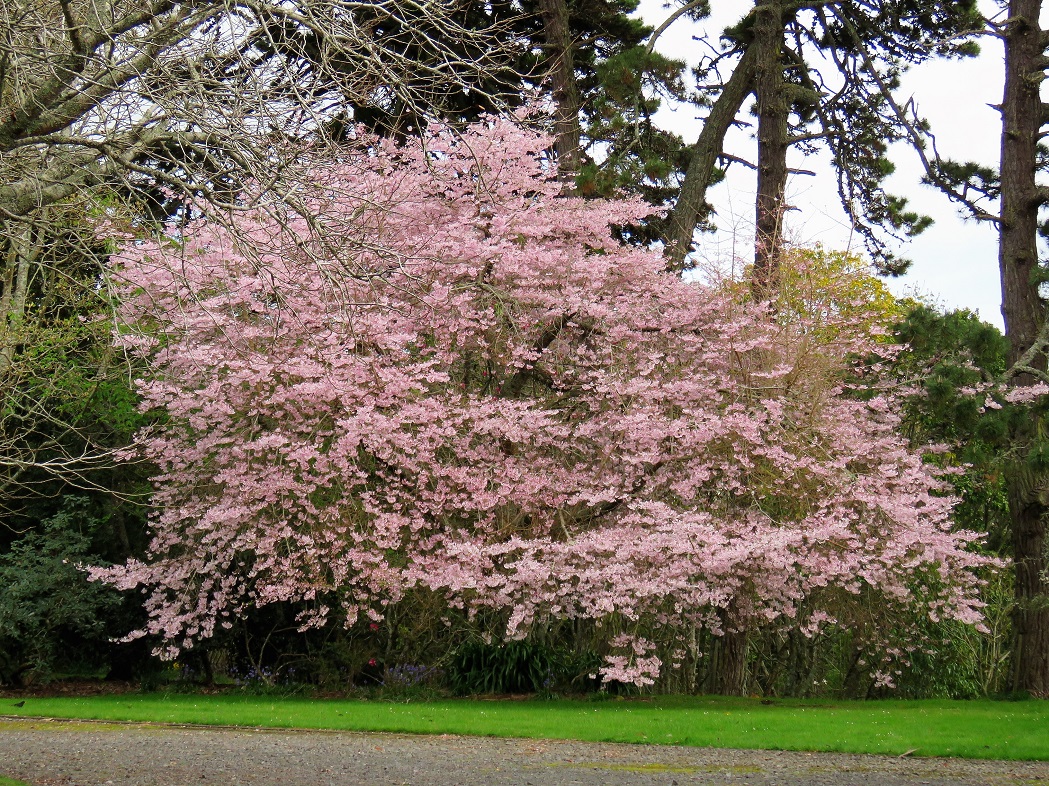
Fallen cherry blossom petals on a pond in the wild North Garden

For overseas readers, our highest level of lockdown, level 4, was one of the tightest lockdowns in the world. Level 3 sits at what most other countries called their lockdown so still stringent. We are in level 2 here which means practicing physical distancing, signing or scanning in and out of shops, adjusting to the thought of wearing masks – and a high level of personal anxiety. So pretty much the state of most of the world. It is tough when only a few days ago, we thought we had left all that behind us.

Floral skypaper

It is still early days in the pandemic. There is so much we do not know. My tolerance for the strident voices calling for opening the border, ‘learning to live with the virus’, returning to the old normality for the sake of businesses and The Economy (caps deliberate) is less than zero. There is no ‘old normality’ anywhere in the world and we had better get used to that for the next year or two at least. It is not locking down that is damaging business; it is Covid19. Business can not thrive in a situation with rampant Covid just as most can not thrive under lockdown. The choice is of an open business environment with uncontrolled community transmission, sickness, death and a very high level of anxiety and fear in the population or going for a safe but limited environment that is Covid-free most of the time. It is a stark choice but we have seen how that latter option works and I am happy to back that as the lesser of two evils.

I wish I could share the scent of Rhododendron cubittii in flower

So, we have battened down the hatches again. Like many around the rest of the country, I am grateful to the people of greater Auckland who are cooperating with efforts to stamp out this latest cluster. As I write this, it does appear to be just a single cluster, all connected to one source.

Just an unnamed seedling in the wilder reaches of the garden

But the seasons and the plants are Covid free. It is wonderfully reassuring that the environment continues on its normal cycle even as the human inhabitants can not.
I brought home samples of three options for laying the paths in our new summer garden. The palest option is crushed limestone. While it is not as starkly white as some I have seen, I think we have decided it will be too bright, given we are going to have large areas of it. I am okay with the darker option which is largely crushed shell, though it is a little darker than I wanted. The middle one is a mix of the two and I think we will try for that one. All will compact down to give a fairly smooth surface. They are used widely on farm tracks and cattle races because they compact and don’t have sharp pieces to damage the hooves of livestock.

Self-sown nikau palm to the left of the vireya rhododendron

I retrieved this vireya rhododendron from a neglected area at the back of Mark’s vegetable garden and moved it into the Avenue Garden, where I was redoing all the underplanting two months ago. Working in our woodland areas, it occurred to me that if this garden is ever abandoned and left to its own devices, it would revert to a forest of nikau palms, puriri, kawakawa (pepper tree), tree ferns (ponga), karaka and seedling prunus, I pull out seedling nikau palms by the score and remove every seedling prunus that I come across.

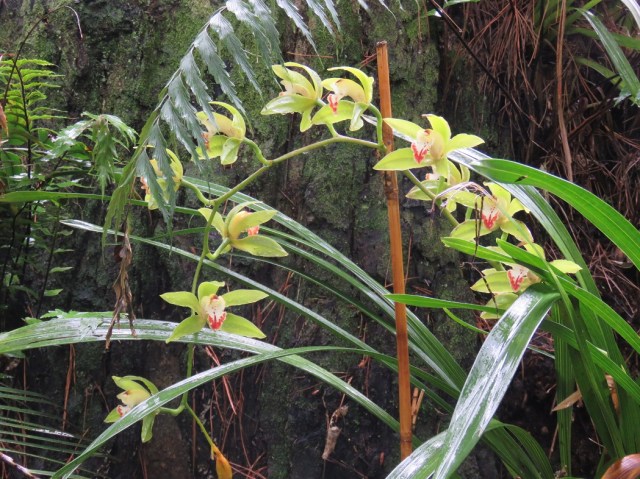
Pretty calanthe orchids in abundance in the woodland areas

In times of uncertainty, there are still flowers and gardens. Kia kaha, readers. Stay safe and stay sane.

Magnolia Burgundy Star opening its red starry blloms.


Of magnolias, mood lighting and more on Cold Water Surf

Just another unnamed seedling

I feel that we are becoming increasingly reclusive in this new world we are facing in 2020 but there are many worse places to become reclusive than here. It is magnolia season.

Magnolia × soulangeana ‘Alexandrina’

It is time for my annual reminders on magnolias.

  • If your magnolia opens with two separate coloured blooms (white first and with deep red just opening in the email enquiring about this phenomenon this morning), you have a case of escaped root stock. The root stock is generally stronger growing and will overwhelm the grafted variety over time, if you don’t remove it. This is not a case where you can have two for the price for one.
  • Ripped petals are usually being eaten by kereru, sometimes rosellas in northern parts of the country. Kereru are a protected species, rosellas are a gaudy Australia export so not.
  • Buds which fail to open or only produce distorted, misshapen blooms have almost certainly been eaten out in the bud stage by possums or rats who like to nip out the centre. Mark carries out extensive trapping and shooting to keep these pest numbers low here.
  • If you are into spraying your lawn in spring, do it now. If you delay, the faintest whiff of spray drift as magnolias start to open their leaf buds can cause significant damage to the new foliage which will be unsightly until the leaves drop next autumn and, over time, can weaken the tree.
  • It might be true in the UK that you can’t move magnolias – or it may be a factoid – but here in NZ we can move magnolias and we have done it many times. Just make sure you get as big a root system as you can manage and if the root system is small, prune the tree hard.

Lanarth at the top, Mark’s purple below

We have been hesitating about whether we can fairly describe Mark’s selection (as yet unnamed) as purple. Magnolia campbelli var. mollicomata ‘Lanarth’ is widely seen as setting the standard for purple magnolias. I finally got around to lining up petals of Mark’s purple and Lanarth petals to compare. Magnolias are variable so I picked up the darkest petals of Lanarth I could find and it seems that the colour of Mark’s measures up.

Top to bottom: Lanarth, Mark’s purple, Vulcan and Burgundy Star

Just out of interest, I added in Vulcan petals. Vulcan was the first of the new generation magnolias 30 years ago that moved into red tones, rather than purple. The few at the bottom are of Burgundy Star, the next generation of reds bred from Vulcan. Mark is getting to cleaner reds.

More on Cold Water Surf (or any other washing powder) and moss. You can, and I have, use it on moss in the lawn. We accept moss but preferably the fine forms. I am not a fan of liverwort and some of the coarse mosses and Surf works on them.

Hard surfaces? Hmmm. It works. It kills the moss. If all you want to do is to get rid of slippery growth, it may be fine to sprinkle it generously, wait for rain and then use a stiff brush a few days later. I want these pavers back to their soft gold so I tackled these with a wire brush but it is going to be a lot of hard work to restore the whole area. I think I will resort to the water blaster (jet washer).

Finally, a few mood shots from this week. We do not generally get mist or fog so this morning mist gathering in a lower area seemed appropriately mystical to me.

On a grey morning, a few shafts of rising sun broke through to illuminate the magnolia in the distance. It was a somewhat startling sight.

Fairy Magnolia White

More often, this clarity of light is the norm for us, even in winter. That is Mark’s Fairy Magnolia White which really does have an exceptionally long flowering season.