About climate change

I am not usually one for sharing social media memes but today, I make an exception. They say far more succinctly than I can what needs to be said about climate change.

Thank you Joel Pett. Mark is of the view that it matters not one whit whether people believe in climate change or not because only an idiot could think that we can continue trashing the planet as we are and not suffer catastrophic consequences. We MUST change our ways. Urgently.

And for those of you who find it all too much, thank you Olga Evans.

We have made major changes in our own lives here, to reduce our carbon footprint and consumption. The issue that worries me at a personal level is air travel, exacerbated by being a New Zealander. For us it is four hours and two flights to get over to our children in Australia (all our three children live in different east coast Australian cities), about twenty five hours in the air to get to the UK or Europe (and another twenty five hours to get home again). That is one where I am pinning my hopes on new technologies to reduce the impact of flying.

In the meantime, I am listening to the young people who are mobilising on this matter. I would much rather listen to them than to older folks (mostly, but not all, old men) who last studied science back in their high school years fifty or sixty years ago but who have found some dodgy website that backs up their complacent world view, no matter what the majority of the world’s scientists are saying.

Change is coming. Massive change. The planet does not care whether you or I believe in climate change. The longer we insist on continuing the status quo, the more shocking that change will be.


A week of determined gardening

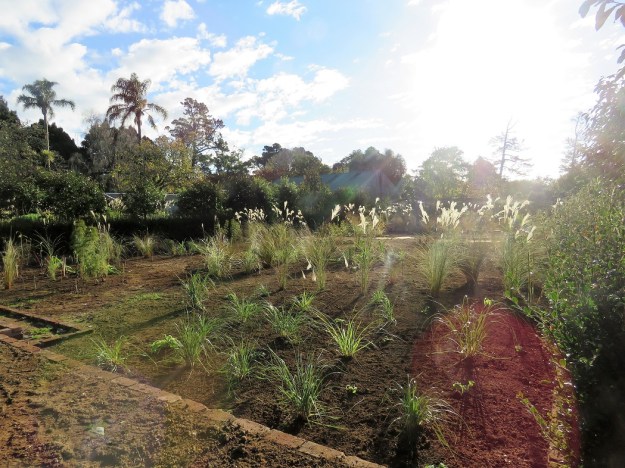
The first half is now all planted

I have not been shilly-shallying around. The first half of the new court garden is planted and I have started on the second half. This is not light work. Mark has rotary hoed and I follow up with raking the area out and getting clods of roots out, as well as squishing the abundance of grass grubs. It has only just occurred to me that had I transferred all those grubs to a jar instead, we should have had enough for a meal of alternative protein. Whether grass grubs are delicious when tossed in garlic butter in a hot pan will likely remain mystery, however. I am not that intrepid.

Starting on the other half – the pressure is on to get it planted before winter sets in 

I describe this as romantic chat between two wheelbarrows (me being a two barrow gardener)

The rush is on because our soils are still warm and temperatures are mild, despite it being late autumn. I am hoping for a few more weeks of grace so the plants can start forming new roots. You would not want to be doing it this late in the season in colder climates or places with heavy soil where the plants would languish in wet, compacting ground. With our excellent drainage and friable, volcanic soils, we have much more leeway.

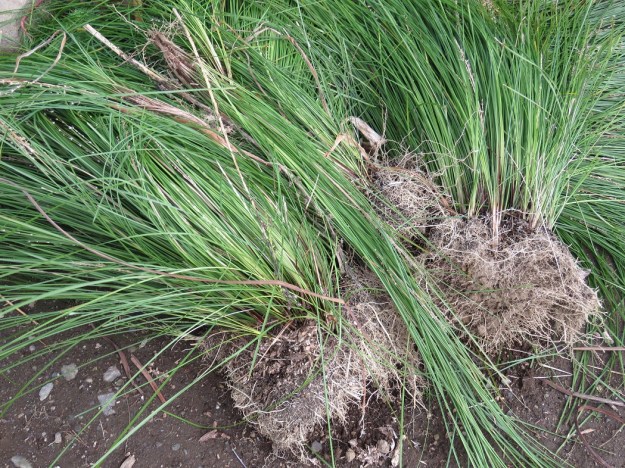
My plantings are neither complex nor detailed. This is a novel experience here. Most of our garden is highly detailed so going with sweeping plantings of large growing perennials is very different and way easier to put in. Because I am digging and dividing from other areas to get the plant material, it is heavy work but it means I am able to put in sizeable clumps at finished spacings. Had I bought the plants, it would be different. When you are starting with nursery-grown plants in small 10 cm pots, it is really difficult to envisage their mature size and the instinct, always, is to over-plant to get a quicker effect. That of course makes for more work in the future because that over-planting will need thinning sooner, rather than later.

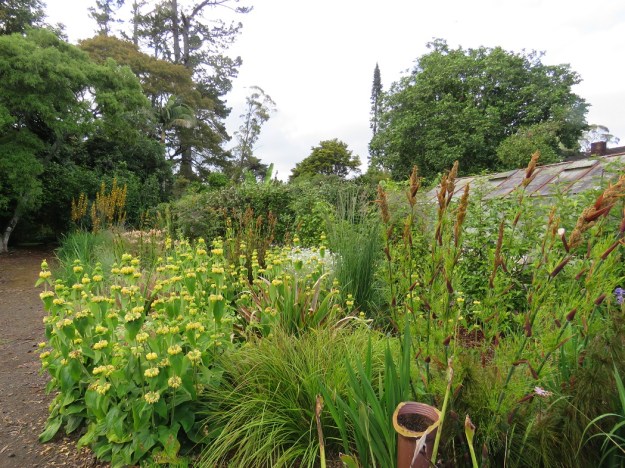
B I G salvias for autumn colour, though I am having to cut back early because of transplanting them

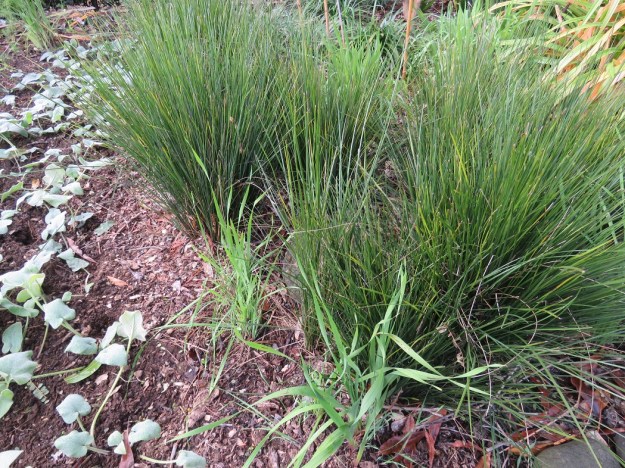
I planted the waves of foundation plants first, using just seven different plant varieties (5 grasses, Astelia chathamica and Elegia capensis), added the blocks of a few additional plants I wanted to use (two black flaxes or phormium, a block of rushes that I have lost the name of already, the giant Albuca nelsonii and a plant of Carmichaelia williamsii which has had a hard life but I hope will survive and thrive) . Finally, I added the flowers. At this stage just the giant inula (likely Inula magnifica), big salvias for autumn flowering, pale foxgloves and Verbascum creticum. I hope I have at last found the right spot for these botanical thugs. The plant selection is fairly typical of the way we garden in that it will end up around 25% native plants integrated with exotics. We have never gone for the deliberate “native garden” but instead select native plants that will work in a mixed situation.

The discards of earlier generations to the left, our plastic generation to the right

There are times when working in the garden here takes on the flavour of an archaeological dig. This used to be a farm and farmers were not exactly renowned for taking their rubbish to the dump. It then became an outlying area of the garden in Mark’s father time, before becoming nursery in our time. I always gather up all the non-biodegradable rubbish as I garden and this haul interested me. Given that our nursery years coincided with the widespread switch to plastics, I was surprised that the volume of modern plastics and synthetics (on the right) was not greater. We must have been tidier than I thought. On the left is the older rubbish. Metal, glass, broken china and some pieces of clay pots, basically. There is quite a lot of broken horticultural glass there. Felix was doing his home propagation back in the days of terracotta pots and wooden seed trays covered with sheets of glass. While the broken glass would have been hazardous in the beginning, time has dulled the edges. Unlike modern plastics, I don’t think there is evidence that glass and shards of pottery enter the food chain and pollute the oceans. In this time when there is growing concern at plastics in the environment, we are relieved to be out of the nursery industry – a business that is now built on extensive use of plastics, some of which may be reused but precious little of it will ever be recycled.

Dahlia imperialis towers some 3 to 4 metres high against the autumn sky

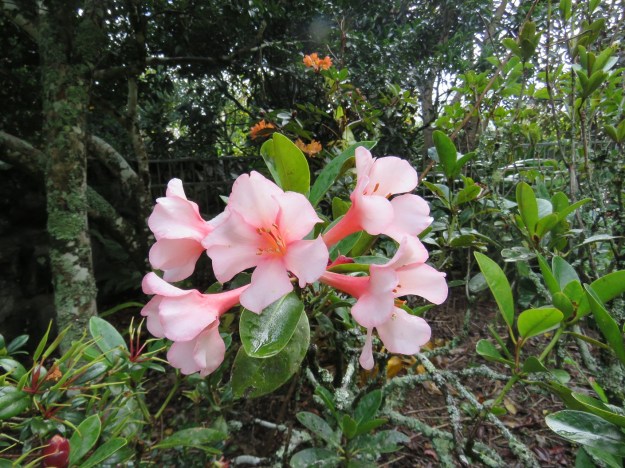
Finally, because I read a brave comment in a southern blog this week boldly declaring, “Even though it’s May, that most dire of months for gardens in the southern hemisphere…” (waving to my friend, Robyn Kilty) , I offer you three flowering plants this week. All are big, rangy, brittle, frost tender and come into their own just as the autumn storms hit. But are they not lovely?

This evergreen tree hydrangea is even larger. Now, I understand classified as a form of H. aspera

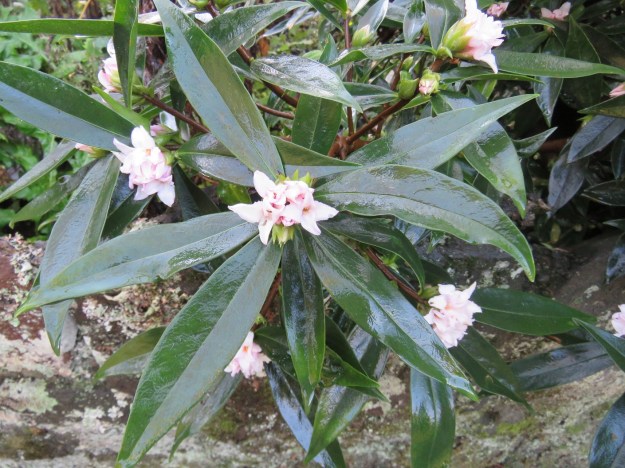
And the luculia season has started, bring us sweet scent. Luculia pinceana ‘Fragrant Cloud’.


The ornamental oxalis

The white form of Oxalis purpurea – the best of them all

Back in our nursery days, we had a large range of ornamental oxalis. I see in our old mailorder catalogues that we offered over 20 different varieties that we had in production at the time and I wrote extolling their autumn merits for several publications.

Twenty years on and the oxalis collection has refined itself down. It is the difference between gardening in containers and gardening in the soil. Some of those varieties were so delicate and touchy that we have lost them. Others needed to be kept confined because of their invasive proclivities. Some flowered prettily enough but their season was so short that it was hard to justify their place in the garden. I decided years ago that I was not going to fluff around with plants in containers. We have quite enough garden with many different micro-climates. If plants couldn’t perform in the garden, I didn’t have the time or inclination to nurture them in controlled conditions in containers.

These days, the oxalis we still have are the stand-out performers (and a few of the nasty weed ones that most of us battle – particularly the creeping weed which I think is Oxalis corniculata). The star has always been and still is the beautiful, well-behaved Oxalis purpurea alba. Large white flowers in abundance over a long period of time and not invasive. At this time of the year, I am more than happy to use it as ground cover in sunny positions. Oxalis flowers don’t open without the sun so they need to be in open conditions.

Oxalis purpurea nigrescens

O. purpurea is a variable species. The striking red-leafed form (O. purpurea nigrescens) with pink flowers comes a bit later and is invasive so needs to be kept confined. We also have a strong-growing (somewhat invasive) green-leafed form with very large pink flowers which is worth keeping and also has a long flowering season. Back in the days, I recall more than one person telling me that there was a red leafed form with the large white flowers but I have never seen it so I rather doubt its existence.

Oxalis luteola as runner-up in my best garden oxalis list

The standout yellow is Oxalis luteola. It, too, is well behaved and forms a gentle, non-invasive mat that flowers for a long time in mid- autumn, combining well without competing with other bulbs like the dwarf narcissi that are in growth but won’t flower until late winter and early spring. It leaves the rabbit-ear Oxalis fabaefolia in the dust for length of flowering time. Both have large, showy yellow flowers but the latter’s flowering time can be measured in days rather than weeks.

Oxalis massoniana

I am very fond of little Oxalis massoniana with its dainty apricot and yellow blooms but it needs a bit of nurturing to keep it going. The popular old candy-stripe O. versicolour is happy left to its own devices in the rockery but will not come into its season for a few weeks yet. It is the only one I know that looks more interesting when its flowers aren’t open because the striped buds disappear into a fairly ordinary white flower on sunny days.

I have hung onto the strong-growing O.eckloniana for its large lilac blooms but I keep it confined to a shallow pot sunk into the rockery. I could rustle up a few of the others from around the garden, like O.hirta in both lavender and pink, O. bowiei, O, lobata, the unusual double form of O. peduncularis  and O.polyphylla but they are not the star performers that luteola  and purpurea alba both are.

If you are into container gardening, a collection of different ornamental oxalis species give interest on a sunny terrace or door step from autumn to mid-winter. I saw somebody listing a whole range of different oxalis on Trade Me at one stage. In fact, it looked like somebody had bought our full collection all those years ago and kept it going so they are still around. If somebody offers you O. purpurea alba or O. luteola, don’t reject them just because they are oxalis. They are worth having.

Oh look! Here is a little display board I prepared earlier of under half of the oxalis that we used to grow

Planting the new court garden

A big, blank space. Bamboo stakes are used to define the areas to be be cultivated and to get the curves right. 

In the world of gardening, I am not sure that there is much that is more exciting than starting planting a new garden which has been years in mental incubation. Indeed, I am surprised how positively thrilling I am finding it to be out in the space actually putting the plants in.

It is a blank canvas, what we refer to as the court garden, on account of it looking like a tennis court when it was just an open space. We have talked about it a lot, stood and looked at the space and mentally envisaged the possibilities – which were pretty much endless – for this open, sunny area. Having narrowed down the plan, I set about refining the plant palette and building up the material to go in. As Mark has observed in the past, ours started as a poor man’s garden. His father could not afford to buy in all the material to plant up the large garden across several acres so applied himself to raising a lot of it. These days, rather than a poor man’s garden, it is an economical couple’s garden. It would cost a lot to buy in all the plants needed to fill over 450 square metres and they would arrive as small specimens. I have been gently building up plants for a few years now so what are going in are reasonable large divisions. Instant effect, Mark calls it.

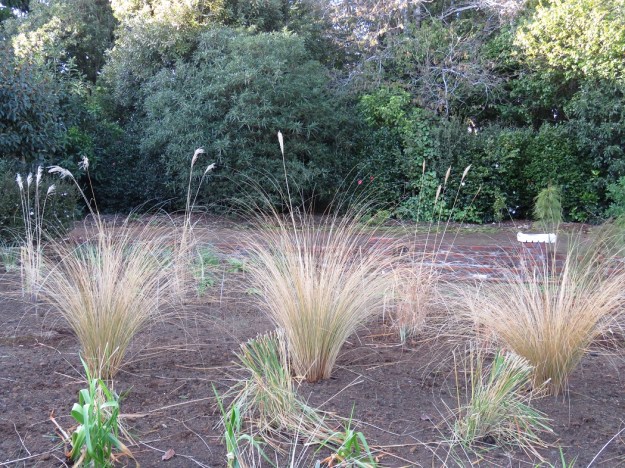
This is to be my contemporary grass garden, inspired by the work of Christopher Bradley-Hole at Bury Court  but different. Immersive, not pictorial, to coin the phrase of English writer, Tim Richardson. It is set a little lower than surrounding areas so we step down into it to be surrounded by the movement of large grasses, shoulder or head high, planted in waves. A prairie on steroids perhaps? It is not designed to be viewed from a vantage point so much as to be experienced within.

Doryanthes palmeri (which will grow much larger) with Stipa gigantea

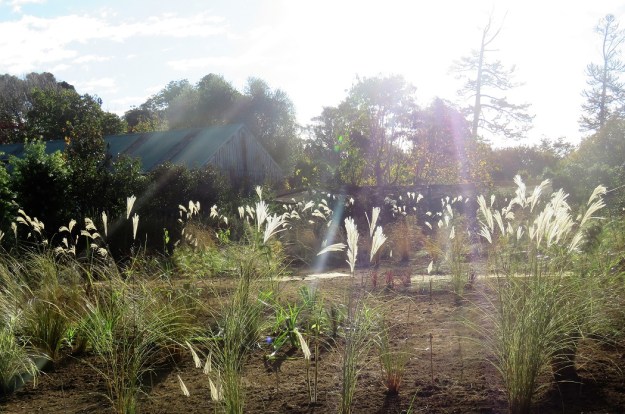
I have planted the first waves using Miscanthus ‘Morning Light’, Stipa gigantea, Chionocloa rubra and Calamagrostris ‘Karl Foerster’. And I have found a suitable space for Doryanthes palmeri. The next two waves will be Elegia capensis and Astelia chathamica. I do need to buy in about three plants of our native austroderia, commonly known as  toetoe. For, as Mark says, what is a grass garden in New Zealand if it lacks toetoe? I have sufficient plants for a wave of Chionocloa flavicans (which looks like a smaller toetoe) but I am not pinning my hopes on that because it seems to be like Christmas dinner for the rabbits and I am learning that I must garden that area with the rabbits, rather than fighting them all the time. It is one of the very few plants I am using that we have not trialled and come to understand already.

Moody miscanthus in the autumn light . It will be on a much larger scale in the new garden

Once I have planted all the waves of grass, then I will paint within with the few flowering plants I plan to use – the giant autumn-flowering salvias in yellow and red, tall yellow Verbascum creticum for spring, the very tall white nicotiana we have seeding around the place, maybe foxgloves in white and fennel. Nothing small, nothing detailed, no bulbs except the huge Albuca nelsonii. I expect the large evening primrose to find its way into the area of its own accord and I am sure Verbena bonariensis will seed down from the neighbouring borders. But the flowering plants are all secondary to the movement of the grasses.

Mark is rotary hoeing. The vintage piece of equipment in front is his prized Planet Junior that he uses often.

For those of you who are interested in the mechanics, Mark killed off the weeds and dead-headed the nasty carex we have through there to reduce future seeding. He is currently rotary hoeing the area. I drew up a planting plan and expected to be out there with my large piece of graph paper, keeping fairly closely to that plan. But in practice, it is just a guide. My spacings on paper were too close. My eyes on the ground are better than a paper plan. I rake out the rough-turned sods and then lay out each wave and sometimes I dig the plants back up again to move them a little to change the angle or the spacings. I am constantly mindful that this must be a low maintenance area. We have quite enough high maintenance areas already.

We won’t mulch immediately. Because our soils are so wonderfully friable, we will allow the first couple of flushes of weeds to germinate and rake them off. Weed control from the start is critical, especially with big grasses. Only then will we mulch. I have decided against the fine gravel mulch I had thought I would use. I am sure I will have to refine the plantings at least once in the early years and don’t want all that gravel incorporated into the soil. Neither do I want sharp edgings to the paths (which are about 1.8 metres wide to allow for plant flop). I want it to be more seamless so the current thinking is that we may opt for a granulated bark mulch which can be spread across both garden and paths. That we will have to buy in by the truckload.

We should see results this summer in our soft growing conditions and by the second summer, it should be hitting its stride. I am optimistic. Sure, it is hard work but if you are into active gardening, this is probably the peak of fun.  The culmination of years of thinking and planning and something entirely different. I will keep readers posted on progress.

Postscript: I am a dirty-kneed gardener. Mark laughs at me and regularly tells me I should not be allowed indoors. Indeed, I often shed my trousers in the laundry before I enter the house. Don’t tell me about knee pads. I have tried them and they don’t suit me. I have an abundance of kneeling pads but unless it is wet, muddy and cold, I find it easier to wash my clothes than constantly re-position the kneeling pads.

What I don’t understand is how Mark stays so clean, despite gardening as much as I do. Well I do know. He either uses long-handled tools or squats. My gardening mother stayed clean by always bending. With dodgy knees and a dodgy lower back, I kneel. Kneelers with dirty knees unite, I say.

Autumn is icumen in

It is indubitably autumn. Not only do the autumn bulbs tell us this, but the night time temperatures have dropped considerably. It is the time of the year when we have our annual debate about whether it is time to start lighting fires yet.

We live in relatively large house. Not, I hasten to add, large by modern McMansion standards. We may have five double bedrooms (some almost palatial) but we lack the requisite six bathrooms of such modern, aspirational mansions. Lacking a maid or housekeeper, I am not perturbed by their absence and am happy to make do with just two. But we also lack the heat ducting systems that go into modern houses. We heat the entire house with wood collected from around the property. This is by choice. I don’t want a heat pump because I don’t want the humming and whirring that usually accompanies them and we haven’t spent a lifetime of trying to keep our power bills low to give in and splash out now. Not as long as we can manage the firewood.

The 1950s with wetback. Elderly Spike to the left and Dudley to the right

We light two fires. The open fireplace in the dining room is not an efficient heat source by modern standards but it has a wetback and we must be one of the few households whose power bills actually drop in winter because of that hot water.

The dogs prefer the Big Grunter which never throws sparks at them

What we call the Big Grunter in the hallway is a far more efficient heat generator, being of Canadian design where they are used to much colder winters. It heats the cold side of the house and the entire upper story to the point where we can be too hot as a result. The dogs don’t mind. They have their winter daybeds beside the Big Grunter and are happy to snooze away cold winter days. On particularly bleak days, I have seen Mark light that fire in the early morning for the benefit of the dogs.

It is the pine cone and faggot time of the fire season. This does not count as burning our way through the winter firewood supplies. It is midway territory. We may be one of the few households with a designated pine cone shed. What we lack in bathrooms, we make up for in sheds here. The volume of pine cones depends on whether one of our massive pine trees has fallen in the year. None have in the past fifteen months so it is just the cones I have picked up from the gardens and lawn but it should be enough to get us through the shoulder season.

I could do with a faggot binder in my life but I have never seen one in NZ

The enormous eucalyptus at our entrance provides a near endless supply of faggot material all year round

I have decided to reclaim the word faggot from its ugly, homophobic abusive connotations. Besides, what other word can be applied to the gatherings of gum twigs and bark that fall in abundance? Lacking the historic faggot bundler that I spotted at a stately home in Yorkshire, I pack these for kindling into sacks and store them for this time of the year.

It is not cold enough for this daily ritual yet

When winter comes, Mark will take over firewood duties and cut kindling and bring in four baskets of wood each day. Until that time, we will burn our faggots and pine cones and pretend that we haven’t really started to seriously light the fire yet. What do we burn? Anything and everything that falls or is expendable and generates good heat – pine, prunus, schima, camellia and more.

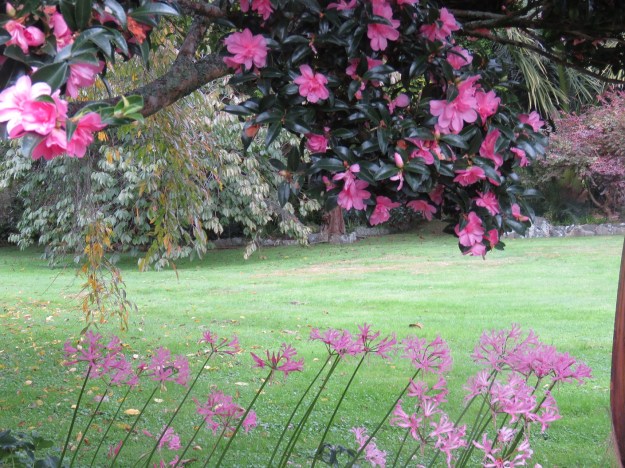
I set out to gather some of the autumn bulb flowers for the top photo but heavy rain and a grey morning meant pickings were limited mostly to Nerine sarniensis hybrids and Cyclamen hederafolium with just a couple of oxalis flowers and one lilac Moraea polystachya open.  I shall return to the oxalis collection another day.