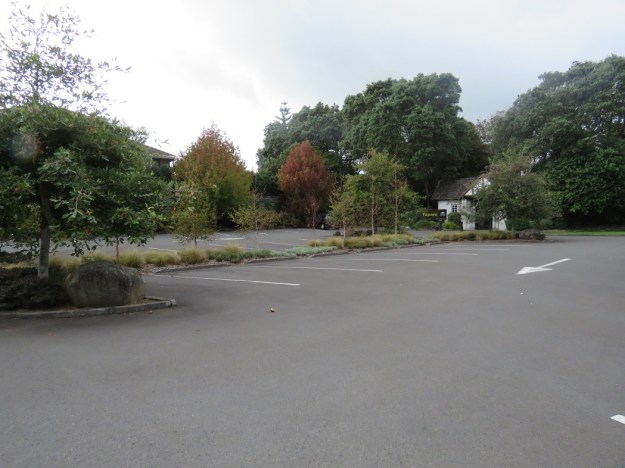
‘A sense of arrival’

A sense of arrival. But empty. 

Mark and I have longstanding running jokes about garden car parks. This, I admit, may not be a common source of amusement to many others. It all came about when we were recruited to a small group in an effort to preserve the spirit of the trust gardens being taken over by one of our local councils. It was not a positive experience in any way, shape or form. In fact it scarred most in our small group of maybe eight or ten leading private gardeners. Our involvement was not welcomed. Not. In. Any. Way. We were left in no doubt of that. But the experience gave us the car park jokes.

This is because, in that typically bureaucratic way of local government in this country, the council commissioned many expensive consultants’ reports and convened a TAG – a technical advisory group which rather appeared to be hand-picked to give them the outcomes they wanted. I can’t recall offhand how much they spent on these reports but I am pretty sure it was into the hundreds of thousands of dollars. And one theme that came through repeatedly was the need, apparently, to establish a sense of arrival at the gardens.

That sense of arrival was, it appeared, mostly about car parking. For what do you see first when you arrive? The car park. All three trust gardens ended up with pretty detailed car parks as a high priority.

We have done a fair amount of garden visiting in our time, including overseas and have seen some pretty rudimentary, though functional, car parks. When an official from that council went on a fact-finding mission to look at the infrastructure of major UK gardens, I wanted to comment to him on his return, “You must have been very disappointed in their car parks” but Mark wouldn’t let me. My recollection is that the car park at Hidcote was modest, at Great Dixter it was informal and at Sissinghurst, we were simply worried about whether we would even find a vacant space.

The car parking area at Giardino di Ninfa

The most gorgeous car park of all was the grove of trees at Ninfa, south of Rome. Ours was the only car on the day we were there because we had the place to ourselves. I understand on their official open days, the crowds are such that one shuffles along in line so presumably the car park is chocka block. We have one tree in our car parking area – Prunus Pearly Shadows – and it is a bit surprising that people manage to reverse into it, given it is fairly obvious. I wonder how much rear bumper damage happens at Ninfa.

From memory, I think we worked out that we can park 27 cars in our car park area, if we manage it carefully. Prunus Pearly Shadows in the middle is apparently a hazard. Several drivers have failed to see it. 

We have a small car park because when we open the garden, it is a safety matter to get the vehicles off our dangerous road. We know quite a bit about the vagaries of parking habits. In fact the general public shows a lamentable lack of common sense when it comes to parking. But we did soon learn that if we parked the first car in the right place at the right angle, others followed suit so we would sometimes put our own car out in the car park to set the tone for the day. This is why you often see car parks sealed with painted lines – the supermarket look. Of course, if you want painted lines, you have to seal the area. As soon as you put in large areas of seal (and cars take up a lot of space, camper vans and coaches even more), you also have to put in drainage systems to deal with the run-off because there is no ground absorption. The aforementioned council rose to this challenge with a very tidy set-up which I bet was expensive. But there is nothing environmentally friendly about large expanses of seal. Nothing cheap, either.
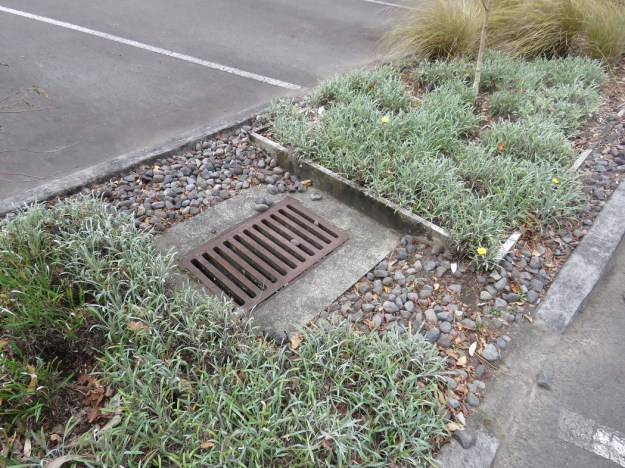
Dealing to the storm water in the somewhat grand but indubitably stylish car park at the council garden

A more modest approach to dealing with car parking in unsealed areas at Pensthorpe – a busy tourist attraction in Norfolk

I once asked Mark what he thought gave the greatest sense of arrival at a garden. “A FULL car park,” he replied. It is hard to argue with that.
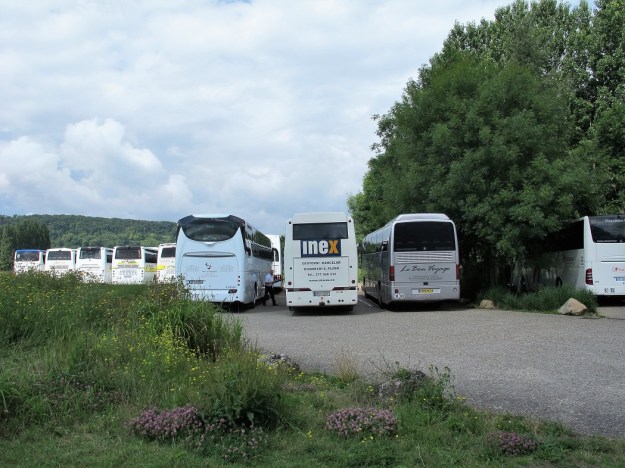
Part of the coach parking area at Monet’s garden in Giverny. Those coaches were parked up to three deep.
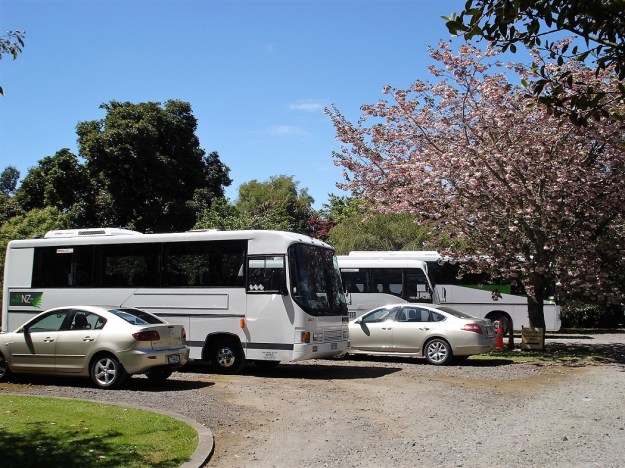
We are more modest back home. But the retired senior government minister who came in saying “It’s just like Sissinghurst” (referring to the trouble he had finding a car park), endeared himself to us forever, despite his subsequent and very public fall from grace.
“But it’s not native so it is expendable”

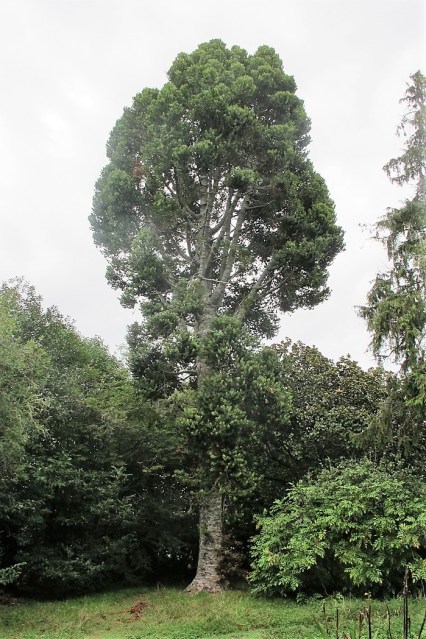
The kauri in our park – a high value native tree beyond reproach but it has taken over 60 years to get this size and is not suitable for most urban settings

I can’t tell you how irritated I get by this sentiment and I have seen it trotted out on several occasions recently. I get irritated because it rarely reflects a thoughtful position. And when you drill down, it only applies to trees. The speaker is just as likely to be drinking tea, coffee or wine – all from imported plant material. Indeed almost 100% of food we eat in this country comes from imported plants originally, even if it is now grown in the backyard. All our fruit, all our vegetables. All our meat is raised on pasture that is comprised of exotic grasses. Our grains are all imported species, as are  our grazing animals. Even the dominant earthworms include many foreigners.

The vast majority of flowers that adorn our gardens or we buy to bring indoors to beautify our environment are of foreign origin. Our forestry industry is built on imported plant species.

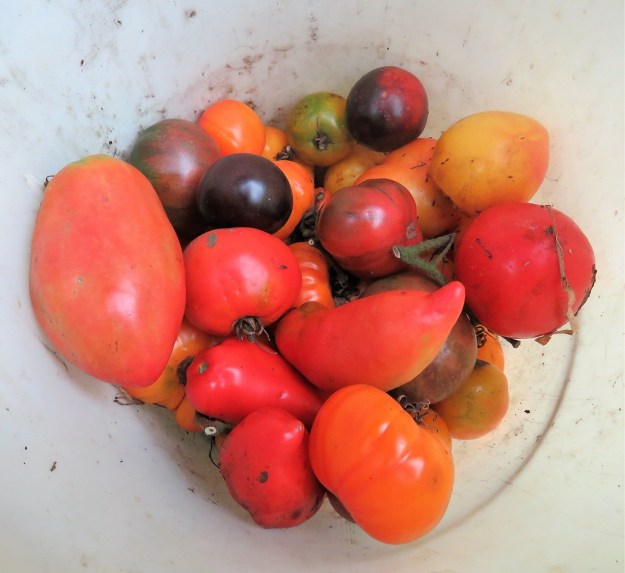
All our foods have been imported at some stage of our history. Mark grew a fine range of tomatoes this season – selections from around the world

Most of us live in very heavily modified environments and lead lives that would be totally unsustainable without imported plant material. This is not to say that we should not value and defend the very few pockets of land which remain with vestiges of original vegetation. These are of high value and we should be trying to protect, extend and restore these. But your suburban street, small holding or farm is never going to achieve native plant purity. And only planting dwarf fruit trees is not going to do anything to modify climate change or produce much of the oxygen that we breathe.

Alas, we are also a nation that, in the main, does not value trees and is ready to fell them at the first opportunity. “It is not a native,” is the justification often put up by the chainsaw brigade. (Or, if it is a pohutukawa, “it is a weed”!) That does not mean it is expendable and of no value. The world has even more beautiful trees than delicious food crops. And it takes a lot longer to grow a mature tree than a lettuce or basil plant. Some of those trees will adapt and grow in conditions where few of our native varieties will survive. Most of our native trees evolved in a forested environment, used to growing in company. There are not that many that will adapt to being single specimens or even a row of trees on an exposed coastline or a windswept road verge.

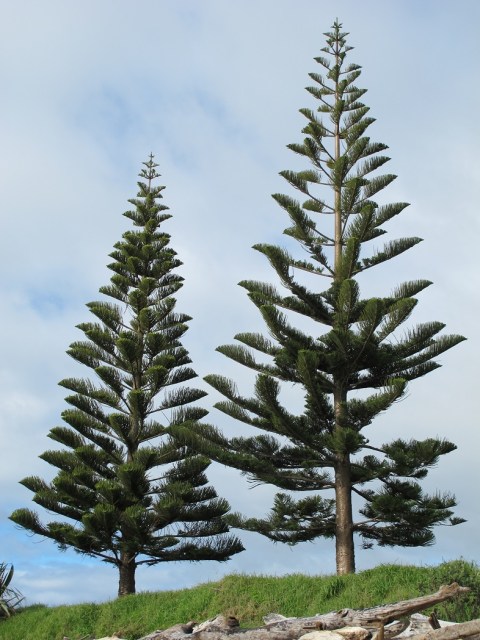
The much maligned and derided Norfolk Island pine

Particular contempt is often reserved for the Norfolk Island pine which does very well in many parts of New Zealand, looking handsome and healthy, even on exposed coastlines. Stop and think for a moment, before you reach for the chainsaw with contemptuous dismissal of this tree. It comes from the same plant family as our native kauri. It also originates on Norfolk Island which is about as close as any ‘foreign’ land gets to us.

A variation on this line is “I only grow plants that are native or edible”. Oh, okay. All of the above arguments apply. It is fine for you to declare that you only want a garden where every plant is either native or edible. Just don’t espouse this viewpoint as though it is the higher moral ground because it is actually quite a naïve position. Lawn and grass should of course be banned in such a garden, unless you are going to locate and harvest one of our native grasses.

What the world needs is more trees to purify the air, to provide oxygen, to enhance eco systems and the environment, to slow down erosion and to modify climate change. I understand that some people do not see any aesthetic value in trees. I don’t agree with that view but I see evidence of it so I must acknowledge that not everybody sees big trees as being something of beauty. But it is no accident that wealthy areas of cities are often referred to as ‘leafy suburbs’. Pretty much without exception, they have established trees to soften the hard concrete and sealed urban landscape. There are not many New Zealand native trees that will tolerate, let alone thrive in the harsh, urban landscape. Rule out exotic trees and all we will have in cities are nikau palms, kowhai and pohutukawa in northern areas.

The problem with trees is that they take 20 years to get established and upwards of forty to start reaching maturity. Yet they can be felled in minutes. But, still many argue, if they are not native, they are of no intrinsic value.

A life without magnolias would be unthinkable for us, but they are anything but native

The making of gardens, old and new

I came over to my office first thing this morning, prepared to put in a solid hour or two on a tax return which has a deadline of Wednesday. GST, which is our sales tax. It is my six monthly ordeal by boredom. But the early light was so appealing that I grabbed my camera and was diverted to way more interesting thoughts.

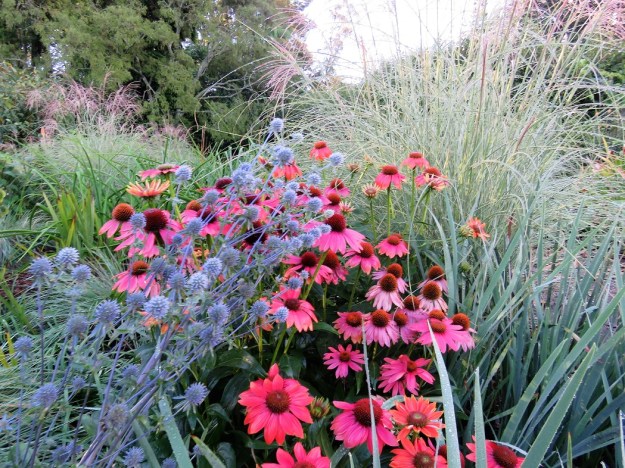
Echinacea, eryngium and miscanthus in the new grass garden 

I only started planting the new grass garden maybe ten months ago but over summer it has filled in and it is looking remarkably well established. Not ready for the grand photos of the whole scene yet but it is coming together and bringing me great delight. Reassuringly, given the amount of effort that is going into it, I am now confident it will work.


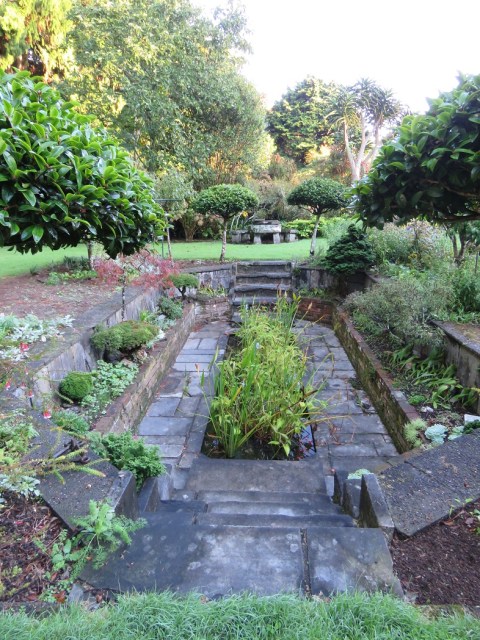
The central sunken garden is to remain

The decision to strip out the central borders of the rose garden was more recent. It was Tony Murrell, friend, Auckland-based designer and garden media personality, who suggested last October that I strip out these beds and I have now reached the point where I am fairly confident he was right. The central sunken garden will remain as the landscape feature and I have fully renovated it. We have lost more treasures than we have kept in this highly detailed area but the pleione orchids have thrived, to the point where I thought I should rename it the pleione garden. Mark’s father dug this area by hand back in the early 1950s and lined it in granite and marble.

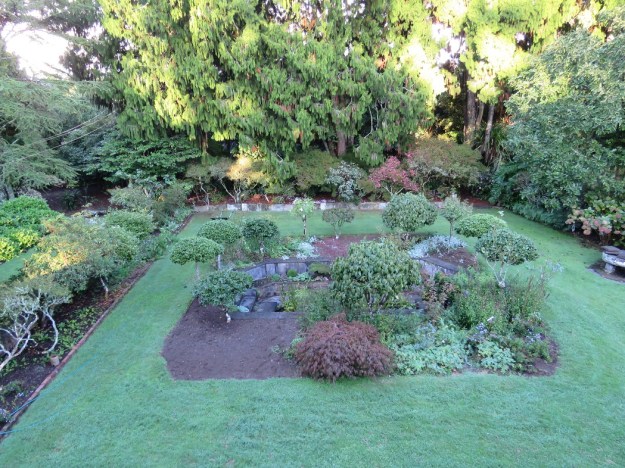
The outer concrete edging in the centre is to go and the area will be grassed around the remaining shrubs

The feature dwarf camellias, of which there are eight, and two dwarf maples, are to stay. They give some botanical interest, form and character but the outer edging in concrete will be lifted and removed and the area grassed. It should be a crisper look to an area that I have never enjoyed gardening. I knew I had to do something because I averted my eyes from it for the better part of last year and possibly much of the year before. I have never enjoyed working in this area.

I now realise if there is no pleasure in gardening a certain area, then something is wrong with either the concept or the execution. It is not for want of trying. This central area has had at least three major makeovers done on it in the last twenty years and none of them have really worked. This fourth one is the most radical. Gut most of it out and make it simpler and visually stronger.

We describe the new caterpillar garden as a blank slate but we are still working around a beautiful Podocarpus henkelli and a grapefruit tree. We never get totally blank slates here.

Gutting a garden is a major task unless you are willing to scrap all the plants, which is not our way at all. No. I must lift and relocate most of them and that is a detailed job. A few went to the grass garden – irises, liriope and eryngiums, mostly. Most are going to another new garden which we loosely refer to as the caterpillar garden. This is because Mark has laid out the structure in dainty little Camellia microphylla (just coming into flower now) in the form of the basket fungus, so based on pentagons. After it has flowered for this season – and it has a very short flowering season – he plans to start clipping it into the shape of an undulating caterpillar. For this idea, we acknowledge leading UK designer, Tom Stuart-Smith.

Camellia microphylla for the caterpillar hedging. And colouring in some spaces with blue asters

The design gives separate compartments for planting, somewhat like in-fill housing. We want it simple, eyecatching and easy(ish) to maintain. Mark’s vision is of the central enclosures rising up above the caterpillar shapes in blues and whites and the outside blocks in shades of blue, lavender, lilac, white and a bit of pink but not too much. If you are trying to envisage the scene, the caterpillar garden alone is about 25 metres long and 8 metres at its widest with 5 central enclosures and about 15 outer spaces to be coloured in. It is not for the faint-hearted gardener and we could never afford to do it if we had to buy the plants in. But the gutting of the old rose garden area has supplied many which I have lifted, divided and replanted into compost in the freshly dug new garden area. These are larger block plantings in a far more modern style than we have in the older areas of the garden.

The challenge is to integrate a more modern area into the existing garden so the transition is seamless, rather than disjointed or jarring. It helps that this is a sunny, flat, open area that is by its very physical attributes different to the rest of the garden.

Morning light shining behind the first grape leaf to colour for autumn

We are not into instant gardening. These things take time and we will not be doing the big reveal for another year or two yet. But it is keeping me busy because I am doing most of the planting. I am leaving Mark to worry about the structural elements that still have to go into this area and the small matter of moving the propagation houses somewhere else entirely. It should happen. It just won’t happen in the next few weeks or even months.

I was born impatient but time, experience and age have taught me patience and how to take a longer term view. Mark describes this new garden development as ‘our last lunge’. We want to get it right before we settle down into our dotage. There is no great rush and there is much delight and satisfaction in the process. And really, for us, gardening is an ongoing process, not an end product.

From the crowds of WOMAD to the peace at home

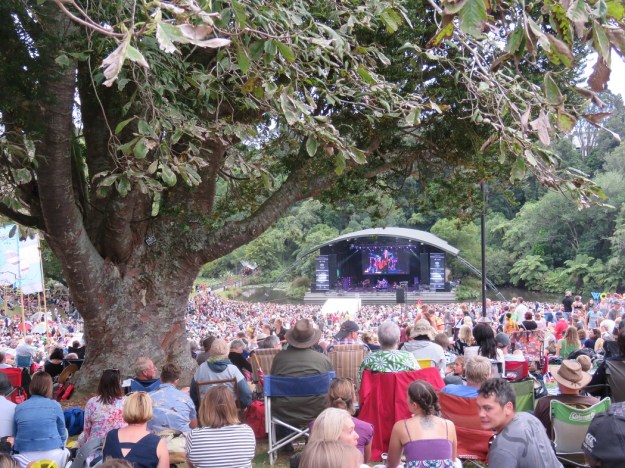
The main stage, known as the Bowl of Brooklands. 

There have been a number of different things happening in our lives lately, so gardening has taken something of a back seat. Instead, I thought I would showcase the area of our local gardens that we know as “The Bowl” and Brooklands Park. For those who have been to New Plymouth, these are the upper reaches of Pukekura Park, a wonderful legacy from a much earlier generation,  close to the centre of the city.

This was WOMAD weekend – the world music festival which travels the globe. It is a huge event for our small city and I wanted to share the beauty of the location which accommodates 3 large stages and 3 small stages, plus all the other accoutrements of festivals.

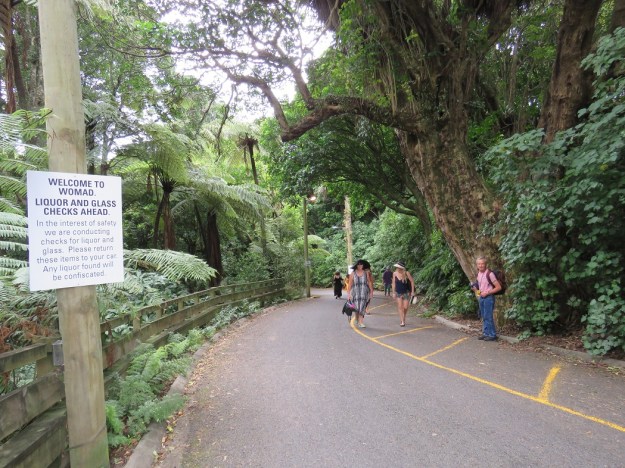
The entrances alone set the scene. That is Mark in the coral pink tee shirt, standing by George’s tree. I wrote a short tribute to George Fuller when he died. A former curator of the park for many years, he set up camp beneath that puriri tree to protest plans to remove it in order to widen the road access. In this, he was successful, as can be seen. George may be dead but his tree lives on.
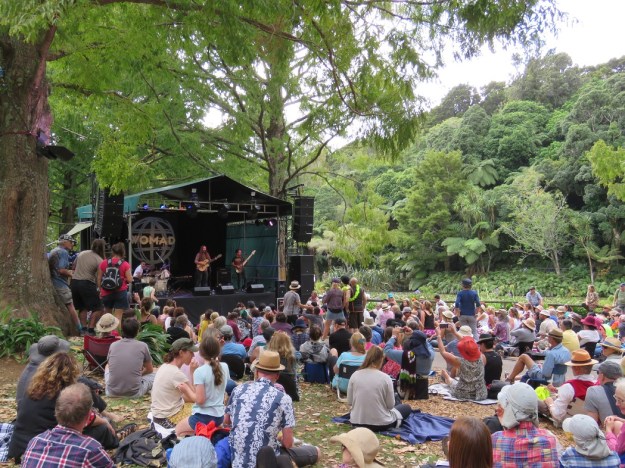
The entire WOMAD festival takes place within the embrace of trees. I particularly like the small Dell Stage for its intimacy and charm.
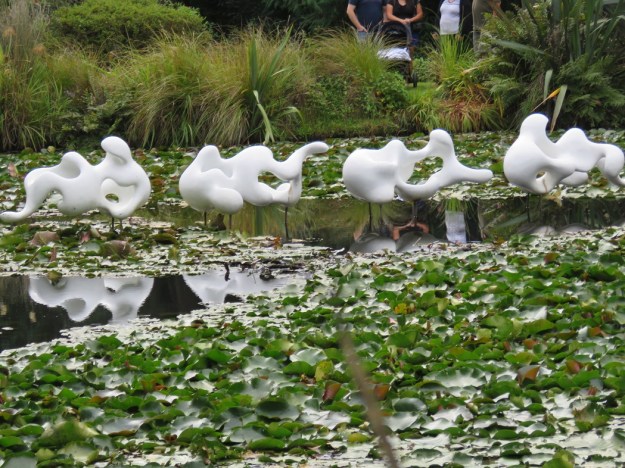
Adjacent to The Dell is this lily pond. It is a good exercise in knowing your water lilies. Some lilies S P R E A D to take up all the water, which rather defeats the reflective qualities. If you plan on growing a few water lilies at home, my advice is not to plant these overly strong triffids but to seek out smaller growing, named varieties which may be less inclined to stage a takeover bid. There are easier maintenance tasks than thinning water lilies.
From memory, the white sculpture is based on cloud formations and was placed to be reflected in the water. To me, I fear, they are more evocative of toothy molars but each to their own.

We were at WOMAD this time because I was involved. Nothing musical – I do not have a musical bone in my body, although Mark is an ageing rock and pop drummer from way back. He still has his drum kit, though I banished it to the shed rather than a spare bedroom. I was interviewing winemaker Allan Scott, a leading light in the Marlborough wine industry and one of a fairly small number of independent wineries in an increasingly multinational, corporate industry. The session was accompanied by wine tasting (five wines) and food matching with canapes. It is a situation where I rather regretted my unbreakable rule of never drinking when presenting to an audience. Sauvignon blanc, Chardonnay, Gewurtztraminer, Riesling and Pinot noir – but not a drop passed my lips until we had finished.

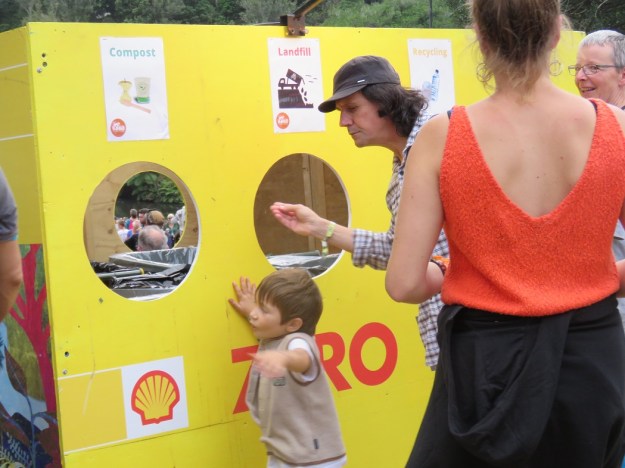
One of the other aspects of our WOMAD that really impresses me is the zero waste priority. Unlike most events that attract thousands of people, WOMAD is simply remarkable for its total absence of rubbish on the ground and the use of compostable or reusable serving dishes and drinking vessels. It is proof that with a good set-up and plenty of good management, litter and plastic waste can be eliminated.
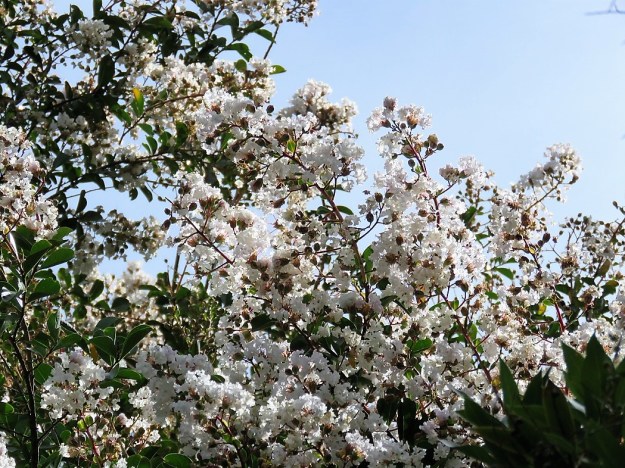

Our white crepe myrtle

It is a three day festival, but we piked after two days. We are not used to crowds and noise, and come Sunday, we were both happy to have a quiet day in the garden at home. Down in our park the crepe myrtle (lagerstroemia) is like blossom. It does not often bloom like this but this is an indication of the long, hot, summer we had this year. Usually we grow it for its attractive bark and the flowers are sparse and pass without attracting attention.

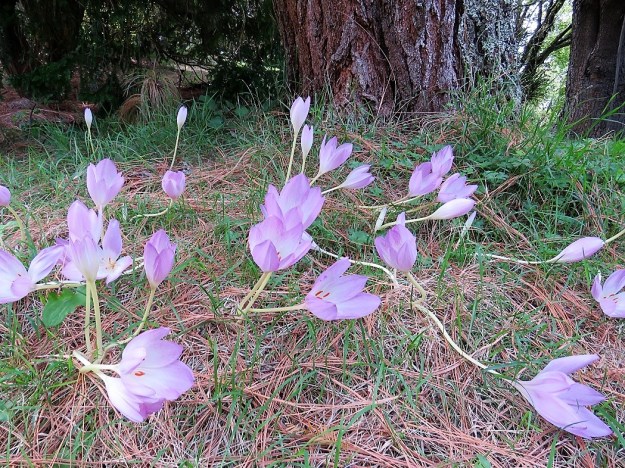
Colchicums are not the same as autumn crocus

The colchicums are also flowering – in the rockery but also naturalised down in the park area that we now call the meadow. That is surely a sign that autumn is here.

Daisy, daisy

“Daisy, Daisy, give me your answer do
I’m half crazy all for the love of you”

These days such songs running through the brain on repeat are called ‘ear worms’. It may interest you, as it interested me, to find that this particular song was written in 1892. It may have been an ear worm for 126 years now. 

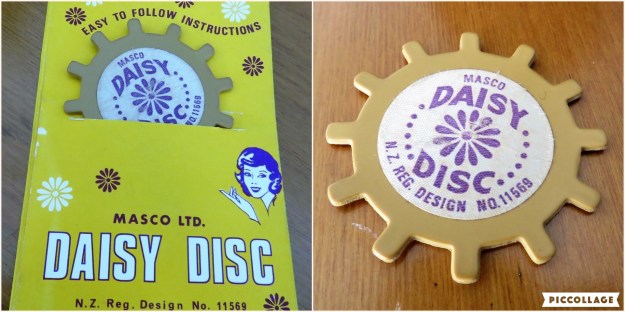
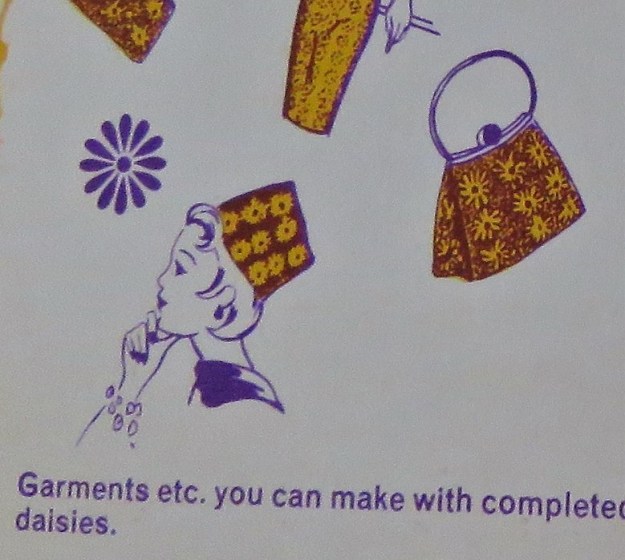
In sorting out my haberdashery – in other words, reorganising my sewing desk – I came across this delight, the Daisy Disc. I can’t recall having noticed this before so it must date back to my very late mother-in-law whose sewing desk I inherited. I see it has the price of 30c on it, so I can date it to post July 10, 1967 when New Zealand swapped to decimal currency. It was the instruction folder that delighted me, with its pictures of projects and the following bold statement:

                “Your DAISY DISC is as versatile as your crochet hook, or knitting needles. Give it the same care and you will have hours of rewarding pleasure.”

The instructions are something else. Step one was fine – wind the wool 2 or 3 times around opposite spokes in turn. But then we come to the second step:
“Fig. 2.

Break wool about 12 inches from the DAISY DISC and thread through needle. Pass needle under petals 1 and 12, bring back over petal 1, then under 12 and 11, under 11 and 10 (ie under two and back over one etc. See Fig 3.)”

Got that? Then we get to the instructions on how to join the daisies, because of course you want to join a whole lot of daisies to make your daisy dress, evening top or handbag. For this, you must be able to read a crochet pattern. I once went to night classes to learn how to crochet. In self defence, this was back in the very late 1970s and I wanted to be able to make crochet lampshades with long, silken fringes that were all the rage back then. So I think I can decode the instructions as far as encasing the first unsuspecting daisy in a crochet frame is concerned, but to join in the second daisy confounded me.

“Work as for 1st. up to 1st 5 ch loop., 2 ch., sl. st. in 1 loop of centre st. of a corner 5 ch. loop on 1st. daisy, 2 ch., 1 tr. back in same petal on 2nd daisy. (1ch. sl. st.in next 3 ch. loop on 1st daisy, 1 ch. 1 d.c. back in the next petal on 2nd daisy) twice.”

Followed that, have you? Because we are only half way through the instructions on how to join your daisies. There is a whole lot more. This is way more complex than knitting or crocheting peggy squares and I know what the abbreviations of  tr., d.c., ch., and sl. st. mean. It might as well be double dutch, otherwise.

I looked at the suggested projects for our daisy motifs and I was struggling to find a clear winner. Would it be the wildly impractical baby blanket, the adorned evening shoe or the daisy earrings? But then I spotted the fez-style hat. Ladies and gents, that must be the clear winner.


One day I must find the instructions for The Lost Art of Camellia Waxing. I use capitals to give sufficient gravitas to this largely forgotten activity. I am sure I stowed that somewhere safe as an interesting hobby option for ladies at home with a great deal of time on their hands.

I went looking for daisies in the garden to illustrate this post but came up rather short. I did not go far enough, I tell you. I should have done some googling first. Their family of Asteraceae is huge. Not just the obvious asters which are so pretty in flower at this time of early autumn, but also cosmos, tagetes (marigolds), sunflowers, echinacea, rudbeckia, even dahlias. I was sad that one of our largest and showiest daisy plants, the spectacular Montanoa bipinnatifida (Mexican tree daisy) died last year. But Mark has just told me that we still have it. A seedling has emerged near the original plant. The monarch butterflies will get to feed on it again.

The monarcnh on the montanoa in very late autumn

I used to sew. A lot. Can you tell? These days, i garden instead. Even more.